


Professor of Biology & Institute for Health Computing, U of Maryland; explores how viruses impact human & environmental health;
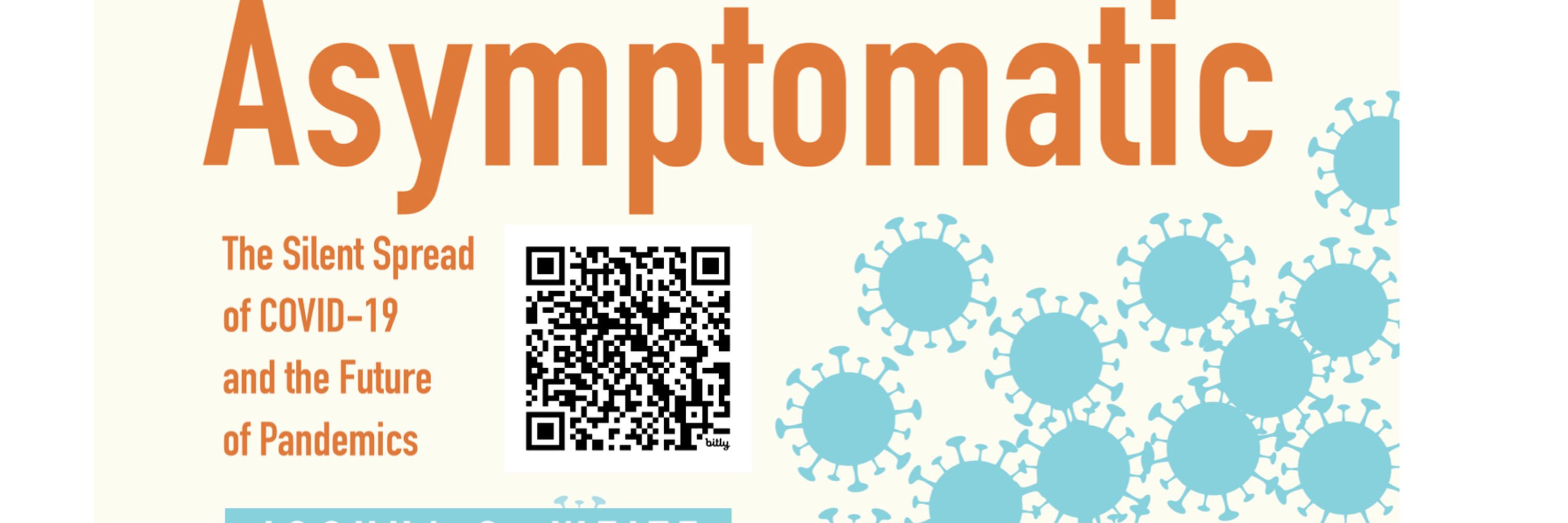
'Asymptomatic' (JHU Press - https://bit.ly/asymptomatic_book)
&
'Science Matters' (https://substack.com/@joshuasweitz) ..
more
Professor of Biology & Institute for Health Computing, U of Maryland; explores how viruses impact human & environmental health;
'Asymptomatic' (JHU Press - https://bit.ly/asymptomatic_book)
&
'Science Matters' (https://substack.com/@joshuasweitz)
Joshua S. Weitz is an American biologist. He is both a professor of biology and the Clark Leadership Chair in Data Analytics at the University of Maryland. Previously, he was a professor at Georgia Tech, where he was the founding director of the Interdisciplinary Graduate Program in Quantitative Biosciences. In 2017, he was elected a Fellow of the American Association for the Advancement of Science. .. more
Institut de Biologie de l'École Normale Supérieure; Georgia Institute of Technology; University of Maryland, College Park • Bacteriophages and microbial interactions, Evolution and Genetic Dynamics, COVID-19 epidemiological studies

Take-home: Slashing NSF by >50% will lead to ~$11 billion in economic loss and extensive job loss and reduced training opportunities in communities nationwide.
Report: osf.io/e8rnc
a 🧵
Change depends on us.
/🧵
We must continue to insist on NIH's scientific independence and the independence of research decisions supporting who does research and what research is funded, especially if its Director will not.

"I’ve come to this anti-vax conference with a message that we need to be more boldly anti-vax"
www.nytimes.com/2025/11/10/u...

Duke University Virtual Fireside Chat, Jan 27, 2026
www.dukechronicle.com/article/duke...

Yes, asymptomatic spread was real (and critical).
But, there were still far more people to be infected beyond March 2020 with catastrophic impacts and Bhattacharya continues to minimize this harm as a means to an end.
joshuasweitz.substack.com/p/revisionis...
"Taking the right steps in spring 2020 required being realistic about the COVID-19 threat. While many scientists and public health experts were aware of the threat, the Santa Clara study presented a counter-argument that helped fuel confusion and misinformation."
statmodeling.stat.columbia.edu/2020/04/19/f...
But none of this was right.

www.statnews.com/2020/03/17/a...


"that means that there's about 85 times more people who've had it per person that actually identified having it."
www.hoover.org/research/fig...

In fact, and despite lives saved due to vaccinations, ~250,000 individuals died of COVID in that range:
www.cdc.gov/nchs/nvss/vs...

www.imperial.ac.uk/media/imperi...
"You could see the relative risk really, really easily in the data. It was really older people that were at high risk of dying from the disease."

Here you go, reader beware:
(it's hardly a 'gift', but there you go)
🎁
www.nytimes.com/2026/01/29/o...
Reposted by Gavin A. Schmidt, Janet Murray

a 🧵
www.amazon.com/Asymptomatic...
Need stronger coffee.
Reposted by Larry W. Hunter

NIH is not an ideological toy or 'arm'. We must insist on its scientific independence, especially if its Director will not.
🚨
www.dukechronicle.com/article/duke...
Reposted by Joshua S. Weitz


March 7th, 2026 in Washington, DC.
We're mobilizing the fight for science and democracy. In the face of assaults on our families, freedoms, and futures, we're taking back science!
Learn more at www.standupforscience.net/ma... (linked in bio)
Reposted by Anne Applebaum, Mariana Mazzucato, Stephen M. Walt , and 171 more Anne Applebaum, Mariana Mazzucato, Stephen M. Walt, Michael E. Mann, Joanna Bryson, Anna O. Law, Marc Lynch, Kim L. Scheppele, Elizabeth Saunders, Rebecca Solnit, Archon Fung, Nandita Sharma, Matthew Bunn, Nancy Kanwisher, Yadvinder Malhi, Michael Wagner, John T. Jost, Stephan Lewandowsky, Robbert Sanderman, David M. Schultz, Simon Burgess, Marco Festa‐Bianchet, David M. Farrell, Will Jennings, Ashish Arora, Peter Thorne, Martin J. Attrill, Jesse M. Shapiro, Christina C. Hicks, Richard Betts, Richard J. Butler, Mattias Hallquist, Patrick A. Jansen, Jonathan A. Foley, Michael T. Meyer, Joshua S. Weitz, John R. Hutchinson, Mieke Van Houtte, Steve Peers, John McLaren, Andrew Watt, Andreas Ortmann, Tim Bale, Tom Shakespeare, Mark D. White, Steven S. Smith, Jill Marshall, Rosemary A. Joyce, Caroline Krafft, Jürgen Maier, Leigh Sparks, Marina Jirotka, David Rothschild, Martin Gaynor, Elizabeth Stokoe, Melissa Johnson, Vincent Tiberj, Michael J. Allen, Rupert Read, Christian E. Weller, Ian M. Kinchin, Dawn J. Wright, Joseph Schafer, Hester Blum, Markus Jäntti, Anders Nilsson, Alison Phipps, Dominik Wiedenhofer, Ramón López Facal, Gerard H. Kuper, Libby Robin, David S. Cohen, Joni Lovenduski, Alan Stewart, Patrick Walsh, Sanford F. Schram, Kevin Carey, Shelly Lundberg, Inderjeet Parmar, Göran Bolin, Jussi T. Eronen, Marta Mìrazón Lahr, Raffaella Ravinetto, Smith, Peter Schöttler, Andrew Leyshon, Melanie C. Green, Janet Murray, Steven High, David R. Miller, Robert Wolfe, Duncan Bell, Jesús Rodríguez Pomeda, Patrick Svensson, Wilson McLeod, Stephen D. Murphy, Gerald Friedman, Stacy D. VanDeveer, Fabio Giglietto, Beatriz Gallardo Paúls, Lyndsey Stonebridge, Juan Moreno‐Cruz, Todd Pugatch, Howard Stevenson, Stephen Ryan, Elizabeth Stevenson, Michael D. McDonald, Anne Norton, Josef Früchtl, Manuel Puppis, Graeme Warren, Talia Schaffer, Graham Dutfield, Marco Haan, Antoine Bernard de Raymond, Fredrik Albritton Jonsson, Paul Fisher, Michelle Williams, Alberto Corsín Jiménez, Christian Fisch, Lisa Diedrich, Nicola Carr, Enrique Fatás, Philipp Sarasin, Jessica Silbey, Feargal Cochrane, Stuart White, Mary Jane Curry, Susan Strasser, Marko Lindroos, Claire L. Adida, Sharon Erickson Nepstad, Andrew Guthrie Ferguson, Patrick Meier, Vaughan S. Roberts, Raúl Pacheco-Vega, Ryan K. Brook, Florian Keusch, Andrew Rudalevige, Olivier Jourdan, Hisham Zerriffi, Sean P. Corcoran, Cullen S. Hendrix, Jon Dean, Eric J. Sundquist, Guillaume Allègre, Eric J. Segall, Jason A. Heppler, Karen O’Leary, Uwe M. Martens, Alexander Woywodt, Thomas D. Carroll, David S. Tanenhaus, Kate Jackson, Suzanne Conklin Akbari, Mary McAuliffe, Aviel Roshwald, Pepper D. Culpepper, Émilien Ruiz, Nathan P. Kalmoe, Ryan Calo, Jaap Kooijman, Aidan O’Sullivan, Dan Immergluck, Jeannette Sutton, Fiona Armstrong, Beth Tellman, Lorna Hughes, Ernesto Castañeda, David Spurrett, Dunlap, Stuart Shapiro, David Darmofal, Lars Gamfeldt

Stay free