Eric Hehman
banner
erichehman.bsky.social
Eric Hehman
@erichehman.bsky.social

prejudice, person perception at McGill | https://prejudicemap.org

Psychology 43%
Neuroscience 16%
Pinned
New paper led by Kelsey Neuenswander looking at perceptual exposure to fat/thin bodies and anti-fat attitudes.
www.nature.com/articles/s44...
Perceptual exposure influences body size perceptions and anti-fat attitudes - Communications Psychology
Repeated visual exposure to bodies of varying sizes alters cognitive representations of weight and may influence anti-fat attitudes over time.
www.nature.com
ISCON and PMIG call for nominations for the Ostrom Award for Career Contribution to Social Cognition.

Eligibility: 25 years post PhD (awards are not given posthumously).

More detail here:
www.socialcognition.net/ostrom-award

1/2
Ostrom Award | Home
www.socialcognition.net

Applications considered beginning on April 24 and continue on a rolling basis until the position is filled.

Would appreciate a share!
Also I'll be at SPSP in a few weeks, please reach out if you want to chat about the position
Postdoc position!

Myself and @jordanaxt.bsky.social are seeking applications for a shared post-doctoral researcher at McGill, beginning Fall 2026.

Topic area broadly centered on intergroup dynamics, prejudice, discrimination

Full description here: hehmanlab.org/ad
1/2
ad
hehmanlab.org
About 10 years ago, I set out to better understand the drivers of radicalization and deradicalization into white supremacy. Work from our endeavors is starting to come out, and I am no longer concerned about sharing it.

I want to share the findings from one of these studies, published last March. 🧵

Then again, my brain lets me drink
New paper on planned missingness. Recently been liking the approach of planned missingness in a survey -> FIML to estimate constructs.

psycnet.apa.org/fulltext/202...
psycnet.apa.org
McGill is hiring a faculty lecturer in social psychology, in a (non-adjunct) permanent teaching position.

Please consider being my colleague, Montreal is really great: mcgill.wd3.myworkdayjobs.com/en-US/McGill...
Faculty Lecturer - Department of Psychology
Please refer to the How to Apply for a Job (for External Candidates) job aid for instructions on how to apply. If you are an active McGill employee (ie: currently in an active contract or position at ...
mcgill.wd3.myworkdayjobs.com

The followup longitudinal experiment provides causal evidence that exposure to thin bodies leads to an increased likelihood of categorizing bodies as fat, while exposure to fat bodies reduces this likelihood.

Study 2 is particularly cool, capitalized on France's ban of underweight models in 2015 to test the possibly causal relationship between the policy and anti-fat attitudes (which decrease after the ban).

This paper is pretty neat because it combines correlational (regional variation), quasi, and experimental work to examine anti-fat attitudes.
Can see regional variation in anti-fat attitudes here prejudicemap.org which correlate with regional obesity rates
Prejudice Map
prejudicemap.org

Reposted by Linda J. Skitka

This figure and the size of the correlation continues to blow me away
📣 Our introduction to structural causal models in science studies is now published:
doi.org/10.1162/QSS....

@tklebel.bsky.social and I tried to make our introduction as accessible as possible. We illustrate the theory by three case studies based on a simulated model of Open Science. 🧵(1/6)

1/9 New blog is live! This is part 2 of a series—last time we looked at the Dunning-Kruger effect, now we are digging in to Implicit vs Explicit attitudes and the Implicit Association Test. To start, of course we need a good meme...

haines-lab.com/post/part-2-...
#AcademicSky #PrejudiceResearch

New paper out by Paolini et al. on habit-ruptures in intergroup contact

www.nature.com/articles/s44...

(If you like that, our also team has a related paper in press at American Psychologist, led by Rose Meleady)
psycnet.apa.org/record/2026-...
Towards a habit-rupture model of intergroup contact in everyday settings - Nature Reviews Psychology
The literature assumes that intergroup contact is naturally occurring, positive and consistently associated with positive outcomes, but these premises are inconsistent with everyday intergroup contact...
www.nature.com
Looking for data that the government is pulling down? We may have it backed up for you. Check our portal: portal.datarescueproject.org

Know of data being taken down or worried about a data source? Let us know: baserow.datarescueproject.org/form/r7V1c44...

I appreciate the sharing jay van bavel
We should no longer trust data collected on MTurk
link.springer.com/article/10.3...

My guess is that other online data is going to drop in quality due to LLMs. This is going to be an existential crisis for the behavioral sciences.

It only finds him ok!

63% (!!) of the emails asking me about applying to my lab this year started with verbatim "I hope this email finds you well."

Was not the case last year.
Project Implicit is a research nonprofit behind tools millions use to understand bias. Like many public science orgs, sustaining this work has become increasingly difficult. We are at risk of closing without additional support.

Help protect this impt work by donating here: 4agc.com/donate/impli...
A new paper by George Borjas—who served this past year in the Trump White House designing some of its anti-immigration policies—claims to display evidence of ideological bias among researchers who study immigration.

doi.org/10.1126/scia...

🧵 Thread—>

Reposted by Eric Hehman

🚨 New paper out in PSPB! 🚨 We found that an “Inclusivity Page” that instructors in the intervention condition added to their course syllabi resulted in better grades among students from marginalized groups. journals.sagepub.com/doi/10.1177/...
Sage Journals: Discover world-class research
Subscription and open access journals from Sage, the world's leading independent academic publisher.
journals.sagepub.com
For researchers interested in semantic change over years and decades...

I've created a toolkit — lexichron — for measuring long-term shifts in word meanings using Google Ngrams and other corpora (e.g., COHA, COCA).

Here's the public GitHub repo:
github.com/eric-d-knowl...

🧵
GitHub - eric-d-knowles/lexichron
Contribute to eric-d-knowles/lexichron development by creating an account on GitHub.
github.com

Reposted by Eric Hehman

What if we had law journals run by people who weren’t literal law students

I have todd heathertons toaster. Def weird but makes a good toast.
My mentor James Sellars once asked me "Who are your influences?" I said John Cage. He vaguely gestured toward his patio: "Those are John Cage's houseplants."
"I own William Faulker's cake knife," a sentence that is both straightforward and true, and yet sounds completely deranged

Reposted by Eric Hehman

My mentor James Sellars once asked me "Who are your influences?" I said John Cage. He vaguely gestured toward his patio: "Those are John Cage's houseplants."
"I own William Faulker's cake knife," a sentence that is both straightforward and true, and yet sounds completely deranged

Reposted by Eric Hehman

Associate or Full professor not working in Canada? Canada (McGill) wants you.
McGill is recruiting top-tier researchers working abroad through the federally funded Canada Impact+ Research Chairs program, addressing global and national challenges. The first round is due in early 2026.

Learn more and submit your candidacy: https://mcgill.ca/x/5Zh
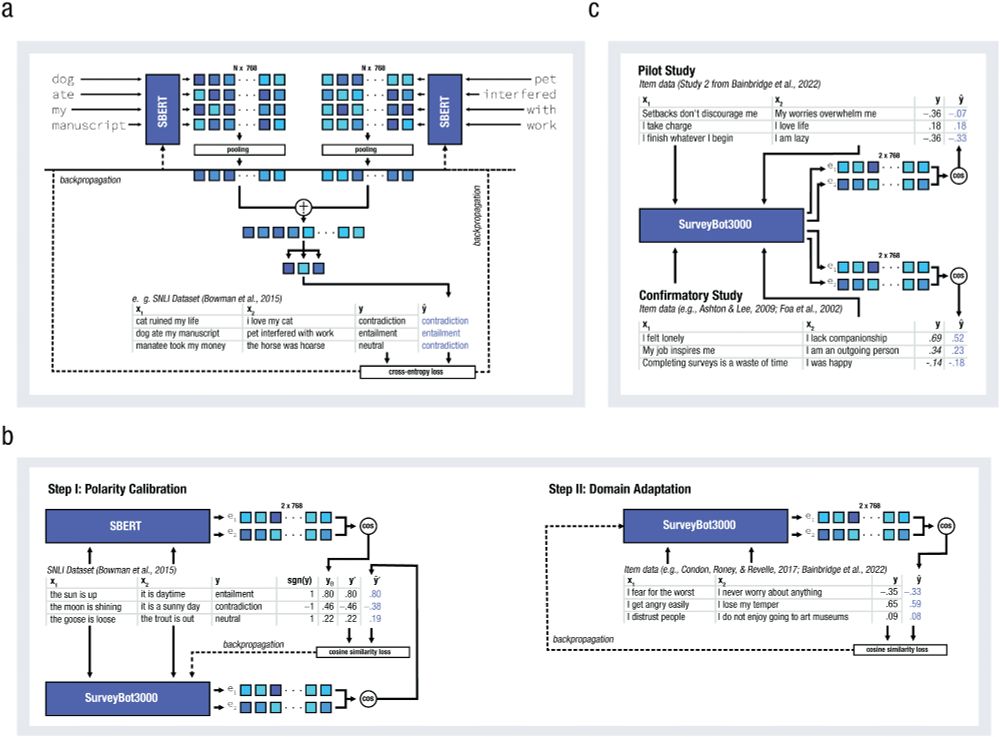
Finally, @bjoernhommel.bsky.social's and my paper introducing the SurveyBot3000 is officially out in AMPPS. It's a fine-tuned language model that guesstimates correlations between survey items from text alone. Not perfectly, but useful for search, for example.
journals.sagepub.com/doi/10.1177/...
Did you know that from tomorrow, Qualtrics is offering synthetic panels (AI-generated participants)?

Follow me down a rabbit hole I'm calling "doing science is tough and I'm so busy, can't we just make up participants?"