Matt Grossmann
banner
mattgrossmann.bsky.social
Matt Grossmann
@mattgrossmann.bsky.social

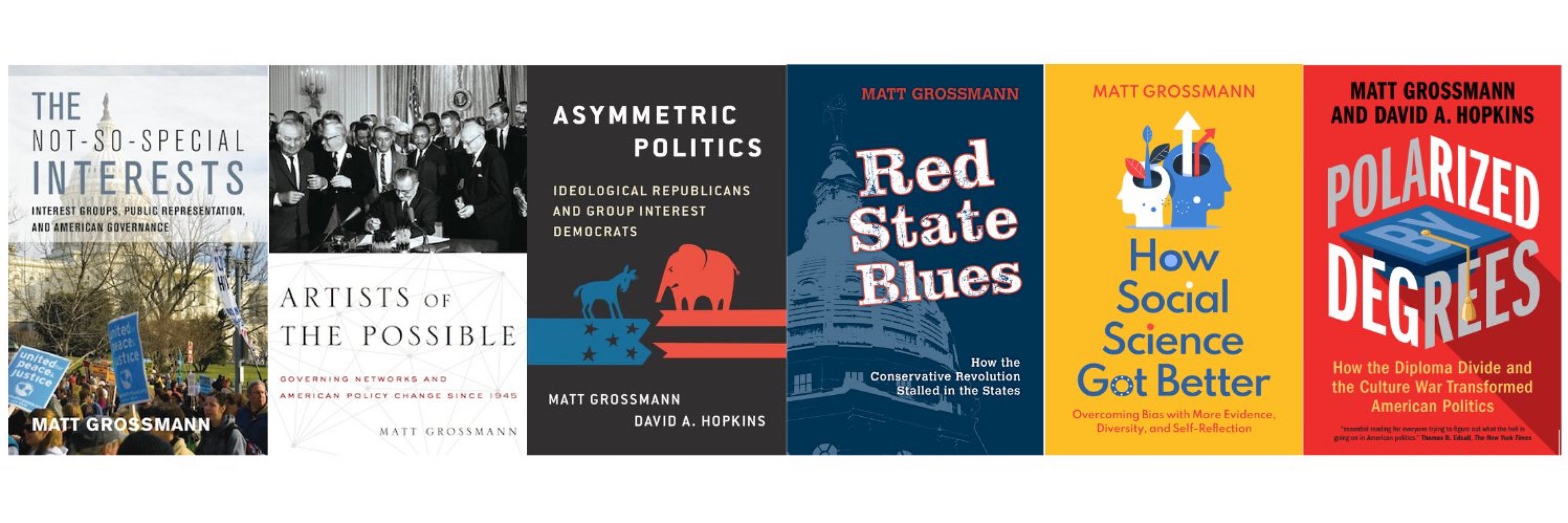
Michigan State political scientist & IPPSR Director; Hooked bookstore/cafe Co-owner; Science of Politics Podcast; New book: Polarized by Degrees

Political science 59%
Business 20%

Reposted by Matt Grossmann

Reposted by Matt Grossmann

Liberal-Conservative ideological self-placement is an increasingly reliable summary of political views that increasingly predicts vote choice
www.journals.uchicago.edu/doi/10.1086/...

Revisiting Ideology Measures in Political Surveys | The Journal of Politics: Vol 88, No 1
The empirical evidence in this article demonstrates that responses to the regularly included questions in the American National Election Study asking respondents to place themselves on an Extremely Li...
www.journals.uchicago.edu

State legislators that can more easily run for Congress cooperate less across party lines & vote in more extreme ways
www.journals.uchicago.edu/doi/10.1086/...

Personalist ruling parties increase attacks on central bank independence, increase pressure for looser monetary policy, & move legal changes that decrease bank autonomy
www.journals.uchicago.edu/doi/10.1086/...

New paper w/ Kulesza & @cmwitko.bsky.social

A worry about campaign contribution limits is that they don't stop money, they just shift it to Citizens United/SpeechNow "independent expenditures"

We find that this didn't happen. Keep calm & regulate on

www.dropbox.com/scl/fi/nk11m...

1/n

Congress is appropriating more $ for scientific research, against admin's wishes. DK how this interacts with many admin cancelations last year. It could mean there's even more new $ to go out, given prior central staff cuts & multi-year cancelled grants.

www.nytimes.com/2026/01/10/s...
Congress Is Reversing Trump’s Steep Budget Cuts to Science
www.nytimes.com

Niskanen also released their website redesign today:
www.niskanencenter.org
Niskanen Center - Niskanen Center
Niskanen Center works to advance U.S. public policy through engagement on issues like immigration, climate, and social policy.
www.niskanencenter.org

My new personal website is ready:
mattg.org

Which groups win policy under each party?

Whites under Republicans, minorities under Democrats
New #ScienceOfPolitics podcast/transcript with Agustin Markarian
www.niskanencenter.org/which-groups...
Which groups win policy under each party? - Niskanen Center
Agustin Markarian finds that different groups see their policy preferences better represented depending on which party is in power.
www.niskanencenter.org

Reposted by Matt Grossmann

Reposted by Matt Grossmann

Correct link here dynamicdemocracy.us
I'm pleased to report that my forthcoming book is now available for pre-sale. What's more, if you become a paid subscriber to Tusk, I'll send you a complimentary copy of the book!
More about the book below (1/4):
smotus.substack.com/p/my-new-boo...

Reposted by Matt Grossmann

#AI may indeed exacerbate our bad academic habits:

#LLM science summaries were nearly five times more likely than human-authored science summaries to contain broad generalizations (95% CI [3.06, 7.70], p < 0.001).

And newer models over-generalized more; not less!

doi.org/10.1098/rsos...

#philSci

Because AI models are trained on current research practices, they may exacerbate our tendencies like overselling results from limited data, overinterpreting statistical significance, & quickly claiming causality, especially because they are even better at generating interpretations of any results

We can progress across-the-board if we attend to these trade-offs, but that may mean lowering relative standards for generalizability & causal inference for hard ?s we still want to advance. We already do this implicitly, but may need to formalize these expectations.

AI-enhanced research acceleration is likely to supercharge these trade-offs, helping exhaust what can be learned from current mass public data, geographic relationships, & text & voting data, but diverting from less-tractable but key historical, elite-level, & international ?s.

Social science has long faced trade-offs between data availability (& causal answerability) and relative question importance. For example, survey experiments on convenience samples have grown even in international relations, where they cannot advance key ?s but may inflate others