



Elias Adriaenssens
@elias-adriaenssens.bsky.social
Postdoc with Sascha Martens and Tim Clausen at the Vienna BioCenter (VBC). #MSCA Fellow. Formerly University of Oxford and University of Antwerp.
Pinned
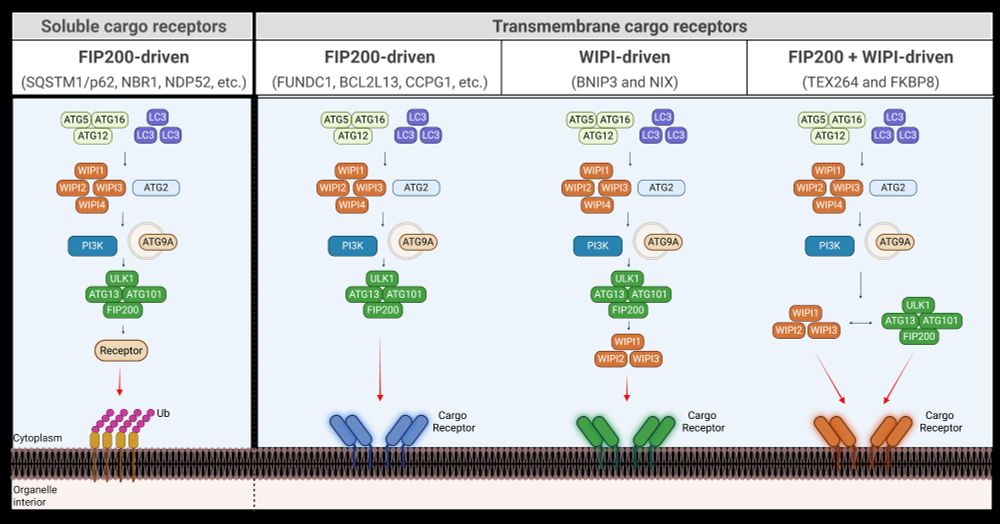
And it's out!
I'm thrilled to share our new paper (Adriaenssens et al., Nat Cell Biol 2025).
This paper describes a new mechanism for the initiation of autophagosome biogenesis.
We found that this WIPI-ATG13-driven pathway is preferentially used by a group of transmembrane autophagy receptors.
I'm thrilled to share our new paper (Adriaenssens et al., Nat Cell Biol 2025).
This paper describes a new mechanism for the initiation of autophagosome biogenesis.
We found that this WIPI-ATG13-driven pathway is preferentially used by a group of transmembrane autophagy receptors.
Reposted by Elias Adriaenssens
I’m happy to share our new preprint! We uncovered the full diversity of bacterial TIR-based antiviral immune signaling, massively expanded the known diversity of Thoeris systems, and revealed conservation of TIR-derived immune signals across the tree of life.
www.biorxiv.org/content/10.6...
www.biorxiv.org/content/10.6...

Systematic discovery of TIR-based immune signaling systems in bacteria
Toll/interleukin-1 receptor (TIR) domains are important for immune signaling across humans, plants and bacteria. These domains were recently found to produce immune signaling molecules in plant immuni...
www.biorxiv.org
December 4, 2025 at 9:25 AM
I’m happy to share our new preprint! We uncovered the full diversity of bacterial TIR-based antiviral immune signaling, massively expanded the known diversity of Thoeris systems, and revealed conservation of TIR-derived immune signals across the tree of life.
www.biorxiv.org/content/10.6...
www.biorxiv.org/content/10.6...
Reposted by Elias Adriaenssens

In ISSUE 23
Highligh: IL-26 - no guts, no glory
Review: initiating autophagy by selective receptors
Method: 3D-SPARK for spatial mapping of DNA synthesis
Resource: senotypes across aging human and mouse tissues
Cover: Sachin Kotak et al @spindlebehavior.bsky.social
link.springer.com/journal/4431...
Highligh: IL-26 - no guts, no glory
Review: initiating autophagy by selective receptors
Method: 3D-SPARK for spatial mapping of DNA synthesis
Resource: senotypes across aging human and mouse tissues
Cover: Sachin Kotak et al @spindlebehavior.bsky.social
link.springer.com/journal/4431...

December 4, 2025 at 7:43 AM
In ISSUE 23
Highligh: IL-26 - no guts, no glory
Review: initiating autophagy by selective receptors
Method: 3D-SPARK for spatial mapping of DNA synthesis
Resource: senotypes across aging human and mouse tissues
Cover: Sachin Kotak et al @spindlebehavior.bsky.social
link.springer.com/journal/4431...
Highligh: IL-26 - no guts, no glory
Review: initiating autophagy by selective receptors
Method: 3D-SPARK for spatial mapping of DNA synthesis
Resource: senotypes across aging human and mouse tissues
Cover: Sachin Kotak et al @spindlebehavior.bsky.social
link.springer.com/journal/4431...
Reposted by Elias Adriaenssens

Pharmacological activation of AMPK rescues mitophagy defects in models of FBXL4-related mitochondrial DNA depletion syndrome https://www.biorxiv.org/content/10.64898/2025.12.03.692069v1
December 4, 2025 at 8:31 AM
Pharmacological activation of AMPK rescues mitophagy defects in models of FBXL4-related mitochondrial DNA depletion syndrome https://www.biorxiv.org/content/10.64898/2025.12.03.692069v1
Reposted by Elias Adriaenssens

New online: Translational activators align mRNAs at the small mitoribosomal subunit for translation initiation

Translational activators align mRNAs at the small mitoribosomal subunit for translation initiation
Nature Structural & Molecular Biology, Published online: 03 December 2025; doi:10.1038/s41594-025-01726-yMitochondrial translational activators (TAs) facilitate transcript-specific translation. Using selective ribosome profiling and cryo-electron microscopy, the authors show that TAs bind to the 5′ untranslated region of their target transcript to position mitoribosomes for initiation.
go.nature.com
December 3, 2025 at 10:32 PM
New online: Translational activators align mRNAs at the small mitoribosomal subunit for translation initiation
Reposted by Elias Adriaenssens

Freaking wild videos - go watch all of them! I cannot decide which one I love more! Radler et al. "Dynamic protrusions mediate unique crawling motility in Asgard Archaea (Promethearchaeota)" Very creative live-microscopy work #testthymetagenomichypotheses
www.biorxiv.org/content/10.1...
www.biorxiv.org/content/10.1...

December 3, 2025 at 3:41 AM
Freaking wild videos - go watch all of them! I cannot decide which one I love more! Radler et al. "Dynamic protrusions mediate unique crawling motility in Asgard Archaea (Promethearchaeota)" Very creative live-microscopy work #testthymetagenomichypotheses
www.biorxiv.org/content/10.1...
www.biorxiv.org/content/10.1...
Reposted by Elias Adriaenssens
ADAR1 editing is necessary for only a small subset of cytosolic dsRNAs to evade MDA5-mediated autoimmunity @natgenet.nature.com @stanforduniversity.bsky.social
www.nature.com/articles/s41...
www.nature.com/articles/s41...

December 3, 2025 at 8:47 PM
ADAR1 editing is necessary for only a small subset of cytosolic dsRNAs to evade MDA5-mediated autoimmunity @natgenet.nature.com @stanforduniversity.bsky.social
www.nature.com/articles/s41...
www.nature.com/articles/s41...
Reposted by Elias Adriaenssens
Last MitoTALK of 2025!
Ewa Warczak
@bomba_ewa
From Synthesis to Stability: Understanding the Lifecycle of Mitochondrial Proteins
Thursday, December 4, usual time.
See you there?
mitotalks.org
Ewa Warczak
@bomba_ewa
From Synthesis to Stability: Understanding the Lifecycle of Mitochondrial Proteins
Thursday, December 4, usual time.
See you there?
mitotalks.org

December 4, 2025 at 1:07 AM
Last MitoTALK of 2025!
Ewa Warczak
@bomba_ewa
From Synthesis to Stability: Understanding the Lifecycle of Mitochondrial Proteins
Thursday, December 4, usual time.
See you there?
mitotalks.org
Ewa Warczak
@bomba_ewa
From Synthesis to Stability: Understanding the Lifecycle of Mitochondrial Proteins
Thursday, December 4, usual time.
See you there?
mitotalks.org
Reposted by Elias Adriaenssens
VAPB is a critical regulating factor in cGAS-STING–mediated innate immune responses
www.science.org/doi/10.1126/...
www.science.org/doi/10.1126/...

December 4, 2025 at 3:17 AM
VAPB is a critical regulating factor in cGAS-STING–mediated innate immune responses
www.science.org/doi/10.1126/...
www.science.org/doi/10.1126/...
Reposted by Elias Adriaenssens
Oxidative phosphorylation complexes contain subunits encoded by both the nuclear and mitochondrial genomes. How do cells coordinate the synthesis and assembly of these complexes at the inner membrane? We teamed up with Martin Ott (@mitolab.bsky.social) to address this in two recent papers.
December 3, 2025 at 8:42 PM
Oxidative phosphorylation complexes contain subunits encoded by both the nuclear and mitochondrial genomes. How do cells coordinate the synthesis and assembly of these complexes at the inner membrane? We teamed up with Martin Ott (@mitolab.bsky.social) to address this in two recent papers.
Reposted by Elias Adriaenssens

An Asgard Archaeon (Lokiarchaeum ossiferum) growing and retracting its arms
December 3, 2025 at 8:32 PM
An Asgard Archaeon (Lokiarchaeum ossiferum) growing and retracting its arms
Reposted by Elias Adriaenssens
Crawling motility of Lokiarchaeum ossiferum, our favorite Asgard Archaeon.
December 3, 2025 at 8:35 PM
Crawling motility of Lokiarchaeum ossiferum, our favorite Asgard Archaeon.
Reposted by Elias Adriaenssens
Asgard on the move ! Watch our videos!
Biorxiv.org/content/10.1101/2025.11.30.690169v1
Biorxiv.org/content/10.1101/2025.11.30.690169v1

Dynamic protrusions mediate unique crawling motility in Asgard Archaea (Promethearchaeota)
Crawling motility is a hallmark of eukaryotic cells and requires a dynamic actin cytoskeleton, regulated adhesion, and spatially organized signalling pathways1–3. Asgard archaea (phylum Promethearchae...
Biorxiv.org
December 3, 2025 at 8:22 PM
Asgard on the move ! Watch our videos!
Biorxiv.org/content/10.1101/2025.11.30.690169v1
Biorxiv.org/content/10.1101/2025.11.30.690169v1
Reposted by Elias Adriaenssens
Our study on the molecular function of translational activators for mitochondrial protein synthesis is published:
rdcu.be/eSWxT
A great collaboration with @stirlingchurchman.bsky.social and @sshaolab.bsky.social with structural work from our @pelleeas.bsky.social
Funded by @kawresearch.bsky.social
rdcu.be/eSWxT
A great collaboration with @stirlingchurchman.bsky.social and @sshaolab.bsky.social with structural work from our @pelleeas.bsky.social
Funded by @kawresearch.bsky.social

Translational activators align mRNAs at the small mitoribosomal subunit for translation initiation
Nature Structural & Molecular Biology - Mitochondrial translational activators (TAs) facilitate transcript-specific translation. Using selective ribosome profiling and cryo-electron microscopy,...
rdcu.be
December 3, 2025 at 1:39 PM
Our study on the molecular function of translational activators for mitochondrial protein synthesis is published:
rdcu.be/eSWxT
A great collaboration with @stirlingchurchman.bsky.social and @sshaolab.bsky.social with structural work from our @pelleeas.bsky.social
Funded by @kawresearch.bsky.social
rdcu.be/eSWxT
A great collaboration with @stirlingchurchman.bsky.social and @sshaolab.bsky.social with structural work from our @pelleeas.bsky.social
Funded by @kawresearch.bsky.social
Reposted by Elias Adriaenssens
Absolutely! And Asgard archaea don’t just have ESCRT-III, they also encode ESCRT-I, ESCRT-II, and ubiquitin, maybe an ancient endomembrane trafficking system? And with the internal vesicles described by the Baum and Bharat groups… it really feels like exciting discoveries are coming!!🤩
December 1, 2025 at 10:59 PM
Absolutely! And Asgard archaea don’t just have ESCRT-III, they also encode ESCRT-I, ESCRT-II, and ubiquitin, maybe an ancient endomembrane trafficking system? And with the internal vesicles described by the Baum and Bharat groups… it really feels like exciting discoveries are coming!!🤩
Reposted by Elias Adriaenssens
Glad to have this finally published: www.sciencedirect.com/science/arti... lots of new data since the #preprint. If you are into selective #autophagy, #evolution, #proteostasis Please have a look!

December 1, 2025 at 5:44 PM
Glad to have this finally published: www.sciencedirect.com/science/arti... lots of new data since the #preprint. If you are into selective #autophagy, #evolution, #proteostasis Please have a look!
Reposted by Elias Adriaenssens

New paper! @plantophagy.bsky.social and his team, including @victorsmh6.bsky.social and @marintianava.bsky.social at the GMI of the @oeaw.bsky.social, discovered an important player in plant adaptation to stress: selective autophagy receptor, CESAR. Read more: www.oeaw.ac.at/gmi/detail/n...

December 1, 2025 at 4:15 PM
New paper! @plantophagy.bsky.social and his team, including @victorsmh6.bsky.social and @marintianava.bsky.social at the GMI of the @oeaw.bsky.social, discovered an important player in plant adaptation to stress: selective autophagy receptor, CESAR. Read more: www.oeaw.ac.at/gmi/detail/n...
Reposted by Elias Adriaenssens

New preprint out! We show that PROTAC-induced ubiquitination can bypass canonical ERAD to degrade ER membrane proteins. Wonderful collaboration w/ @dannomura.bsky.social and huge credit to grad student superstar Sydney Tomlinson!
www.biorxiv.org/content/10.1...
www.biorxiv.org/content/10.1...

Induced ubiquitination bypasses canonical ERAD to drive ER protein degradation
Heterobifunctional proteolysis-targeting chimeras (PROTACs) have emerged as a powerful strategy to degrade disease-relevant proteins, enabling targeting of previously "undruggable" proteins. Current d...
www.biorxiv.org
December 1, 2025 at 5:14 PM
New preprint out! We show that PROTAC-induced ubiquitination can bypass canonical ERAD to degrade ER membrane proteins. Wonderful collaboration w/ @dannomura.bsky.social and huge credit to grad student superstar Sydney Tomlinson!
www.biorxiv.org/content/10.1...
www.biorxiv.org/content/10.1...
Reposted by Elias Adriaenssens
New preprint from the lab!!🎉
We show that Asgard archaea ESCRT-III proteins can trigger membrane fission and reveal its molecular mechanism, offering clues to how these cells may have built internal compartments. But do these organisms even have these compartments?
www.biorxiv.org/content/10.1...
We show that Asgard archaea ESCRT-III proteins can trigger membrane fission and reveal its molecular mechanism, offering clues to how these cells may have built internal compartments. But do these organisms even have these compartments?
www.biorxiv.org/content/10.1...

Molecular basis for cellular compartmentalization by an ancient membrane fission mechanism
The emergence of cell compartmentalization depends on membrane fission to create the endomembrane compartments. In eukaryotes, membrane fission is commonly executed by ESCRT-III, a protein complex con...
www.biorxiv.org
December 1, 2025 at 9:09 AM
New preprint from the lab!!🎉
We show that Asgard archaea ESCRT-III proteins can trigger membrane fission and reveal its molecular mechanism, offering clues to how these cells may have built internal compartments. But do these organisms even have these compartments?
www.biorxiv.org/content/10.1...
We show that Asgard archaea ESCRT-III proteins can trigger membrane fission and reveal its molecular mechanism, offering clues to how these cells may have built internal compartments. But do these organisms even have these compartments?
www.biorxiv.org/content/10.1...
Reposted by Elias Adriaenssens

TDP-43 suppression of ATP8A2 cryptic splicing implicates phosphatidylserine-driven neuroinflammation in ALS/FTD www.biorxiv.org/content/10.1...

TDP-43 suppression of ATP8A2 cryptic splicing implicates phosphatidylserine-driven neuroinflammation in ALS/FTD
Inappropriate externalization of phosphatidylserine (PS) is a candidate mechanism of pathogenic neuroinflammation, a critical driver of neurodegenerative disease. ATP8A2, a flippase that maintains PS ...
www.biorxiv.org
November 29, 2025 at 2:31 PM
TDP-43 suppression of ATP8A2 cryptic splicing implicates phosphatidylserine-driven neuroinflammation in ALS/FTD www.biorxiv.org/content/10.1...
Reposted by Elias Adriaenssens

Now online! Innate immune and metabolic signals induce mitochondria-dependent membrane lysis via mitoxyperiosis

Innate immune and metabolic signals induce mitochondria-dependent membrane lysis via mitoxyperiosis
Wang et al. identify a new lytic cell death pathway, mitoxyperilysis, triggered by the synergy of innate immune activation and metabolic stress. This process is regulated by mTORC2 and involves persistent mitochondria-membrane contact, leading to localized oxidative damage and cell lysis, with implications for inflammatory diseases and cancer therapy.
dlvr.it
November 28, 2025 at 3:59 PM
Now online! Innate immune and metabolic signals induce mitochondria-dependent membrane lysis via mitoxyperiosis
Reposted by Elias Adriaenssens
Reposted by Elias Adriaenssens

#NoTimeToDie! Welcome mitoxyperiosis! Kanneganti, Wang &co show @cp-cell.bsky.social that energy starvation via carbon deprivation in the presence of innate immune stimuli triggers a new form of cell death dependent on mitochondria-driven plasma membrane oxidative damage!

Innate immune and metabolic signals induce mitochondria-dependent membrane lysis via mitoxyperiosis
Wang et al. identify a new lytic cell death pathway, mitoxyperilysis, triggered by
the synergy of innate immune activation and metabolic stress. This process is regulated
by mTORC2 and involves persis...
www.cell.com
November 28, 2025 at 4:56 PM
#NoTimeToDie! Welcome mitoxyperiosis! Kanneganti, Wang &co show @cp-cell.bsky.social that energy starvation via carbon deprivation in the presence of innate immune stimuli triggers a new form of cell death dependent on mitochondria-driven plasma membrane oxidative damage!
Reposted by Elias Adriaenssens

Assembly of Fe-S clusters in the cytosol is an essential process in eukaryotic cells. This study shows that, unlike in other eukaryotes, this pathway takes place on the #mitochondrial outer surface in #Toxoplasma @plosbiology.org 🧪 plos.io/3KnjxL3
![Top: Models for the spatial organization of the CIA pathway in T. gondii and related organisms. A sulfur-containing product of the mitochondrial ISC pathway (possibly a [2Fe-2S] cluster) is exported from the mitochondrion. [4Fe-4S] clusters assemble on the NBP35 scaffold (N35) at the mitochondrial outer membrane, with electrons for this process donated from NADPH via mitochondrial Tah18 (T18) and possibly Dre2 (D2). [4Fe-4S] clusters are transferred from the NBP35 scaffold to Nar1 (N1), and further to the CIA targeting complex (CTC) comprised of CIA1 (C1), CIA2 (C2) and MMS19 (M19). CIA1 contains an extended CD5 loop (green) that mediates localization of the entire CTC to the mitochondrion. The CD5 loop may bind to (i) outer mitochondrial membrane lipids or (ii) outer mitochondrial membrane accessory proteins, and place the CTC in position to receive FeS clusters from Nar1. Alternatively, (iii) the CD5 loop may mediate interactions with FeS client proteins that are anchored on the mitochondrial outer membrane, thus facilitating FeS transfer from the CTC to these proteins. Elements of the diagram were created in BioRender. Bottom: The CIA pathway localizes to the mitochondrion of Toxoplasma gondii. Immunofluorescence assays of TgTah18-HA and TgDre2-HA expressing parasites, probed with anti-HA antibodies (green) to label the proteins-of-interest and anti-TgTom40 antibodies (magenta) to label the mitochondrion. Scale bars are 2 µm.](https://cdn.bsky.app/img/feed_thumbnail/plain/did:plc:5522ztebtekoor5efelihqhb/bafkreifgajr3ojktnxypvgen6ebql7tg5ov3equvc6prgcio3tp3rhmi6m@jpeg)
November 27, 2025 at 5:23 PM
Assembly of Fe-S clusters in the cytosol is an essential process in eukaryotic cells. This study shows that, unlike in other eukaryotes, this pathway takes place on the #mitochondrial outer surface in #Toxoplasma @plosbiology.org 🧪 plos.io/3KnjxL3
Reposted by Elias Adriaenssens

How does fever work?
Our new Science paper shows how elevated body temperature can protect against severe influenza and that avian-origin viruses escape this defence.
This is likely one reason why bird flus and some pandemic influenzas can be so severe.🧵
www.science.org/doi/10.1126/...
Our new Science paper shows how elevated body temperature can protect against severe influenza and that avian-origin viruses escape this defence.
This is likely one reason why bird flus and some pandemic influenzas can be so severe.🧵
www.science.org/doi/10.1126/...

Avian-origin influenza A viruses tolerate elevated pyrexic temperatures in mammals
Host body temperature can define a virus’s replicative profile—influenza A viruses (IAVs) adapted to 40° to 42°C in birds are less temperature sensitive in vitro compared with human isolates adapted t...
www.science.org
November 27, 2025 at 7:55 PM
How does fever work?
Our new Science paper shows how elevated body temperature can protect against severe influenza and that avian-origin viruses escape this defence.
This is likely one reason why bird flus and some pandemic influenzas can be so severe.🧵
www.science.org/doi/10.1126/...
Our new Science paper shows how elevated body temperature can protect against severe influenza and that avian-origin viruses escape this defence.
This is likely one reason why bird flus and some pandemic influenzas can be so severe.🧵
www.science.org/doi/10.1126/...
Reposted by Elias Adriaenssens
