




Reposted by Samaneh Chaharmiri
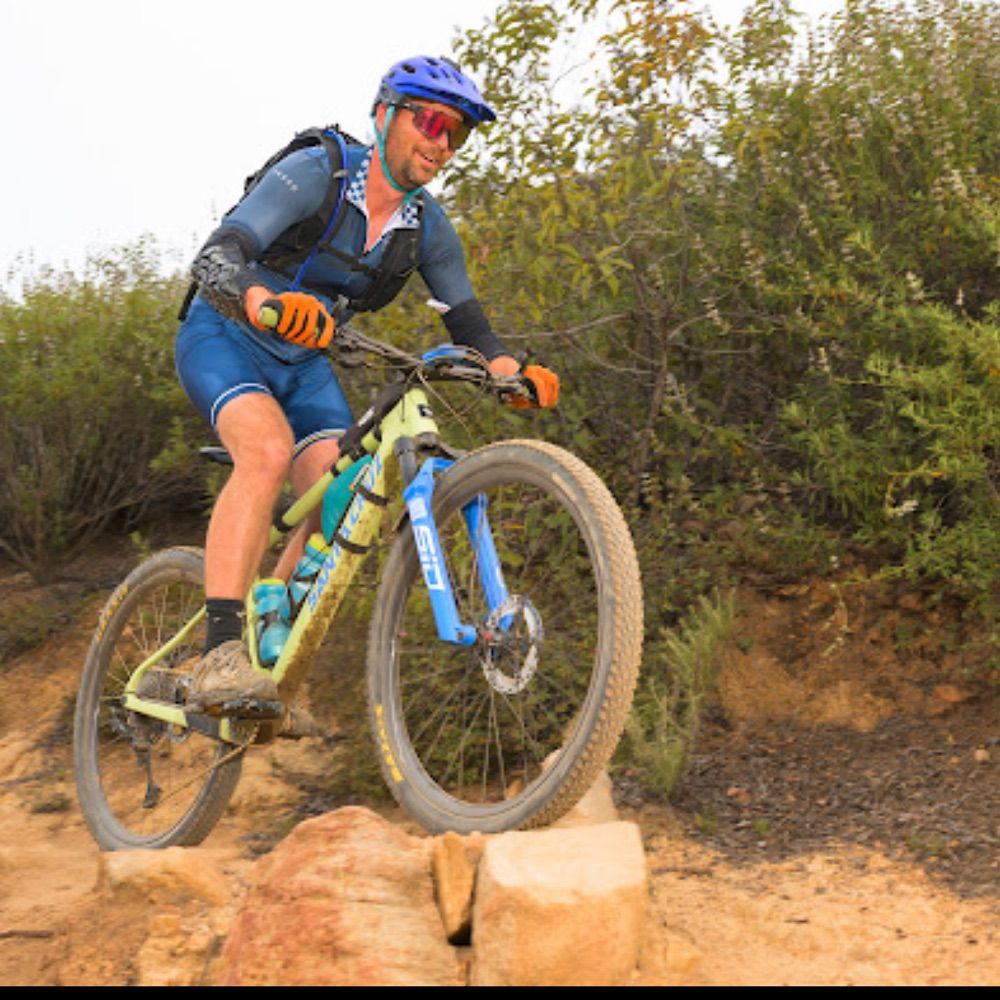
The best keychain ever - ty. This was a molecule discovered in this work www.cell.com/cell/fulltex... . To Prof. Ipsita - I can’t wait to see what you will discover in your own lab at Penn State. Such a pleasure to have had you as a co-worker in the lab. @ipsitamohanty.bsky.social

The underappreciated diversity of bile acid modifications
Using mass spectrometry-based tools to mine public untargeted MS/MS data revealed
the vastly underappreciated diversity of bile acids hidden in plain sight and led
to the discovery of previously unkno...
www.cell.com
December 12, 2025 at 11:39 PM
The best keychain ever - ty. This was a molecule discovered in this work www.cell.com/cell/fulltex... . To Prof. Ipsita - I can’t wait to see what you will discover in your own lab at Penn State. Such a pleasure to have had you as a co-worker in the lab. @ipsitamohanty.bsky.social

Reposted by Samaneh Chaharmiri
This is an important paper to read for people that are trying to understand metabolomics data. Ions detected (features) are not molecules and molecules will generate many ion forms. Be aware of MS ion forms - understand and leverage them. Dark metabolome has a lot of discovery potential.
The existence of unintentional fragmentation (often referred to as in-source fragments) in untargeted #metabolomics data can cause uncertainty among newcomers to the field and skepticism among data consumers such as medical experts or biologists.
pubs.acs.org/doi/10.1021/...
pubs.acs.org/doi/10.1021/...

A Perspective on Unintentional Fragments and Their Impact on the Dark Metabolome, Untargeted Profiling, Molecular Networking, Public Data, and Repository Scale Analysis
In/postsource fragments (ISFs) arise during electrospray ionization or ion transfer in mass spectrometry when molecular bonds break, generating ions that can complicate data interpretation. Although ISFs have been recognized for decades, their contribution to untargeted metabolomics─particularly in the context of the so-called “dark matter” (unannotated MS or MS/MS spectra) and the “dark metabolome” (unannotated molecules)─remains unsettled. This ongoing debate reflects a central tension: while some caution against overinterpreting unidentified signals lacking biological evidence, others argue that dismissing them too quickly risks overlooking genuine molecular discoveries. These discussions also raise a deeper question: what exactly should be considered part of the metabolome? As metabolomics advances toward large-scale data mining and high-throughput computational analysis, resolving these conceptual and methodological ambiguities has become essential. In this perspective, we propose a refined definition of the “dark metabolome” and present a systematic overview of ISFs and related ion forms, including adducts and multimers. We examine their impact on metabolite annotation, experimental design, statistical analysis, computational workflows, and repository-scale data mining. Finally, we provide practical recommendations─including a set of dos and do nots for researchers and reviewers─and discuss the broader implications of ISFs for how the field explores unknown molecular space. By embracing a more nuanced understanding of ISFs, metabolomics can achieve greater rigor, reduce misinterpretation, and unlock new opportunities for discovery.
pubs.acs.org
December 7, 2025 at 7:55 AM
This is an important paper to read for people that are trying to understand metabolomics data. Ions detected (features) are not molecules and molecules will generate many ion forms. Be aware of MS ion forms - understand and leverage them. Dark metabolome has a lot of discovery potential.
Reposted by Samaneh Chaharmiri

Cryptococcus neoformans is responsible for nearly 200,000 deaths per year - more than any other fungal pathogen. In this talk, Caroline Coelho describes development of a large-scale imaging platform to investigate host-pathogen interactions
👉 Book here: www.britmycolsoc.org.uk/bms-talks.html
👉 Book here: www.britmycolsoc.org.uk/bms-talks.html

November 28, 2025 at 1:30 PM
Cryptococcus neoformans is responsible for nearly 200,000 deaths per year - more than any other fungal pathogen. In this talk, Caroline Coelho describes development of a large-scale imaging platform to investigate host-pathogen interactions
👉 Book here: www.britmycolsoc.org.uk/bms-talks.html
👉 Book here: www.britmycolsoc.org.uk/bms-talks.html


November 27, 2025 at 5:24 PM
😍😍😍#mushrooms

November 27, 2025 at 12:13 PM
😍😍😍#mushrooms
Reposted by Samaneh Chaharmiri
We are delighted to sponsor the Natural Products in the 'Omics Era' symposium at @pacifichem.bsky.social!
Keynote speakers include @pieterdorrestein.bsky.social whose research focuses on new MS-based methods to understand the chemistry of microbes #ORG018
📅19-20 December 2025
🔗pacifichem.org
Keynote speakers include @pieterdorrestein.bsky.social whose research focuses on new MS-based methods to understand the chemistry of microbes #ORG018
📅19-20 December 2025
🔗pacifichem.org

November 19, 2025 at 9:01 AM
We are delighted to sponsor the Natural Products in the 'Omics Era' symposium at @pacifichem.bsky.social!
Keynote speakers include @pieterdorrestein.bsky.social whose research focuses on new MS-based methods to understand the chemistry of microbes #ORG018
📅19-20 December 2025
🔗pacifichem.org
Keynote speakers include @pieterdorrestein.bsky.social whose research focuses on new MS-based methods to understand the chemistry of microbes #ORG018
📅19-20 December 2025
🔗pacifichem.org
Reposted by Samaneh Chaharmiri

@markowenmartin.bsky.social shares how his students test moss- and lichen-derived bacteria for antibiotic activity, using Micrococcus luteus as a control
Except from Matters Microbial 116: Microbes in the Concrete Instead of the Abstract
Except from Matters Microbial 116: Microbes in the Concrete Instead of the Abstract
November 16, 2025 at 4:46 PM
@markowenmartin.bsky.social shares how his students test moss- and lichen-derived bacteria for antibiotic activity, using Micrococcus luteus as a control
Except from Matters Microbial 116: Microbes in the Concrete Instead of the Abstract
Except from Matters Microbial 116: Microbes in the Concrete Instead of the Abstract


Reposted by Samaneh Chaharmiri
🚨 CMM LATAM Unit website is now live 🚨
Explore the CMM LATAM unit, established by University of São Paulo, Brazil and the MRC Centre for Medical Mycology (CMM).
🌍 Explore cutting edge research
🎓 Discover funding and training opportunities
🛡️ Join the FAILSAFE network
cmm-latam.com
Explore the CMM LATAM unit, established by University of São Paulo, Brazil and the MRC Centre for Medical Mycology (CMM).
🌍 Explore cutting edge research
🎓 Discover funding and training opportunities
🛡️ Join the FAILSAFE network
cmm-latam.com

November 4, 2025 at 5:31 PM
🚨 CMM LATAM Unit website is now live 🚨
Explore the CMM LATAM unit, established by University of São Paulo, Brazil and the MRC Centre for Medical Mycology (CMM).
🌍 Explore cutting edge research
🎓 Discover funding and training opportunities
🛡️ Join the FAILSAFE network
cmm-latam.com
Explore the CMM LATAM unit, established by University of São Paulo, Brazil and the MRC Centre for Medical Mycology (CMM).
🌍 Explore cutting edge research
🎓 Discover funding and training opportunities
🛡️ Join the FAILSAFE network
cmm-latam.com
Reposted by Samaneh Chaharmiri

From Mass to Class: Classification of Amphetamines MS/MS Spectra via Graph Neural Networks #JCIM pubs.acs.org/doi/10.1021/...

From Mass to Class: Classification of Amphetamines MS/MS Spectra via Graph Neural Networks
Identifying emerging novel psychoactive substances (NPS), using liquid chromatography high-resolution tandem mass spectrometry (LC-HR-MS/MS), is often hindered by their frequent absence from mass spec...
pubs.acs.org
November 1, 2025 at 7:02 PM
From Mass to Class: Classification of Amphetamines MS/MS Spectra via Graph Neural Networks #JCIM pubs.acs.org/doi/10.1021/...
Reposted by Samaneh Chaharmiri
Cool 🦠
William Schmidt
Gerard Wong Lab @UCLA
Nature Microbiology
Pseudomonas aeruginosa lays down Psl exopolysaccharide as it crawls
Other cells detect and follow these trails using type IV pili pulling against adhesins like CdrA triggering c-di-GMP & cAMP surges to shift into early biofilm mode
William Schmidt
Gerard Wong Lab @UCLA
Nature Microbiology
Pseudomonas aeruginosa lays down Psl exopolysaccharide as it crawls
Other cells detect and follow these trails using type IV pili pulling against adhesins like CdrA triggering c-di-GMP & cAMP surges to shift into early biofilm mode

Pseudomonas aeruginosa senses exopolysaccharide trails using type IV pili and adhesins during biofilm formation - Nature Microbiology
Opposing forces generated by exopolysaccharide trail binding versus type IV pilus retraction generate a high cyclic diGMP–high cyclic AMP state in Pseudomonas aeruginosa that promotes social motility.
www.nature.com
October 29, 2025 at 3:41 AM
Cool 🦠
William Schmidt
Gerard Wong Lab @UCLA
Nature Microbiology
Pseudomonas aeruginosa lays down Psl exopolysaccharide as it crawls
Other cells detect and follow these trails using type IV pili pulling against adhesins like CdrA triggering c-di-GMP & cAMP surges to shift into early biofilm mode
William Schmidt
Gerard Wong Lab @UCLA
Nature Microbiology
Pseudomonas aeruginosa lays down Psl exopolysaccharide as it crawls
Other cells detect and follow these trails using type IV pili pulling against adhesins like CdrA triggering c-di-GMP & cAMP surges to shift into early biofilm mode
Reposted by Samaneh Chaharmiri
Analysis of bioactive compounds in Gardenia jasminoides from different regions by UFLC/QTRAP-MS and PCA #Medicine journals.lww.com/md-journal/f...
journals.lww.com
October 15, 2025 at 8:03 PM
Analysis of bioactive compounds in Gardenia jasminoides from different regions by UFLC/QTRAP-MS and PCA #Medicine journals.lww.com/md-journal/f...

Reposted by Samaneh Chaharmiri
HT SpaceM: A high-throughput and reproducible method for small-molecule single-cell metabolomics #Cell #MassSpec www.cell.com/cell/fulltex...

HT SpaceM: A high-throughput and reproducible method for small-molecule single-cell metabolomics
Single-cell metabolomics (SCM) can probe metabolic heterogeneity but is hindered by
low sensitivity for small molecules, limited scalability, and the lack of standardized
frameworks for data analysis....
www.cell.com
September 7, 2025 at 12:57 PM
HT SpaceM: A high-throughput and reproducible method for small-molecule single-cell metabolomics #Cell #MassSpec www.cell.com/cell/fulltex...
Reposted by Samaneh Chaharmiri

We are looking for a 3-year postdoc to work with Daniel Probst, Justin van der Hooft and myself on an exciting project involving federated learning and integrative omics for discovery of new antibiotics from natural products.
Apply here: www.wur.nl/en/vacancy/p...
Please share!
Apply here: www.wur.nl/en/vacancy/p...
Please share!
www.wur.nl
September 8, 2025 at 9:07 AM
We are looking for a 3-year postdoc to work with Daniel Probst, Justin van der Hooft and myself on an exciting project involving federated learning and integrative omics for discovery of new antibiotics from natural products.
Apply here: www.wur.nl/en/vacancy/p...
Please share!
Apply here: www.wur.nl/en/vacancy/p...
Please share!

Reposted by Samaneh Chaharmiri
It started with a concept of using data science and mass spectrometry for drug discovery with the goal to help people improve quality of their lives enveda.com. Now it’s a 🦄 that is getting a real shot at doing so with great clinical leads and in clinical trials www.youtube.com/watch?v=VafS....
Home
enveda.com
September 5, 2025 at 3:21 AM
It started with a concept of using data science and mass spectrometry for drug discovery with the goal to help people improve quality of their lives enveda.com. Now it’s a 🦄 that is getting a real shot at doing so with great clinical leads and in clinical trials www.youtube.com/watch?v=VafS....
Reposted by Samaneh Chaharmiri
Interested in a co-authorship?
We’re building a tool for repository-scale untargeted #metabolomics and #exposomics of #environmental data. To make it the best it can be, we’re looking for people willing to share high-resolution LC-MS/MS (DDA) data from #water, #soil, #sediment, and related samples.
We’re building a tool for repository-scale untargeted #metabolomics and #exposomics of #environmental data. To make it the best it can be, we’re looking for people willing to share high-resolution LC-MS/MS (DDA) data from #water, #soil, #sediment, and related samples.

August 26, 2025 at 7:51 PM
Interested in a co-authorship?
We’re building a tool for repository-scale untargeted #metabolomics and #exposomics of #environmental data. To make it the best it can be, we’re looking for people willing to share high-resolution LC-MS/MS (DDA) data from #water, #soil, #sediment, and related samples.
We’re building a tool for repository-scale untargeted #metabolomics and #exposomics of #environmental data. To make it the best it can be, we’re looking for people willing to share high-resolution LC-MS/MS (DDA) data from #water, #soil, #sediment, and related samples.
Reposted by Samaneh Chaharmiri
🌊🦠🧪 Delighted to share this work now out in @isme-microbes.bsky.social: doi.org/10.1093/isme... The currency of microbial life is chemistry, but there’s so much still unknown about how metabolic interactions shape communities. 1/

Vitamin auxotrophies shape microbial community assembly on model marine particles
Abstract. Microbial community assembly is governed by the flow of carbon sources and other primary metabolites between species. However, central metabolism
doi.org
August 25, 2025 at 10:21 PM
🌊🦠🧪 Delighted to share this work now out in @isme-microbes.bsky.social: doi.org/10.1093/isme... The currency of microbial life is chemistry, but there’s so much still unknown about how metabolic interactions shape communities. 1/
Reposted by Samaneh Chaharmiri
Yes reach out to Yasin for this project. It will allow a worldwide picture of the environmental metabolome. This can be already published or not yet published data but will need world coordinates.
Interested in a co-authorship?
We’re building a tool for repository-scale untargeted #metabolomics and #exposomics of #environmental data. To make it the best it can be, we’re looking for people willing to share high-resolution LC-MS/MS (DDA) data from #water, #soil, #sediment, and related samples.
We’re building a tool for repository-scale untargeted #metabolomics and #exposomics of #environmental data. To make it the best it can be, we’re looking for people willing to share high-resolution LC-MS/MS (DDA) data from #water, #soil, #sediment, and related samples.
August 26, 2025 at 9:46 PM
Yes reach out to Yasin for this project. It will allow a worldwide picture of the environmental metabolome. This can be already published or not yet published data but will need world coordinates.
Reposted by Samaneh Chaharmiri
🄰
🄿🅁🄾🄱🄸🄾🅃🄸🄲
🄵🄾🅁
🅂🅃🅁🄾🄺🄴
🅁🄴🄲🄾🅅🄴🅁🅈 ??
Low 𝘓𝘢𝘤𝘵𝘰𝘣𝘢𝘤𝘪𝘭𝘭𝘶𝘴 𝘢𝘤𝘪𝘥𝘰𝘱𝘩𝘪𝘭𝘶𝘴 levels in the gut predicted cognitive decline after ischemic stroke
Probiotic supplementation improved cognition in mice + human clinical trial by ↑ linoleic acid uptake → microglial peroxisomes → anti-inflammatory reprogramming
🄿🅁🄾🄱🄸🄾🅃🄸🄲
🄵🄾🅁
🅂🅃🅁🄾🄺🄴
🅁🄴🄲🄾🅅🄴🅁🅈 ??
Low 𝘓𝘢𝘤𝘵𝘰𝘣𝘢𝘤𝘪𝘭𝘭𝘶𝘴 𝘢𝘤𝘪𝘥𝘰𝘱𝘩𝘪𝘭𝘶𝘴 levels in the gut predicted cognitive decline after ischemic stroke
Probiotic supplementation improved cognition in mice + human clinical trial by ↑ linoleic acid uptake → microglial peroxisomes → anti-inflammatory reprogramming

Lactobacillus acidophilus promotes cognitive function recovery via regulating microglial peroxisomal function in cerebral ischemia
Huang et al. report that L. acidophilus deficiency correlates with cognitive decline
in cerebral ischemia patients. In cerebral ischemia mouse models, L. acidophilus supplementation
enhances linoleic ...
www.cell.com
August 18, 2025 at 8:08 AM
🄰
🄿🅁🄾🄱🄸🄾🅃🄸🄲
🄵🄾🅁
🅂🅃🅁🄾🄺🄴
🅁🄴🄲🄾🅅🄴🅁🅈 ??
Low 𝘓𝘢𝘤𝘵𝘰𝘣𝘢𝘤𝘪𝘭𝘭𝘶𝘴 𝘢𝘤𝘪𝘥𝘰𝘱𝘩𝘪𝘭𝘶𝘴 levels in the gut predicted cognitive decline after ischemic stroke
Probiotic supplementation improved cognition in mice + human clinical trial by ↑ linoleic acid uptake → microglial peroxisomes → anti-inflammatory reprogramming
🄿🅁🄾🄱🄸🄾🅃🄸🄲
🄵🄾🅁
🅂🅃🅁🄾🄺🄴
🅁🄴🄲🄾🅅🄴🅁🅈 ??
Low 𝘓𝘢𝘤𝘵𝘰𝘣𝘢𝘤𝘪𝘭𝘭𝘶𝘴 𝘢𝘤𝘪𝘥𝘰𝘱𝘩𝘪𝘭𝘶𝘴 levels in the gut predicted cognitive decline after ischemic stroke
Probiotic supplementation improved cognition in mice + human clinical trial by ↑ linoleic acid uptake → microglial peroxisomes → anti-inflammatory reprogramming
Reposted by Samaneh Chaharmiri
The best of both worlds with awesome speakers that will focus on how the microbiome affects ecosystems at a mechanistic level. Can’t wait for this meeting.

Two conferences, one reg! Sign up for Microbiome Metabolism & Metabolites + get Human Microbiome FREE. Joint keynotes: Emily P. Balskus & Mohamed S. Abou Donia. keysym.us/KSMicroMetab26 @pieterdorrestein.bsky.social @mfgrp.bsky.social @inesthiele.bsky.social #KSMicroMetab26 #KSMicrobiome26

Microbiome Metabolism and Metabolites: Discovery and Function in Health and Disease | Keystone Symposia
Join us at the Keystone Symposia on Microbiome Metabolism and Metabolites: Discovery and Function in Health and Disease, January 2026, in Banff, with field leaders!
keysym.us
August 12, 2025 at 11:35 PM
The best of both worlds with awesome speakers that will focus on how the microbiome affects ecosystems at a mechanistic level. Can’t wait for this meeting.
Reposted by Samaneh Chaharmiri

#NatMicroPicks
Hidden microbial world in trees🌳
Living wood hosts trillions of bacteria making trees a complex ecosystems with major roles in forest health and function.
#PlantMicro #MicroSky
www.nature.com/articles/s41...
Hidden microbial world in trees🌳
Living wood hosts trillions of bacteria making trees a complex ecosystems with major roles in forest health and function.
#PlantMicro #MicroSky
www.nature.com/articles/s41...
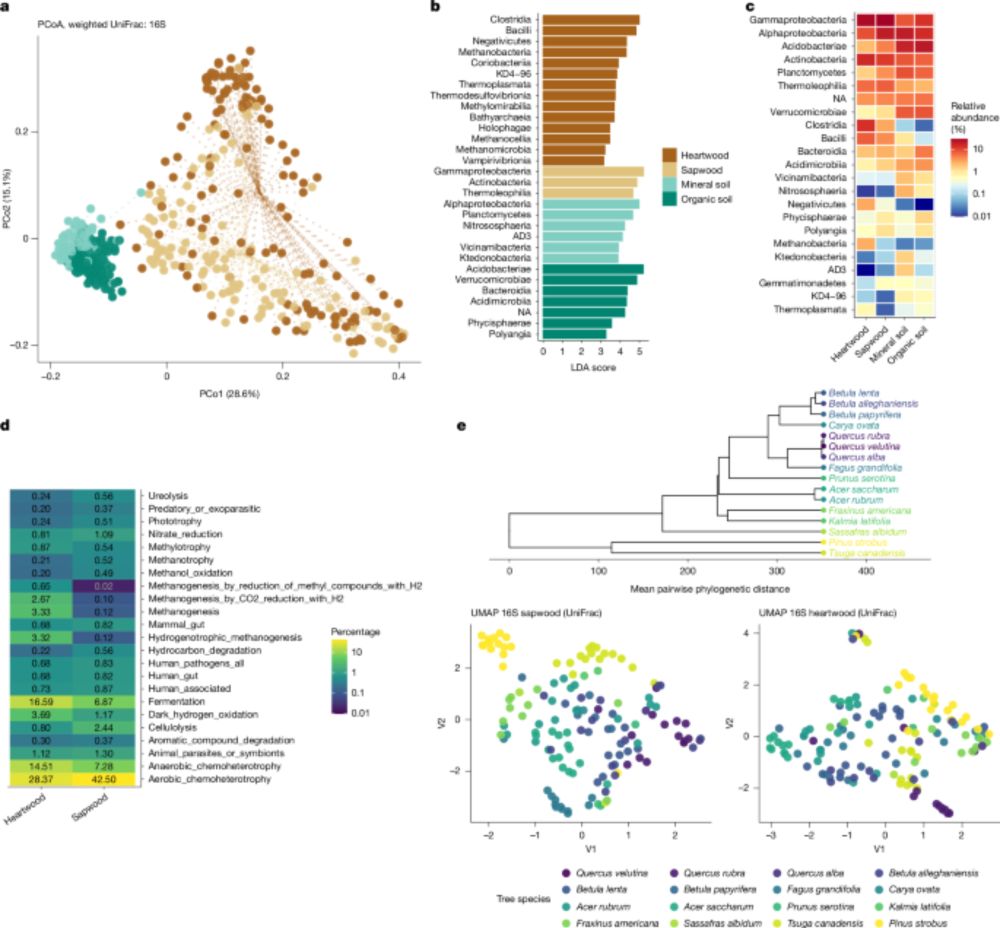
A diverse and distinct microbiome inside living trees - Nature
Microbiome analyses of living trees show that a single tree can host approximately one trillion bacteria, with microbial communities distinctly partitioned between heartwood and sapwood and with minim...
www.nature.com
August 8, 2025 at 2:28 PM
#NatMicroPicks
Hidden microbial world in trees🌳
Living wood hosts trillions of bacteria making trees a complex ecosystems with major roles in forest health and function.
#PlantMicro #MicroSky
www.nature.com/articles/s41...
Hidden microbial world in trees🌳
Living wood hosts trillions of bacteria making trees a complex ecosystems with major roles in forest health and function.
#PlantMicro #MicroSky
www.nature.com/articles/s41...
Reposted by Samaneh Chaharmiri

taxburst v0.3.0 is now released - this is an update of the Krona visualization system for microbiome/metagenome taxonomy analyses. Enjoy!
Announcing taxburst, an update of the Krona software for taxonomy exploration
Announcing taxburst for metagenome taxonomy!
ivory.idyll.org
August 8, 2025 at 2:19 PM
taxburst v0.3.0 is now released - this is an update of the Krona visualization system for microbiome/metagenome taxonomy analyses. Enjoy!