



Chao Liu
@ployaaaa.bsky.social
Ph.D., Institute of Microbiology, Chinese Academy of Sciences;
CRISPR-Cas system, defense system, TA system, phage and microbes.
CRISPR-Cas system, defense system, TA system, phage and microbes.
Reposted by Chao Liu

Amazing findings in geometry-based immune activation! Two bacterial defence systems detect phage-encoded ring oligomers, assemble high-order molecular complexes, and trigger abortive infection.
www.nature.com/articles/s41...
www.nature.com/articles/s41...
www.nature.com/articles/s41...
www.nature.com/articles/s41...


February 4, 2026 at 6:25 PM
Amazing findings in geometry-based immune activation! Two bacterial defence systems detect phage-encoded ring oligomers, assemble high-order molecular complexes, and trigger abortive infection.
www.nature.com/articles/s41...
www.nature.com/articles/s41...
www.nature.com/articles/s41...
www.nature.com/articles/s41...
Reposted by Chao Liu
🧬 Metabolic arms race continues!
We discovered a new NAD⁺-depleting bacterial immune system aRES and phage enzymes that overcome it.
Our preprint is out: www.biorxiv.org/content/10.6...
We discovered a new NAD⁺-depleting bacterial immune system aRES and phage enzymes that overcome it.
Our preprint is out: www.biorxiv.org/content/10.6...
Bacterial defense via RES-mediated NAD+ depletion is countered by phage phosphatases
Many bacterial defense systems restrict phage infection by breaking the molecule NAD+ to its constituents, adenosine diphosphate ribose (ADPR) and nicotinamide (Nam). To counter NAD+ depletion-mediated defense, phages evolved NAD+ reconstitution pathway 1 (NARP1), which uses ADPR and Nam to rebuild NAD+. Here we report a bacterial defense system called aRES, involving RES-domain proteins that degrade NAD+ into Nam and ADPR-1″-phosphate (ADPR-1P). This molecule cannot serve as a substrate for NARP1, so that NAD+ depletion by aRES defends against phages even if they encode NARP1. We further discover that some phages evolved an extended NARP1 pathway capable of overcoming aRES defense. In these phages, the NARP1 operon also includes a specialized phosphatase, which dephosphorylates ADPR-1P to form ADPR, a substrate from which NARP1 then reconstitutes NAD+. Other phages encode inhibitors that directly bind aRES proteins and physically block their active sites. Our study describes new layers in the NAD+-centric arms race between bacteria and phages and highlights the centrality of the NAD+ pool in cellular battles between viruses and their hosts. ### Competing Interest Statement The authors have declared no competing interest. European Research Council, ERC-AdG GA 101018520 Israel Science Foundation, MAPATS grant 2720/22 Deutsche Forschungsgemeinschaft, SPP 2330, grant 464312965 Minerva Foundation with funding from the Federal German Ministry for Education and Research research grant from Magnus Konow in honor of his mother Olga Konow Rappaport Ministry of Aliyah and Immigrant Absorption, https://ror.org/05aycsg86 Clore Scholars Program
www.biorxiv.org
January 29, 2026 at 11:20 AM
🧬 Metabolic arms race continues!
We discovered a new NAD⁺-depleting bacterial immune system aRES and phage enzymes that overcome it.
Our preprint is out: www.biorxiv.org/content/10.6...
We discovered a new NAD⁺-depleting bacterial immune system aRES and phage enzymes that overcome it.
Our preprint is out: www.biorxiv.org/content/10.6...
Reposted by Chao Liu

A prophage-encoded abortive infection protein preserves host and prophage spread www.nature.com/articles/s41...

A prophage-encoded abortive infection protein preserves host and prophage spread - Nature
A Gifsy-1 prophage–encoded higher eukaryotes and prokaryotes nucleotide-binding protein, HepS, senses Siphoviridae infection, activates abortive defence by cleaving host transfer RNAs, blocks rival ph...
www.nature.com
January 28, 2026 at 11:01 PM
Reposted by Chao Liu
Reposted by Chao Liu

Reposted by Chao Liu

Phold's manuscript is now available @narjournal.bsky.social thanks to @susiegriggo.bsky.social @npbhavya.bsky.social @vijinim.bsky.social @linsalrob.bsky.social @martinsteinegger.bsky.social @milot.bsky.social @eunbelivable.bsky.social & others not on bsky #phagesky academic.oup.com/nar/article/...
January 14, 2026 at 5:10 AM
Phold's manuscript is now available @narjournal.bsky.social thanks to @susiegriggo.bsky.social @npbhavya.bsky.social @vijinim.bsky.social @linsalrob.bsky.social @martinsteinegger.bsky.social @milot.bsky.social @eunbelivable.bsky.social & others not on bsky #phagesky academic.oup.com/nar/article/...
Reposted by Chao Liu

Reposted by Chao Liu

NLR-like immunity in bacteria
A new study from the Alex Gao lab. The scope of this work is incredible!!!
www.biorxiv.org/content/10.6...
A new study from the Alex Gao lab. The scope of this work is incredible!!!
www.biorxiv.org/content/10.6...

Diverse bacterial pattern recognition receptors sense the conserved phage proteome
Recognition of foreign molecules inside cells is critical for immunity in all domains of life. Proteins of the STAND NTPase superfamily, including eukaryotic nucleotide-binding oligomerization domain ...
www.biorxiv.org
January 5, 2026 at 1:59 PM
NLR-like immunity in bacteria
A new study from the Alex Gao lab. The scope of this work is incredible!!!
www.biorxiv.org/content/10.6...
A new study from the Alex Gao lab. The scope of this work is incredible!!!
www.biorxiv.org/content/10.6...
Reposted by Chao Liu

Phage-associated Cas12p nucleases require binding to bacterial thioredoxin for activation and cleavage of target DNA www.nature.com/articles/s41...

January 4, 2026 at 5:56 AM
Phage-associated Cas12p nucleases require binding to bacterial thioredoxin for activation and cleavage of target DNA www.nature.com/articles/s41...
Reposted by Chao Liu


A prophage-encoded sRNA limits phage infection of adherent-invasive E. coli
#PLoSPathogen from @prsecor.bsky.social
journals.plos.org/plospathogen...
#PLoSPathogen from @prsecor.bsky.social
journals.plos.org/plospathogen...

A prophage-encoded sRNA limits phage infection of adherent-invasive E. coli
Author summary Prophages—viral genomes integrated into bacterial chromosomes—are common in enteric bacteria and can profoundly influence bacterial physiology and ecological fitness. Here we show that ...
journals.plos.org
January 3, 2026 at 12:07 PM
Reposted by Chao Liu

@peterfineran.bsky.social and colleagues develop Tn-seq for phages by leveraging anti-CRISPR (Acr) as a positive
selectable marker in the presence of CRISPR-Cas counter-selection, and identify essential genes in phage from non model orgs
www.biorxiv.org/content/10.6...
selectable marker in the presence of CRISPR-Cas counter-selection, and identify essential genes in phage from non model orgs
www.biorxiv.org/content/10.6...

December 20, 2025 at 11:34 PM
@peterfineran.bsky.social and colleagues develop Tn-seq for phages by leveraging anti-CRISPR (Acr) as a positive
selectable marker in the presence of CRISPR-Cas counter-selection, and identify essential genes in phage from non model orgs
www.biorxiv.org/content/10.6...
selectable marker in the presence of CRISPR-Cas counter-selection, and identify essential genes in phage from non model orgs
www.biorxiv.org/content/10.6...
Reposted by Chao Liu

Microbes weaponizing secondary metabolites to make rivals vulnerable to phage attack 🧪🦠
www.nature.com/articles/s41...
www.nature.com/articles/s41...
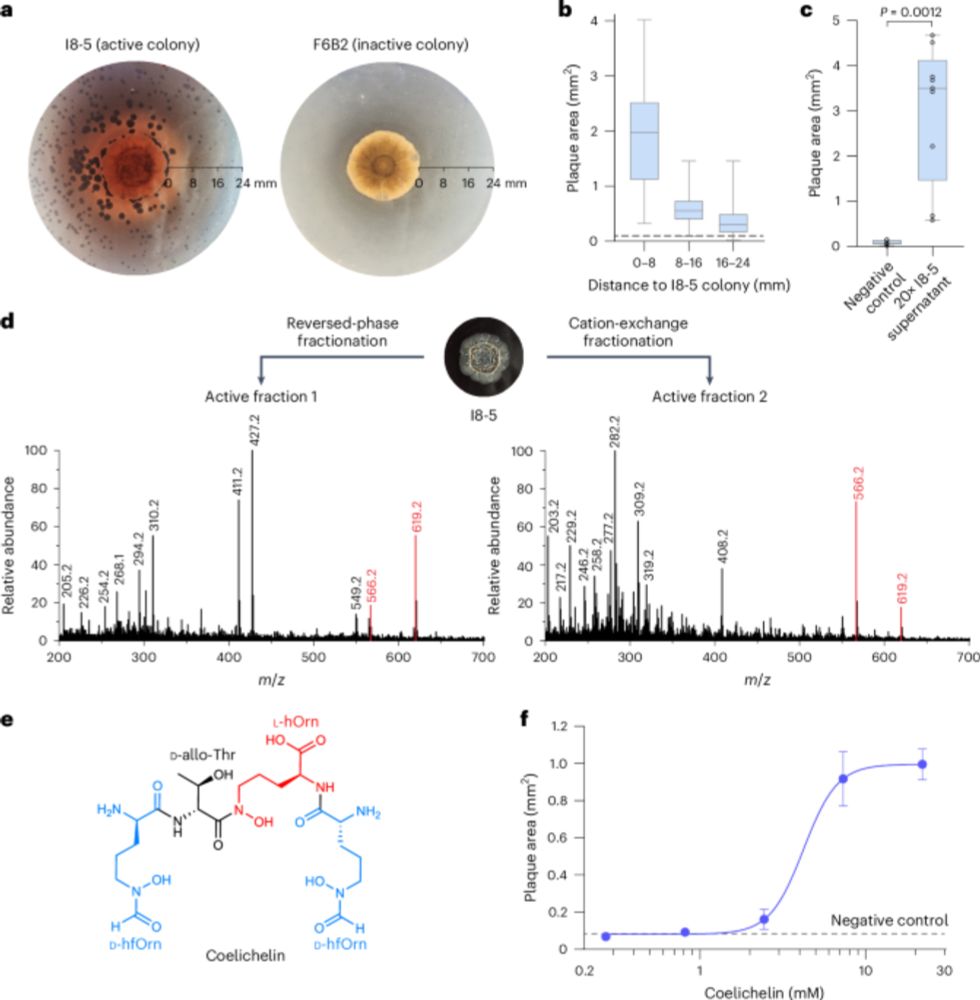
Streptomyces secretes a siderophore that sensitizes competitor bacteria to phage infection - Nature Microbiology
A secondary metabolite sensitizes competitor Bacillus subtilis to a wide panel of lytic phages by sequestering iron and preventing the activation of Spo0A.
www.nature.com
December 19, 2025 at 3:03 PM
Microbes weaponizing secondary metabolites to make rivals vulnerable to phage attack 🧪🦠
www.nature.com/articles/s41...
www.nature.com/articles/s41...
Reposted by Chao Liu
Reposted by Chao Liu
Reposted by Chao Liu

✨New preprint!
🧵1/4 Excited to share our work on AI-guided design of minimal RNA-guided nucleases. Amazing work by @petrskopintsev.bsky.social @isabelesain.bsky.social @evandeturk.bsky.social et al!
Multi-lab collaboration @banfieldlab.bsky.social @jhdcate.bsky.social @jacobsenucla.bsky.social🧬
🔗👇
🧵1/4 Excited to share our work on AI-guided design of minimal RNA-guided nucleases. Amazing work by @petrskopintsev.bsky.social @isabelesain.bsky.social @evandeturk.bsky.social et al!
Multi-lab collaboration @banfieldlab.bsky.social @jhdcate.bsky.social @jacobsenucla.bsky.social🧬
🔗👇
December 9, 2025 at 7:52 AM
✨New preprint!
🧵1/4 Excited to share our work on AI-guided design of minimal RNA-guided nucleases. Amazing work by @petrskopintsev.bsky.social @isabelesain.bsky.social @evandeturk.bsky.social et al!
Multi-lab collaboration @banfieldlab.bsky.social @jhdcate.bsky.social @jacobsenucla.bsky.social🧬
🔗👇
🧵1/4 Excited to share our work on AI-guided design of minimal RNA-guided nucleases. Amazing work by @petrskopintsev.bsky.social @isabelesain.bsky.social @evandeturk.bsky.social et al!
Multi-lab collaboration @banfieldlab.bsky.social @jhdcate.bsky.social @jacobsenucla.bsky.social🧬
🔗👇
Reposted by Chao Liu
Phages are full of genes of unknown function that are likely adaptive in specific conditions.
New preprint: Phage TnSeq identifies essential genes rapidly and knocks all non-essentials. We would like to send a pool of phiKZ mutants to anyone wanting it! Reach out
tinyurl.com/bdcfrejh
New preprint: Phage TnSeq identifies essential genes rapidly and knocks all non-essentials. We would like to send a pool of phiKZ mutants to anyone wanting it! Reach out
tinyurl.com/bdcfrejh

December 8, 2025 at 3:04 PM
Phages are full of genes of unknown function that are likely adaptive in specific conditions.
New preprint: Phage TnSeq identifies essential genes rapidly and knocks all non-essentials. We would like to send a pool of phiKZ mutants to anyone wanting it! Reach out
tinyurl.com/bdcfrejh
New preprint: Phage TnSeq identifies essential genes rapidly and knocks all non-essentials. We would like to send a pool of phiKZ mutants to anyone wanting it! Reach out
tinyurl.com/bdcfrejh
Reposted by Chao Liu
Preprint: Systematic discovery of TIR-based immune signaling systems in bacteria
Conservation of TIR-derived signals accross the tree of life! We found bacterial TIR immune systems that signal via canonical cADPR (like in humans) and 2'cADPR (a plant immune signal).
Documented 11 Thoeris types
Conservation of TIR-derived signals accross the tree of life! We found bacterial TIR immune systems that signal via canonical cADPR (like in humans) and 2'cADPR (a plant immune signal).
Documented 11 Thoeris types

December 4, 2025 at 1:56 PM
Preprint: Systematic discovery of TIR-based immune signaling systems in bacteria
Conservation of TIR-derived signals accross the tree of life! We found bacterial TIR immune systems that signal via canonical cADPR (like in humans) and 2'cADPR (a plant immune signal).
Documented 11 Thoeris types
Conservation of TIR-derived signals accross the tree of life! We found bacterial TIR immune systems that signal via canonical cADPR (like in humans) and 2'cADPR (a plant immune signal).
Documented 11 Thoeris types
Reposted by Chao Liu


Reposted by Chao Liu


Reposted by Chao Liu

🧬🛡️How are new immune mechanisms created?
We show how Lamassu antiphage system, originated from a DNA-repair complex and evolved into a compact and modular immune machine, wt Dinshaw Patel lab in @pnas.org.
👏 @matthieu-haudiquet.bsky.social, Arpita Chakravarti & all authors!
doi.org/10.1073/pnas...
We show how Lamassu antiphage system, originated from a DNA-repair complex and evolved into a compact and modular immune machine, wt Dinshaw Patel lab in @pnas.org.
👏 @matthieu-haudiquet.bsky.social, Arpita Chakravarti & all authors!
doi.org/10.1073/pnas...


November 27, 2025 at 9:35 AM
🧬🛡️How are new immune mechanisms created?
We show how Lamassu antiphage system, originated from a DNA-repair complex and evolved into a compact and modular immune machine, wt Dinshaw Patel lab in @pnas.org.
👏 @matthieu-haudiquet.bsky.social, Arpita Chakravarti & all authors!
doi.org/10.1073/pnas...
We show how Lamassu antiphage system, originated from a DNA-repair complex and evolved into a compact and modular immune machine, wt Dinshaw Patel lab in @pnas.org.
👏 @matthieu-haudiquet.bsky.social, Arpita Chakravarti & all authors!
doi.org/10.1073/pnas...
Reposted by Chao Liu
Work I co-led with @jnoms.bsky.social is now online at
@cp-cellhostmicrobe.bsky.social ! We revealed a previously unrealized diversity of viral immune-evasion proteins that selectively destroy different cyclic nucleotide signals used in bacterial immunity.
www.sciencedirect.com/science/arti...
@cp-cellhostmicrobe.bsky.social ! We revealed a previously unrealized diversity of viral immune-evasion proteins that selectively destroy different cyclic nucleotide signals used in bacterial immunity.
www.sciencedirect.com/science/arti...

Divergent viral phosphodiesterases for immune signaling evasion
Cyclic dinucleotides (CDNs) and other short oligonucleotides play fundamental roles in immune system activation in organisms ranging from bacteria to …
www.sciencedirect.com
November 25, 2025 at 9:10 PM
Work I co-led with @jnoms.bsky.social is now online at
@cp-cellhostmicrobe.bsky.social ! We revealed a previously unrealized diversity of viral immune-evasion proteins that selectively destroy different cyclic nucleotide signals used in bacterial immunity.
www.sciencedirect.com/science/arti...
@cp-cellhostmicrobe.bsky.social ! We revealed a previously unrealized diversity of viral immune-evasion proteins that selectively destroy different cyclic nucleotide signals used in bacterial immunity.
www.sciencedirect.com/science/arti...
Reposted by Chao Liu

I am so excited to share our project with you! We find prokaryotic proteases activate toxic enzymes and pores as a modular strategy in phage defense. We studied four fascinating protease-toxin pairs that are abundant across bacterial genomes:
www.biorxiv.org/content/10.1...
www.biorxiv.org/content/10.1...

Proteolytic activation of diverse antiviral defense modules in prokaryotes
Linked protease–effector modules are widespread in prokaryotic antiviral defense, yet the mechanisms of most remain poorly understood. Here we show that four of the most prevalent modules—metallo-β-la...
www.biorxiv.org
November 15, 2025 at 11:49 PM
I am so excited to share our project with you! We find prokaryotic proteases activate toxic enzymes and pores as a modular strategy in phage defense. We studied four fascinating protease-toxin pairs that are abundant across bacterial genomes:
www.biorxiv.org/content/10.1...
www.biorxiv.org/content/10.1...
Reposted by Chao Liu

New from the @doudna-lab.bsky.social and first author @owentuck.bsky.social!

Our nuclease-protease story is out! We explored a fascinating case of coevolution and modularity in prokaryotic immune systems: www.science.org/doi/10.1126/...
Thanks to wonderful coauthors/collaborators/friends, the whole @doudna-lab.bsky.social and everyone at @innovativegenomics.bsky.social
Thanks to wonderful coauthors/collaborators/friends, the whole @doudna-lab.bsky.social and everyone at @innovativegenomics.bsky.social

Recurrent acquisition of nuclease-protease pairs in antiviral immunity
Antiviral immune systems diversify by integrating new genes into existing pathways, creating new mechanisms of viral resistance. We identified genes encoding a predicted nuclease paired with a trypsin...
www.science.org
November 14, 2025 at 12:27 AM
New from the @doudna-lab.bsky.social and first author @owentuck.bsky.social!
Reposted by Chao Liu
#microsky #phagesky
Predicting host- #phage interactions from genomics.
www.biorxiv.org/content/10.1...
Predicting host- #phage interactions from genomics.
www.biorxiv.org/content/10.1...

Phylogeny-agnostic strain-level prediction of phage-host interactions from genomes
Bacteriophages offer promising alternatives to antibiotics for treating drug-resistant infections and engineering microbiomes, but applications are limited by inability to select phages infecting spec...
www.biorxiv.org
November 16, 2025 at 9:53 AM
#microsky #phagesky
Predicting host- #phage interactions from genomics.
www.biorxiv.org/content/10.1...
Predicting host- #phage interactions from genomics.
www.biorxiv.org/content/10.1...
Reposted by Chao Liu
#microsky #phagesky #phage defence
Anti-CRISPR protein hijacks host’s enolase to tackle and block CRISPR-Cas
www.nature.com/articles/s41...
Anti-CRISPR protein hijacks host’s enolase to tackle and block CRISPR-Cas
www.nature.com/articles/s41...

A phage-encoded anti-CRISPR protein co-opts host enolase to prevent type III CRISPR immunity - Nature Microbiology
Streptococcus thermophilus phages circumvent host CRISPR defences via AcrIIIA2, which complexes with enolase, a highly abundant glycolysis enzyme, to block phage RNA binding.
www.nature.com
November 11, 2025 at 4:27 PM
#microsky #phagesky #phage defence
Anti-CRISPR protein hijacks host’s enolase to tackle and block CRISPR-Cas
www.nature.com/articles/s41...
Anti-CRISPR protein hijacks host’s enolase to tackle and block CRISPR-Cas
www.nature.com/articles/s41...