



Jeffrey Vedanayagam
@antisense.bsky.social
Assistant Professor at University of Texas at San Antonio. Study evolution/regulation of selfish genes. Manage two labs. Research lab🔬🧪🧬🖥️ with some ease but the other lab 🐶🐾 is un-manageable!
https://www.anti-sense.org/
https://www.anti-sense.org/
Reposted by Jeffrey Vedanayagam

How did dogs evolve from wolves—and what does their DNA reveal about behavior? 🐕 A new PNAS Special Feature explores canine domestication, migration, and genetic links to behavior and human traits. Read now: https://ow.ly/y4aS50XMxef

December 19, 2025 at 10:00 PM
How did dogs evolve from wolves—and what does their DNA reveal about behavior? 🐕 A new PNAS Special Feature explores canine domestication, migration, and genetic links to behavior and human traits. Read now: https://ow.ly/y4aS50XMxef
Reposted by Jeffrey Vedanayagam

Hey all, I reached out to the PO of my NIGMS MIRA to ask if the gov't shut down, and rescheduling of study sections, might allow for some accommodation to the standard rule that PIs cannot resubmit a MIRA while their MIRA (or other RPG) is under review (waiting in scores or summary statements) 🧪
December 19, 2025 at 7:17 PM
Hey all, I reached out to the PO of my NIGMS MIRA to ask if the gov't shut down, and rescheduling of study sections, might allow for some accommodation to the standard rule that PIs cannot resubmit a MIRA while their MIRA (or other RPG) is under review (waiting in scores or summary statements) 🧪
Reposted by Jeffrey Vedanayagam
What does it take to achieve the highest level of human performance? Across athletics, science, chess, and music
@science.org
science.org/doi/10.1126/...
@science.org
science.org/doi/10.1126/...

Recent discoveries on the acquisition of the highest levels of human performance
Scientists have long debated the origins of exceptional human achievements. This literature review summarizes recent evidence from multiple domains on the acquisition of world-class performance. We re...
science.org
December 18, 2025 at 10:47 PM
What does it take to achieve the highest level of human performance? Across athletics, science, chess, and music
@science.org
science.org/doi/10.1126/...
@science.org
science.org/doi/10.1126/...
Reposted by Jeffrey Vedanayagam

Transcriptomics in the era of long-read sequencing
#Review by @carolinamonzo.bsky.social, Tianyuan Liu & @anaconesa.bsky.social @conesalab.bsky.social @csic.es
Free to read here: rdcu.be/efBjP
#Review by @carolinamonzo.bsky.social, Tianyuan Liu & @anaconesa.bsky.social @conesalab.bsky.social @csic.es
Free to read here: rdcu.be/efBjP

Transcriptomics in the era of long-read sequencing
Nature Reviews Genetics - Advances in long-read sequencing are driving the implementation of these technologies for transcriptome profiling. The authors provide a comprehensive guide to long-read...
rdcu.be
December 17, 2025 at 12:31 PM
Transcriptomics in the era of long-read sequencing
#Review by @carolinamonzo.bsky.social, Tianyuan Liu & @anaconesa.bsky.social @conesalab.bsky.social @csic.es
Free to read here: rdcu.be/efBjP
#Review by @carolinamonzo.bsky.social, Tianyuan Liu & @anaconesa.bsky.social @conesalab.bsky.social @csic.es
Free to read here: rdcu.be/efBjP
Reposted by Jeffrey Vedanayagam

Absolutely thrilled to share the latest work from my lab focused on the variation and evolution of human centromeres among global populations! We assembled 2,110 human centromeres, identifying 226 new major haplotypes and 1,870 α-satellite HOR variants. www.biorxiv.org/content/10.6...

December 16, 2025 at 4:06 PM
Absolutely thrilled to share the latest work from my lab focused on the variation and evolution of human centromeres among global populations! We assembled 2,110 human centromeres, identifying 226 new major haplotypes and 1,870 α-satellite HOR variants. www.biorxiv.org/content/10.6...
Reposted by Jeffrey Vedanayagam

Very happy to share our paper rdcu.be/eUImj out today in @natcellbio.nature.com 🎉🎉🎉
We uncover an unexpected role for endogenous Xist RNA in regulating X-linked genes that escape X-inactivation.
We uncover an unexpected role for endogenous Xist RNA in regulating X-linked genes that escape X-inactivation.

Escape from X inactivation is directly modulated by Xist noncoding RNA
Nature Cell Biology - The authors show that increased Xist RNA levels can induce de novo silencing of genes that normally escape X inactivation. SPEN depletion prevents the silencing of escape...
rdcu.be
December 15, 2025 at 4:22 PM
Very happy to share our paper rdcu.be/eUImj out today in @natcellbio.nature.com 🎉🎉🎉
We uncover an unexpected role for endogenous Xist RNA in regulating X-linked genes that escape X-inactivation.
We uncover an unexpected role for endogenous Xist RNA in regulating X-linked genes that escape X-inactivation.
Reposted by Jeffrey Vedanayagam

@pravrutharaman.bsky.social got super intrigued about EZHIP/CATACOMB, previously identified as a histone H3K27M mimic of PRC2. You can read about her efforts here: www.biorxiv.org/content/10.6... We hope these analyses will help spur more analyses in this very cool gene! 1/

Dynamic evolution of EZHIP, an inhibitor of the Polycomb Repressive Complex 2 in mammals
The Polycomb Repressive Complex 2 (PRC2) is an ancient, conserved chromatin-interacting complex that controls gene expression, facilitating differentiation and cellular identity during development. It...
www.biorxiv.org
December 13, 2025 at 10:08 PM
@pravrutharaman.bsky.social got super intrigued about EZHIP/CATACOMB, previously identified as a histone H3K27M mimic of PRC2. You can read about her efforts here: www.biorxiv.org/content/10.6... We hope these analyses will help spur more analyses in this very cool gene! 1/
Reposted by Jeffrey Vedanayagam

Can one map the genome-wide binding (1) and its protein partners (2) simultaneously from the same sample?
Yes, one can. with CUT&ID ✂️🪪
Spearheaded — singlehandedly — by @annanordin.bsky.social
No need of transgenesis, cloning and overexpression.
Check it out, it's fast and its works.
Yes, one can. with CUT&ID ✂️🪪
Spearheaded — singlehandedly — by @annanordin.bsky.social
No need of transgenesis, cloning and overexpression.
Check it out, it's fast and its works.

December 13, 2025 at 7:00 AM
Can one map the genome-wide binding (1) and its protein partners (2) simultaneously from the same sample?
Yes, one can. with CUT&ID ✂️🪪
Spearheaded — singlehandedly — by @annanordin.bsky.social
No need of transgenesis, cloning and overexpression.
Check it out, it's fast and its works.
Yes, one can. with CUT&ID ✂️🪪
Spearheaded — singlehandedly — by @annanordin.bsky.social
No need of transgenesis, cloning and overexpression.
Check it out, it's fast and its works.
Reposted by Jeffrey Vedanayagam


Reposted by Jeffrey Vedanayagam

Confused by all the histones that are cropping up in organisms that are decidedly NOT eukaryotes? check out our review - fantastic work by team NucEvo in the #Lugerlab
The Expanding Histone Universe: Histone-Based DNA Organization in Noneukaryotic Organisms - www.annualreviews.org/content/jour...
The Expanding Histone Universe: Histone-Based DNA Organization in Noneukaryotic Organisms - www.annualreviews.org/content/jour...

December 9, 2025 at 3:14 PM
Confused by all the histones that are cropping up in organisms that are decidedly NOT eukaryotes? check out our review - fantastic work by team NucEvo in the #Lugerlab
The Expanding Histone Universe: Histone-Based DNA Organization in Noneukaryotic Organisms - www.annualreviews.org/content/jour...
The Expanding Histone Universe: Histone-Based DNA Organization in Noneukaryotic Organisms - www.annualreviews.org/content/jour...
Reposted by Jeffrey Vedanayagam

Our cornetto work is now published at www.nature.com/articles/s41...
It can do near-T2T assembly using @nanoporetech.com adaptive sampling
- with less 💸
- reference agnostic, so works for non-humans
- not just blood, even saliva
Just presented at #abacbs2025 yesterday.
It can do near-T2T assembly using @nanoporetech.com adaptive sampling
- with less 💸
- reference agnostic, so works for non-humans
- not just blood, even saliva
Just presented at #abacbs2025 yesterday.
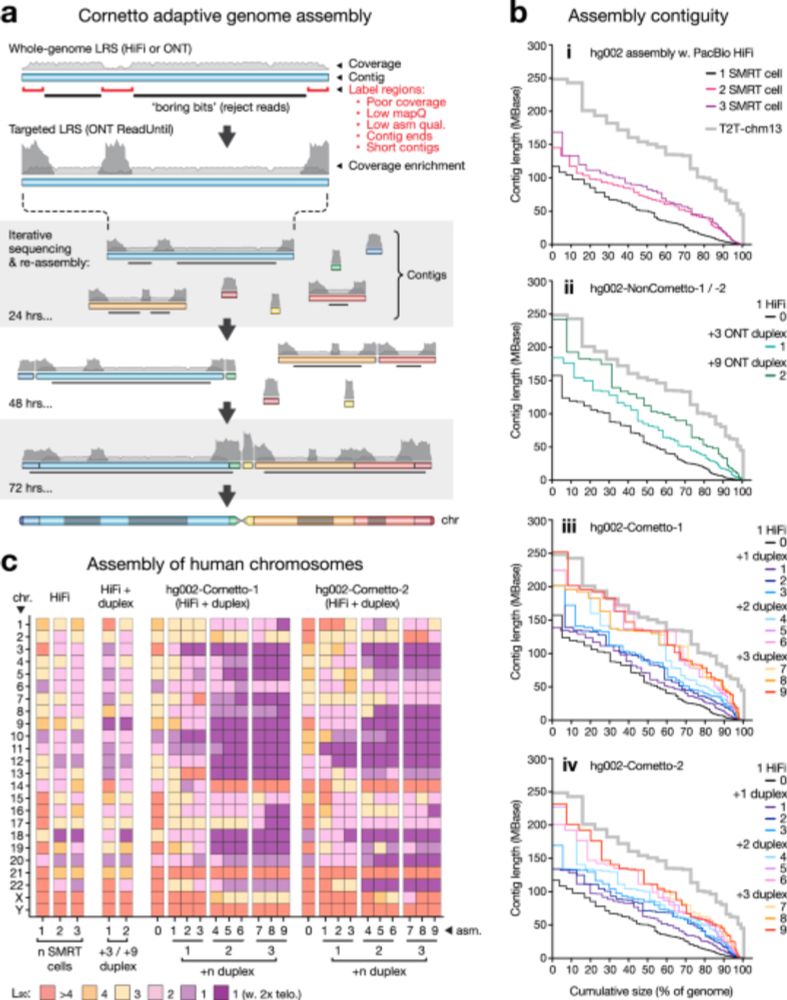
Targeted sequencing and iterative assembly of near-complete genomes - Nature Communications
Long-read sequencing enables high-quality genome assemblies, but challenges remain. Here, the authors introduce Cornetto, a method that improves assembly quality, enables genome sequencing from saliva...
www.nature.com
November 26, 2025 at 4:12 AM
Our cornetto work is now published at www.nature.com/articles/s41...
It can do near-T2T assembly using @nanoporetech.com adaptive sampling
- with less 💸
- reference agnostic, so works for non-humans
- not just blood, even saliva
Just presented at #abacbs2025 yesterday.
It can do near-T2T assembly using @nanoporetech.com adaptive sampling
- with less 💸
- reference agnostic, so works for non-humans
- not just blood, even saliva
Just presented at #abacbs2025 yesterday.
Reposted by Jeffrey Vedanayagam

So excited to finally be able to share my first paper and the culmination of my PhD work with @felipekteixeira.bsky.social 🪰🔬
www.pnas.org/doi/10.1073/...
www.pnas.org/doi/10.1073/...

December 4, 2025 at 9:41 PM
So excited to finally be able to share my first paper and the culmination of my PhD work with @felipekteixeira.bsky.social 🪰🔬
www.pnas.org/doi/10.1073/...
www.pnas.org/doi/10.1073/...
Reposted by Jeffrey Vedanayagam
a life changing opportunity made possible by the Nobel Prize funds awarded to John Sulston -- the @sangerinstitute.bsky.social runs the Sanger Prize scheme, open to an undergrad from any LMIC to spend 3 months here learning all about genomics. more details here www.sanger.ac.uk/about/study/...
November 20, 2025 at 5:39 PM
a life changing opportunity made possible by the Nobel Prize funds awarded to John Sulston -- the @sangerinstitute.bsky.social runs the Sanger Prize scheme, open to an undergrad from any LMIC to spend 3 months here learning all about genomics. more details here www.sanger.ac.uk/about/study/...
Reposted by Jeffrey Vedanayagam

🪱 Selfish genes are everywhere and drive some of biology’s biggest innovations (CRISPR, antibody recombination, epigenetics). Yet almost no one asks the obvious question: how does a selfish gene begin? Our new manuscript uncovers how selfishness can emerge directly from the host genome.
November 24, 2025 at 1:03 PM
🪱 Selfish genes are everywhere and drive some of biology’s biggest innovations (CRISPR, antibody recombination, epigenetics). Yet almost no one asks the obvious question: how does a selfish gene begin? Our new manuscript uncovers how selfishness can emerge directly from the host genome.
Reposted by Jeffrey Vedanayagam
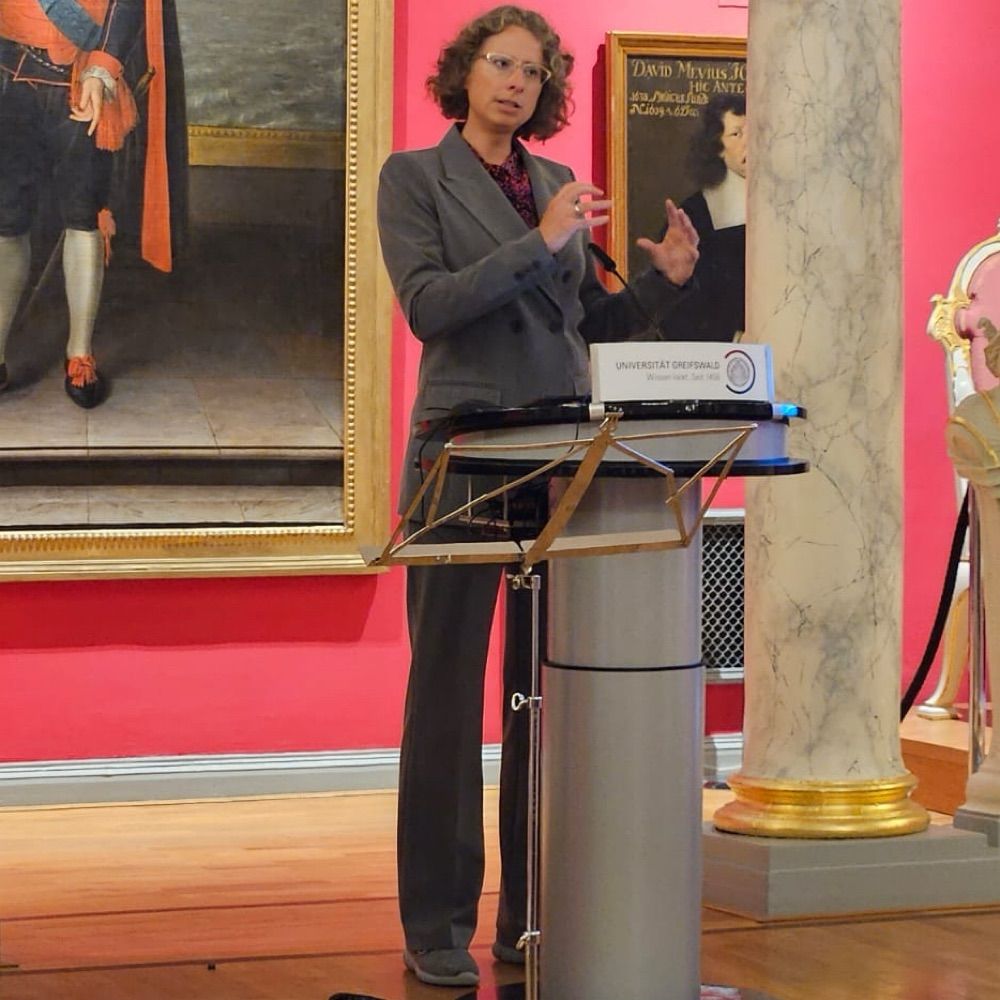
We all wish peer review to be rapid and professional: doesn’t always go like that. But I am relieved to finally see Helixer by @alisandra-denton.bsky.social and team published in Nature Method. Congratulations! www.nature.com/articles/s41...

Helixer: ab initio prediction of primary eukaryotic gene models combining deep learning and a hidden Markov model - Nature Methods
By leveraging both deep learning and hidden Markov models, Helixer achieves broad taxonomic coverage for ab initio gene annotation of eukaryotic genomes from fungi, plants, vertebrates and invertebrat...
www.nature.com
November 28, 2025 at 4:58 AM
We all wish peer review to be rapid and professional: doesn’t always go like that. But I am relieved to finally see Helixer by @alisandra-denton.bsky.social and team published in Nature Method. Congratulations! www.nature.com/articles/s41...
Reposted by Jeffrey Vedanayagam

Today in @nature.com, in work led by @adititm.bsky.social, we report the ability to prompt Evo to generate functional de novo genes.
You shall know a gene by the company it keeps!
You shall know a gene by the company it keeps!

November 19, 2025 at 4:24 PM
Today in @nature.com, in work led by @adititm.bsky.social, we report the ability to prompt Evo to generate functional de novo genes.
You shall know a gene by the company it keeps!
You shall know a gene by the company it keeps!
Reposted by Jeffrey Vedanayagam

I taught (and co-taught) a course on human population genetics from 2000-2024. Having retired, I'm now making all the course materials public: github.com/alanrogers/p... #popgen #evbio

GitHub - alanrogers/popgen: A course on population genetics
A course on population genetics. Contribute to alanrogers/popgen development by creating an account on GitHub.
github.com
November 27, 2025 at 7:10 PM
I taught (and co-taught) a course on human population genetics from 2000-2024. Having retired, I'm now making all the course materials public: github.com/alanrogers/p... #popgen #evbio
Reposted by Jeffrey Vedanayagam

How to keep in step when your (protein) partner speeds up…
Here we investigated the adaptive remodeling of a protein-protein interaction surface essential for telomere protection.
Congrats to whole team!
www.science.org/doi/10.1126/...
Here we investigated the adaptive remodeling of a protein-protein interaction surface essential for telomere protection.
Congrats to whole team!
www.science.org/doi/10.1126/...

Rapid compensatory evolution within a multiprotein complex preserves telomere integrity
Intragenomic conflict with selfish genetic elements spurs adaptive changes in subunits of essential multiprotein complexes. Whether and how these adaptive changes disrupt interactions within such comp...
www.science.org
November 28, 2025 at 5:22 PM
How to keep in step when your (protein) partner speeds up…
Here we investigated the adaptive remodeling of a protein-protein interaction surface essential for telomere protection.
Congrats to whole team!
www.science.org/doi/10.1126/...
Here we investigated the adaptive remodeling of a protein-protein interaction surface essential for telomere protection.
Congrats to whole team!
www.science.org/doi/10.1126/...
Reposted by Jeffrey Vedanayagam

Very proud to have our latest work now online in
@natsmb.nature.com. A wonderful team effort across the centromere community, across @jansenlab.bsky.social @naltemose.bsky.social @dfachinetti.bsky.social and Giunta labs. Happy reading! 1/4
www.nature.com/articles/s41...
@natsmb.nature.com. A wonderful team effort across the centromere community, across @jansenlab.bsky.social @naltemose.bsky.social @dfachinetti.bsky.social and Giunta labs. Happy reading! 1/4
www.nature.com/articles/s41...

Heterochromatin boundaries maintain centromere position, size and number - Nature Structural & Molecular Biology
Carty et al. identify the H3K9 methyltransferases that restrict the size and position of the centromere protein A chromatin domain, maintaining functional centromeres.
www.nature.com
November 27, 2025 at 9:58 PM
Very proud to have our latest work now online in
@natsmb.nature.com. A wonderful team effort across the centromere community, across @jansenlab.bsky.social @naltemose.bsky.social @dfachinetti.bsky.social and Giunta labs. Happy reading! 1/4
www.nature.com/articles/s41...
@natsmb.nature.com. A wonderful team effort across the centromere community, across @jansenlab.bsky.social @naltemose.bsky.social @dfachinetti.bsky.social and Giunta labs. Happy reading! 1/4
www.nature.com/articles/s41...
Reposted by Jeffrey Vedanayagam

In general, let's just stop paying companies that host this BS.
Fight the drain of scientific publishing.
arxiv.org/abs/2511.04820
Fight the drain of scientific publishing.
arxiv.org/abs/2511.04820

November 28, 2025 at 7:32 AM
In general, let's just stop paying companies that host this BS.
Fight the drain of scientific publishing.
arxiv.org/abs/2511.04820
Fight the drain of scientific publishing.
arxiv.org/abs/2511.04820
Reposted by Jeffrey Vedanayagam
Functions of RNA m6A methylation at the molecular, genomic and organismal level: go.nature.com/484M6pB
Free to read here: rdcu.be/eR4zx
Free to read here: rdcu.be/eR4zx

November 27, 2025 at 12:51 PM
Functions of RNA m6A methylation at the molecular, genomic and organismal level: go.nature.com/484M6pB
Free to read here: rdcu.be/eR4zx
Free to read here: rdcu.be/eR4zx
Reposted by Jeffrey Vedanayagam

Happy to share that my PhD project is finally published!🪱✨
Selfish genes are found across the tree of life. They can disrupt inheritance patterns and at the same time act as units for molecular innovation. Here we tried to answer one big question: how do selfish genes emerge in the first place?
Selfish genes are found across the tree of life. They can disrupt inheritance patterns and at the same time act as units for molecular innovation. Here we tried to answer one big question: how do selfish genes emerge in the first place?

Recurrent evolution of selfishness from an essential tRNA synthetase in Caenorhabditis tropicalis 🧪
www.nature.com/articles/s41...
www.nature.com/articles/s41...

Recurrent evolution of selfishness from an essential tRNA synthetase in Caenorhabditis tropicalis - Nature Ecology & Evolution
In Caenorhabditis tropicalis, three toxin–antidote elements arose via gene duplication from the essential tRNA-synthetase subunit FARS-3. The ancestral antidote probably acquired affinity for FARS-3, ...
www.nature.com
November 24, 2025 at 9:10 PM
Happy to share that my PhD project is finally published!🪱✨
Selfish genes are found across the tree of life. They can disrupt inheritance patterns and at the same time act as units for molecular innovation. Here we tried to answer one big question: how do selfish genes emerge in the first place?
Selfish genes are found across the tree of life. They can disrupt inheritance patterns and at the same time act as units for molecular innovation. Here we tried to answer one big question: how do selfish genes emerge in the first place?
Reposted by Jeffrey Vedanayagam

Latest work out today in @currentbiology.bsky.social
We find the fly development gene bicoid is much older than previously thought (~20 million yrs older!) 🪰🧬
To pinpoint its origins we tackled the Diptera phylogeny, providing some resolution (many open questions remain).
🔗 tinyurl.com/2vyuevpy
We find the fly development gene bicoid is much older than previously thought (~20 million yrs older!) 🪰🧬
To pinpoint its origins we tackled the Diptera phylogeny, providing some resolution (many open questions remain).
🔗 tinyurl.com/2vyuevpy
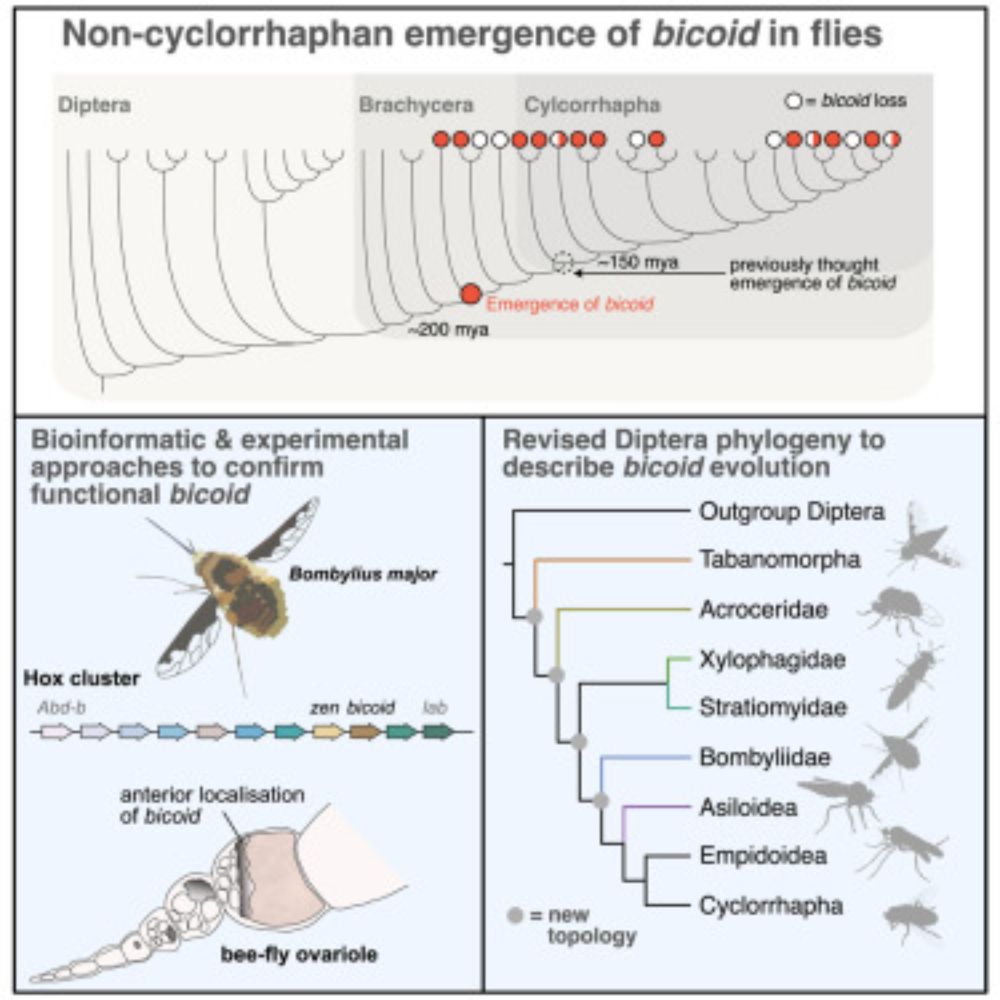
Revised evolutionary relationships within Brachycera and the early origin of bicoid in flies
Mulhair et al. uncover a functional bicoid in non-cyclorrhaphan flies, pushing the
gene's origin back by ∼20 million years. Reassessing the Diptera phylogeny using the
largest dataset to date permits ...
www.cell.com
October 17, 2025 at 3:14 PM
Latest work out today in @currentbiology.bsky.social
We find the fly development gene bicoid is much older than previously thought (~20 million yrs older!) 🪰🧬
To pinpoint its origins we tackled the Diptera phylogeny, providing some resolution (many open questions remain).
🔗 tinyurl.com/2vyuevpy
We find the fly development gene bicoid is much older than previously thought (~20 million yrs older!) 🪰🧬
To pinpoint its origins we tackled the Diptera phylogeny, providing some resolution (many open questions remain).
🔗 tinyurl.com/2vyuevpy
Reposted by Jeffrey Vedanayagam
And now we have Arabidopsis plants with 8 chromosomes instead of 10 and no obvious phenotypic differences, this week in @science.org
#PlantScience
Paper here: www.science.org/doi/10.1126/...
Perspective here:
www.science.org/doi/10.1126/...
#PlantScience
Paper here: www.science.org/doi/10.1126/...
Perspective here:
www.science.org/doi/10.1126/...

CRISPR-Cas–mediated heritable chromosome fusions in Arabidopsis
The genome of Arabidopsis thaliana consists of 10 chromosomes. By inducing CRISPR-Cas–mediated breaks at subcentromeric and subtelomeric sequences, we fused entire chromosome arms, obtaining two eight...
www.science.org
November 21, 2025 at 10:20 AM
And now we have Arabidopsis plants with 8 chromosomes instead of 10 and no obvious phenotypic differences, this week in @science.org
#PlantScience
Paper here: www.science.org/doi/10.1126/...
Perspective here:
www.science.org/doi/10.1126/...
#PlantScience
Paper here: www.science.org/doi/10.1126/...
Perspective here:
www.science.org/doi/10.1126/...
Reposted by Jeffrey Vedanayagam
Sharing this important article... for no reason whatsoever.
"We must also continue to deepen and refine our understanding of fundamental biological processes because these details frequently hold the keys to major advances in applied research."
elifesciences.org/articles/102...
"We must also continue to deepen and refine our understanding of fundamental biological processes because these details frequently hold the keys to major advances in applied research."
elifesciences.org/articles/102...
November 23, 2025 at 12:21 AM
Sharing this important article... for no reason whatsoever.
"We must also continue to deepen and refine our understanding of fundamental biological processes because these details frequently hold the keys to major advances in applied research."
elifesciences.org/articles/102...
"We must also continue to deepen and refine our understanding of fundamental biological processes because these details frequently hold the keys to major advances in applied research."
elifesciences.org/articles/102...