


Jan-Willem Veening
@veeninglab.com
Professor and director at the Department of Fundamental Microbiology, University of Lausanne, https://veeninglab.com/. Interested in antibiotic resistance, bacterial cell biology, host-microbe interactions.
Reposted by Jan-Willem Veening

We are hiring for group leaders again — EBI is a great place to start your research group!
embl.wd103.myworkdayjobs.com/EMBL/job/Hin...
embl.wd103.myworkdayjobs.com/EMBL/job/Hin...

Research Group Leader
Do you want to lead groundbreaking research in computational biology? Join us at EMBL-EBI! EMBL's European Bioinformatics Institute (EMBL-EBI) is seeking talented and highly-motivated scientists to jo...
embl.wd103.myworkdayjobs.com
January 30, 2026 at 9:02 AM
We are hiring for group leaders again — EBI is a great place to start your research group!
embl.wd103.myworkdayjobs.com/EMBL/job/Hin...
embl.wd103.myworkdayjobs.com/EMBL/job/Hin...
Reposted by Jan-Willem Veening


A prophage-encoded abortive infection protein preserves host and prophage spread www.nature.com/articles/s41...

A prophage-encoded abortive infection protein preserves host and prophage spread - Nature
A Gifsy-1 prophage–encoded higher eukaryotes and prokaryotes nucleotide-binding protein, HepS, senses Siphoviridae infection, activates abortive defence by cleaving host transfer RNAs, blocks rival ph...
www.nature.com
January 28, 2026 at 11:01 PM
Reposted by Jan-Willem Veening
🚨 Hiring Alert! 🚨My lab at Institut Pasteur is recruiting several Postdocs! We have exciting open projects in: 🦠 Synthetic Biology and🛡️ Bacterial Immunity. Come do great science with us in the middle of Paris! 🇫🇷🥐 research.pasteur.fr/en/job/postd...
Postdoctoral position - Synthetic Biology / Bacterial Immunity - Research
The Bikard lab at Institut Pasteur in Paris is seeking to hire postdoctoral researchers. We are investigating bacteria / bacteriophages interactions, and the genetic innovation that happens at this in...
research.pasteur.fr
January 28, 2026 at 11:19 AM
🚨 Hiring Alert! 🚨My lab at Institut Pasteur is recruiting several Postdocs! We have exciting open projects in: 🦠 Synthetic Biology and🛡️ Bacterial Immunity. Come do great science with us in the middle of Paris! 🇫🇷🥐 research.pasteur.fr/en/job/postd...
Reposted by Jan-Willem Veening

🎬 When #biology met #medicine...
Third episod 👉 Avec trois microbiologistes, Amelieke Cremers, Jan-Willem Veening et Sylvain Meylan
Lire l'interview croisée www.unil.ch/news/fr/1768...
@dmf-unil.bsky.social @unil.bsky.social @veeninglab.com #fbm #chuv #infectiologie
Third episod 👉 Avec trois microbiologistes, Amelieke Cremers, Jan-Willem Veening et Sylvain Meylan
Lire l'interview croisée www.unil.ch/news/fr/1768...
@dmf-unil.bsky.social @unil.bsky.social @veeninglab.com #fbm #chuv #infectiologie

Sepsis: vers une infectiologie de précision
Une rencontre lors d’un congrès international a donné naissance à une collaboration Unil-CHUV autour d’un objectif commun: mieux identifier les infections à pneumocoques, en particulier lorsqu’elles é...
www.unil.ch
January 27, 2026 at 9:46 AM
🎬 When #biology met #medicine...
Third episod 👉 Avec trois microbiologistes, Amelieke Cremers, Jan-Willem Veening et Sylvain Meylan
Lire l'interview croisée www.unil.ch/news/fr/1768...
@dmf-unil.bsky.social @unil.bsky.social @veeninglab.com #fbm #chuv #infectiologie
Third episod 👉 Avec trois microbiologistes, Amelieke Cremers, Jan-Willem Veening et Sylvain Meylan
Lire l'interview croisée www.unil.ch/news/fr/1768...
@dmf-unil.bsky.social @unil.bsky.social @veeninglab.com #fbm #chuv #infectiologie
Reposted by Jan-Willem Veening

Strep/Enterococcal colleagues!
Streptococcal Biology GRC/GRS are open for applications. Acceptances are underway and the meeting is on track to fill up.
If you’re aiming for a short talk (lots of slots), registering early matters for full consideration.
Share widely!
www.grc.org/streptococca...
Streptococcal Biology GRC/GRS are open for applications. Acceptances are underway and the meeting is on track to fill up.
If you’re aiming for a short talk (lots of slots), registering early matters for full consideration.
Share widely!
www.grc.org/streptococca...
2026 Streptococcal Biology Conference GRC
The 2026 Gordon Research Conference on Streptococcal Biology will be held in Lucca (Barga), Lucca Italy. Apply today to reserve your spot.
www.grc.org
January 21, 2026 at 11:48 AM
Strep/Enterococcal colleagues!
Streptococcal Biology GRC/GRS are open for applications. Acceptances are underway and the meeting is on track to fill up.
If you’re aiming for a short talk (lots of slots), registering early matters for full consideration.
Share widely!
www.grc.org/streptococca...
Streptococcal Biology GRC/GRS are open for applications. Acceptances are underway and the meeting is on track to fill up.
If you’re aiming for a short talk (lots of slots), registering early matters for full consideration.
Share widely!
www.grc.org/streptococca...
The @dmf-unil.bsky.social is supporting the application of a candidate for the SNSF/ERC Starting Grant (deadline 5th of May). Reach out to me if you are interested. We are collecting CV’s until the 8th of Feb. We can offer a stimulating scientific environment and help with the application/interview.
January 20, 2026 at 3:41 PM
The @dmf-unil.bsky.social is supporting the application of a candidate for the SNSF/ERC Starting Grant (deadline 5th of May). Reach out to me if you are interested. We are collecting CV’s until the 8th of Feb. We can offer a stimulating scientific environment and help with the application/interview.
Reposted by Jan-Willem Veening

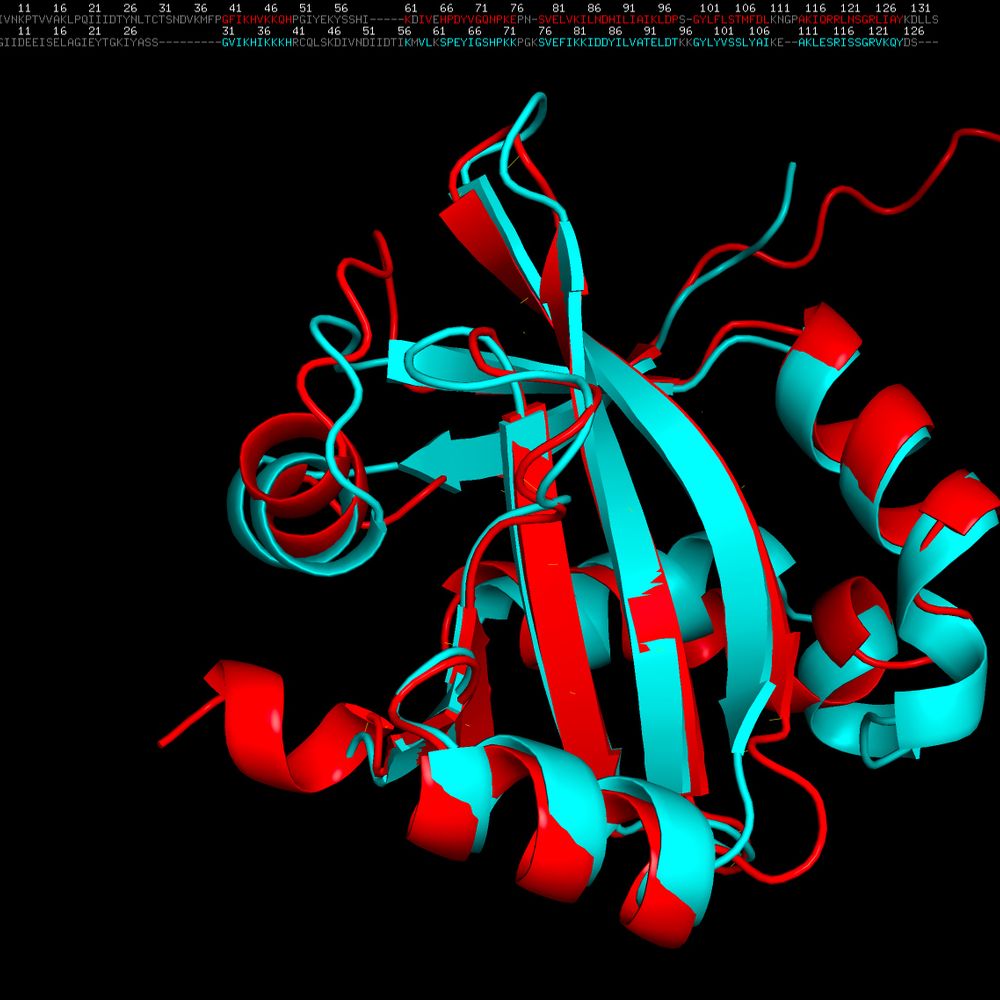
Fabian was quicker :) But yes, we have an open postdoc position in bacterial bioenergetics and membrane biology, using on B. subtilis as the model. Come join us! @cbcb-newcastle.bsky.social is a great place to work, and we are a friendly, international lab. Visa+IHS fees covered. #microsky

January 14, 2026 at 8:56 PM
Fabian was quicker :) But yes, we have an open postdoc position in bacterial bioenergetics and membrane biology, using on B. subtilis as the model. Come join us! @cbcb-newcastle.bsky.social is a great place to work, and we are a friendly, international lab. Visa+IHS fees covered. #microsky
Reposted by Jan-Willem Veening

📢 We are hiring 📢 1st round of recruiting for our ERC project BacImmune-Decode! @erc.europa.eu
We are looking for a postdoc for wet-lab work on regulation of phage defence systems in bacteria using high-throughput microbial genetics. Check it out: lnkd.in/es7AE968
#Hiring #Postdoc #Microbiology
We are looking for a postdoc for wet-lab work on regulation of phage defence systems in bacteria using high-throughput microbial genetics. Check it out: lnkd.in/es7AE968
#Hiring #Postdoc #Microbiology
LinkedIn
This link will take you to a page that’s not on LinkedIn
lnkd.in
January 14, 2026 at 8:55 AM
📢 We are hiring 📢 1st round of recruiting for our ERC project BacImmune-Decode! @erc.europa.eu
We are looking for a postdoc for wet-lab work on regulation of phage defence systems in bacteria using high-throughput microbial genetics. Check it out: lnkd.in/es7AE968
#Hiring #Postdoc #Microbiology
We are looking for a postdoc for wet-lab work on regulation of phage defence systems in bacteria using high-throughput microbial genetics. Check it out: lnkd.in/es7AE968
#Hiring #Postdoc #Microbiology
Reposted by Jan-Willem Veening

Looking for a POSTDOC to work on jumbo phages (those with large genomes and fascinating cell biology), using our latest ASO technology (Gerovac M et al. 2025 Nature) to define RNA export mechanisms as well as to help to advance phage therapy. Here's the job ad.

December 19, 2025 at 10:51 PM
Looking for a POSTDOC to work on jumbo phages (those with large genomes and fascinating cell biology), using our latest ASO technology (Gerovac M et al. 2025 Nature) to define RNA export mechanisms as well as to help to advance phage therapy. Here's the job ad.
Reposted by Jan-Willem Veening

What is better than one? Two connected papers!
#NewResearch
S protein of Streptococcus pneumoniae activates PBP1a and coordinates with a wider GpsB-associated multi-protein complex to regulate peptidoglycan remodelling and cell division.
#MicroSky 🦠
www.nature.com/articles/s41...
#NewResearch
S protein of Streptococcus pneumoniae activates PBP1a and coordinates with a wider GpsB-associated multi-protein complex to regulate peptidoglycan remodelling and cell division.
#MicroSky 🦠
www.nature.com/articles/s41...
December 19, 2025 at 2:06 PM
What is better than one? Two connected papers!
#NewResearch
S protein of Streptococcus pneumoniae activates PBP1a and coordinates with a wider GpsB-associated multi-protein complex to regulate peptidoglycan remodelling and cell division.
#MicroSky 🦠
www.nature.com/articles/s41...
#NewResearch
S protein of Streptococcus pneumoniae activates PBP1a and coordinates with a wider GpsB-associated multi-protein complex to regulate peptidoglycan remodelling and cell division.
#MicroSky 🦠
www.nature.com/articles/s41...
Reposted by Jan-Willem Veening
#NewResearch
S protein from Streptococcus pneumoniae activates cell wall repair and modification to promote virulence against in vivo antimicrobial pressures including lysozyme and LL-37 @veeninglab.com
#MicroSky 🦠
www.nature.com/articles/s41...
S protein from Streptococcus pneumoniae activates cell wall repair and modification to promote virulence against in vivo antimicrobial pressures including lysozyme and LL-37 @veeninglab.com
#MicroSky 🦠
www.nature.com/articles/s41...

Pneumococcal S protein coordinates cell wall modification and repair to resist host antimicrobials - Nature Microbiology
Streptococcal S protein activates a peptidoglycan cell wall repair and modification complex to promote resistance of Streptococcus pneumoniae to lysozyme and LL-37, and increase virulence during infec...
www.nature.com
December 19, 2025 at 2:05 PM
#NewResearch
S protein from Streptococcus pneumoniae activates cell wall repair and modification to promote virulence against in vivo antimicrobial pressures including lysozyme and LL-37 @veeninglab.com
#MicroSky 🦠
www.nature.com/articles/s41...
S protein from Streptococcus pneumoniae activates cell wall repair and modification to promote virulence against in vivo antimicrobial pressures including lysozyme and LL-37 @veeninglab.com
#MicroSky 🦠
www.nature.com/articles/s41...
Reposted by Jan-Willem Veening
📰 News Recherche
L’équipe @veeninglab.com @dmf-unil.bsky.social @unil.bsky.social a mis en évidence chez le streptocoque le rôle central de la protéine S dans l’arsenal de défense de cette bactérie qui peut se révéler très pathogène.
➡️ www.unil.ch/news/fr/1761...
L’équipe @veeninglab.com @dmf-unil.bsky.social @unil.bsky.social a mis en évidence chez le streptocoque le rôle central de la protéine S dans l’arsenal de défense de cette bactérie qui peut se révéler très pathogène.
➡️ www.unil.ch/news/fr/1761...

La protéine S, clé de la virulence des streptocoques
L’équipe du Pr Jan-Willem Veening, au Département de microbiologie fondamentale de l’Unil, a mis en évidence chez le streptocoque le rôle central de la protéine S dans l’arsenal de défense de cette ba...
www.unil.ch
December 19, 2025 at 2:53 PM
📰 News Recherche
L’équipe @veeninglab.com @dmf-unil.bsky.social @unil.bsky.social a mis en évidence chez le streptocoque le rôle central de la protéine S dans l’arsenal de défense de cette bactérie qui peut se révéler très pathogène.
➡️ www.unil.ch/news/fr/1761...
L’équipe @veeninglab.com @dmf-unil.bsky.social @unil.bsky.social a mis en évidence chez le streptocoque le rôle central de la protéine S dans l’arsenal de défense de cette bactérie qui peut se révéler très pathogène.
➡️ www.unil.ch/news/fr/1761...

December 19, 2025 at 10:31 AM
I'm not sure what to think about this. Most top open access journals cost more than CHF 3,500 to publish so will not be covered by SNSF funding. It will make it even more difficult for small universities to publish in top journals because of budget limitations.

#OpenAccess to scientific publications has become the norm. From 2027, the SNSF will be limiting its OA funding. Already in autumn 2026, researchers will be able to publish their articles free of charge on Open Research Europe (diamond open access).
➡️ sohub.io/7nru
➡️ sohub.io/7nru
December 18, 2025 at 10:47 AM
I'm not sure what to think about this. Most top open access journals cost more than CHF 3,500 to publish so will not be covered by SNSF funding. It will make it even more difficult for small universities to publish in top journals because of budget limitations.
Coupled to the general budget cuts by both the canton and federal government to our University (and it's happening at most institutes in Switzerland), this would be really bad. The project funding scheme is really the best thing about Swiss science, so please don't touch this!
The SNSF is considering restrictions for its Project funding. Goal: to ensure the quality of evaluation & stable success rates despite an increasing number of applications and limited funding. The final decision will be made in January 2026.
👉 buff.ly/iGOCf7R
#research #science
👉 buff.ly/iGOCf7R
#research #science

Project funding restrictions envisaged
The SNSF is responding to increased demand from researchers in order to ensure evaluation quality and stabilise success rates.
buff.ly
December 18, 2025 at 10:40 AM
Coupled to the general budget cuts by both the canton and federal government to our University (and it's happening at most institutes in Switzerland), this would be really bad. The project funding scheme is really the best thing about Swiss science, so please don't touch this!
Reposted by Jan-Willem Veening
🧵Enterococcus faecalis is not just an extracellular organism. 🧵 A growing body of work shows it can survive + REPLICATE inside host cells, and that intracellular life may seed persistence, dissemination, and reinfection. 1/n #MMBR @asm.org journals.asm.org/doi/10.1128/...

Enterococcus faecalis: an overlooked cell invader | Microbiology and Molecular Biology Reviews
SUMMARYEnterococcus faecalis and Enterococcus faecium are human pathobionts that exhibit a dual lifestyle as commensal and pathogenic bacteria. The pathogenic lifestyle is associated with specific conditions involving host susceptibility and intestinal ...
journals.asm.org
December 18, 2025 at 9:19 AM
🧵Enterococcus faecalis is not just an extracellular organism. 🧵 A growing body of work shows it can survive + REPLICATE inside host cells, and that intracellular life may seed persistence, dissemination, and reinfection. 1/n #MMBR @asm.org journals.asm.org/doi/10.1128/...
Reposted by Jan-Willem Veening
Very pleased to share that our recent article with
@veeninglab.com in @natcomms.nature.com
was selected for the Editor's Highlights, which aims to showcase the 50 best papers recently published in the area of #microbiology & infectious diseases!
www.nature.com/collections/...
@veeninglab.com in @natcomms.nature.com
was selected for the Editor's Highlights, which aims to showcase the 50 best papers recently published in the area of #microbiology & infectious diseases!
www.nature.com/collections/...

Microbiology and infectious diseases
This page highlights recent articles on all aspects of bacteriology, mycology, parasitology and virology, covering the biology of pathogens, host-pathogen ...
www.nature.com
December 17, 2025 at 8:33 PM
Very pleased to share that our recent article with
@veeninglab.com in @natcomms.nature.com
was selected for the Editor's Highlights, which aims to showcase the 50 best papers recently published in the area of #microbiology & infectious diseases!
www.nature.com/collections/...
@veeninglab.com in @natcomms.nature.com
was selected for the Editor's Highlights, which aims to showcase the 50 best papers recently published in the area of #microbiology & infectious diseases!
www.nature.com/collections/...
Reposted by Jan-Willem Veening

New preprint! 🐝 We engineered a bacterial biosensor to reveal micron-scale arabinose gradients in the honeybee gut. Congratulations to Audam and all co-authors. Great collaboration with @pengellab.bsky.social as part of the NCCR Microbiomes at @fbm-unil.bsky.social
www.biorxiv.org/content/10.1...
www.biorxiv.org/content/10.1...

Engineered symbiont biosensor maps micron-scale sugar gradients in the honeybee gut
The honeybee gut microbiota plays a key role in shaping host health and susceptibility to disease. Yet, the nutrient environment it experiences within the gut remains poorly characterized. In particul...
www.biorxiv.org
December 17, 2025 at 9:14 AM
New preprint! 🐝 We engineered a bacterial biosensor to reveal micron-scale arabinose gradients in the honeybee gut. Congratulations to Audam and all co-authors. Great collaboration with @pengellab.bsky.social as part of the NCCR Microbiomes at @fbm-unil.bsky.social
www.biorxiv.org/content/10.1...
www.biorxiv.org/content/10.1...
Reposted by Jan-Willem Veening

We are looking forward to sunnier days and some fantastic presentations at our #ProkaryoticCellBio meeting in Portugal next July! Grants, Early Bird pricing and Talk slots close on 12 Jan, register & submit today to join us! 🌞
👉https://bit.ly/48G29dP
👉https://bit.ly/48G29dP

December 16, 2025 at 3:36 PM
We are looking forward to sunnier days and some fantastic presentations at our #ProkaryoticCellBio meeting in Portugal next July! Grants, Early Bird pricing and Talk slots close on 12 Jan, register & submit today to join us! 🌞
👉https://bit.ly/48G29dP
👉https://bit.ly/48G29dP
Reposted by Jan-Willem Veening
I just published: ERC-Plus: jackpot science or missed chance to fix academia?
My reflections on ERC-Plus, Europe’s newest ultra-competitive research grant and what it tells us about the academic culture we’re building.
medium.com/p/erc-plus-j...
My reflections on ERC-Plus, Europe’s newest ultra-competitive research grant and what it tells us about the academic culture we’re building.
medium.com/p/erc-plus-j...

ERC-Plus: jackpot science or missed chance to fix academia?
My reflections on ERC-Plus, Europe’s newest ultra-competitive research grant and what it tells us about the academic culture we’re…
medium.com
December 3, 2025 at 11:42 AM
I just published: ERC-Plus: jackpot science or missed chance to fix academia?
My reflections on ERC-Plus, Europe’s newest ultra-competitive research grant and what it tells us about the academic culture we’re building.
medium.com/p/erc-plus-j...
My reflections on ERC-Plus, Europe’s newest ultra-competitive research grant and what it tells us about the academic culture we’re building.
medium.com/p/erc-plus-j...
Cool work from Heath Murray's lab where they use Cas9 nickase to study how ssDNA breaks are repaired in Bacillus subtilis #MicroSky www.nature.com/articles/s41...
Rescuing the bacterial replisome at a nick requires recombinational repair and helicase reloading - Nature Communications
DNA damage can lead to cell death. Here, the authors show that a simple cut on either strand of DNA can inactivate bacterial chromosome replication. Surprisingly, only a core set of recombination prot...
www.nature.com
November 28, 2025 at 2:25 PM
Cool work from Heath Murray's lab where they use Cas9 nickase to study how ssDNA breaks are repaired in Bacillus subtilis #MicroSky www.nature.com/articles/s41...
Reposted by Jan-Willem Veening
New Publication! In this collaboration with @veeninglab.com at the @unil.bsky.social, we used multi-omics to examine the response of Streptococcus pneumoniae to infection-mimicking growth conditions, discovering a novel regulator of membrane fatty acid composition.
www.nature.com/articles/s41...
www.nature.com/articles/s41...

Multi-omics profiling reveals atypical sugar utilization and a key membrane composition regulator in Streptococcus pneumoniae - Nature Communications
The pathogen Streptococcus pneumoniae can adapt to diverse microenvironments in the human body. Here, De Bakker et al. study these adaptation responses, showing unusual sugar utilization and identifyi...
www.nature.com
November 25, 2025 at 5:04 PM
New Publication! In this collaboration with @veeninglab.com at the @unil.bsky.social, we used multi-omics to examine the response of Streptococcus pneumoniae to infection-mimicking growth conditions, discovering a novel regulator of membrane fatty acid composition.
www.nature.com/articles/s41...
www.nature.com/articles/s41...
Reposted by Jan-Willem Veening
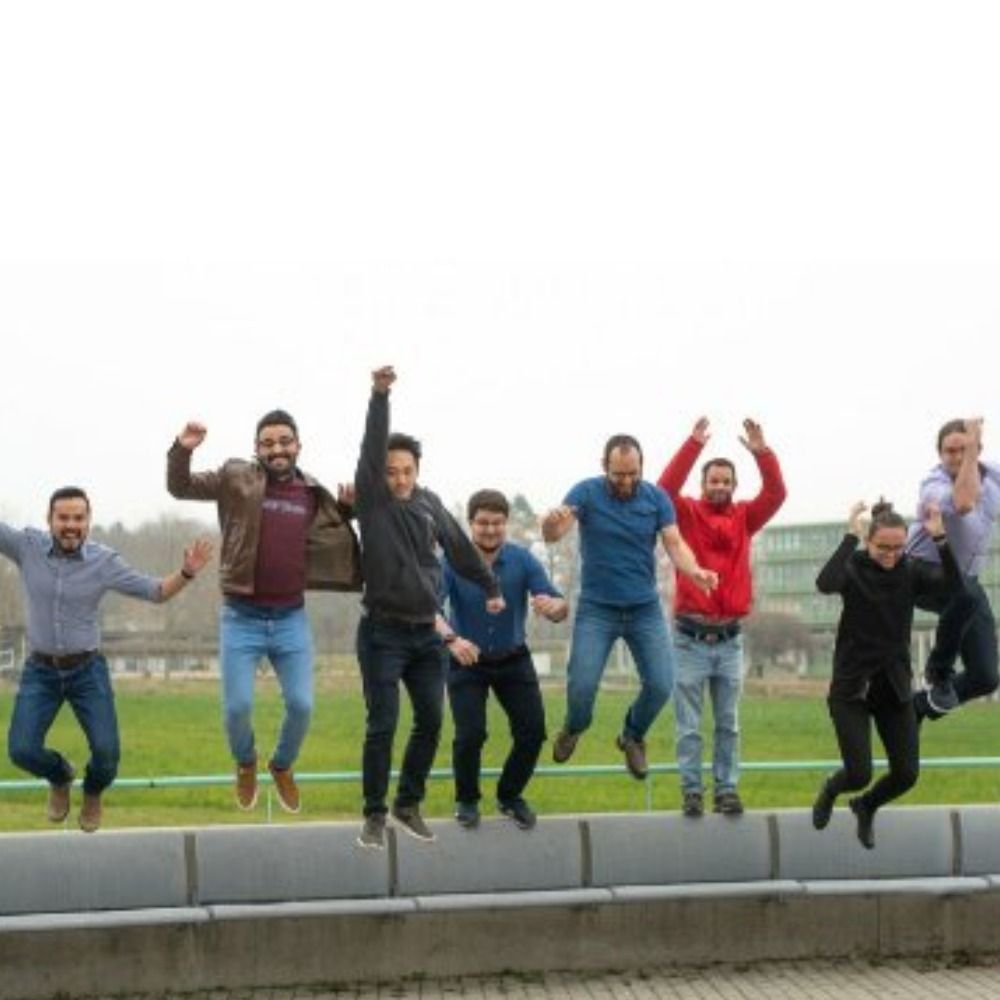
The hinge bypass gate paper is finally out! doi.org/10.1038/s414...
We show how loop-extruding SMC complexes can maintain DNA entrapment while bypassing obstacles on DNA — including transcription machinery & potentially other SMCs.
A lucky convergence of 3 projects lead to the initial discovery!
We show how loop-extruding SMC complexes can maintain DNA entrapment while bypassing obstacles on DNA — including transcription machinery & potentially other SMCs.
A lucky convergence of 3 projects lead to the initial discovery!

The SMC Hinge is a Selective Gate for Obstacle Bypass - Nature Communications
SMC complexes are ring-shaped motors that fold DNA by extruding loops, but how they navigate large DNA obstacles is unclear. Here, Liu et al., show that SMC complexes bypass obstacles by threading obs...
doi.org
November 25, 2025 at 3:26 PM
The hinge bypass gate paper is finally out! doi.org/10.1038/s414...
We show how loop-extruding SMC complexes can maintain DNA entrapment while bypassing obstacles on DNA — including transcription machinery & potentially other SMCs.
A lucky convergence of 3 projects lead to the initial discovery!
We show how loop-extruding SMC complexes can maintain DNA entrapment while bypassing obstacles on DNA — including transcription machinery & potentially other SMCs.
A lucky convergence of 3 projects lead to the initial discovery!
Really cool paper from @vincentdebakker.bsky.social @jonbakerlab.bsky.social now published @natcomms.nature.com #MicroSky www.nature.com/articles/s41...
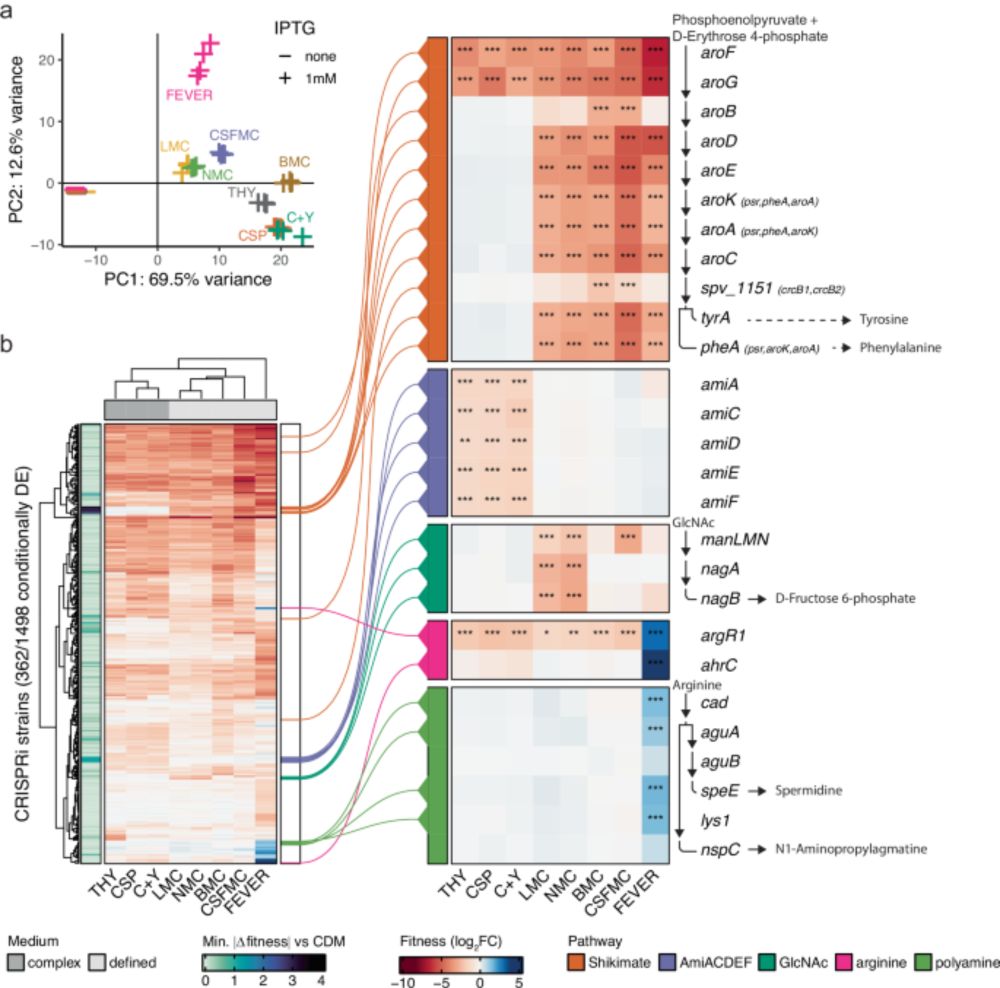
Multi-omics profiling reveals atypical sugar utilization and a key membrane composition regulator in Streptococcus pneumoniae - Nature Communications
The pathogen Streptococcus pneumoniae can adapt to diverse microenvironments in the human body. Here, De Bakker et al. study these adaptation responses, showing unusual sugar utilization and identifyi...
www.nature.com
November 25, 2025 at 1:44 PM
Really cool paper from @vincentdebakker.bsky.social @jonbakerlab.bsky.social now published @natcomms.nature.com #MicroSky www.nature.com/articles/s41...