Ricard Solé
banner
ricardsole.bsky.social
Ricard Solé
@ricardsole.bsky.social

Scientist & skeptic. Dad. Book addict. Pathologically curious. Origins and Evolution of Complexity, Synthetic Transitions, Liquid Brains, and Earth Terraformation. ICREA + SFI professor. Author. Secular humanist.

Biology 28%
Physics 16%
Pinned
Back to @sfiscience.bsky.social joining the night shift (with some extra coffee) at the Cormac McCarthy's Library. Working on criticality + cancer, statistical physics of ant colonies, the Physarum Lagrangian, universal genetic codes, synthetic agriculture & hybrid agencies.
@jordiplam.bsky.social

Yes, but have in mind that, as you move from smaller scales (molecular, sub cellular, cellular) to larger ones (neural networks, brains) new properties emerge that cannot be reduced to those of the units.

Not necessarily. In this case, a physical/molecular process contains a key element of what we usually consider an essential element of neuronal pattern recognition. How relevant is this to generate true cognitive capacities? That's why I start with a question.

I use "cognition" in a generic way (with question mark). The important point is that a property that we always associate to neural memory (Hebb's rule) can be found in a molecular context. No perception (I believe) but a common, perhaps very common trait of pattern recognition in a general sense.
TIL about a memorial ceremony in Iceland in 2019 to mark the end of a glacier, changing the place name from Okjökull to Ok (jökull = glacier). Uncompromising wording on the bronze plaque:
"This is to acknowledge that we know what is happening and what needs to be done. Only you know if we did it".

well, that was an unfortunate combination of letters...

Could cognition emerge from matter at scales far below neurons? This @nature.com paper explores whether molecular self-assembly can perform neural-like classification. The work suggests that even physical processes may carry out sophisticated information processing.
www.nature.com/articles/s41...

Aquesta evolució és inevitable (no sé si desitjable) atesa la força dels interessos comercials. Encara som lluny d’una intel·ligència realment “humana”, però la IA ha permès accelerar el coneixement (no pas substituir-lo). La qüestió és si les regulacions podran limitar-ne els problemes derivats.

Why do brains generalize so well while today’s neural networks often fail outside their training data? Check this paper in @cp-neuron.bsky.social argues how neuroscience can guide better architectures & representations. Check the table below.
www.sciencedirect.com/science/arti...

Reposted by Ricard V. Solé
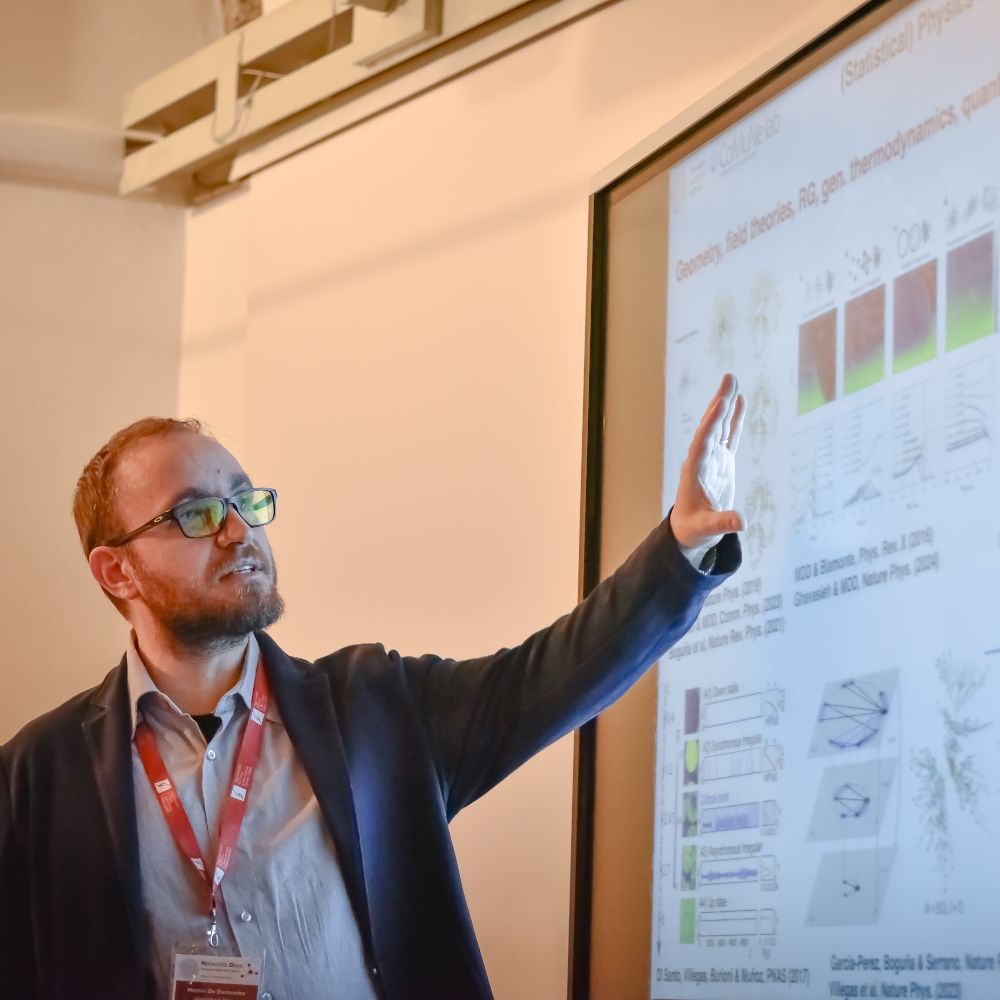
Network Medicine is entering a new phase: one that demands we rethink how we study, model and ultimately treat complex diseases.

www.sciencedirect.com/science/arti...

#ComplexSystems #NetworkScience #Medicine #MedSky 🧪🧬🌐

🧵 1/

Not me.

Agreed. The rest make a lot of noise. he problem is that they are too often the ones that create public opinion about all that.

Why? Don't you realize that you are trying to provide an explanation of a large-scale phenomenon using atomic-scale concepts? There is no need for that. We have lots to do and understand but the recurrent appeal to the QM is the wrong direction (why the hell we ned that?).

I think the common attraction to physics-like views ignores the great understanding that we already have about the ways n which dynamical integration of information takes place. It's computational neuroscience, emergent dynamics and an evolutionary perspective. Reductionistic views are nonsense.

This is already happening among a broad range of disciplines, from network science, physics, imaging or biophysics to psychology, engineering and philosophy. Neuroscience IS the central part, and fairly well developped. Much to do ahead, but no magic QM is needed.

Penrose authority in Theoretical Physics has been instrumental in failing to see how weak is the "microtubule" argument. No one has shown the causal relation, and the QM effects themselves are not relevant. The Emperor is naked. Check:

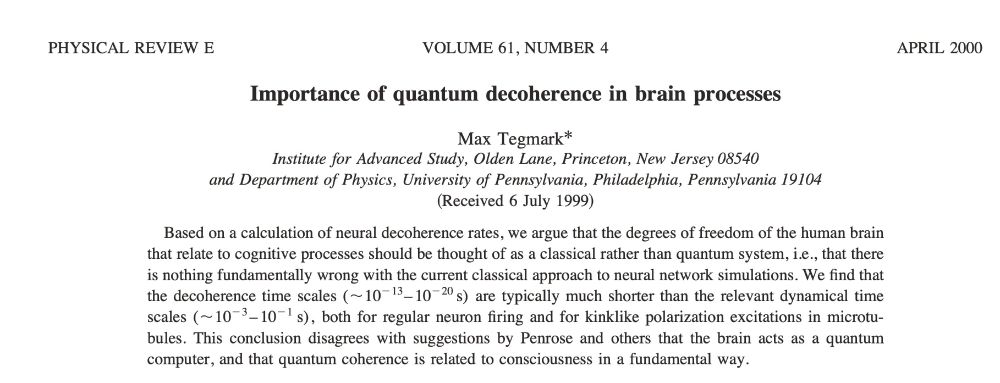
I think is a really good one, with lots of estimates that sugggest that quantum decoherence dominates the small-scale neural world (and thus no causal explanation for consciousness).

Reposted by Ricard V. Solé

A new special issue of Philosophical Transactions B takes on one of science’s biggest questions: how life begins.

Rather than retracing Earth’s history, the authors look for the universal conditions that could make life possible anywhere, approaching the question from many fields and angles.
How life begins and where it might happen again
A recent special issue of Philosophical Transactions B takes on one of the biggest mysteries in science: how life first began. Instead of trying to replay Earth’s exact history, the issue’s authors lo...
www.santafe.edu

I know many physicists who have moved into neuroscience (seriously, not just superficially) and are doing groundbreaking work. And I think this is awesome. And some have made strong points concerning QM and its lack of relevance to consciousness:

That's exactly what I said: "physicists WHO invoke", not ALL physicists. Tired of listening that quantum events (probably not even happening) in neurons "explain" consciousness. This is a very dishonest and arrogant view.

So after listening to multiple talks by philosophers of mind who defend consciousness as the substrate of the entire universe, and physicists who invoke quantum mechanics as the source of consciousness, the conclusion is clear: they have no idea about neuroscience, nor any interest to know about it.

Big Brother is already here.

Reposted by Ricard V. Solé

Phase transitions, bifurcations, thermal vents, exoplanets and their interactive maps, as well as pointers to a whole special issue just published in @royalsocietypublishing.org about origin of life.

With Spotify and Apple podcasts as usual.

What do you need more?

CC: @ricardsole.bsky.social
When matter came alive: the physics of life’s emergence
Exploring the origins of life through the mathematical theory of transitions
manlius.substack.com

I am really intrigued by your comment...

Thanks!

... which connects with the problem of individuality. Multicellular organisms (animals in particular) achieve a unique potential to develop nervous systems and learn through their lives. The multicellularity of biofilms and bacterial aggregates has a very different nature and limits.