


Kanika Jain
@kanika0386.bsky.social
🎓 Faculty( research track) @ Yale School of Medicine | AHA CDA & TPA Awardee | Passionate about Platelets, Proteostasis, CVD, Alzheimer’s & Aging. ECEB member at ATVB, Circ Res, and FASEB. ✍️ Scientist in job & writer at❤️! 🌟 Open to new job opportunities!
Reposted by Kanika Jain

Our new paper is out now in Nature Communications! We uncovered the function of XBP1 in beta cells of a preclinical model of T1D and identified unique and shared gene regulatory networks driven by IRE1 and XBP1.
www.nature.com/articles/s41...
www.nature.com/articles/s41...

Defining the role of β-cell IRE1α/XBP1 pathway and its gene regulatory network components in non-obese diabetic mice - Nature Communications
Modulating the unfolded protein response (UPR) can induce protective dedifferentiation of β-cells in non-obese diabetic mice. Here, the authors show that β-cell deletion of UPR transcription factor XB...
www.nature.com
November 26, 2025 at 2:28 PM
Our new paper is out now in Nature Communications! We uncovered the function of XBP1 in beta cells of a preclinical model of T1D and identified unique and shared gene regulatory networks driven by IRE1 and XBP1.
www.nature.com/articles/s41...
www.nature.com/articles/s41...
Interesting study!
November 26, 2025 at 12:51 AM
Interesting study!
Grateful for the invitation to speak at Emerging Leaders in Neuroscience Seminar @weillcornell.bsky.social
My talk , “Beyond the Brain: Clues from Platelets in Alzheimer’s Pathology,” explored what platelets can tell us about AD disease progression/prognosis.
#Neuroscience #Alzheimers #platelet
My talk , “Beyond the Brain: Clues from Platelets in Alzheimer’s Pathology,” explored what platelets can tell us about AD disease progression/prognosis.
#Neuroscience #Alzheimers #platelet

October 4, 2025 at 12:14 AM
Grateful for the invitation to speak at Emerging Leaders in Neuroscience Seminar @weillcornell.bsky.social
My talk , “Beyond the Brain: Clues from Platelets in Alzheimer’s Pathology,” explored what platelets can tell us about AD disease progression/prognosis.
#Neuroscience #Alzheimers #platelet
My talk , “Beyond the Brain: Clues from Platelets in Alzheimer’s Pathology,” explored what platelets can tell us about AD disease progression/prognosis.
#Neuroscience #Alzheimers #platelet
Thrilled to be awarded a 3 yr @ahascience.bsky.social Transformational Project Award to investigate how platelet UPR drives functional fidelity in aging/CVD.
This takes forward my research on platelet protein aggregates in Alzheimer (AHA CDA).❤️↔️🧠
@yaleschoolofmed.bsky.social
@yalecvrc.bsky.social
This takes forward my research on platelet protein aggregates in Alzheimer (AHA CDA).❤️↔️🧠
@yaleschoolofmed.bsky.social
@yalecvrc.bsky.social
July 28, 2025 at 11:58 PM
Thrilled to be awarded a 3 yr @ahascience.bsky.social Transformational Project Award to investigate how platelet UPR drives functional fidelity in aging/CVD.
This takes forward my research on platelet protein aggregates in Alzheimer (AHA CDA).❤️↔️🧠
@yaleschoolofmed.bsky.social
@yalecvrc.bsky.social
This takes forward my research on platelet protein aggregates in Alzheimer (AHA CDA).❤️↔️🧠
@yaleschoolofmed.bsky.social
@yalecvrc.bsky.social

June 29, 2025 at 9:20 PM

June 26, 2025 at 4:54 AM
Congratulations! That’s definitely a cause for celebration 🎉
May 28, 2025 at 3:13 AM
Congratulations! That’s definitely a cause for celebration 🎉
Reposted by Kanika Jain

MEK1/2 inhibitors suppress pathological α-synuclein and neurotoxicity in cell models and a humanized mouse model of Parkinson’s disease | Science Translational Medicine www.science.org/doi/10.1126/...

MEK1/2 inhibitors suppress pathological α-synuclein and neurotoxicity in cell models and a humanized mouse model of Parkinson’s disease
MEK1/2 inhibitors lowered pathological αsyn in a humanized mouse model, suggesting an oral treatment strategy for Parkinson’s disease.
www.science.org
May 15, 2025 at 9:22 AM
MEK1/2 inhibitors suppress pathological α-synuclein and neurotoxicity in cell models and a humanized mouse model of Parkinson’s disease | Science Translational Medicine www.science.org/doi/10.1126/...
We’re the heroes in our own blockbuster life movies—the genre may be action, drama, comedy or tragedy. Dont judge the music of one with the special effects of another.
Cheer for the effort, not just the award…
Cheer for the effort, not just the award…
May 10, 2025 at 7:07 PM
We’re the heroes in our own blockbuster life movies—the genre may be action, drama, comedy or tragedy. Dont judge the music of one with the special effects of another.
Cheer for the effort, not just the award…
Cheer for the effort, not just the award…
We’re the heroes in our own blockbuster life movies—the genre may be action, drama, comedy or tragedy. Dont judge the music of one with the special effects of another.
Cheer for the effort, not just the award…
Cheer for the effort, not just the award…

If you’re over 30, quote this with some life advice 🤌🏼
May 10, 2025 at 7:06 PM
We’re the heroes in our own blockbuster life movies—the genre may be action, drama, comedy or tragedy. Dont judge the music of one with the special effects of another.
Cheer for the effort, not just the award…
Cheer for the effort, not just the award…
Kudos to Kathy Martin (Chair) @yalecvrc.bsky.social , ATVB & organizers for this excellent conference bringing together the leaders & colleagues in vascular research for 2 1/2 days of invigorating scientific discussions. Also memorable were the PhD reunions!
@tarunssky.bsky.social
@tarunssky.bsky.social


May 1, 2025 at 1:50 AM
Kudos to Kathy Martin (Chair) @yalecvrc.bsky.social , ATVB & organizers for this excellent conference bringing together the leaders & colleagues in vascular research for 2 1/2 days of invigorating scientific discussions. Also memorable were the PhD reunions!
@tarunssky.bsky.social
@tarunssky.bsky.social
Honored to be a Finalist for the Brinkhous Award recognizing excellence in #Thrombosis research at #Vasculardiscovery25 & an opportunity to share our research on #platelets in #Alzheimer’s Disease.
@yaleschoolofmed.bsky.social
@ahascience.bsky.social
@yalecvrc.bsky.social
@yaleschoolofmed.bsky.social
@ahascience.bsky.social
@yalecvrc.bsky.social

May 1, 2025 at 1:50 AM
Honored to be a Finalist for the Brinkhous Award recognizing excellence in #Thrombosis research at #Vasculardiscovery25 & an opportunity to share our research on #platelets in #Alzheimer’s Disease.
@yaleschoolofmed.bsky.social
@ahascience.bsky.social
@yalecvrc.bsky.social
@yaleschoolofmed.bsky.social
@ahascience.bsky.social
@yalecvrc.bsky.social
Definitely interested!
April 2, 2025 at 7:03 PM
Definitely interested!
Choosing the Right Lens: Pf4 vs. Gp1b in Viewing Platelet COX-1.
An ATVB blog article where we discuss the recent ATVB study comparing Pf4-Cre & Gp1ba-Cre models, highlighting how COX-1 depletion affects thrombogenesis & atherogenesis differently.
AHA Blogs www.ahajournals.org/do/10.1161/b...
An ATVB blog article where we discuss the recent ATVB study comparing Pf4-Cre & Gp1ba-Cre models, highlighting how COX-1 depletion affects thrombogenesis & atherogenesis differently.
AHA Blogs www.ahajournals.org/do/10.1161/b...
American Heart Association Journals
www.ahajournals.org
March 5, 2025 at 3:49 PM
Choosing the Right Lens: Pf4 vs. Gp1b in Viewing Platelet COX-1.
An ATVB blog article where we discuss the recent ATVB study comparing Pf4-Cre & Gp1ba-Cre models, highlighting how COX-1 depletion affects thrombogenesis & atherogenesis differently.
AHA Blogs www.ahajournals.org/do/10.1161/b...
An ATVB blog article where we discuss the recent ATVB study comparing Pf4-Cre & Gp1ba-Cre models, highlighting how COX-1 depletion affects thrombogenesis & atherogenesis differently.
AHA Blogs www.ahajournals.org/do/10.1161/b...
March 5, 2025 at 3:30 PM
Interesting review!
www.nature.com/articles/s41...
www.nature.com/articles/s41...

Biomarkers of aging: functional aspects still trump molecular parameters - npj Aging
Biomarkers of aging are indispensable for testing interventions. While promising, the recent focus on molecular aspects should not detract from the functional parameters for which excellent correlatio...
www.nature.com
March 5, 2025 at 2:20 PM
Interesting review!
www.nature.com/articles/s41...
www.nature.com/articles/s41...
Reposted by Kanika Jain
These are testing times for all scientists ...Let's keep doing what we can, keeping fingers crossed ...
#Hibluesky #research #platelets
#Hibluesky #research #platelets

March 4, 2025 at 10:57 PM
These are testing times for all scientists ...Let's keep doing what we can, keeping fingers crossed ...
#Hibluesky #research #platelets
#Hibluesky #research #platelets
Reposted by Kanika Jain

💊 Thrombocytopenia + antiplatelet therapy = a tricky balance. New study from Wolfgang Bergmeier team shows clopidogrel increases bleeding risk, while aspirin may be safer.
What does this mean for patients? Find out: www.rpthjournal.org/article/S247...
What does this mean for patients? Find out: www.rpthjournal.org/article/S247...

February 27, 2025 at 6:08 PM
💊 Thrombocytopenia + antiplatelet therapy = a tricky balance. New study from Wolfgang Bergmeier team shows clopidogrel increases bleeding risk, while aspirin may be safer.
What does this mean for patients? Find out: www.rpthjournal.org/article/S247...
What does this mean for patients? Find out: www.rpthjournal.org/article/S247...
Reposted by Kanika Jain
In their Review, @jontytownson.bsky.social and Cinzia Progida @biovitenskap.bsky.social discuss the emerging roles of the endoplasmic reticulum in mechanosensing and mechanotransduction.
journals.biologists.com/jcs/article/...
journals.biologists.com/jcs/article/...

March 3, 2025 at 9:51 AM
In their Review, @jontytownson.bsky.social and Cinzia Progida @biovitenskap.bsky.social discuss the emerging roles of the endoplasmic reticulum in mechanosensing and mechanotransduction.
journals.biologists.com/jcs/article/...
journals.biologists.com/jcs/article/...
In the exact same position- hope our love for science and what we do triumphs over all this….gone through all the phases of anger, denial, frustration and now resigned to just give my best shot as and when feasible…
February 23, 2025 at 12:26 AM
In the exact same position- hope our love for science and what we do triumphs over all this….gone through all the phases of anger, denial, frustration and now resigned to just give my best shot as and when feasible…
Reposted by Kanika Jain

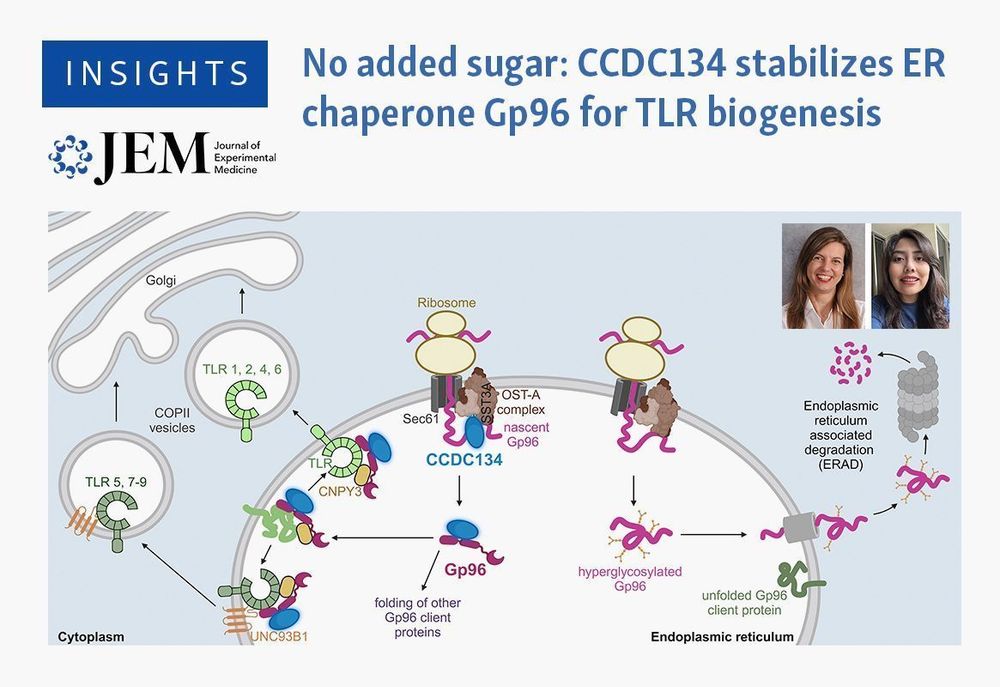
No added sugar: CCDC134 stabilizes ER chaperone Gp96 for TLR biogenesis. Leslie Domínguez Cadena and Antje Blumenthal discuss new study from @lbernaleau.bsky.social et al. @@rebsamenlab.bsky.social (https://buff.ly/3ZrE70d) in Insights: https://buff.ly/4gwjt5N
February 12, 2025 at 7:19 PM
No added sugar: CCDC134 stabilizes ER chaperone Gp96 for TLR biogenesis. Leslie Domínguez Cadena and Antje Blumenthal discuss new study from @lbernaleau.bsky.social et al. @@rebsamenlab.bsky.social (https://buff.ly/3ZrE70d) in Insights: https://buff.ly/4gwjt5N
Reposted by Kanika Jain
New publication from my PhD research looking at influences of sex on brain health outcomes in a rodent model of Alzheimer’s disease (AD) risk 🎉: link.springer.com/article/10.1...
Big thank you to the best co-authors, @liisagalea.bsky.social, Melike Cevizci, and Stephanie Lieblich 🙏
Big thank you to the best co-authors, @liisagalea.bsky.social, Melike Cevizci, and Stephanie Lieblich 🙏

Sex-specific influences of APOEε4 genotype on hippocampal neurogenesis and progenitor cells in middle-aged rats - Biology of Sex Differences
Background Alzheimer’s disease (AD) disproportionately and uniquely affects females, and these sex differences are further exacerbated by the presence of Apolipoprotein (APOE) ε4 alleles, the top gene...
link.springer.com
February 11, 2025 at 8:06 PM
New publication from my PhD research looking at influences of sex on brain health outcomes in a rodent model of Alzheimer’s disease (AD) risk 🎉: link.springer.com/article/10.1...
Big thank you to the best co-authors, @liisagalea.bsky.social, Melike Cevizci, and Stephanie Lieblich 🙏
Big thank you to the best co-authors, @liisagalea.bsky.social, Melike Cevizci, and Stephanie Lieblich 🙏
This is an amazing work! Congratulations to the team👏🏼👏🏼👏🏼
February 6, 2025 at 11:47 PM
This is an amazing work! Congratulations to the team👏🏼👏🏼👏🏼
I don’t think I have felt a month go on for so long…with one stress after another each day…just because I like studying stress responses doesn’t mean I ❤️them ! 🤷🏻♀️
February 1, 2025 at 8:27 PM
I don’t think I have felt a month go on for so long…with one stress after another each day…just because I like studying stress responses doesn’t mean I ❤️them ! 🤷🏻♀️