
Giulio Mattioli
banner
giuliomattioli.bsky.social
Giulio Mattioli
@giuliomattioli.bsky.social

Transport researcher with views on + than 1 topic - EU / Italian citizen with views on + than 1 country. Used to be in the UK. Now in Germany at TU Dortmund. Views my own https://t.co/ltfHVOHZe4

Engineering 25%
Energy 23%
Pinned
We have published a new paper and it's one I'm really happy with. A collaboration with Janina Welsch of ILS Dortmund. rdcu.be/eS96s

We look at the relationship between migration background / ethnicity and travel behaviour, using UK data.

THREAD on the findings

Which brings us back to motonormativity ;)

Ahhh interesting no I wasn't aware of that. One way of interpreting our findings is that cycling seems to be a lot more loaded with "culture", "identity" (whether ethnic or otherwise) and socialisation than cars and buses.

Thank you Ian! It's a great dataset

Yes one of the interesting findings is that cycling seems to be more culturally / ethnically "loaded" than car use.

Yes that's one of the main vehicles of "transport assimilation" - migrants in the first few years are a lot less likely to own cars.

Previous literature had also found evidence of "ethnic neighbourhood effects" whereby, say, someone from an ethnic minority group would use the car even less when living in a neighbourhood where many people from the same ethnicity live.

We find little evidence of this in England.

/END

We try & interpret these differences based on what we know from the existing literature on cultural attitudes & socialisation, but also discrimination processes.

But some differences remain:

- Non-British White respondents tend to cycle the most

- Black and (particularly) Asian respondents tend to cycle the least

- Black respondents tend to use the bus the most
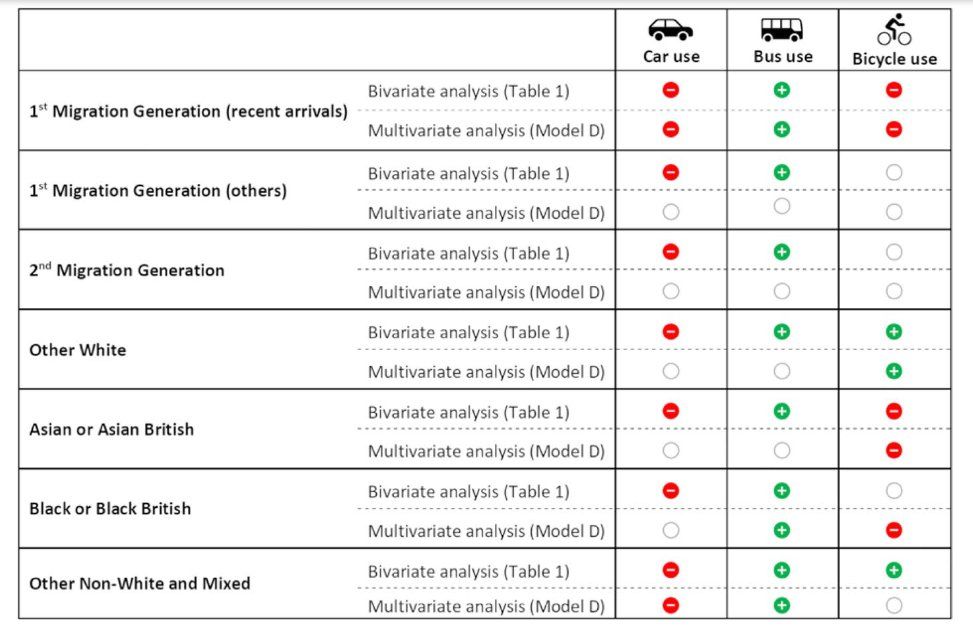
Many of these differences in travel behaviour between ethnic groups are actually due to socio-economic differences and them living in areas that are more conducive to cycling and public transport use. So they tend to disappear when controlling for that.

However (and even after this "assimilation" period), people from ethnic minorities keep travelling differently to some extent. In order words, the ethnicity effect is more long-lasting than the migration effect (as we are able to disentangle the two).

We find evidence of a "transport assimilation" effect whereby migrants travel very differently from locals in the first 5/10 years after arrival (more bus use, less car and bicycle), but then "normalise" over time.

We find that migrants and ethnic minority groups in England travel very differently than the average of the population.

But once you control for their socio-economic characteristics and for the area in which they live, most differences disappear.

Thanks to this data we can answer questions such as:

- do migrants drive less simply because of their particular socio-economic characteristics?

- do ethnic minorities cycle more simply because they tend to live in more "cyclable" places?

We looked into this using the UK @usociety.bsky.social dataset. It includes rich information on migration background, oversamples the main ethnic minorities, and allows us include information on accessibility by different modes & share of people by ethnicity in the neighbourhood.

There's a few studies on the travel behaviour of migrants / ethnic minority groups - see this review paper doi.org/10.1080/0144...

They often find that they use cars less, but the mechanisms behind it are not so clear

There are also few studies from Europe
What do we know about immigrants’ travel behaviour? A systematic literature review and proposed conceptual framework
Immigrants make up a significant population in many countries; in some countries as many as 30% of the population was born overseas. An increasing number of studies have found that immigrants are l...
doi.org
Collapse of key Atlantic current could bring extreme drought to Europe for centuries, study finds. @swinda.bsky.social
That's an under-appreciated impact of #AMOC shutdown, of particular concern given the recent results showing much higher likelihood of this. 1/2
www.livescience.com/planet-earth...

Reposted by Giulio Mattioli

"Support for cycling infrastructure and traffic restrictions [but] particularly opposed the removal of car parking... Cyclists and drivers favoured segregated cycling infrastructure"

New UK study has some nuanced insights into what the public might support www.sciencedirect.com/science/arti...
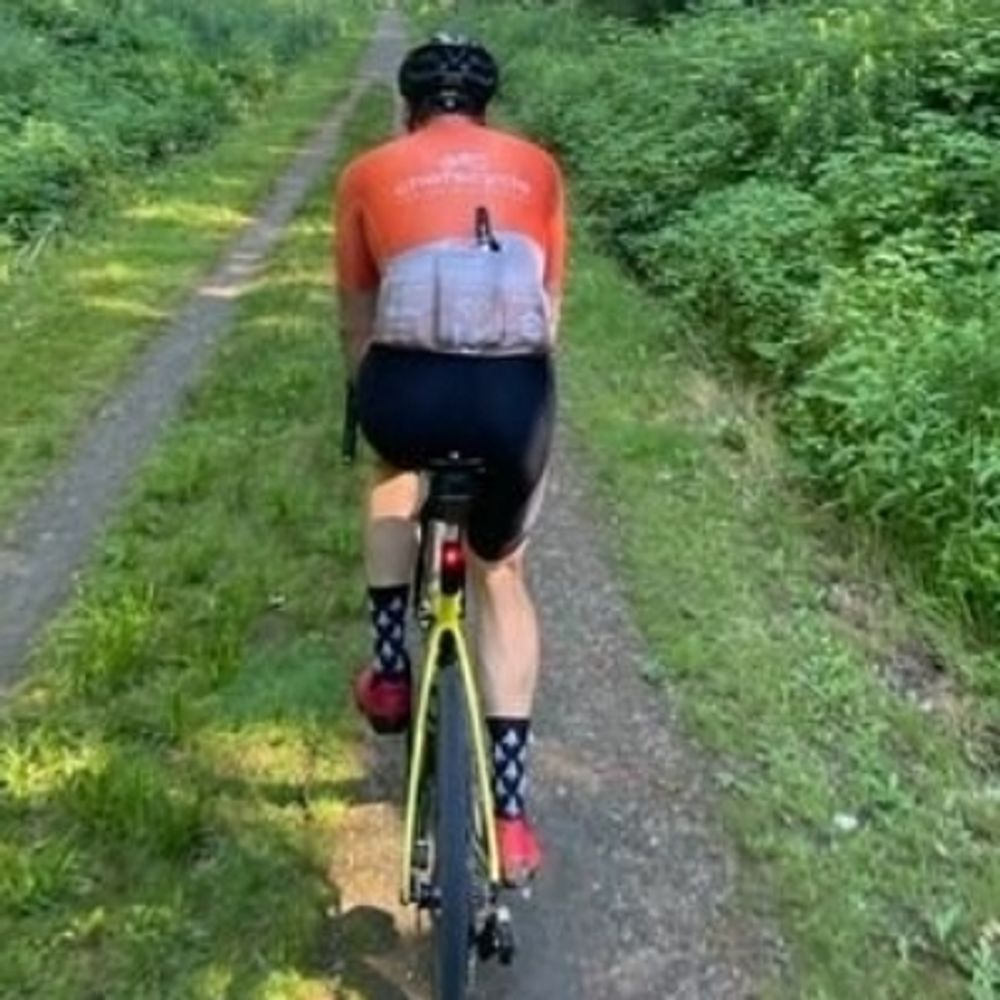
Great example of motonormativity
I think another weird facet to this is if you say "I was driving today & there are so many terrible, dangerous drivers," people tend to be like "ugh, I know" but if you say "I was cycling today & there are so many terrible, dangerous drivers," they furiously disagree & imply it was your own fault.
Something I've been thinking about a lot lately is how when a driver does something wrong, the public and media don't smear all drivers as reckless assholes. But when a cyclist — and especially an e-biker — does something wrong, all bicyclists get attacked and blamed.

Reposted by Giulio Mattioli

I think another weird facet to this is if you say "I was driving today & there are so many terrible, dangerous drivers," people tend to be like "ugh, I know" but if you say "I was cycling today & there are so many terrible, dangerous drivers," they furiously disagree & imply it was your own fault.
Something I've been thinking about a lot lately is how when a driver does something wrong, the public and media don't smear all drivers as reckless assholes. But when a cyclist — and especially an e-biker — does something wrong, all bicyclists get attacked and blamed.

Transport and energy researchers, for years: "Please for the love of all that is holy, do NOT incentivize plug-in hybrids"

The German government: "How about we incentivize plug-in hybrids again?"

Reposted by Giulio Mattioli

@giuliomattioli.bsky.social:
"One more year of selling fossil fuel vehicles will fix it"

#alwaysbecharging
www.linkedin.com/posts/electr...

The fascinating thing about it though, is that it is both: a necessity (for some) and a problem to avoid. And the problem to avoid the most is that it becomes a necessity for some. How does that happen? How could we make sure that it doesn't? It's not either or, it's more complicated than that.

Are those even concepts, "clean air dependence" and "food dependence"? I don't think they're in common use. Typically when we call about "dependence" on something (for example "car dependence") is precisely because such dependence is seen as problematic.

You can advocate for that for sure - but I do research, not advocacy so if I focus on this problem that's entirely fair, it doesn't mean I "normalize" it.

Awful feedback loops it's what I am interested in. Someone's got to do it :)

Sure that's the kind of reasoning you did. But most migrants do fly to visit their families, and that's the kind of processes I am interested in when studying "flight dependence"

What about people who have family over the world though

How would it "kill" such family?

It increases more in relative (not absolute) terms: it more than doubled over that period, holiday didn't.