



@martaig.bsky.social
Reposted

Our paper on the role of neurons in Nematostella head regeneration is now out at @currentbiology.bsky.social Big thank you to all collaborators, it was a pleasure!
Ectopic head regeneration after nervous system ablation in a sea anemone: Current Biology www.cell.com/current-biol...
Ectopic head regeneration after nervous system ablation in a sea anemone: Current Biology www.cell.com/current-biol...

Ectopic head regeneration after nervous system ablation in a sea anemone
Via genetic ablation of neurons, Mazloumi Gavgani et al. show that the nervous system
is essential for defining axial polarity during whole-body regeneration in the sea
anemone Nematostella vectensis.
www.cell.com
November 18, 2025 at 10:00 AM
Our paper on the role of neurons in Nematostella head regeneration is now out at @currentbiology.bsky.social Big thank you to all collaborators, it was a pleasure!
Ectopic head regeneration after nervous system ablation in a sea anemone: Current Biology www.cell.com/current-biol...
Ectopic head regeneration after nervous system ablation in a sea anemone: Current Biology www.cell.com/current-biol...
Reposted
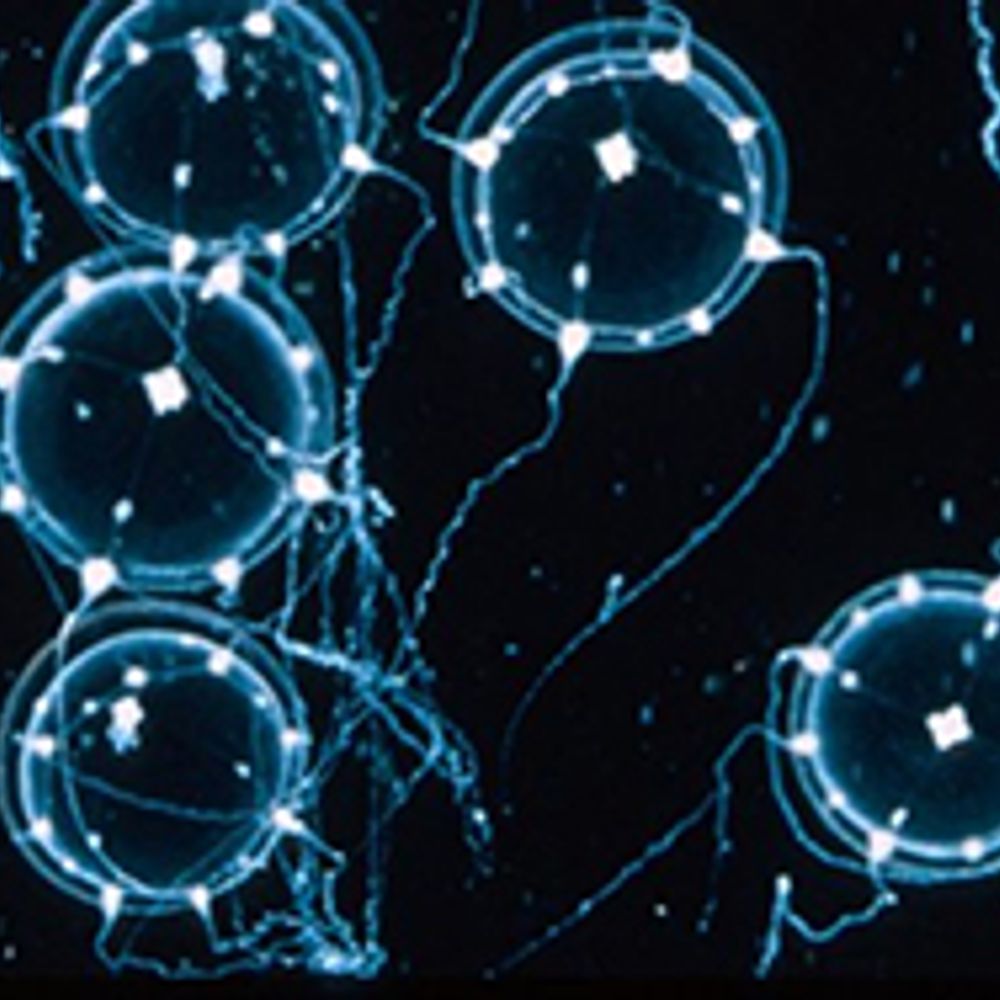
Drawing together findings from several projects over many years, we make a case that neural cell types in the Clytia larva have two embryological origins: i-cells and ectodermal.
bioRxiv 2025.11.17.688882; doi: doi.org/10.1101/2025...
bioRxiv 2025.11.17.688882; doi: doi.org/10.1101/2025...

November 19, 2025 at 7:43 AM
Drawing together findings from several projects over many years, we make a case that neural cell types in the Clytia larva have two embryological origins: i-cells and ectodermal.
bioRxiv 2025.11.17.688882; doi: doi.org/10.1101/2025...
bioRxiv 2025.11.17.688882; doi: doi.org/10.1101/2025...
Reposted

We are pleased to announce our next #SEBD2026 meeting! The meeting will take place in El Rompido, Huelva, from the 28th to the 30th of October 2026 #savethedate @cabd-upo-csic.bsky.social @isdb.bsky.social @gfeev.bsky.social @ijdb.bsky.social @devbiol.bsky.social @devdynamics.bsky.social

November 14, 2025 at 7:53 AM
We are pleased to announce our next #SEBD2026 meeting! The meeting will take place in El Rompido, Huelva, from the 28th to the 30th of October 2026 #savethedate @cabd-upo-csic.bsky.social @isdb.bsky.social @gfeev.bsky.social @ijdb.bsky.social @devbiol.bsky.social @devdynamics.bsky.social
Reposted

🚨New preprint from the lab! This work led by @akshayjg.bsky.social & @smfernandezmoya.bsky.social shows how the RNA binding protein STAU2 regulates the timing of neurogenesis in iPSC-derived human cells
www.biorxiv.org/content/10.1...
www.biorxiv.org/content/10.1...

Staufen2 modulates the temporal dynamics of human neurogenesis in vitro
RNA-binding proteins (RBPs) play a central role in post-transcriptional regulation during brain development, yet their specific functions in coordinating human neural lineage decisions remain poorly u...
www.biorxiv.org
October 2, 2025 at 4:40 PM
🚨New preprint from the lab! This work led by @akshayjg.bsky.social & @smfernandezmoya.bsky.social shows how the RNA binding protein STAU2 regulates the timing of neurogenesis in iPSC-derived human cells
www.biorxiv.org/content/10.1...
www.biorxiv.org/content/10.1...
Reposted
I’m really happy to present #SCALPEL, a new #Nextflow tool to quantify transcript isoforms at the single-cell level using conventional 3’ scRNA-seq data #scRNA-seq #single-cell #tools #isoforms
www.nature.com/articles/s41...
www.nature.com/articles/s41...
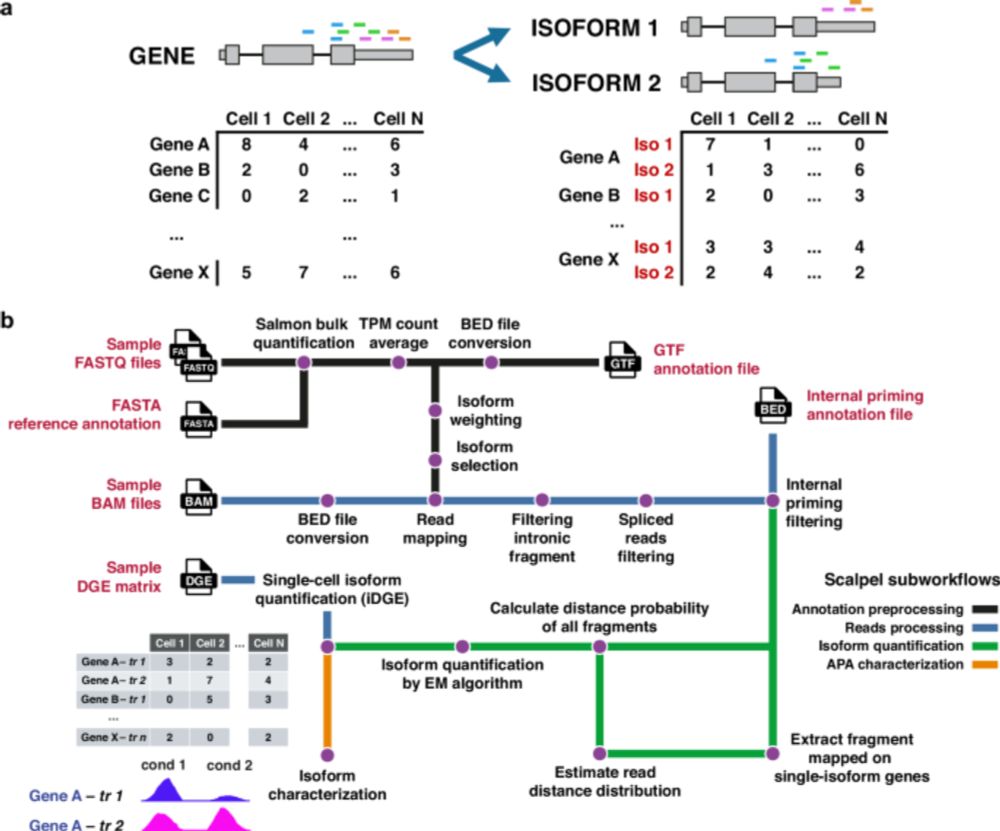
Quantification of transcript isoforms at the single-cell level using SCALPEL - Nature Communications
Single-cell RNA-seq facilitates the study of transcriptome diversity in individual cells. Here, authors introduce a tool for isoform quantification at the single-cell level using 3’ scRNA-seq data, co...
www.nature.com
July 14, 2025 at 10:31 AM
I’m really happy to present #SCALPEL, a new #Nextflow tool to quantify transcript isoforms at the single-cell level using conventional 3’ scRNA-seq data #scRNA-seq #single-cell #tools #isoforms
www.nature.com/articles/s41...
www.nature.com/articles/s41...
Reposted
I am very happy to have posted my first bioRxiv preprint. A long time in the making - and still adding a few final touches to it - but we're excited to finally have it out there in the wild:
www.biorxiv.org/content/10.1...
Read below for a few highlights...
www.biorxiv.org/content/10.1...
Read below for a few highlights...
Decoding cnidarian cell type gene regulation
Animal cell types are defined by differential access to genomic information, a process orchestrated by the combinatorial activity of transcription factors that bind to cis -regulatory elements (CREs) to control gene expression. However, the regulatory logic and specific gene networks that define cell identities remain poorly resolved across the animal tree of life. As early-branching metazoans, cnidarians can offer insights into the early evolution of cell type-specific genome regulation. Here, we profiled chromatin accessibility in 60,000 cells from whole adults and gastrula-stage embryos of the sea anemone Nematostella vectensis. We identified 112,728 CREs and quantified their activity across cell types, revealing pervasive combinatorial enhancer usage and distinct promoter architectures. To decode the underlying regulatory grammar, we trained sequence-based models predicting CRE accessibility and used these models to infer ontogenetic relationships among cell types. By integrating sequence motifs, transcription factor expression, and CRE accessibility, we systematically reconstructed the gene regulatory networks that define cnidarian cell types. Our results reveal the regulatory complexity underlying cell differentiation in a morphologically simple animal and highlight conserved principles in animal gene regulation. This work provides a foundation for comparative regulatory genomics to understand the evolutionary emergence of animal cell type diversity. ### Competing Interest Statement The authors have declared no competing interest. European Research Council, https://ror.org/0472cxd90, ERC-StG 851647 Ministerio de Ciencia e Innovación, https://ror.org/05r0vyz12, PID2021-124757NB-I00, FPI Severo Ochoa PhD fellowship European Union, https://ror.org/019w4f821, Marie Skłodowska-Curie INTREPiD co-fund agreement 75442, Marie Skłodowska-Curie grant agreement 101031767
www.biorxiv.org
July 6, 2025 at 6:15 PM
I am very happy to have posted my first bioRxiv preprint. A long time in the making - and still adding a few final touches to it - but we're excited to finally have it out there in the wild:
www.biorxiv.org/content/10.1...
Read below for a few highlights...
www.biorxiv.org/content/10.1...
Read below for a few highlights...