



JCLS
@jcls-io.bsky.social
Journal of Computational Literary Studies (JCLS), edited by Evelyn Gius, Peer Trilcke and Christof Schöch.
This international journal is published in diamond open access, peer-reviewed, international, and also organizing an annual conference (CCLS).
This international journal is published in diamond open access, peer-reviewed, international, and also organizing an annual conference (CCLS).
New article in #JCLS 4(1)! 📢
We’re excited to announce “Do Large Language Models Understand Literature? Case Studies and Probing Experiments on German Poetry” by @fotisjannidis.bsky.social, Kleymann, @julianschroeter.bsky.social & Zinsmeister. doi.org/10.48694/jcls.4225
#JCLS #CLS #LLM #Poetry
We’re excited to announce “Do Large Language Models Understand Literature? Case Studies and Probing Experiments on German Poetry” by @fotisjannidis.bsky.social, Kleymann, @julianschroeter.bsky.social & Zinsmeister. doi.org/10.48694/jcls.4225
#JCLS #CLS #LLM #Poetry

December 10, 2025 at 5:57 PM
New article in #JCLS 4(1)! 📢
We’re excited to announce “Do Large Language Models Understand Literature? Case Studies and Probing Experiments on German Poetry” by @fotisjannidis.bsky.social, Kleymann, @julianschroeter.bsky.social & Zinsmeister. doi.org/10.48694/jcls.4225
#JCLS #CLS #LLM #Poetry
We’re excited to announce “Do Large Language Models Understand Literature? Case Studies and Probing Experiments on German Poetry” by @fotisjannidis.bsky.social, Kleymann, @julianschroeter.bsky.social & Zinsmeister. doi.org/10.48694/jcls.4225
#JCLS #CLS #LLM #Poetry
Excited about the #JCLS articles and working on a #ComputationalLiteraryStudies draft yourself?
Be part of the journal and submit to our Conference Track by January 8: jcls.io/site/cfp/
#CCLS2026 #CLS #LiteraryComputing #CfP
Be part of the journal and submit to our Conference Track by January 8: jcls.io/site/cfp/
#CCLS2026 #CLS #LiteraryComputing #CfP

December 4, 2025 at 7:41 PM
Excited about the #JCLS articles and working on a #ComputationalLiteraryStudies draft yourself?
Be part of the journal and submit to our Conference Track by January 8: jcls.io/site/cfp/
#CCLS2026 #CLS #LiteraryComputing #CfP
Be part of the journal and submit to our Conference Track by January 8: jcls.io/site/cfp/
#CCLS2026 #CLS #LiteraryComputing #CfP
The authors tackle a major challenge in #NLP: #LLM-Memorization and #Copyright
👉 Can derived text formats (DTFs) be used safely for research on #in-copyright texts without enabling reconstruction of the original?
#CLS #NLG #DTF #LiteraryComputing #CCLS25 #OpenScience
jcls.io/issue/118/in...
👉 Can derived text formats (DTFs) be used safely for research on #in-copyright texts without enabling reconstruction of the original?
#CLS #NLG #DTF #LiteraryComputing #CCLS25 #OpenScience
jcls.io/issue/118/in...


December 4, 2025 at 7:19 PM
The authors tackle a major challenge in #NLP: #LLM-Memorization and #Copyright
👉 Can derived text formats (DTFs) be used safely for research on #in-copyright texts without enabling reconstruction of the original?
#CLS #NLG #DTF #LiteraryComputing #CCLS25 #OpenScience
jcls.io/issue/118/in...
👉 Can derived text formats (DTFs) be used safely for research on #in-copyright texts without enabling reconstruction of the original?
#CLS #NLG #DTF #LiteraryComputing #CCLS25 #OpenScience
jcls.io/issue/118/in...
New article in #JCLS 4(1)! 🎉
Du, Ackerschewski, Navruz, Sınır, Valline & @christofs.bsky.social: “Reconstructing Shuffled Text. Bad Results for #NLP, but Good News for Using #In-Copyright Texts” doi.org/10.48694/jcl...
#CLS #DTF #LiteraryComputing #CCLS25 #OpenScience #Copyright
Du, Ackerschewski, Navruz, Sınır, Valline & @christofs.bsky.social: “Reconstructing Shuffled Text. Bad Results for #NLP, but Good News for Using #In-Copyright Texts” doi.org/10.48694/jcl...
#CLS #DTF #LiteraryComputing #CCLS25 #OpenScience #Copyright

December 4, 2025 at 7:16 PM
New article in #JCLS 4(1)! 🎉
Du, Ackerschewski, Navruz, Sınır, Valline & @christofs.bsky.social: “Reconstructing Shuffled Text. Bad Results for #NLP, but Good News for Using #In-Copyright Texts” doi.org/10.48694/jcl...
#CLS #DTF #LiteraryComputing #CCLS25 #OpenScience #Copyright
Du, Ackerschewski, Navruz, Sınır, Valline & @christofs.bsky.social: “Reconstructing Shuffled Text. Bad Results for #NLP, but Good News for Using #In-Copyright Texts” doi.org/10.48694/jcl...
#CLS #DTF #LiteraryComputing #CCLS25 #OpenScience #Copyright
They offer a critical #survey of the #SoA of #EventDetection in journalism, history, and literary studies. By comparing their model to a storyline analysis framework used in news, they show how fiction and non-fiction can be analyzed studying narrative progression across domains. 📖✨ #CCLS25

December 2, 2025 at 7:23 PM
They offer a critical #survey of the #SoA of #EventDetection in journalism, history, and literary studies. By comparing their model to a storyline analysis framework used in news, they show how fiction and non-fiction can be analyzed studying narrative progression across domains. 📖✨ #CCLS25
By inserting an artificial word with precisely defined frequency and #dispersion, they test how well different measures detect what’s truly #distinctive.
Their findings uncover that a #TF-IDF -based measure is more sensitive to dispersion variations than other dispersion-based measures. #Evaluation
Their findings uncover that a #TF-IDF -based measure is more sensitive to dispersion variations than other dispersion-based measures. #Evaluation

November 21, 2025 at 3:32 PM
By inserting an artificial word with precisely defined frequency and #dispersion, they test how well different measures detect what’s truly #distinctive.
Their findings uncover that a #TF-IDF -based measure is more sensitive to dispersion variations than other dispersion-based measures. #Evaluation
Their findings uncover that a #TF-IDF -based measure is more sensitive to dispersion variations than other dispersion-based measures. #Evaluation
By randomizing #LLM prompts and analyzing moral #keywords via co-occurrence #networks and hierarchical clustering, @andrewpiper.bsky.social uncovers latent “moral communities” across 20th–21st century #English-language #fiction.

November 17, 2025 at 7:32 PM
By randomizing #LLM prompts and analyzing moral #keywords via co-occurrence #networks and hierarchical clustering, @andrewpiper.bsky.social uncovers latent “moral communities” across 20th–21st century #English-language #fiction.
Keith et al. develop quantitative methods to examine how gender is portrayed across 100+ 17th-century plays by #Calderón.
#CLS #DigitalHumanities #JCLS #LiteraryComputing #Plays #CCLS25 @dracor.org
#CLS #DigitalHumanities #JCLS #LiteraryComputing #Plays #CCLS25 @dracor.org

November 14, 2025 at 6:59 PM
Keith et al. develop quantitative methods to examine how gender is portrayed across 100+ 17th-century plays by #Calderón.
#CLS #DigitalHumanities #JCLS #LiteraryComputing #Plays #CCLS25 @dracor.org
#CLS #DigitalHumanities #JCLS #LiteraryComputing #Plays #CCLS25 @dracor.org
Jacobson et al. explore how #ReaderUncertainty becomes a source of insight by embracing interpretive #ambiguity.
Drawing on 1,026 questionnaire responses from the #HebrewNovelProject, they examine how readers express uncertainty—from skipping questions to outright rejecting interpretive frameworks.
Drawing on 1,026 questionnaire responses from the #HebrewNovelProject, they examine how readers express uncertainty—from skipping questions to outright rejecting interpretive frameworks.

October 30, 2025 at 6:16 PM
Jacobson et al. explore how #ReaderUncertainty becomes a source of insight by embracing interpretive #ambiguity.
Drawing on 1,026 questionnaire responses from the #HebrewNovelProject, they examine how readers express uncertainty—from skipping questions to outright rejecting interpretive frameworks.
Drawing on 1,026 questionnaire responses from the #HebrewNovelProject, they examine how readers express uncertainty—from skipping questions to outright rejecting interpretive frameworks.
On average: Persephone shows higher power, while Hades exhibits higher agency — revealing shifting dynamics in myth reinterpretation. ⚖️
A fascinating look at #gender, #power & classical reception through #NLP and #fanfiction. ✨
A fascinating look at #gender, #power & classical reception through #NLP and #fanfiction. ✨

October 23, 2025 at 4:46 PM
On average: Persephone shows higher power, while Hades exhibits higher agency — revealing shifting dynamics in myth reinterpretation. ⚖️
A fascinating look at #gender, #power & classical reception through #NLP and #fanfiction. ✨
A fascinating look at #gender, #power & classical reception through #NLP and #fanfiction. ✨
How “domestic” is a #Victorian novel?
Guhr et al. fine-tune a #LanguageModel to detect implicit domestic spaces – rooms, gardens, even #ships – beyond obvious keywords like 'house' or 'home.' – A new way to read #19th-century #fiction through the lens of #space and study the rise of #domesticity.
Guhr et al. fine-tune a #LanguageModel to detect implicit domestic spaces – rooms, gardens, even #ships – beyond obvious keywords like 'house' or 'home.' – A new way to read #19th-century #fiction through the lens of #space and study the rise of #domesticity.

September 30, 2025 at 5:39 AM
How “domestic” is a #Victorian novel?
Guhr et al. fine-tune a #LanguageModel to detect implicit domestic spaces – rooms, gardens, even #ships – beyond obvious keywords like 'house' or 'home.' – A new way to read #19th-century #fiction through the lens of #space and study the rise of #domesticity.
Guhr et al. fine-tune a #LanguageModel to detect implicit domestic spaces – rooms, gardens, even #ships – beyond obvious keywords like 'house' or 'home.' – A new way to read #19th-century #fiction through the lens of #space and study the rise of #domesticity.
#CLS meets #spatial analysis! 🏡
"Making #BERT Feel at Home. Modelling #DomesticSpace in #19th-Century British and Irish #Fiction" by @guhrs.bsky.social, J. Monaco, @alexsherman.bsky.social, @mattgwr.bsky.social and M. Algee-Hewitt is now live at #JCLS 4(1). 10.48694/jcls.4164 #transformer
"Making #BERT Feel at Home. Modelling #DomesticSpace in #19th-Century British and Irish #Fiction" by @guhrs.bsky.social, J. Monaco, @alexsherman.bsky.social, @mattgwr.bsky.social and M. Algee-Hewitt is now live at #JCLS 4(1). 10.48694/jcls.4164 #transformer

September 30, 2025 at 5:32 AM
#CLS meets #spatial analysis! 🏡
"Making #BERT Feel at Home. Modelling #DomesticSpace in #19th-Century British and Irish #Fiction" by @guhrs.bsky.social, J. Monaco, @alexsherman.bsky.social, @mattgwr.bsky.social and M. Algee-Hewitt is now live at #JCLS 4(1). 10.48694/jcls.4164 #transformer
"Making #BERT Feel at Home. Modelling #DomesticSpace in #19th-Century British and Irish #Fiction" by @guhrs.bsky.social, J. Monaco, @alexsherman.bsky.social, @mattgwr.bsky.social and M. Algee-Hewitt is now live at #JCLS 4(1). 10.48694/jcls.4164 #transformer
- Methodology & results on JCLS 4(1): doi.org/10.48694/jcl...
A model for studying cultural communities far beyond St. Petersburg.
#DigitalHumanities #CulturalNetworkAnalysis #ComputationalLiteraryStudies #CCLS2025 #CLS #JCLS
A model for studying cultural communities far beyond St. Petersburg.
#DigitalHumanities #CulturalNetworkAnalysis #ComputationalLiteraryStudies #CCLS2025 #CLS #JCLS

September 22, 2025 at 2:18 PM
- Methodology & results on JCLS 4(1): doi.org/10.48694/jcl...
A model for studying cultural communities far beyond St. Petersburg.
#DigitalHumanities #CulturalNetworkAnalysis #ComputationalLiteraryStudies #CCLS2025 #CLS #JCLS
A model for studying cultural communities far beyond St. Petersburg.
#DigitalHumanities #CulturalNetworkAnalysis #ComputationalLiteraryStudies #CCLS2025 #CLS #JCLS
How do literary communities actually form?
@maria-lev.bsky.social analyzes the networks of collaboration and aesthetic affinity that are documented through cultural events — e.g. readings, book launches, festivals. These real-world networks often remain invisible in text-based literary history.
@maria-lev.bsky.social analyzes the networks of collaboration and aesthetic affinity that are documented through cultural events — e.g. readings, book launches, festivals. These real-world networks often remain invisible in text-based literary history.

September 22, 2025 at 2:15 PM
How do literary communities actually form?
@maria-lev.bsky.social analyzes the networks of collaboration and aesthetic affinity that are documented through cultural events — e.g. readings, book launches, festivals. These real-world networks often remain invisible in text-based literary history.
@maria-lev.bsky.social analyzes the networks of collaboration and aesthetic affinity that are documented through cultural events — e.g. readings, book launches, festivals. These real-world networks often remain invisible in text-based literary history.
The study maps 20 years of literary life in St. Petersburg (1999–2019) analyzing events as community-structuring mechanisms.
📊 15,012 events · 11,777 participants · 862 venues · over 100,000 attendance records
📊 15,012 events · 11,777 participants · 862 venues · over 100,000 attendance records

September 22, 2025 at 2:11 PM
The study maps 20 years of literary life in St. Petersburg (1999–2019) analyzing events as community-structuring mechanisms.
📊 15,012 events · 11,777 participants · 862 venues · over 100,000 attendance records
📊 15,012 events · 11,777 participants · 862 venues · over 100,000 attendance records
The very first #DraCorSummit kicked off today 🎭 a full week dedicated to computational drama analysis!
We’re excited to be a partner of this event. Selected papers will appear in a special issue on computational drama analysis in #JCLS (2026).
Stay tuned! #CLS #DramaAnalysis #DraCor @dracor.org
We’re excited to be a partner of this event. Selected papers will appear in a special issue on computational drama analysis in #JCLS (2026).
Stay tuned! #CLS #DramaAnalysis #DraCor @dracor.org

September 1, 2025 at 6:36 PM
The very first #DraCorSummit kicked off today 🎭 a full week dedicated to computational drama analysis!
We’re excited to be a partner of this event. Selected papers will appear in a special issue on computational drama analysis in #JCLS (2026).
Stay tuned! #CLS #DramaAnalysis #DraCor @dracor.org
We’re excited to be a partner of this event. Selected papers will appear in a special issue on computational drama analysis in #JCLS (2026).
Stay tuned! #CLS #DramaAnalysis #DraCor @dracor.org
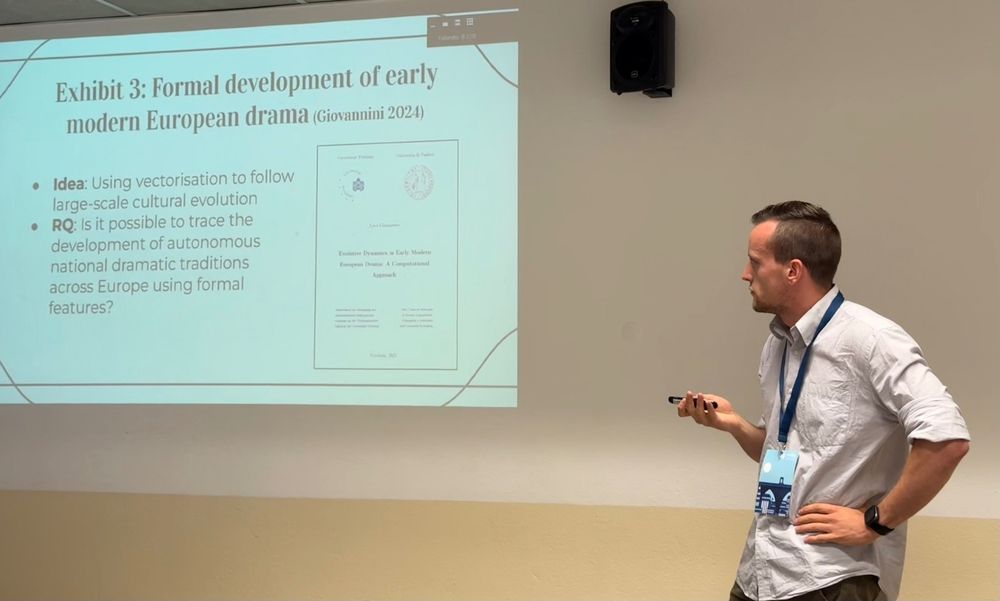
In his "Modest Proposal for Operationalizing Dramatic Texts", @lucagiovannini.bsky.social presents 3 exhibits, including his recently completed PhD thesis on the "Formal Development of Early Modern European Drama". Congratulations! 🎓 #PhDone #CLS #Drama #Operationalization
July 18, 2025 at 3:36 PM
In his "Modest Proposal for Operationalizing Dramatic Texts", @lucagiovannini.bsky.social presents 3 exhibits, including his recently completed PhD thesis on the "Formal Development of Early Modern European Drama". Congratulations! 🎓 #PhDone #CLS #Drama #Operationalization
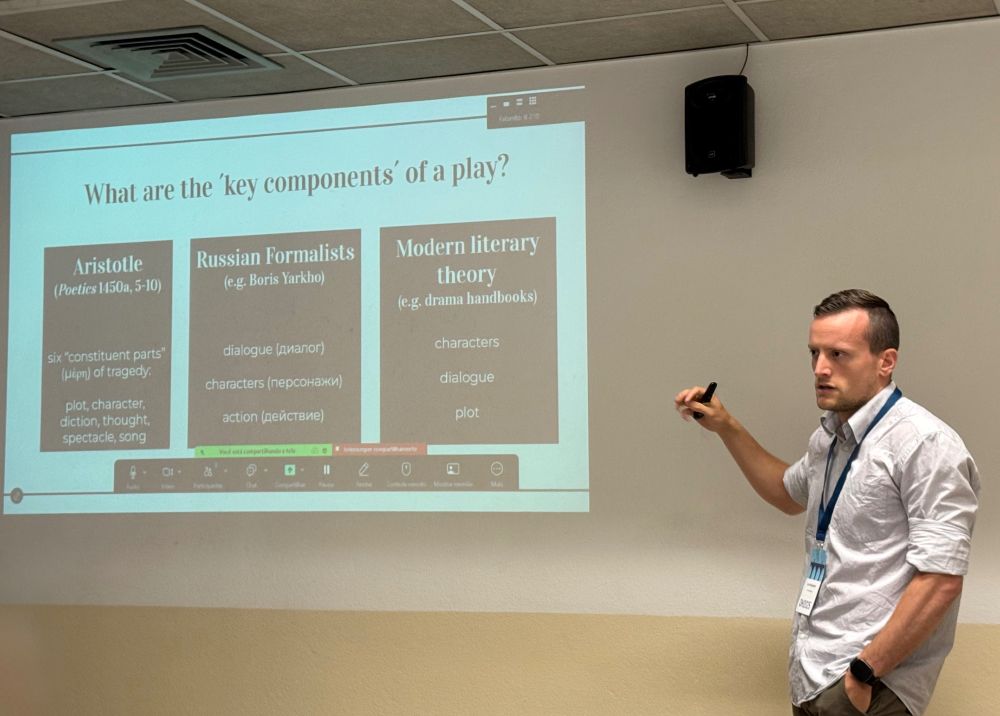
What are the key components of a #play? 🎭
#DH2025: @lucagiovannini.bsky.social takes us on a tour through centuries of thinking from #Aristotle’s #Poetics, through Russian formalism, to modern literary theory and unpacks the question offering a fresh perspective.
#drama #operationalization #CLS
#DH2025: @lucagiovannini.bsky.social takes us on a tour through centuries of thinking from #Aristotle’s #Poetics, through Russian formalism, to modern literary theory and unpacks the question offering a fresh perspective.
#drama #operationalization #CLS
July 18, 2025 at 3:33 PM
What are the key components of a #play? 🎭
#DH2025: @lucagiovannini.bsky.social takes us on a tour through centuries of thinking from #Aristotle’s #Poetics, through Russian formalism, to modern literary theory and unpacks the question offering a fresh perspective.
#drama #operationalization #CLS
#DH2025: @lucagiovannini.bsky.social takes us on a tour through centuries of thinking from #Aristotle’s #Poetics, through Russian formalism, to modern literary theory and unpacks the question offering a fresh perspective.
#drama #operationalization #CLS
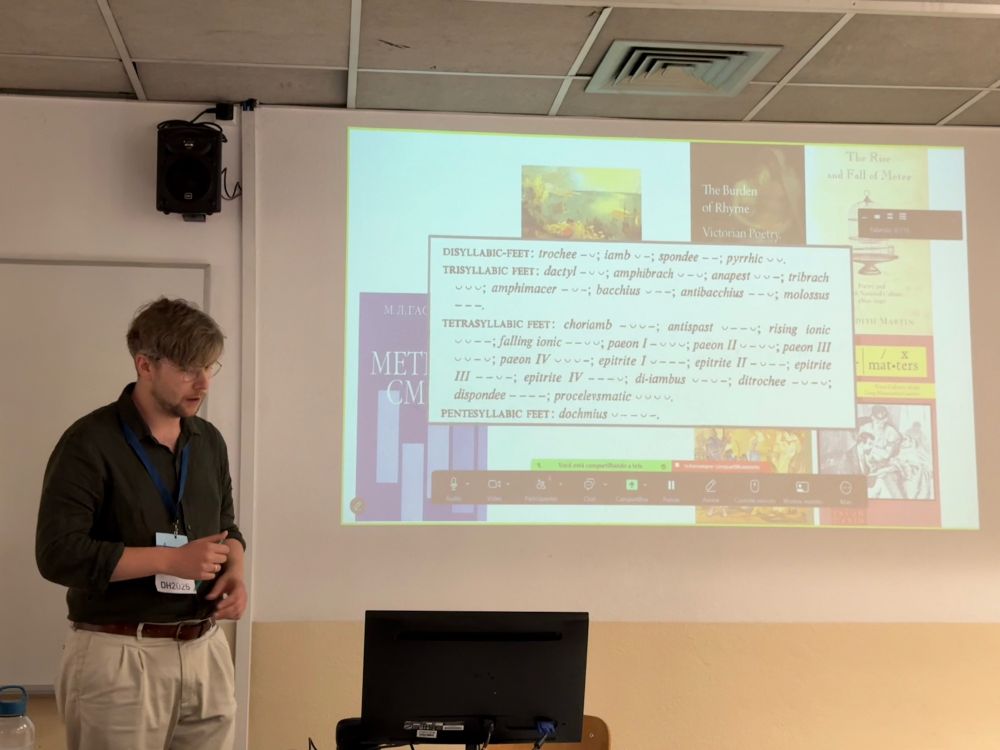
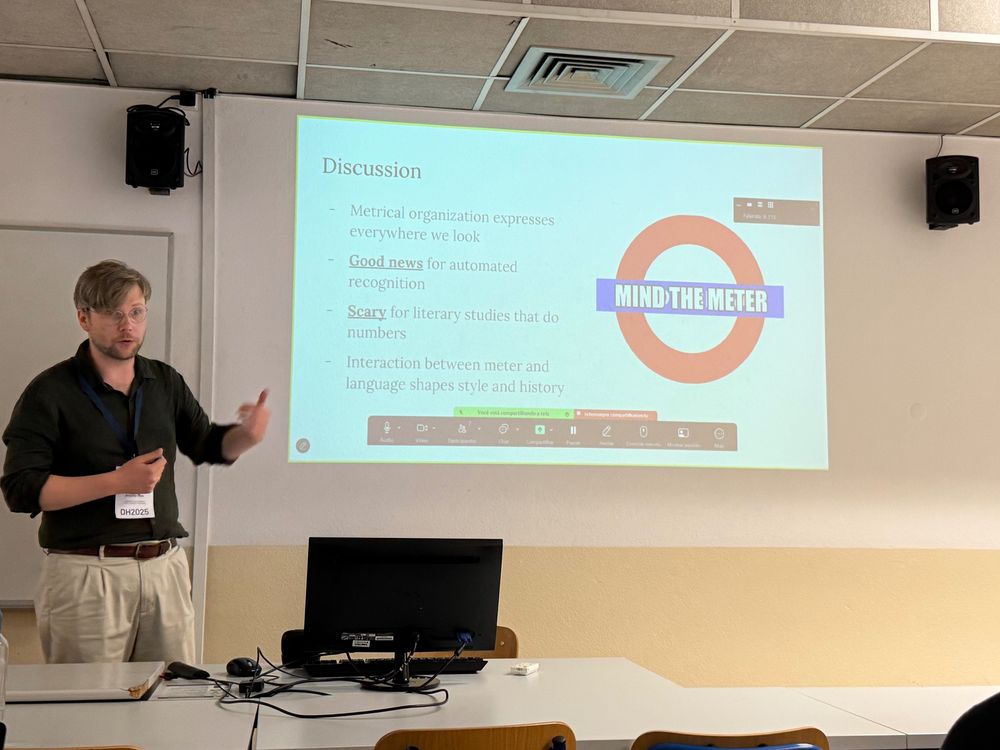
#DH2025: What are we really measuring when we count words? @artjomshl.bsky.social, @philaut.bsky.social & @plechac.bsky.social show how different meters distinctly shape seemingly unrelated feature distributions across Czech, German & Russian #poetry. Their main finding: Mind the meter! #CLS
July 18, 2025 at 1:48 PM
#DH2025: What are we really measuring when we count words? @artjomshl.bsky.social, @philaut.bsky.social & @plechac.bsky.social show how different meters distinctly shape seemingly unrelated feature distributions across Czech, German & Russian #poetry. Their main finding: Mind the meter! #CLS
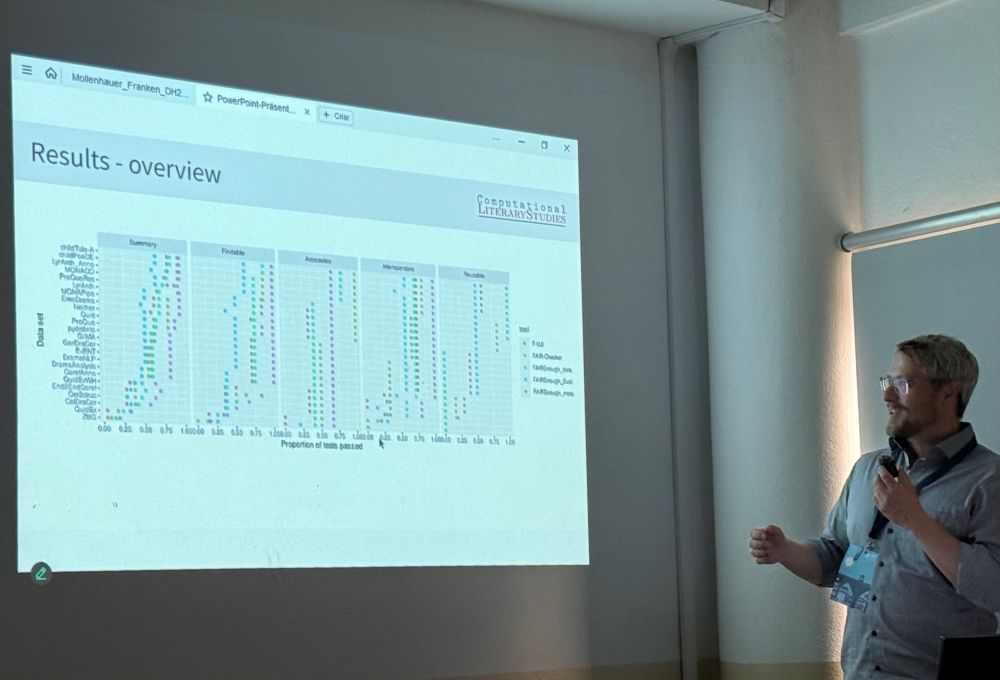
#DH2025: Steffen Pielström, Kerstin Jung & Patrick Helling put the SPP #CLS projects to the test, examining their level of #FAIRness as a case study to assess how equal automated FAIRness tests are.
#FAIR #FAIRprinciples
#FAIR #FAIRprinciples
July 18, 2025 at 10:41 AM
#DH2025: Steffen Pielström, Kerstin Jung & Patrick Helling put the SPP #CLS projects to the test, examining their level of #FAIRness as a case study to assess how equal automated FAIRness tests are.
#FAIR #FAIRprinciples
#FAIR #FAIRprinciples
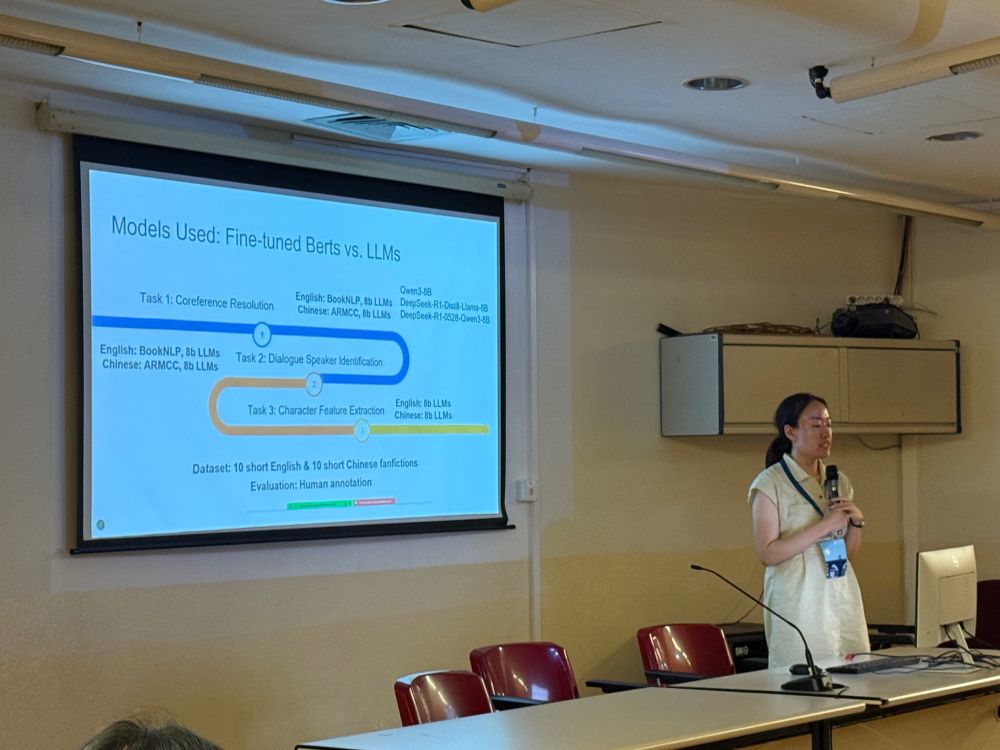
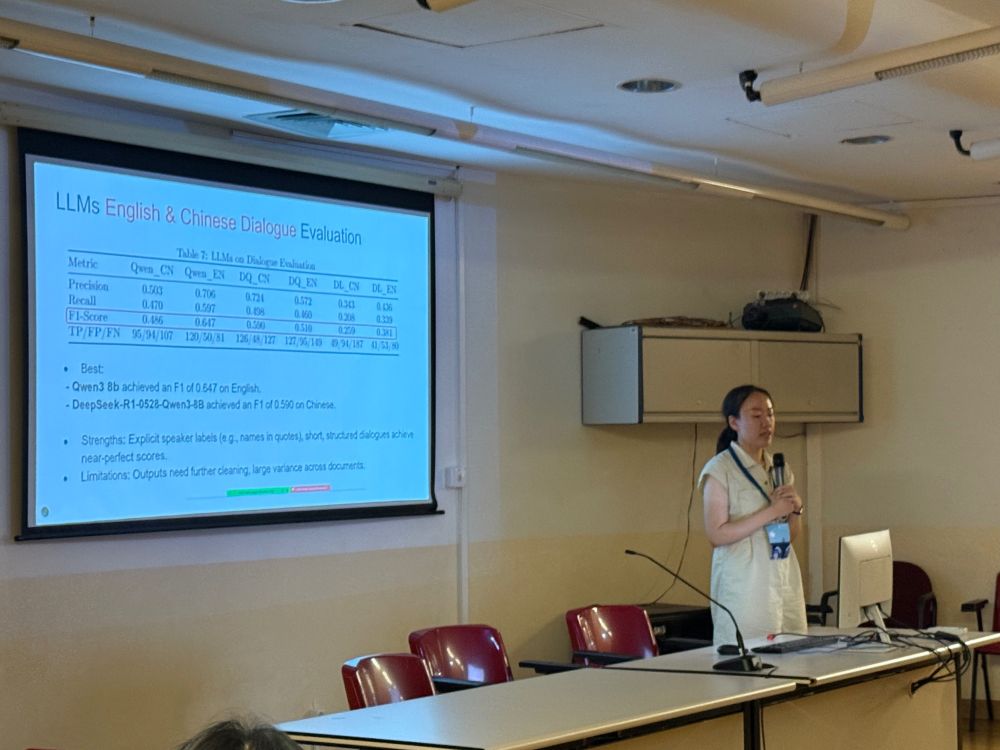
#DH2025: Xiaoyan Yang & @fpianz.bsky.social present a #multilingual #CLS pipeline comparing #English & #Chinese #fanfiction. Using #BookNLP, #ARMCC & #LLMs, they address #CoreferenceResolution, dialogue speaker & character feature extraction 🔥 hot topics at this year's conference. 📚🌏
July 17, 2025 at 3:59 PM
#DH2025: Xiaoyan Yang & @fpianz.bsky.social present a #multilingual #CLS pipeline comparing #English & #Chinese #fanfiction. Using #BookNLP, #ARMCC & #LLMs, they address #CoreferenceResolution, dialogue speaker & character feature extraction 🔥 hot topics at this year's conference. 📚🌏
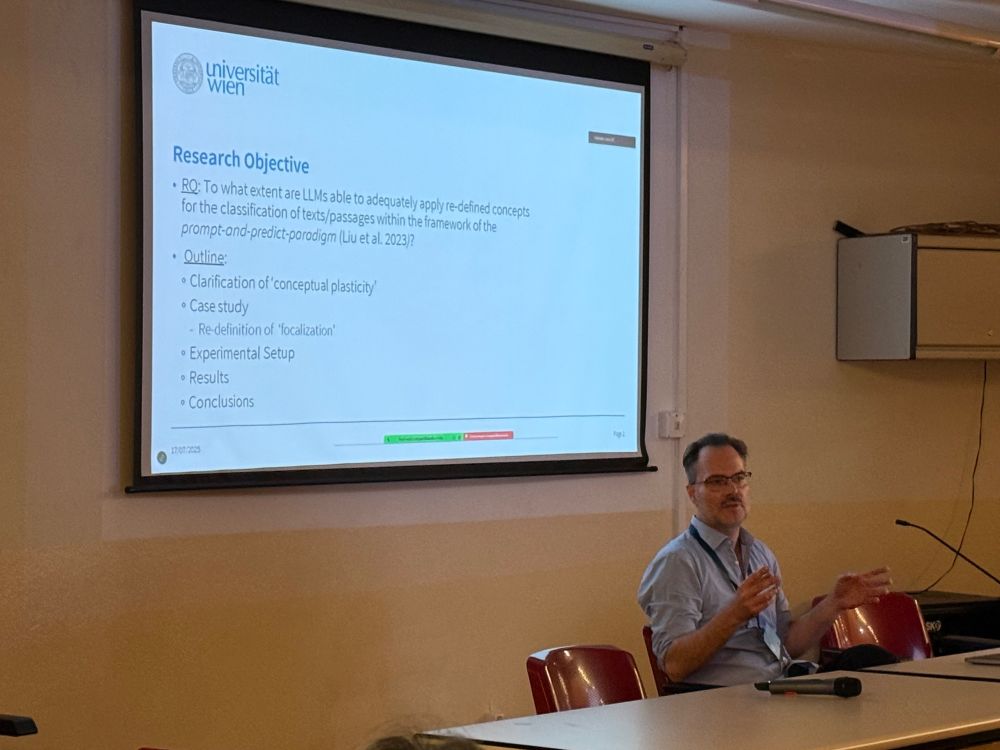
#DH2025: With their research question, Pichler & @janispagel.bsky.social hit the nail on the head 🔨:
Can #LLMs apply redefined literary concepts in the prompt-and-predict paradigm (Liu et al. 2023)?
#CLS #concepts #plasticity
Can #LLMs apply redefined literary concepts in the prompt-and-predict paradigm (Liu et al. 2023)?
#CLS #concepts #plasticity
July 17, 2025 at 3:37 PM
#DH2025: With their research question, Pichler & @janispagel.bsky.social hit the nail on the head 🔨:
Can #LLMs apply redefined literary concepts in the prompt-and-predict paradigm (Liu et al. 2023)?
#CLS #concepts #plasticity
Can #LLMs apply redefined literary concepts in the prompt-and-predict paradigm (Liu et al. 2023)?
#CLS #concepts #plasticity
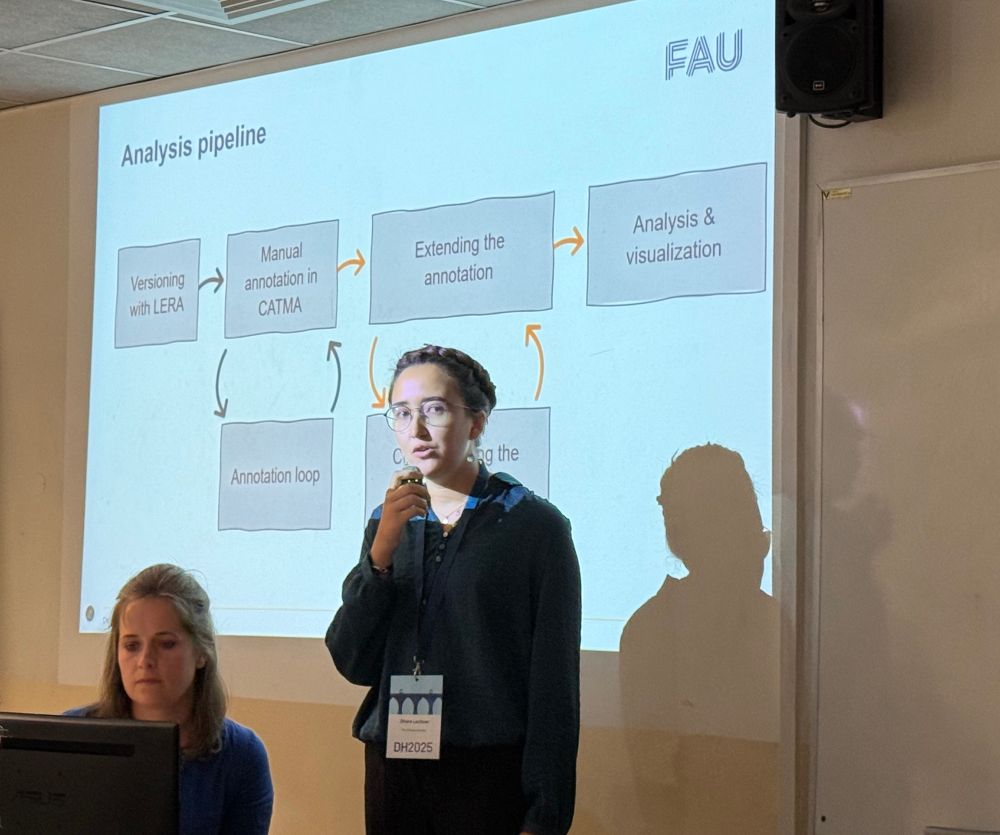
#DH2025: Another #alignment project in #CLS. @anastasiaglawion.bsky.social and Dhara Lechner of @dhssfau.bsky.social present their work on "Tracing #Transformation: editorial shifts in the Grimm brothers’ tales".
#FairyTales #German-language #fiction
#FairyTales #German-language #fiction
July 17, 2025 at 10:09 AM
#DH2025: Another #alignment project in #CLS. @anastasiaglawion.bsky.social and Dhara Lechner of @dhssfau.bsky.social present their work on "Tracing #Transformation: editorial shifts in the Grimm brothers’ tales".
#FairyTales #German-language #fiction
#FairyTales #German-language #fiction
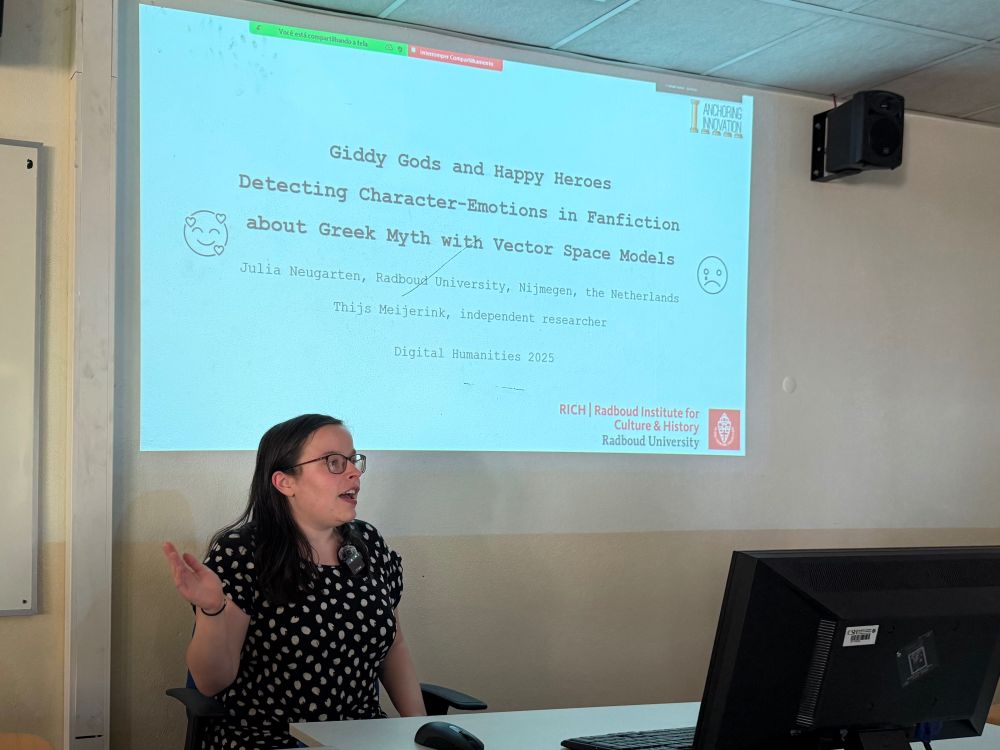
#DH2025: @julianeugarten.bsky.social & Thijs Meijerink present their work titled “Giddy Gods and Happy Heroes: Detecting #Character-Emotions in #Fanfiction about #GreekMyth with #VectorSpaceModels”.
July 16, 2025 at 2:23 PM
#DH2025: @julianeugarten.bsky.social & Thijs Meijerink present their work titled “Giddy Gods and Happy Heroes: Detecting #Character-Emotions in #Fanfiction about #GreekMyth with #VectorSpaceModels”.
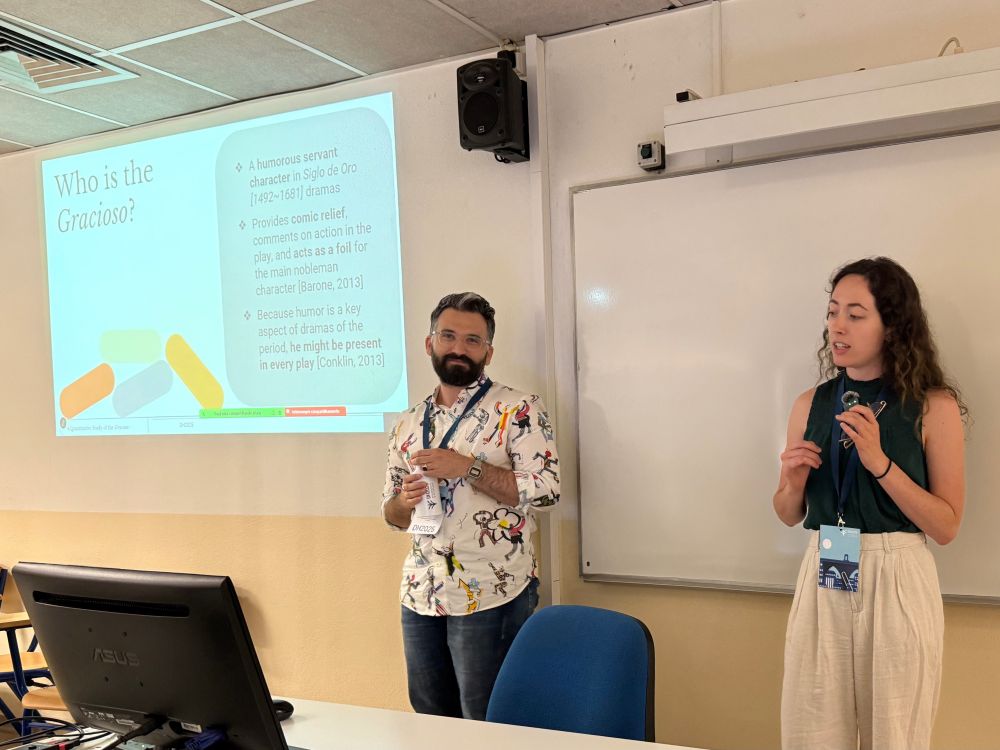
#DH2025: #CLS is everywhere! In SP-09, Allison Anne Keith, Antonio Rojas Castro, et al. present their approach to using #ComputationalMethods to examine, how annotated #gracioso characters can help us understand their structural and narrative role in #Calderón's plays.
#Spanish #drama #annotation
#Spanish #drama #annotation
July 16, 2025 at 10:38 AM
#DH2025: #CLS is everywhere! In SP-09, Allison Anne Keith, Antonio Rojas Castro, et al. present their approach to using #ComputationalMethods to examine, how annotated #gracioso characters can help us understand their structural and narrative role in #Calderón's plays.
#Spanish #drama #annotation
#Spanish #drama #annotation