




Gokul Swamy
@gokul.dev
PhD student at @cmurobotics.bsky.social working on efficient algorithms for interactive learning (e.g. imitation / RL / RLHF). no model is an island. prefers email. https://gokul.dev/. on the job market!
I've been really enjoying the new Ninajirachi album -- it's very Boiler Room-core :)
August 23, 2025 at 6:19 PM
I've been really enjoying the new Ninajirachi album -- it's very Boiler Room-core :)
Thanks for the shout-out and I hope the lectures were at least somewhat understandable! Yeah, once things settle down a bit for me, I'd like to more deeply understand the connection between Rust's structural estimation and IRL as I conceive of it.
August 23, 2025 at 6:16 PM
Thanks for the shout-out and I hope the lectures were at least somewhat understandable! Yeah, once things settle down a bit for me, I'd like to more deeply understand the connection between Rust's structural estimation and IRL as I conceive of it.
We therefore advocate for caution when making or evaluating claims about LLM reasoning and beyond with GRPO and PPO, ideally using algorithms like RLoo or REBEL instead. Check out our blog post for links to our code and W&B logs if you'd like to reproduce our experiments.
July 15, 2025 at 5:46 PM
We therefore advocate for caution when making or evaluating claims about LLM reasoning and beyond with GRPO and PPO, ideally using algorithms like RLoo or REBEL instead. Check out our blog post for links to our code and W&B logs if you'd like to reproduce our experiments.
While this worked out for the better on some seeds, it doesn't have to in general. After all, an algorithm that behaves unexpectedly *well* in one setting can perform unexpectedly *poorly* in another, perhaps more important, setting.
July 15, 2025 at 5:46 PM
While this worked out for the better on some seeds, it doesn't have to in general. After all, an algorithm that behaves unexpectedly *well* in one setting can perform unexpectedly *poorly* in another, perhaps more important, setting.
We see similar results on a didactic bandit problem -- i.e. a problem that has nothing to do with LLMs or reasoning! This implies that PPO / GRPO are fundamentally *not* following the true policy gradient.
July 15, 2025 at 5:46 PM
We see similar results on a didactic bandit problem -- i.e. a problem that has nothing to do with LLMs or reasoning! This implies that PPO / GRPO are fundamentally *not* following the true policy gradient.
We find that RLoo (an unbiased estimate of the vanilla PG) and REBEL (a regression-based approximation of online mirror descent) preserve performance as expected. In contrast, algorithms like PPO / GRPO that include heuristics (e.g. clipping) show a marked and unexpected change in performance.
July 15, 2025 at 5:46 PM
We find that RLoo (an unbiased estimate of the vanilla PG) and REBEL (a regression-based approximation of online mirror descent) preserve performance as expected. In contrast, algorithms like PPO / GRPO that include heuristics (e.g. clipping) show a marked and unexpected change in performance.
So, with a truly random reward function, all policies look equally good. Thus, the *true* policy gradient is zero, as the initial policy is optimal by construction. So, we'd expect performance to flatline. We use random rewards as a *diagnostic task* to compare different RL algs.
July 15, 2025 at 5:46 PM
So, with a truly random reward function, all policies look equally good. Thus, the *true* policy gradient is zero, as the initial policy is optimal by construction. So, we'd expect performance to flatline. We use random rewards as a *diagnostic task* to compare different RL algs.
Lead by Owen Oertell & Wenhao Zhan, joint w/ Steven Wu, Kiante Brantley, Jason Lee, and Wen Sun. If a project has got Wen, Owen, Wenhao, and Qwen on it, you know it's gotta be good 😛.
July 15, 2025 at 5:46 PM
Lead by Owen Oertell & Wenhao Zhan, joint w/ Steven Wu, Kiante Brantley, Jason Lee, and Wen Sun. If a project has got Wen, Owen, Wenhao, and Qwen on it, you know it's gotta be good 😛.
While I can't promise everything will be crystal-clear after going though the lectures (especially because of my handwriting :p), I hope that if nothing else, you can tell how beautiful we all find these ideas. If that feeling comes across, I'll feel like I have succeeded! :)
June 20, 2025 at 3:53 AM
While I can't promise everything will be crystal-clear after going though the lectures (especially because of my handwriting :p), I hope that if nothing else, you can tell how beautiful we all find these ideas. If that feeling comes across, I'll feel like I have succeeded! :)
The second was being able to teach this course with my amazing advisors, Drew Bagnell and Steven Wu -- the folks I learned all of this stuff from. Fun fact: because of parking fees, Drew actually *paid* to lecture. And I'm always grateful to ZSW for pushing me out of the nest.
June 20, 2025 at 3:53 AM
The second was being able to teach this course with my amazing advisors, Drew Bagnell and Steven Wu -- the folks I learned all of this stuff from. Fun fact: because of parking fees, Drew actually *paid* to lecture. And I'm always grateful to ZSW for pushing me out of the nest.
Two other things made this course particularly special. The first was the students and their *incredible* questions -- there were so many times where I was like wow, it took me *YEARS* before I realized that was the right question to be asking.
June 20, 2025 at 3:53 AM
Two other things made this course particularly special. The first was the students and their *incredible* questions -- there were so many times where I was like wow, it took me *YEARS* before I realized that was the right question to be asking.
We also had wonderful guest lectures from Yuda Song
on hybrid RL (youtu.be/1B2XGXQ2hfA), Sanjiban Choudhury on scaling imitation (youtu.be/KnXSeTuCgFI), and Wen Sun on RLHF algorithms (youtu.be/qdkBZJywi_4).
on hybrid RL (youtu.be/1B2XGXQ2hfA), Sanjiban Choudhury on scaling imitation (youtu.be/KnXSeTuCgFI), and Wen Sun on RLHF algorithms (youtu.be/qdkBZJywi_4).
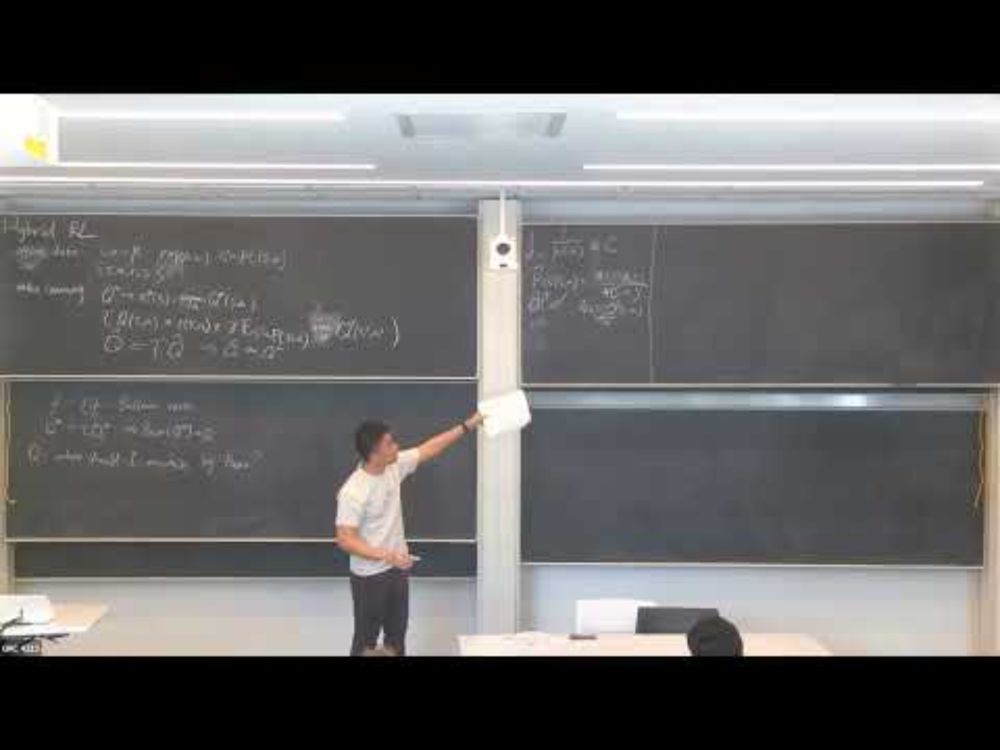
Algorithmic Foundations of Interactive Learning SP25: Lecture 17
YouTube video by Gokul Swamy
youtu.be
June 20, 2025 at 3:53 AM
We also had wonderful guest lectures from Yuda Song
on hybrid RL (youtu.be/1B2XGXQ2hfA), Sanjiban Choudhury on scaling imitation (youtu.be/KnXSeTuCgFI), and Wen Sun on RLHF algorithms (youtu.be/qdkBZJywi_4).
on hybrid RL (youtu.be/1B2XGXQ2hfA), Sanjiban Choudhury on scaling imitation (youtu.be/KnXSeTuCgFI), and Wen Sun on RLHF algorithms (youtu.be/qdkBZJywi_4).
My favorite lectures to give were on the value of interaction in imitation / RLHF! youtu.be/uESAXg-CXFs, youtu.be/N8-Nh_iTmps, youtu.be/qHvB30J5gyo, youtu.be/ZzFjoH47GIg. It took 5 years, but I finally have an answer at least I find compelling :p.
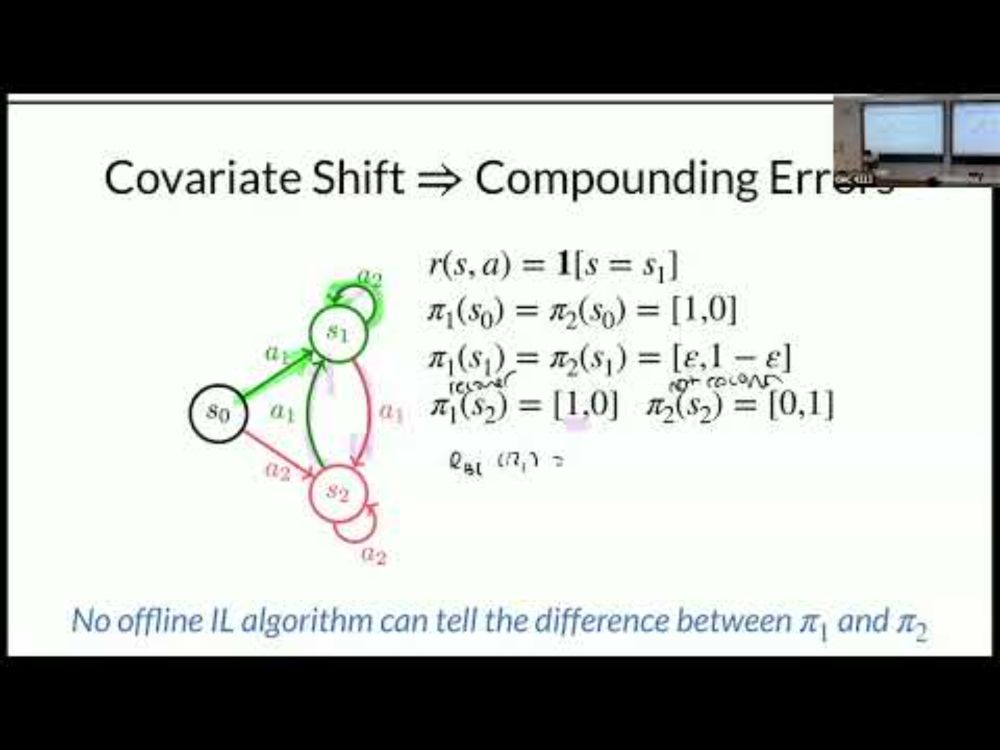
Algorithmic Foundations of Interactive Learning SP25: Lecture 19
YouTube video by Gokul Swamy
youtu.be
June 20, 2025 at 3:53 AM
My favorite lectures to give were on the value of interaction in imitation / RLHF! youtu.be/uESAXg-CXFs, youtu.be/N8-Nh_iTmps, youtu.be/qHvB30J5gyo, youtu.be/ZzFjoH47GIg. It took 5 years, but I finally have an answer at least I find compelling :p.
To do so, we worked backwards from things like ChatGPT and RMA and "backed out" a "dependency graph". We then did a "forward pass" over the semester, going from online learning, to game solving, to core RL, to imitation learning / robot learning, to RLHF / LLM fine-tuning.
June 20, 2025 at 3:53 AM
To do so, we worked backwards from things like ChatGPT and RMA and "backed out" a "dependency graph". We then did a "forward pass" over the semester, going from online learning, to game solving, to core RL, to imitation learning / robot learning, to RLHF / LLM fine-tuning.
I think in a field as fast-paced as machine learning, a good course gives students a conceptual framework for understanding new developments quickly + what is actually "new" vs. the classical algorithms. We also wanted to explain *when* scale isn't "all you need."
June 20, 2025 at 3:53 AM
I think in a field as fast-paced as machine learning, a good course gives students a conceptual framework for understanding new developments quickly + what is actually "new" vs. the classical algorithms. We also wanted to explain *when* scale isn't "all you need."
You can access all the content here:
Course Website: interactive-learning-algos.github.io
Lecture Playlist: youtube.com/playlist?lis...
Scribe Notes "Book": interactive-learning-algos.github.io/assets/pdfs/....
Homeworks / class competition material are also public!
Course Website: interactive-learning-algos.github.io
Lecture Playlist: youtube.com/playlist?lis...
Scribe Notes "Book": interactive-learning-algos.github.io/assets/pdfs/....
Homeworks / class competition material are also public!
Home
Website for AFIL course.
interactive-learning-algos.github.io
June 20, 2025 at 3:53 AM
You can access all the content here:
Course Website: interactive-learning-algos.github.io
Lecture Playlist: youtube.com/playlist?lis...
Scribe Notes "Book": interactive-learning-algos.github.io/assets/pdfs/....
Homeworks / class competition material are also public!
Course Website: interactive-learning-algos.github.io
Lecture Playlist: youtube.com/playlist?lis...
Scribe Notes "Book": interactive-learning-algos.github.io/assets/pdfs/....
Homeworks / class competition material are also public!