



Emma Roscow
@emmaroscow.bsky.social
Machine learning @ EcoVadis | ex-neuroscience-postdoc who still dabbles
Pinned
Emma Roscow
@emmaroscow.bsky.social
· Nov 29

Post-learning replay of hippocampal-striatal activity is biased by reward-prediction signals
Nature Communications - It is unclear which aspects of experience shape sleep’s contributions to learning. Here, by combining neural recordings in rats with reinforcement learning, the...
rdcu.be
New(ish) paper!
It's often said that hippocampal replay, which helps to build up a model of the world, is biased by reward. But the canonical temporal-difference learning requires updates proportional to reward-prediction error (RPE), not reward magnitude
1/4
rdcu.be/eRxNz
It's often said that hippocampal replay, which helps to build up a model of the world, is biased by reward. But the canonical temporal-difference learning requires updates proportional to reward-prediction error (RPE), not reward magnitude
1/4
rdcu.be/eRxNz
Reposted by Emma Roscow

People have been looking at "AI & brains" through the lens of LLMs/transformers. But what latent diffusion? (think text-to-image/video platforms such as Midjourney).
**Class conditioned latent diffusion and semantically cued hippocampus share a remarkably similar computational architecture...**
**Class conditioned latent diffusion and semantically cued hippocampus share a remarkably similar computational architecture...**

January 25, 2026 at 5:59 AM
People have been looking at "AI & brains" through the lens of LLMs/transformers. But what latent diffusion? (think text-to-image/video platforms such as Midjourney).
**Class conditioned latent diffusion and semantically cued hippocampus share a remarkably similar computational architecture...**
**Class conditioned latent diffusion and semantically cued hippocampus share a remarkably similar computational architecture...**
Reposted by Emma Roscow


Reposted by Emma Roscow

A few days ago, I stood in the graveyard of an 1100 year old church, getting damper and damper in the drizzling rain.
A woman walked into the graveyard, waved, said hello, and, as we had previously arranged, handed me a paper bag full of human bones.
The life of a churchwarden is a strange one...
A woman walked into the graveyard, waved, said hello, and, as we had previously arranged, handed me a paper bag full of human bones.
The life of a churchwarden is a strange one...
January 23, 2026 at 11:44 AM
A few days ago, I stood in the graveyard of an 1100 year old church, getting damper and damper in the drizzling rain.
A woman walked into the graveyard, waved, said hello, and, as we had previously arranged, handed me a paper bag full of human bones.
The life of a churchwarden is a strange one...
A woman walked into the graveyard, waved, said hello, and, as we had previously arranged, handed me a paper bag full of human bones.
The life of a churchwarden is a strange one...
Reposted by Emma Roscow

What is wild to me is the defense, BY THE NEURIPS BOARD, that fabricated citations do not mean "the content of the papers themselves [is] necessarily invalidated"
It does. It very much does. What do you think citing other work is for? What do you think writing a paper is for? What do you *think*?
It does. It very much does. What do you think citing other work is for? What do you think writing a paper is for? What do you *think*?

NEW: NeurIPS,one of the world’s top academic AI conferences, accepted research papers with 100+ AI-hallucinated citations, new report claims
fortune.com/2026/01/21/n...
fortune.com/2026/01/21/n...

NeurIPS papers contained 100+ AI-hallucinated citations, new report claims | Fortune
An analysis of NeurIPS 2025 papers by startup GPTZero reveals how AI-generated citations are slipping into elite academic research.
fortune.com
January 21, 2026 at 9:34 PM
What is wild to me is the defense, BY THE NEURIPS BOARD, that fabricated citations do not mean "the content of the papers themselves [is] necessarily invalidated"
It does. It very much does. What do you think citing other work is for? What do you think writing a paper is for? What do you *think*?
It does. It very much does. What do you think citing other work is for? What do you think writing a paper is for? What do you *think*?
Reposted by Emma Roscow

if i could make you read ONE (1) single post to improve your understanding of the challenges of social science in general it would be this one from @markfabian.bsky.social about wellbeing science specifically
profmarkfabian.substack.com/p/airing-my-...
profmarkfabian.substack.com/p/airing-my-...

Airing my grievances with wellbeing science
We have a streetlight problem
profmarkfabian.substack.com
January 19, 2026 at 9:35 AM
if i could make you read ONE (1) single post to improve your understanding of the challenges of social science in general it would be this one from @markfabian.bsky.social about wellbeing science specifically
profmarkfabian.substack.com/p/airing-my-...
profmarkfabian.substack.com/p/airing-my-...
Reposted by Emma Roscow

As I often write in my newsletter, the future of AI doesn't exist yet; we are building it right now, and every policy and regulatory choice counts.
To learn more about pro-human policies, rules, and rights, join 88,800+ subscribers here: www.luizasnewsletter.com
To learn more about pro-human policies, rules, and rights, join 88,800+ subscribers here: www.luizasnewsletter.com
January 15, 2026 at 12:33 PM
As I often write in my newsletter, the future of AI doesn't exist yet; we are building it right now, and every policy and regulatory choice counts.
To learn more about pro-human policies, rules, and rights, join 88,800+ subscribers here: www.luizasnewsletter.com
To learn more about pro-human policies, rules, and rights, join 88,800+ subscribers here: www.luizasnewsletter.com
Reposted by Emma Roscow

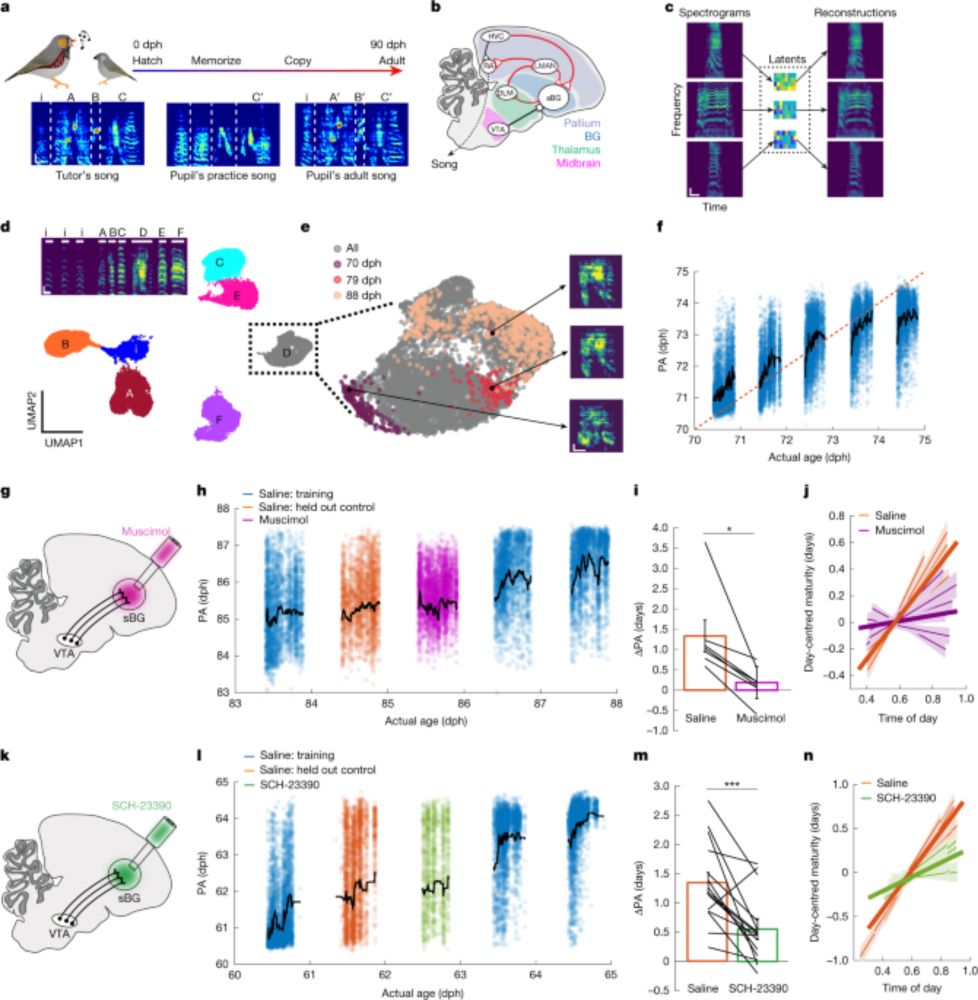
Proud to have contributed to @jiaxuanqi.bsky.social's masterpiece out @nature.com! She shows that dopamine transients track the learned quality of song during juvenile learning and that dopamine release is driven not just by VTA firing, but by a local cholinergic mechanism! (1/x)
Dual neuromodulatory dynamics underlie birdsong learning - Nature
Dopamine release in the basal ganglia of the zebra finch is driven by neurons associated with reinforcement learning and by cholinergic signalling, and tracks performance quality during long-term lear...
www.nature.com
March 12, 2025 at 4:54 PM
Proud to have contributed to @jiaxuanqi.bsky.social's masterpiece out @nature.com! She shows that dopamine transients track the learned quality of song during juvenile learning and that dopamine release is driven not just by VTA firing, but by a local cholinergic mechanism! (1/x)
Reposted by Emma Roscow
How does the brain replay memories during sleep?
Excited to share our new preprint, the outcome of an extensive effort led by Johannes Niediek, showing that reactivation of human concept neurons reflects memory content rather than event sequence.
Excited to share our new preprint, the outcome of an extensive effort led by Johannes Niediek, showing that reactivation of human concept neurons reflects memory content rather than event sequence.

Episodic memory consolidation by reactivation of human concept neurons during sleep reflects contents, not sequence of events https://www.biorxiv.org/content/10.64898/2026.01.10.698827v1
January 13, 2026 at 9:13 AM
How does the brain replay memories during sleep?
Excited to share our new preprint, the outcome of an extensive effort led by Johannes Niediek, showing that reactivation of human concept neurons reflects memory content rather than event sequence.
Excited to share our new preprint, the outcome of an extensive effort led by Johannes Niediek, showing that reactivation of human concept neurons reflects memory content rather than event sequence.
Reposted by Emma Roscow

Engram — separate the factual info from the weights, dedicate more weights to reasoning instead of fact lookup
They store facts outside the main NN layers and perform lookups during inference via n-grams.
This benefits not just knowledge, but also reasoning, bc fewer weights are dedicated to facts
They store facts outside the main NN layers and perform lookups during inference via n-grams.
This benefits not just knowledge, but also reasoning, bc fewer weights are dedicated to facts

January 12, 2026 at 10:28 PM
Engram — separate the factual info from the weights, dedicate more weights to reasoning instead of fact lookup
They store facts outside the main NN layers and perform lookups during inference via n-grams.
This benefits not just knowledge, but also reasoning, bc fewer weights are dedicated to facts
They store facts outside the main NN layers and perform lookups during inference via n-grams.
This benefits not just knowledge, but also reasoning, bc fewer weights are dedicated to facts
Reposted by Emma Roscow

Interesting read on how chunking can emerge directly from #synaptic dynamics: by temporarily suppressing groups of items via synaptic augmentation, #WorkingMemory can retrieve up to 8 items despite a base capacity of only 4.

January 12, 2026 at 8:32 PM
Interesting read on how chunking can emerge directly from #synaptic dynamics: by temporarily suppressing groups of items via synaptic augmentation, #WorkingMemory can retrieve up to 8 items despite a base capacity of only 4.
Reposted by Emma Roscow

With some trepidation, I'm putting this out into the world:
gershmanlab.com/textbook.html
It's a textbook called Computational Foundations of Cognitive Neuroscience, which I wrote for my class.
My hope is that this will be a living document, continuously improved as I get feedback.
gershmanlab.com/textbook.html
It's a textbook called Computational Foundations of Cognitive Neuroscience, which I wrote for my class.
My hope is that this will be a living document, continuously improved as I get feedback.
January 9, 2026 at 1:27 AM
With some trepidation, I'm putting this out into the world:
gershmanlab.com/textbook.html
It's a textbook called Computational Foundations of Cognitive Neuroscience, which I wrote for my class.
My hope is that this will be a living document, continuously improved as I get feedback.
gershmanlab.com/textbook.html
It's a textbook called Computational Foundations of Cognitive Neuroscience, which I wrote for my class.
My hope is that this will be a living document, continuously improved as I get feedback.
Reposted by Emma Roscow

Just published my review of neuroscience in 2025, on The Spike.
The 10th of these, would you believe?
This year we have foundation models, breakthroughs in using light to understand the brain, a gene therapy, and more
Enjoy!
medium.com/the-spike/20...
The 10th of these, would you believe?
This year we have foundation models, breakthroughs in using light to understand the brain, a gene therapy, and more
Enjoy!
medium.com/the-spike/20...

2025: A Review of the Year in Neuroscience
Enlightening the brain
medium.com
December 30, 2025 at 3:52 PM
Just published my review of neuroscience in 2025, on The Spike.
The 10th of these, would you believe?
This year we have foundation models, breakthroughs in using light to understand the brain, a gene therapy, and more
Enjoy!
medium.com/the-spike/20...
The 10th of these, would you believe?
This year we have foundation models, breakthroughs in using light to understand the brain, a gene therapy, and more
Enjoy!
medium.com/the-spike/20...
Reposted by Emma Roscow
Andrej Karpathy is worried about keeping up with software engineering practices

December 27, 2025 at 9:40 AM
Andrej Karpathy is worried about keeping up with software engineering practices
Reposted by Emma Roscow

Where is the story in a book?

Where are thoughts in the brain? Are they in the brain?
December 21, 2025 at 10:32 AM
Where is the story in a book?
Reposted by Emma Roscow
Seven feel-good science stories to round up 2025. All too often we forget to celebrate the positives
🧪
#AcademicSky
www.nature.com/articles/d41...
🧪
#AcademicSky
www.nature.com/articles/d41...

Seven feel-good science stories to restore your faith in 2025
Immense progress in gene-editing, drug discovery and conservation are just some of the reasons to be cheerful about 2025.
www.nature.com
December 18, 2025 at 8:15 AM
Seven feel-good science stories to round up 2025. All too often we forget to celebrate the positives
🧪
#AcademicSky
www.nature.com/articles/d41...
🧪
#AcademicSky
www.nature.com/articles/d41...
Reposted by Emma Roscow

Ok, this is nuts. Once you see it you cannot unsee it. Do you see it?
(OP @drgbuckingham.bsky.social )
(OP @drgbuckingham.bsky.social )

December 16, 2025 at 7:39 PM
Ok, this is nuts. Once you see it you cannot unsee it. Do you see it?
(OP @drgbuckingham.bsky.social )
(OP @drgbuckingham.bsky.social )
Reposted by Emma Roscow

I’ve been hearing two things:
- People are happy they can ask questions quickly without judgment or looking for the Right Person to ask in the office.
- People are unhappy that nobody asksthem questions, because that is how they get to know colleagues and win their trust.
- People are happy they can ask questions quickly without judgment or looking for the Right Person to ask in the office.
- People are unhappy that nobody asksthem questions, because that is how they get to know colleagues and win their trust.

In the AI social sphere:
- Developers like Claude Code + Claude Opus 4.5.
- People appreciate that AI does not judge. Unlike coworkers, who may silently label you as incompetent if you ask one too many “stupid” questions, AI will answer every question - including the ones you are hesitate to ask.
- Developers like Claude Code + Claude Opus 4.5.
- People appreciate that AI does not judge. Unlike coworkers, who may silently label you as incompetent if you ask one too many “stupid” questions, AI will answer every question - including the ones you are hesitate to ask.
December 15, 2025 at 3:18 PM
I’ve been hearing two things:
- People are happy they can ask questions quickly without judgment or looking for the Right Person to ask in the office.
- People are unhappy that nobody asksthem questions, because that is how they get to know colleagues and win their trust.
- People are happy they can ask questions quickly without judgment or looking for the Right Person to ask in the office.
- People are unhappy that nobody asksthem questions, because that is how they get to know colleagues and win their trust.
Reposted by Emma Roscow

This is pretty cool! 👍
google-deepmind.github.io/disco_rl/
google-deepmind.github.io/disco_rl/
Discovering State-of-the-art Reinforcement Learning Algorithms
We show that it is possible to automatically discover a state-of-the-art reinforcement learning (RL) algorithm that outperforms manually-designed ones across a variety of challenging benchmarks.
google-deepmind.github.io
December 15, 2025 at 3:19 PM
This is pretty cool! 👍
google-deepmind.github.io/disco_rl/
google-deepmind.github.io/disco_rl/
Reposted by Emma Roscow
Completely agree. And if I can make a self-promoting plug here, we have a nice table in this paper trying to separate some of these ideas out. The brain is very information-efficient (bits/ATP), while still being very expensive in energy consumption (ATP/sec).
www.sciencedirect.com/science/arti...
www.sciencedirect.com/science/arti...

December 8, 2025 at 2:23 PM
Completely agree. And if I can make a self-promoting plug here, we have a nice table in this paper trying to separate some of these ideas out. The brain is very information-efficient (bits/ATP), while still being very expensive in energy consumption (ATP/sec).
www.sciencedirect.com/science/arti...
www.sciencedirect.com/science/arti...
Reposted by Emma Roscow

Soapbox time: the problem with metabolic efficiency arguments in neuroscience is that they often confuse energy efficiency with energy expenditure. Biological systems are optimized for energy efficiency, but that does NOT imply they are optimized for low energy expenditure 🧵 1/

December 8, 2025 at 1:31 PM
Soapbox time: the problem with metabolic efficiency arguments in neuroscience is that they often confuse energy efficiency with energy expenditure. Biological systems are optimized for energy efficiency, but that does NOT imply they are optimized for low energy expenditure 🧵 1/
Reposted by Emma Roscow

Joint modelling of brain and behaviour dynamics with artificial intelligence
www.nature.com/articles/s41...
www.nature.com/articles/s41...

Joint modelling of brain and behaviour dynamics with artificial intelligence - Nature Reviews Neuroscience
Artificial intelligence is rapidly advancing our mechanistic understanding of the shared structure between the brain and higher-order behaviours. In this Review, Mathis and Mathis synthesize state-of-...
www.nature.com
December 3, 2025 at 4:59 PM
Joint modelling of brain and behaviour dynamics with artificial intelligence
www.nature.com/articles/s41...
www.nature.com/articles/s41...
Reposted by Emma Roscow

As a Doctor Who fan, I had to read and then re-read this.
I am a comma stan.
I am a comma stan.

December 3, 2025 at 9:04 PM
As a Doctor Who fan, I had to read and then re-read this.
I am a comma stan.
I am a comma stan.
Reposted by Emma Roscow

More press on our recent Behavioral and Brain Sciences article:
#philsci #cogsky #CognitiveNeuroscience
@phaueis.bsky.social
aktuell.uni-bielefeld.de/2025/11/24/t...
#philsci #cogsky #CognitiveNeuroscience
@phaueis.bsky.social
aktuell.uni-bielefeld.de/2025/11/24/t...

Thinking Takes Energy
A new study shows how our brain metabolism sets the limits of thinking. Researchers explain why cognitive models remain incomplete without considering biological resources.
aktuell.uni-bielefeld.de
December 1, 2025 at 11:33 PM
More press on our recent Behavioral and Brain Sciences article:
#philsci #cogsky #CognitiveNeuroscience
@phaueis.bsky.social
aktuell.uni-bielefeld.de/2025/11/24/t...
#philsci #cogsky #CognitiveNeuroscience
@phaueis.bsky.social
aktuell.uni-bielefeld.de/2025/11/24/t...
Reposted by Emma Roscow

A neat perspective on what makes RL for LLMs tractable

I'd say that's because it's not sparse reward in a meaningful way, in the same way Go in self-play is not sparse in a meaningful way.
That is, in Go, your reward is 0 for most time steps and only +1/-1 at end. That sound's sparse, but not from an algorithmic perspective.
That is, in Go, your reward is 0 for most time steps and only +1/-1 at end. That sound's sparse, but not from an algorithmic perspective.
December 1, 2025 at 12:52 PM
A neat perspective on what makes RL for LLMs tractable
Reposted by Emma Roscow

1/3 How reward prediction errors shape memory: when people gamble and cues signal unexpectedly high reward probability, those incidental images are remembered better than ones on safe trials, linking RL computations to episodic encoding. #RewardSignals #neuroskyence www.nature.com/articles/s41...

Positive reward prediction errors during decision-making strengthen memory encoding - Nature Human Behaviour
Jang and colleagues show that positive reward prediction errors elicited during incidental encoding enhance the formation of episodic memories.
www.nature.com
November 30, 2025 at 11:12 AM
1/3 How reward prediction errors shape memory: when people gamble and cues signal unexpectedly high reward probability, those incidental images are remembered better than ones on safe trials, linking RL computations to episodic encoding. #RewardSignals #neuroskyence www.nature.com/articles/s41...