



Gijs D Mulders
@gijsmulders.com
Pinned

Reposted by Gijs D Mulders
It's happening!!! Pandora is going to space in just over 16 hours (if all goes well). Pandora is going to help us study exoplanet atmospheres, even when their host stars are misbehaving. I am headed up to Vandenberg to watch the launch shortly, and will make a thread about the mission/launch here!

January 10, 2026 at 8:41 PM
It's happening!!! Pandora is going to space in just over 16 hours (if all goes well). Pandora is going to help us study exoplanet atmospheres, even when their host stars are misbehaving. I am headed up to Vandenberg to watch the launch shortly, and will make a thread about the mission/launch here!
Reposted by Gijs D Mulders

Ever wondered how many bins to choose when making a histogram of data? The answer is that you shouldn't choose a number of bins yourself! ☄️ #astrocode
Here's a little notebook explaining how to make less biased histograms:
Here's a little notebook explaining how to make less biased histograms:

Making histograms is a common way to estimate the true density distribution of a sample. But how can we choose the number of histogram bins? And if we get fancy and use kernel density estimation (KDE)...
Making histograms is a common way to estimate the true density distribution of a sample. But how can we choose the number of histogram bins? And if we get fancy and use kernel density estimation (K...
gist.github.com
December 19, 2025 at 9:19 AM
Ever wondered how many bins to choose when making a histogram of data? The answer is that you shouldn't choose a number of bins yourself! ☄️ #astrocode
Here's a little notebook explaining how to make less biased histograms:
Here's a little notebook explaining how to make less biased histograms:
Reposted by Gijs D Mulders
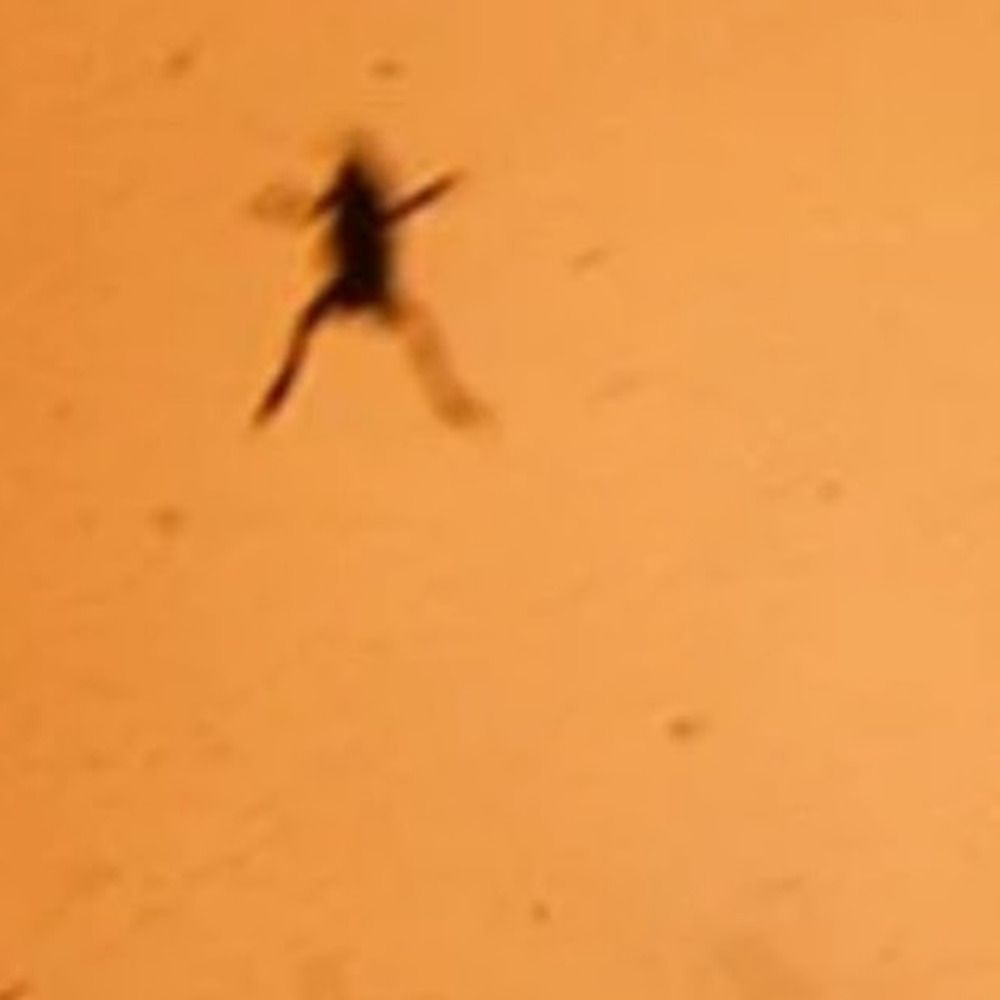
I'm very happy I woke up at 4am this morning to catch 3I/ATLAS right before its closest approach to Earth (today!) This interstellar visitor is traveling over 60 km/s ☄️
At 269 million km (1.8 AU), I took a series of 2.5 min exposures with my Seestar 🔭
At 269 million km (1.8 AU), I took a series of 2.5 min exposures with my Seestar 🔭
December 18, 2025 at 4:13 PM
I'm very happy I woke up at 4am this morning to catch 3I/ATLAS right before its closest approach to Earth (today!) This interstellar visitor is traveling over 60 km/s ☄️
At 269 million km (1.8 AU), I took a series of 2.5 min exposures with my Seestar 🔭
At 269 million km (1.8 AU), I took a series of 2.5 min exposures with my Seestar 🔭
Reposted by Gijs D Mulders
The application for the ESO Summer Research Programme 2026 has just opened!
It‘s a six week programme in Garching close to Munich where pre-Ph.D students can work on a hands-on project.
Working at @eso.org is a fabulous experience, so please help me spread the word ✨
🔗 eso.org/sci/meetings...
It‘s a six week programme in Garching close to Munich where pre-Ph.D students can work on a hands-on project.
Working at @eso.org is a fabulous experience, so please help me spread the word ✨
🔗 eso.org/sci/meetings...
ESO - SummerResearch2026
ESO is the European Organisation for Astronomical Research in the Southern Hemisphere. It operates the La Silla Paranal Observatory in Chile and has its headquarters in Garching, near Munich, Germany.
eso.org
December 17, 2025 at 1:12 PM
The application for the ESO Summer Research Programme 2026 has just opened!
It‘s a six week programme in Garching close to Munich where pre-Ph.D students can work on a hands-on project.
Working at @eso.org is a fabulous experience, so please help me spread the word ✨
🔗 eso.org/sci/meetings...
It‘s a six week programme in Garching close to Munich where pre-Ph.D students can work on a hands-on project.
Working at @eso.org is a fabulous experience, so please help me spread the word ✨
🔗 eso.org/sci/meetings...
Reposted by Gijs D Mulders
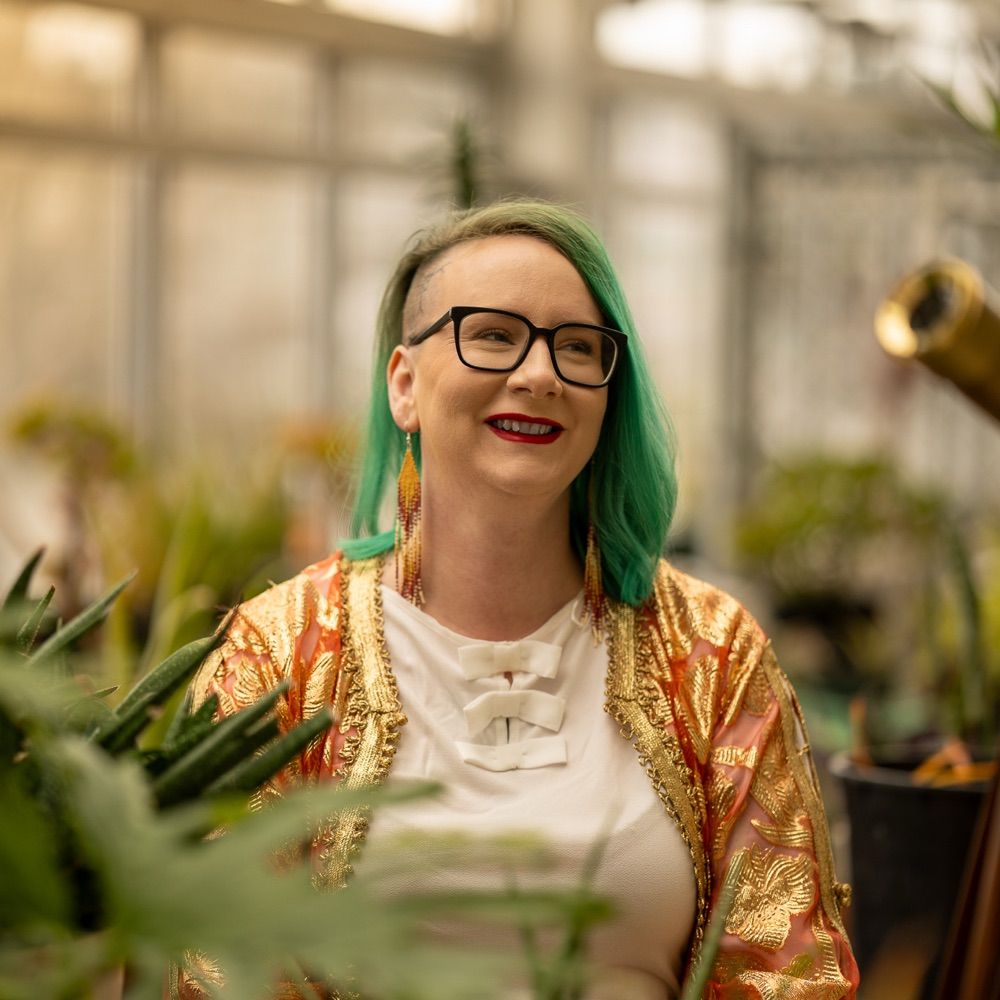
the day is finally here: you can order my debut non-fiction, CLOUDY WITH A CHANCE OF STARSHIPS: HOW THE DRAKE EQUATION REVEALS THE ODDS OF LIFE IN THE COSMOS from B&N!!
www.barnesandnoble.com/w/cloudy-wit...
www.barnesandnoble.com/w/cloudy-wit...

December 13, 2025 at 7:45 PM
the day is finally here: you can order my debut non-fiction, CLOUDY WITH A CHANCE OF STARSHIPS: HOW THE DRAKE EQUATION REVEALS THE ODDS OF LIFE IN THE COSMOS from B&N!!
www.barnesandnoble.com/w/cloudy-wit...
www.barnesandnoble.com/w/cloudy-wit...
Reposted by Gijs D Mulders

⭐️✨🔭Please help us get the message out about the 7th annual international ASPIRE program at @api.uva.nl. This summer 2026 school provides astronomy research experience for talented MSc students from countries where opportunities to move into a PhD program are limited. Applications are due 17 Dec! ⭐️✨🔭
ASPIRE
aspire.science.uva.nl
December 11, 2025 at 1:21 PM
⭐️✨🔭Please help us get the message out about the 7th annual international ASPIRE program at @api.uva.nl. This summer 2026 school provides astronomy research experience for talented MSc students from countries where opportunities to move into a PhD program are limited. Applications are due 17 Dec! ⭐️✨🔭
Equating giant planet occurrence rate of ~20% to the disk fraction, that means a timescale of ~10 Myr for giant planet formation!
New paper led by Fabian Polnitzcky & with @sratzenboeck.bsky.social + @joaoalves.bsky.social: based on the ages of stars with infrared excess in Sco-Cen, it seems planet-forming disks last around twice as long as previous estimates suggest - giving twice as long for planets to form. 🔭☄️ #exoplanets


December 9, 2025 at 2:53 PM
Equating giant planet occurrence rate of ~20% to the disk fraction, that means a timescale of ~10 Myr for giant planet formation!
Reposted by Gijs D Mulders
New paper led by Fabian Polnitzcky & with @sratzenboeck.bsky.social + @joaoalves.bsky.social: based on the ages of stars with infrared excess in Sco-Cen, it seems planet-forming disks last around twice as long as previous estimates suggest - giving twice as long for planets to form. 🔭☄️ #exoplanets
December 9, 2025 at 10:57 AM
New paper led by Fabian Polnitzcky & with @sratzenboeck.bsky.social + @joaoalves.bsky.social: based on the ages of stars with infrared excess in Sco-Cen, it seems planet-forming disks last around twice as long as previous estimates suggest - giving twice as long for planets to form. 🔭☄️ #exoplanets
Question for the #exoplanets crowd:
Does any one know where to find an updated version of this plot?
I'm looking for the "standard" exoplanet mass vs. semi-major axis plot, but with an overlay of which planets have a spectroscopic measurement of their atmosphere
wasp-planets.net/2020/09/29/w...
Does any one know where to find an updated version of this plot?
I'm looking for the "standard" exoplanet mass vs. semi-major axis plot, but with an overlay of which planets have a spectroscopic measurement of their atmosphere
wasp-planets.net/2020/09/29/w...

Which exoplanets do we have atmospheric spectra for?
Here’s an interesting plot created by Zafar Rustamkulov (@exoZafar), a PhD student at Johns Hopkins University. He has added up all the exoplanets for which we have either transmission spectr…
wasp-planets.net
November 19, 2025 at 12:21 AM
Question for the #exoplanets crowd:
Does any one know where to find an updated version of this plot?
I'm looking for the "standard" exoplanet mass vs. semi-major axis plot, but with an overlay of which planets have a spectroscopic measurement of their atmosphere
wasp-planets.net/2020/09/29/w...
Does any one know where to find an updated version of this plot?
I'm looking for the "standard" exoplanet mass vs. semi-major axis plot, but with an overlay of which planets have a spectroscopic measurement of their atmosphere
wasp-planets.net/2020/09/29/w...
Reposted by Gijs D Mulders

Enjoyed giving a UofA Origins talk on how protoplanetary disks evolve – featuring new results from ALMA and JWST. The recording is available here 👇
youtu.be/mdgGgnjVbb0
@uarizonalpl.bsky.social @stewardobservatory.bsky.social
youtu.be/mdgGgnjVbb0
@uarizonalpl.bsky.social @stewardobservatory.bsky.social

Protoplanetary Disk Evolution in the ALMA–JWST Era (Ilaria Pascucci, UArizona/LPL)
YouTube video by Origins Seminars
youtu.be
November 5, 2025 at 4:10 PM
Enjoyed giving a UofA Origins talk on how protoplanetary disks evolve – featuring new results from ALMA and JWST. The recording is available here 👇
youtu.be/mdgGgnjVbb0
@uarizonalpl.bsky.social @stewardobservatory.bsky.social
youtu.be/mdgGgnjVbb0
@uarizonalpl.bsky.social @stewardobservatory.bsky.social
Reposted by Gijs D Mulders
Big congrats to Jennifer Burt, Xavier Dumusque, and Sam Halverson on finishing their epic (instant classic) Annual Reviews of Astronomy & Astrophysics article "Precise Radial Velocities"!
arxiv.org/abs/2511.01954
contains some great new graphics for talks on
#exoplanets #EPRV #DopplerSpectroscopy
arxiv.org/abs/2511.01954
contains some great new graphics for talks on
#exoplanets #EPRV #DopplerSpectroscopy


November 5, 2025 at 7:20 AM
Big congrats to Jennifer Burt, Xavier Dumusque, and Sam Halverson on finishing their epic (instant classic) Annual Reviews of Astronomy & Astrophysics article "Precise Radial Velocities"!
arxiv.org/abs/2511.01954
contains some great new graphics for talks on
#exoplanets #EPRV #DopplerSpectroscopy
arxiv.org/abs/2511.01954
contains some great new graphics for talks on
#exoplanets #EPRV #DopplerSpectroscopy
Reposted by Gijs D Mulders

The NASA #Exoplanet Archive now has Gaia DR3 IDs! This should hopefully make your work and planning observations easier!
exoplanetarchive.ipac.caltech.edu
exoplanetarchive.ipac.caltech.edu

October 16, 2025 at 10:47 PM
The NASA #Exoplanet Archive now has Gaia DR3 IDs! This should hopefully make your work and planning observations easier!
exoplanetarchive.ipac.caltech.edu
exoplanetarchive.ipac.caltech.edu
Reposted by Gijs D Mulders

w/ Oli Shorttle, @johannateske.bsky.social & Eliza Kempton we reviewed our current understanding and prospects for peaking on the inside of small #exoplanets in "Constraining exoplanet interiors using observations of their atmospheres": www.science.org/stoken/autho... & arxiv.org/abs/2510.08844 🔭🧪⚒️☄️

October 13, 2025 at 12:27 PM
w/ Oli Shorttle, @johannateske.bsky.social & Eliza Kempton we reviewed our current understanding and prospects for peaking on the inside of small #exoplanets in "Constraining exoplanet interiors using observations of their atmospheres": www.science.org/stoken/autho... & arxiv.org/abs/2510.08844 🔭🧪⚒️☄️

October 8, 2025 at 9:10 PM
Reposted by Gijs D Mulders

Our paper on the JWST/MIRI observations of the epsilon Eridani system, led by Dr. Schuyler Wolff, were published today! This is the last of the Archetypical Disks in our MIRI Survey, after Fomalhaut and Vega. Just like for those disks, our MIRI images reveal an extended inner asteroid disk!

September 29, 2025 at 7:35 PM
Our paper on the JWST/MIRI observations of the epsilon Eridani system, led by Dr. Schuyler Wolff, were published today! This is the last of the Archetypical Disks in our MIRI Survey, after Fomalhaut and Vega. Just like for those disks, our MIRI images reveal an extended inner asteroid disk!
Reposted by Gijs D Mulders

I'm really excited about this one! It's fantastic working with Dr. Yayaati Chachan:
arxiv.org/abs/2509.20428
"Revising the Giant Planet Mass-Metallicity Relation: Deciphering the Formation Sequence of Giant Planets"
Lots of great nuggets her, including that even super-Jupiters are very metal-rich.
arxiv.org/abs/2509.20428
"Revising the Giant Planet Mass-Metallicity Relation: Deciphering the Formation Sequence of Giant Planets"
Lots of great nuggets her, including that even super-Jupiters are very metal-rich.

Revising the Giant Planet Mass-Metallicity Relation: Deciphering the Formation Sequence of Giant Planets
The rate at which giant planets accumulate solids and gas is a critical component of planet formation models, yet it is extremely challenging to predict from first principles. Characterizing the heavy...
arxiv.org
September 26, 2025 at 4:25 AM
I'm really excited about this one! It's fantastic working with Dr. Yayaati Chachan:
arxiv.org/abs/2509.20428
"Revising the Giant Planet Mass-Metallicity Relation: Deciphering the Formation Sequence of Giant Planets"
Lots of great nuggets her, including that even super-Jupiters are very metal-rich.
arxiv.org/abs/2509.20428
"Revising the Giant Planet Mass-Metallicity Relation: Deciphering the Formation Sequence of Giant Planets"
Lots of great nuggets her, including that even super-Jupiters are very metal-rich.
Reposted by Gijs D Mulders

Sometimes 2025 just feels like a lot, and you need an excuse to celebrate your fabulous team (and the whole exoplanet community!) reaching a new milestone…
Happy 6,000 Confirmed Exoplanets Day, everybody!!!!
(You may recognize the narrator of the video at the link! 🫣)
www.nasa.gov/universe/exo...
Happy 6,000 Confirmed Exoplanets Day, everybody!!!!
(You may recognize the narrator of the video at the link! 🫣)
www.nasa.gov/universe/exo...


September 17, 2025 at 6:22 PM
Sometimes 2025 just feels like a lot, and you need an excuse to celebrate your fabulous team (and the whole exoplanet community!) reaching a new milestone…
Happy 6,000 Confirmed Exoplanets Day, everybody!!!!
(You may recognize the narrator of the video at the link! 🫣)
www.nasa.gov/universe/exo...
Happy 6,000 Confirmed Exoplanets Day, everybody!!!!
(You may recognize the narrator of the video at the link! 🫣)
www.nasa.gov/universe/exo...
Reposted by Gijs D Mulders

Paper day!
You're doing ground-based high-resolution exoplanet transmission spectroscopy and want to analyse the planet—not the star or Earth's atmosphere.
Is there a way to disentangle your spectrum *without* destroying the planet signal?
arxiv.org/abs/2509.12737
🧵⬇️
🔭 #exoplanets #astromethods
You're doing ground-based high-resolution exoplanet transmission spectroscopy and want to analyse the planet—not the star or Earth's atmosphere.
Is there a way to disentangle your spectrum *without* destroying the planet signal?
arxiv.org/abs/2509.12737
🧵⬇️
🔭 #exoplanets #astromethods

TSD: An inverse problem approach for recovering the exoplanetary atmosphere transmission spectrum from high-resolution spectroscopy
Our ability to observe, detect, and characterize exoplanetary atmospheres has grown by leaps and bounds over the last 20 years, aided largely by developments in astronomical instrumentation; improveme...
arxiv.org
September 17, 2025 at 3:05 PM
Paper day!
You're doing ground-based high-resolution exoplanet transmission spectroscopy and want to analyse the planet—not the star or Earth's atmosphere.
Is there a way to disentangle your spectrum *without* destroying the planet signal?
arxiv.org/abs/2509.12737
🧵⬇️
🔭 #exoplanets #astromethods
You're doing ground-based high-resolution exoplanet transmission spectroscopy and want to analyse the planet—not the star or Earth's atmosphere.
Is there a way to disentangle your spectrum *without* destroying the planet signal?
arxiv.org/abs/2509.12737
🧵⬇️
🔭 #exoplanets #astromethods
Reposted by Gijs D Mulders
For the last two years, I've been paying for the Astronomy feeds hosting myself.
It has been a privilege to grow our community here, but I also shouldn't keep doing it for free 😅
That's why I'm delighted to announce that we now have a donations page on Open Collective! 🔭☄️ #astrophotography
It has been a privilege to grow our community here, but I also shouldn't keep doing it for free 😅
That's why I'm delighted to announce that we now have a donations page on Open Collective! 🔭☄️ #astrophotography

The Astrosky Ecosystem - Open Collective
We're building an open-source ecosystem of social media tools for the space science & astronomy communities.
opencollective.com
September 8, 2025 at 3:51 PM
For the last two years, I've been paying for the Astronomy feeds hosting myself.
It has been a privilege to grow our community here, but I also shouldn't keep doing it for free 😅
That's why I'm delighted to announce that we now have a donations page on Open Collective! 🔭☄️ #astrophotography
It has been a privilege to grow our community here, but I also shouldn't keep doing it for free 😅
That's why I'm delighted to announce that we now have a donations page on Open Collective! 🔭☄️ #astrophotography
Reposted by Gijs D Mulders

Seems like Ayumu Shoshi et al. did take a high-resolution ALMA image of the disk around IRAS 04125+2902. arxiv.org/abs/2509.01896
This system also has the youngest transiting #exoplanet, discovered in November 2024 with TESS.
Disk, planet orbit and outer stellar companion orbit are all misaligned.
This system also has the youngest transiting #exoplanet, discovered in November 2024 with TESS.
Disk, planet orbit and outer stellar companion orbit are all misaligned.

September 3, 2025 at 8:21 AM
Seems like Ayumu Shoshi et al. did take a high-resolution ALMA image of the disk around IRAS 04125+2902. arxiv.org/abs/2509.01896
This system also has the youngest transiting #exoplanet, discovered in November 2024 with TESS.
Disk, planet orbit and outer stellar companion orbit are all misaligned.
This system also has the youngest transiting #exoplanet, discovered in November 2024 with TESS.
Disk, planet orbit and outer stellar companion orbit are all misaligned.
Reposted by Gijs D Mulders

Proud supervisor moment: #LeidenObservatory graduate student Richelle van Capelleveen led one of two papers on our discovery of WISPIT 2b, a 5 Jupiter mass exoplanet clearing a path in a circumstellar disk. Laird Close and his team saw it in H-alpha, indicating gas accretion #astrodon 🔭 🧪

August 26, 2025 at 11:51 AM
Proud supervisor moment: #LeidenObservatory graduate student Richelle van Capelleveen led one of two papers on our discovery of WISPIT 2b, a 5 Jupiter mass exoplanet clearing a path in a circumstellar disk. Laird Close and his team saw it in H-alpha, indicating gas accretion #astrodon 🔭 🧪
Reposted by Gijs D Mulders

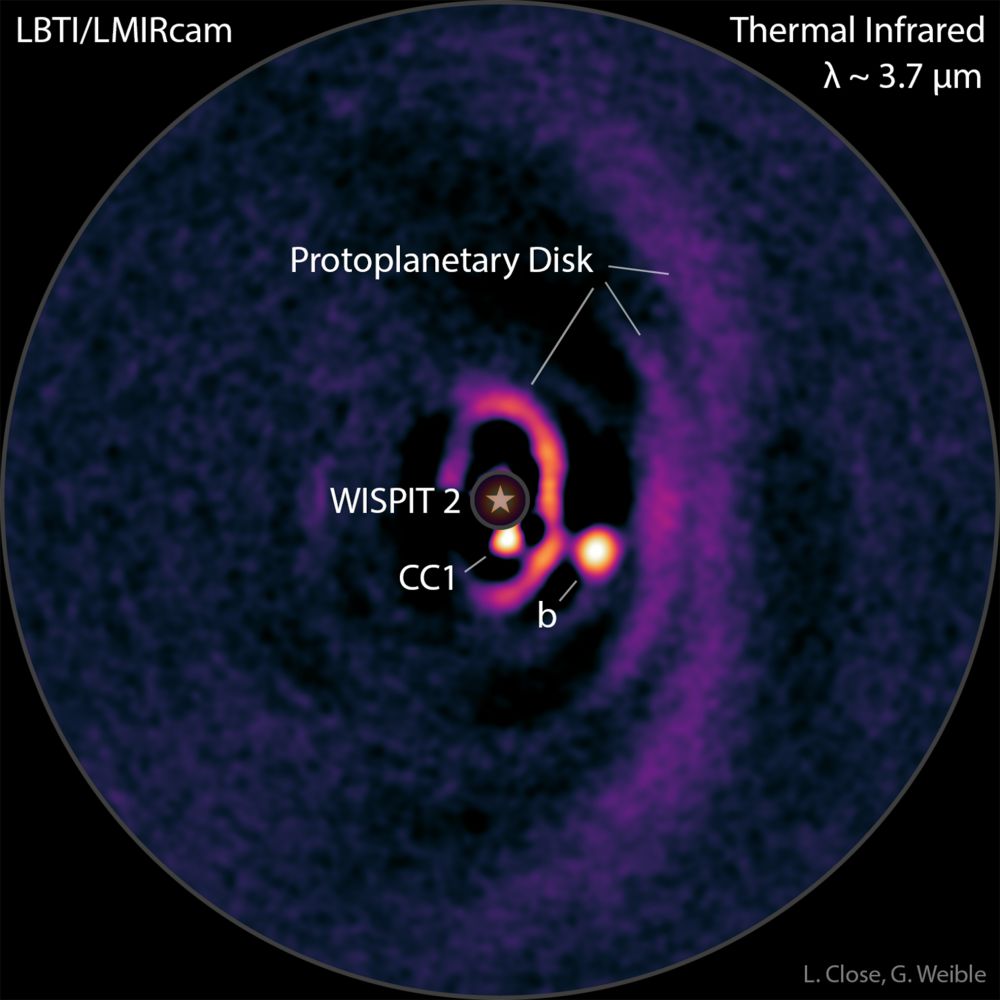
New protoplanet(s?) alert! I'm happy to share this LBTI image of WISPIT 2 from our team's paper led by Laird Close. Planet b was discovered at Hα with MagAO-X following the SPHERE disk discovery (R. van Capelleveen +), and CC1 might be a candidate 2nd (enshrouded?) protoplanet #exoplanets ☄️🔭🧪
August 26, 2025 at 5:40 PM
New protoplanet(s?) alert! I'm happy to share this LBTI image of WISPIT 2 from our team's paper led by Laird Close. Planet b was discovered at Hα with MagAO-X following the SPHERE disk discovery (R. van Capelleveen +), and CC1 might be a candidate 2nd (enshrouded?) protoplanet #exoplanets ☄️🔭🧪

August 20, 2025 at 10:04 PM
Reposted by Gijs D Mulders
I think that mass-loss is important for sub-Neptunes and the "radius valley," but I do not think that "core-powered" escape is significant. We find that "Boil-off," right when the disk dissipates, and then XUV driven escape, are major influences.
ui.adsabs.harvard.edu/abs/2024ApJ....
ui.adsabs.harvard.edu/abs/2024ApJ....
ui.adsabs.harvard.edu
August 19, 2025 at 7:06 PM
I think that mass-loss is important for sub-Neptunes and the "radius valley," but I do not think that "core-powered" escape is significant. We find that "Boil-off," right when the disk dissipates, and then XUV driven escape, are major influences.
ui.adsabs.harvard.edu/abs/2024ApJ....
ui.adsabs.harvard.edu/abs/2024ApJ....
Question for the radial velocity #exoplanets experts:
Is there an animation that shows two spectra being shifted with respect to each other and the corresponding values of the cross correlation function changing?
I think I’ve seen one in a talk but can’t find a nice animation online
Is there an animation that shows two spectra being shifted with respect to each other and the corresponding values of the cross correlation function changing?
I think I’ve seen one in a talk but can’t find a nice animation online
August 18, 2025 at 11:19 PM
Question for the radial velocity #exoplanets experts:
Is there an animation that shows two spectra being shifted with respect to each other and the corresponding values of the cross correlation function changing?
I think I’ve seen one in a talk but can’t find a nice animation online
Is there an animation that shows two spectra being shifted with respect to each other and the corresponding values of the cross correlation function changing?
I think I’ve seen one in a talk but can’t find a nice animation online