




The Fractional Occupation Density (FOD) diagnostic can help to identify systems with multi-reference character in a fast and intuitive way. Check out the recent paper by Bun Chan and our tutorials on FOD with ORCA.
www.faccts.de/docs/orca/6....
pubs.acs.org/doi/full/10....
#ORCAqc #CompChem
www.faccts.de/docs/orca/6....
pubs.acs.org/doi/full/10....
#ORCAqc #CompChem

The Paradox of Global Multireference Diagnostics
Modern computational chemistry methods are a useful tool for modeling many chemical systems, but they are challenged by multireference species (e.g., transition metals). A variety of diagnostics have been formulated to identify such cases. They are typically developed by analyzing multireference characters of small molecules, and many provide an average picture of the entire system. We caution the use of such diagnostics for large systems because large systems may include parts with varying degrees of multireference characters. Specifically, a small but highly multireference component may yield a large error in absolute terms, which may be masked in an average value over the entire molecule. As the calculation of molecular relative energies often concerns errors in absolute terms, such a false sense of safety may be detrimental. A prospective means to tackle this challenge is to use fractional occupation density to identify potentially problematic components in a system and then examine this moiety with higher-level computations on appropriately constructed smaller models.
pubs.acs.org
December 9, 2024 at 1:46 PM
The Fractional Occupation Density (FOD) diagnostic can help to identify systems with multi-reference character in a fast and intuitive way. Check out the recent paper by Bun Chan and our tutorials on FOD with ORCA.
www.faccts.de/docs/orca/6....
pubs.acs.org/doi/full/10....
#ORCAqc #CompChem
www.faccts.de/docs/orca/6....
pubs.acs.org/doi/full/10....
#ORCAqc #CompChem
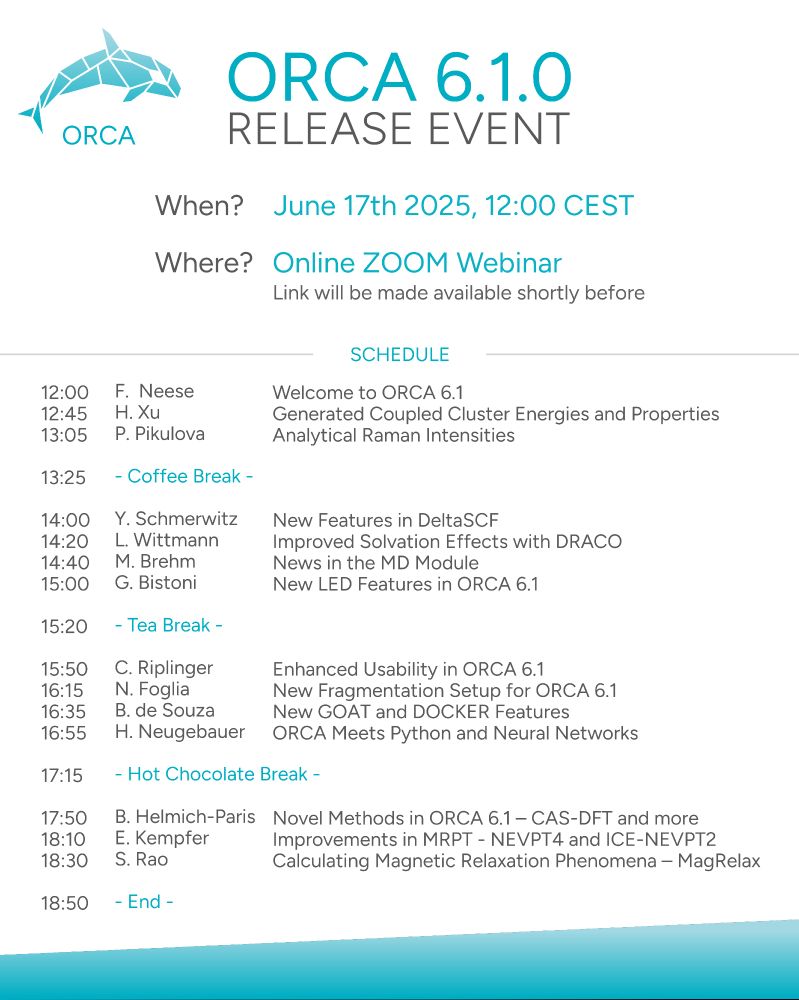
Save the Date! Join us for the ORCA 6.1 (@faccts.de & @orca-qc-official.bsky.social) online release event on 17th June 2025 12:00 CEST. We look forward to many exciting discussions with you!
#ORCAqc #ORCA61 #FACCTs #QuantumChem #CompChem #ChemSky #CompChemSky
#ORCAqc #ORCA61 #FACCTs #QuantumChem #CompChem #ChemSky #CompChemSky
June 5, 2025 at 1:25 PM
Save the Date! Join us for the ORCA 6.1 (@faccts.de & @orca-qc-official.bsky.social) online release event on 17th June 2025 12:00 CEST. We look forward to many exciting discussions with you!
#ORCAqc #ORCA61 #FACCTs #QuantumChem #CompChem #ChemSky #CompChemSky
#ORCAqc #ORCA61 #FACCTs #QuantumChem #CompChem #ChemSky #CompChemSky
Large benchmark sets require an efficient QM software like ORCA (@FACCTs_ORCA & MPI Kofo) both to generate them and to test new methods. With ORCA 6, many tasks became even faster. Try it out, it's completely free for academic use!
#ORCAqc #ORCA6 #CompChem #ChemSky
pubs.acs.org/doi/10.1021/...
#ORCAqc #ORCA6 #CompChem #ChemSky
pubs.acs.org/doi/10.1021/...

Emerging Conformational-Analysis Protocols from the RTCONF55-16K Reaction Thermochemistry Conformational Benchmark Set
RTCONF55-16K is a new, reactive conformational data set based on cost-efficient methods to assess different conformational analysis protocols. Our reference calculations underpinned the accuracy of th...
pubs.acs.org
October 1, 2024 at 3:48 PM
Large benchmark sets require an efficient QM software like ORCA (@FACCTs_ORCA & MPI Kofo) both to generate them and to test new methods. With ORCA 6, many tasks became even faster. Try it out, it's completely free for academic use!
#ORCAqc #ORCA6 #CompChem #ChemSky
pubs.acs.org/doi/10.1021/...
#ORCAqc #ORCA6 #CompChem #ChemSky
pubs.acs.org/doi/10.1021/...
Missed the ORCA 6.1 release event? All talks are now online on our YouTube channel!
www.youtube.com/@faccts_orca
ORCA 6.1 Release Event Playlist:
www.youtube.com/watch?v=mRSk...
#ORCA61 #ORCAqc #FACCTs #MPIKOFO #CompChem #QuantumChem #ChemSky #CompChemSky
www.youtube.com/@faccts_orca
ORCA 6.1 Release Event Playlist:
www.youtube.com/watch?v=mRSk...
#ORCA61 #ORCAqc #FACCTs #MPIKOFO #CompChem #QuantumChem #ChemSky #CompChemSky

FACCTs
FACCTs is bringing the ORCA software to industry - promoting the next Quantum leaps in the Pharma, Materials and Chemical Industries.
www.youtube.com
June 18, 2025 at 3:49 PM
Missed the ORCA 6.1 release event? All talks are now online on our YouTube channel!
www.youtube.com/@faccts_orca
ORCA 6.1 Release Event Playlist:
www.youtube.com/watch?v=mRSk...
#ORCA61 #ORCAqc #FACCTs #MPIKOFO #CompChem #QuantumChem #ChemSky #CompChemSky
www.youtube.com/@faccts_orca
ORCA 6.1 Release Event Playlist:
www.youtube.com/watch?v=mRSk...
#ORCA61 #ORCAqc #FACCTs #MPIKOFO #CompChem #QuantumChem #ChemSky #CompChemSky
Another great method to study XAS in ORCA (@orca-qc-official.bsky.social & @faccts-orca.bsky.social)! Check out the recent paper on core-excited states for open-shell systems with CVS-USTEOM-CCSD in ORCA by Marcos Casanova-Páez and Frank Neese.
#ORCAqc #CompChem #XAS
pubs.acs.org/doi/10.1021/...
#ORCAqc #CompChem #XAS
pubs.acs.org/doi/10.1021/...

Core-Excited States for Open-Shell Systems in Similarity-Transformed Equation-of-Motion Theory
X-ray absorption spectroscopy (XAS) is a powerful method for exploring molecular electronic structure by exciting core electrons into higher unoccupied molecular orbitals. In this study, we present th...
pubs.acs.org
February 3, 2025 at 9:20 AM
Another great method to study XAS in ORCA (@orca-qc-official.bsky.social & @faccts-orca.bsky.social)! Check out the recent paper on core-excited states for open-shell systems with CVS-USTEOM-CCSD in ORCA by Marcos Casanova-Páez and Frank Neese.
#ORCAqc #CompChem #XAS
pubs.acs.org/doi/10.1021/...
#ORCAqc #CompChem #XAS
pubs.acs.org/doi/10.1021/...
The 16th Latin American Conference on Physical Organic Chemistry (CLAFQO-16) starts on November 4th in Florianópolis, Brazil! Bernardo de Souza (@bernadsz.bsky.social) will give a presentation on the new Global Optimizer AlgoriThm (GOAT) in ORCA 6 (FACCTs & MPI Kofo).
#ORCAqc #ORCA6 #CLAFQO16
#ORCAqc #ORCA6 #CLAFQO16

October 23, 2024 at 8:51 AM
The 16th Latin American Conference on Physical Organic Chemistry (CLAFQO-16) starts on November 4th in Florianópolis, Brazil! Bernardo de Souza (@bernadsz.bsky.social) will give a presentation on the new Global Optimizer AlgoriThm (GOAT) in ORCA 6 (FACCTs & MPI Kofo).
#ORCAqc #ORCA6 #CLAFQO16
#ORCAqc #ORCA6 #CLAFQO16
Check out the recent work by Pantazis and Santra (MPI Kofo) who use ORCA's rich quantum chemistry toolkit to investigate the conformational profile of Galactose-α-1,3-Galactose (α-Gal) and the structural basis of its immunological response.
doi.org/10.1002/chem...
#ORCAqc #CompChemSky #ChemSky
doi.org/10.1002/chem...
#ORCAqc #CompChemSky #ChemSky

Conformational Profile of Galactose‐α‐1,3‐Galactose (α‐Gal) and Structural Basis of Its Immunological Response
A multilevel computational analysis of the disaccharide α-Gal describes in detail its rigid conformational profile in solution, while multiscale hybrid (QM/MM) calculations, energy decomposition and ...
doi.org
March 26, 2025 at 10:37 AM
Check out the recent work by Pantazis and Santra (MPI Kofo) who use ORCA's rich quantum chemistry toolkit to investigate the conformational profile of Galactose-α-1,3-Galactose (α-Gal) and the structural basis of its immunological response.
doi.org/10.1002/chem...
#ORCAqc #CompChemSky #ChemSky
doi.org/10.1002/chem...
#ORCAqc #CompChemSky #ChemSky
Increase the efficiency of your embedded cluster model (ECM) calculations in ORCA 6 (FACCTs & Max-Planck-Institut für Kohlenforschung) with the fast multipole method (FMM) by Pauline Colinet, Frank Neese, and Benjamin Helmich-Paris.
doi.org/10.1002/jcc....
#ORCAqc #CompChem #QuantumChem #ChemSky
doi.org/10.1002/jcc....
#ORCAqc #CompChem #QuantumChem #ChemSky
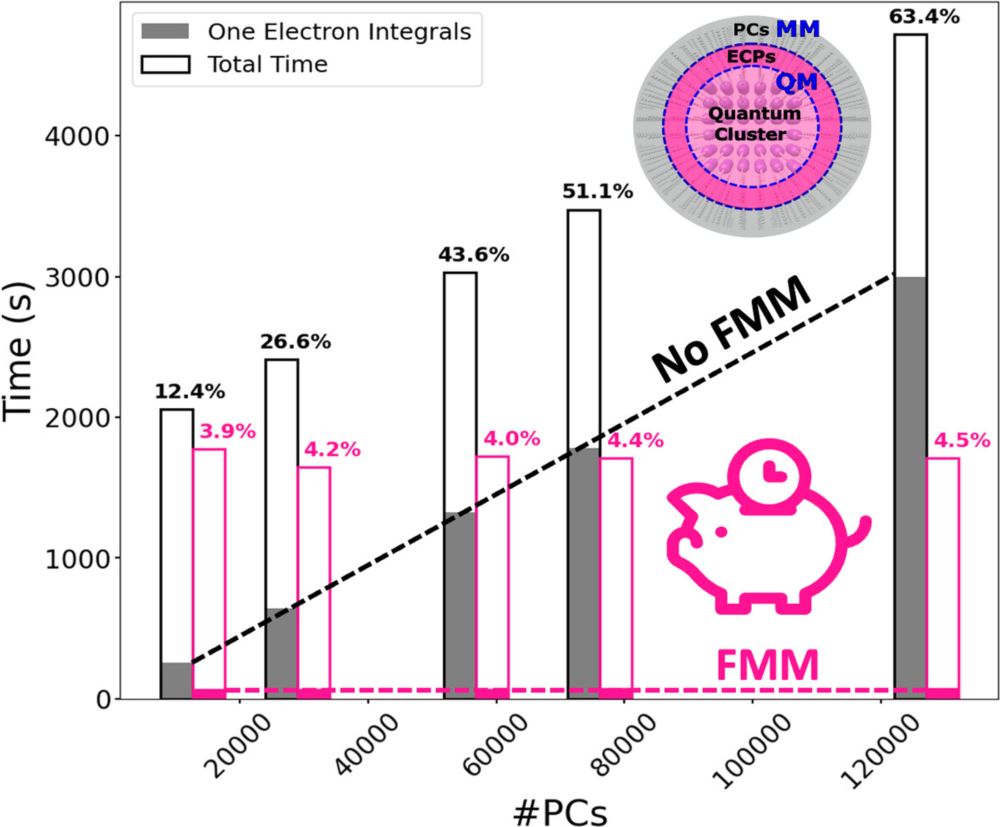
Improving the Efficiency of Electrostatic Embedding Using the Fast Multipole Method
This paper reports the improvement in the efficiency of Embedded Cluster Model (ECM) calculations in ORCA thanks to the implementation of the Fast Multipole Method. The outcome of the work is a one o...
doi.org
December 12, 2024 at 9:17 AM
Increase the efficiency of your embedded cluster model (ECM) calculations in ORCA 6 (FACCTs & Max-Planck-Institut für Kohlenforschung) with the fast multipole method (FMM) by Pauline Colinet, Frank Neese, and Benjamin Helmich-Paris.
doi.org/10.1002/jcc....
#ORCAqc #CompChem #QuantumChem #ChemSky
doi.org/10.1002/jcc....
#ORCAqc #CompChem #QuantumChem #ChemSky
“Built with the high-performance quantum chemistry program package ORCA (Version 6.0.1), OMol25 contains simulations of large atomic systems that, until now, have been out of reach.” - Meta
#ORCAqc #ORCA6 #CompChem #QuantumChem #ML #Meta
ai.meta.com/blog/meta-fa...
arxiv.org/abs/2505.08762
#ORCAqc #ORCA6 #CompChem #QuantumChem #ML #Meta
ai.meta.com/blog/meta-fa...
arxiv.org/abs/2505.08762

Sharing new breakthroughs and artifacts supporting molecular property prediction, language processing, and neuroscience
Meta FAIR is sharing new research artifacts that highlight our commitment to advanced machine intelligence (AMI) through focused scientific and academic progress.
ai.meta.com
May 15, 2025 at 11:02 AM
“Built with the high-performance quantum chemistry program package ORCA (Version 6.0.1), OMol25 contains simulations of large atomic systems that, until now, have been out of reach.” - Meta
#ORCAqc #ORCA6 #CompChem #QuantumChem #ML #Meta
ai.meta.com/blog/meta-fa...
arxiv.org/abs/2505.08762
#ORCAqc #ORCA6 #CompChem #QuantumChem #ML #Meta
ai.meta.com/blog/meta-fa...
arxiv.org/abs/2505.08762
With ORCA 6 (FACCTs & MPI Kofo), openCOSMO-RS became part of its versatile solvation toolkit. Check out the new paper on its most recent parameterization (doi.org/10.1016/j.fl...) and try it yourself with our tutorial.
www.faccts.de/docs/orca/6....
#ChemSky #ORCAqc #ORCA6 #Solvation #CompChem
www.faccts.de/docs/orca/6....
#ChemSky #ORCAqc #ORCA6 #Solvation #CompChem
Implicit Solvation Models - ORCA 6.0 TUTORIALSContentsMenuExpandLight modeDark modeAuto light/dark mode
www.faccts.de
October 31, 2024 at 2:11 PM
With ORCA 6 (FACCTs & MPI Kofo), openCOSMO-RS became part of its versatile solvation toolkit. Check out the new paper on its most recent parameterization (doi.org/10.1016/j.fl...) and try it yourself with our tutorial.
www.faccts.de/docs/orca/6....
#ChemSky #ORCAqc #ORCA6 #Solvation #CompChem
www.faccts.de/docs/orca/6....
#ChemSky #ORCAqc #ORCA6 #Solvation #CompChem
Solute-solvent interactions can have a decisive influence on reaction mechanisms and selectivities. Bistoni, Neese, Harden and co-workers studied the van der Waals solute-solvent interactions in detail using ORCA's method toolkit.
doi.org/10.1039/D4SC...
#ORCAqc #ChemSky #CompChemSky
doi.org/10.1039/D4SC...
#ORCAqc #ChemSky #CompChemSky

Understanding and quantifying the impact of solute–solvent van der Waals interactions on the selectivity of asymmetric catalytic transformations
The majority of enantioselective organocatalytic reactions occur in apolar or weakly polar organic solvents. Nevertheless, the influence of solute–solvent van der Waals forces on the relative kinetics...
doi.org
March 17, 2025 at 9:24 AM
Solute-solvent interactions can have a decisive influence on reaction mechanisms and selectivities. Bistoni, Neese, Harden and co-workers studied the van der Waals solute-solvent interactions in detail using ORCA's method toolkit.
doi.org/10.1039/D4SC...
#ORCAqc #ChemSky #CompChemSky
doi.org/10.1039/D4SC...
#ORCAqc #ChemSky #CompChemSky
The new bugfix version ORCA 6.0.1 (FACCTs & MPI für Kohlenforschung) will be released tomorrow, November 5th 2024. The download of the academic version will be possible via orcaforum.kofo.mpg.de), stay tuned!
#ORCAqc #ORCA6 #CompChem #QuantumChem
#ORCAqc #ORCA6 #CompChem #QuantumChem

November 4, 2024 at 11:57 AM
The new bugfix version ORCA 6.0.1 (FACCTs & MPI für Kohlenforschung) will be released tomorrow, November 5th 2024. The download of the academic version will be possible via orcaforum.kofo.mpg.de), stay tuned!
#ORCAqc #ORCA6 #CompChem #QuantumChem
#ORCAqc #ORCA6 #CompChem #QuantumChem
You can now use g-xTB @grimmelab.bsky.social with ORCA via the ExtOpt feature! Check out our new tutorial and learn how to use it in GOAT, NEB-TS and more.
www.faccts.de/docs/orca/6....
#ORCAqc #FACCTs #gxTB #CompChem #QuantumChem
www.faccts.de/docs/orca/6....
#ORCAqc #FACCTs #gxTB #CompChem #QuantumChem
ORCA as External Optimizer - ORCA 6.1 TUTORIALS
www.faccts.de
June 26, 2025 at 8:32 AM
You can now use g-xTB @grimmelab.bsky.social with ORCA via the ExtOpt feature! Check out our new tutorial and learn how to use it in GOAT, NEB-TS and more.
www.faccts.de/docs/orca/6....
#ORCAqc #FACCTs #gxTB #CompChem #QuantumChem
www.faccts.de/docs/orca/6....
#ORCAqc #FACCTs #gxTB #CompChem #QuantumChem
The GCC 2024 starts next Monday. We hope many of you will join for the presentations by Christoph Riplinger and Jeroen Koopman on different quantum chemical challenges. So save the dates and we'll see you there!
#GCC2024 #ORCAqc #CompChem #QuantumChem #ChemSky
#GCC2024 #ORCAqc #CompChem #QuantumChem #ChemSky

October 30, 2024 at 2:41 PM
The GCC 2024 starts next Monday. We hope many of you will join for the presentations by Christoph Riplinger and Jeroen Koopman on different quantum chemical challenges. So save the dates and we'll see you there!
#GCC2024 #ORCAqc #CompChem #QuantumChem #ChemSky
#GCC2024 #ORCAqc #CompChem #QuantumChem #ChemSky
Join us at the free Virtual Winter School on Computational Chemistry and learn more about the features of ORCA 6! The ORCA workshop starts on Thursday, January 30th at 2 pm CET. The program and more information can be found here:
winterschool.cc/program/day-...
#ORCAqc #ORCA6 #VWSCC #ChemSky
winterschool.cc/program/day-...
#ORCAqc #ORCA6 #VWSCC #ChemSky
Virtual Winter School on Computational Chemistry - Workshop - ORCA 6
Online congress discussing state of the art computational chemistry
winterschool.cc
January 17, 2025 at 9:56 AM
Join us at the free Virtual Winter School on Computational Chemistry and learn more about the features of ORCA 6! The ORCA workshop starts on Thursday, January 30th at 2 pm CET. The program and more information can be found here:
winterschool.cc/program/day-...
#ORCAqc #ORCA6 #VWSCC #ChemSky
winterschool.cc/program/day-...
#ORCAqc #ORCA6 #VWSCC #ChemSky
The academic version of ORCA 6.0.1 (FACCTs & MPI Kofo) can now be downloaded via the ORCA forum (orcaforum.kofo.mpg.de/app.php/portal).
ORCA 6 release talks: youtube.com/@faccts_orca
Manual: www.faccts.de/docs/orca/6....
Tutorials: www.faccts.de/docs/orca/6....
#ORCA6 #ORCAqc #CompChem
ORCA 6 release talks: youtube.com/@faccts_orca
Manual: www.faccts.de/docs/orca/6....
Tutorials: www.faccts.de/docs/orca/6....
#ORCA6 #ORCAqc #CompChem

November 5, 2024 at 1:13 PM
The academic version of ORCA 6.0.1 (FACCTs & MPI Kofo) can now be downloaded via the ORCA forum (orcaforum.kofo.mpg.de/app.php/portal).
ORCA 6 release talks: youtube.com/@faccts_orca
Manual: www.faccts.de/docs/orca/6....
Tutorials: www.faccts.de/docs/orca/6....
#ORCA6 #ORCAqc #CompChem
ORCA 6 release talks: youtube.com/@faccts_orca
Manual: www.faccts.de/docs/orca/6....
Tutorials: www.faccts.de/docs/orca/6....
#ORCA6 #ORCAqc #CompChem
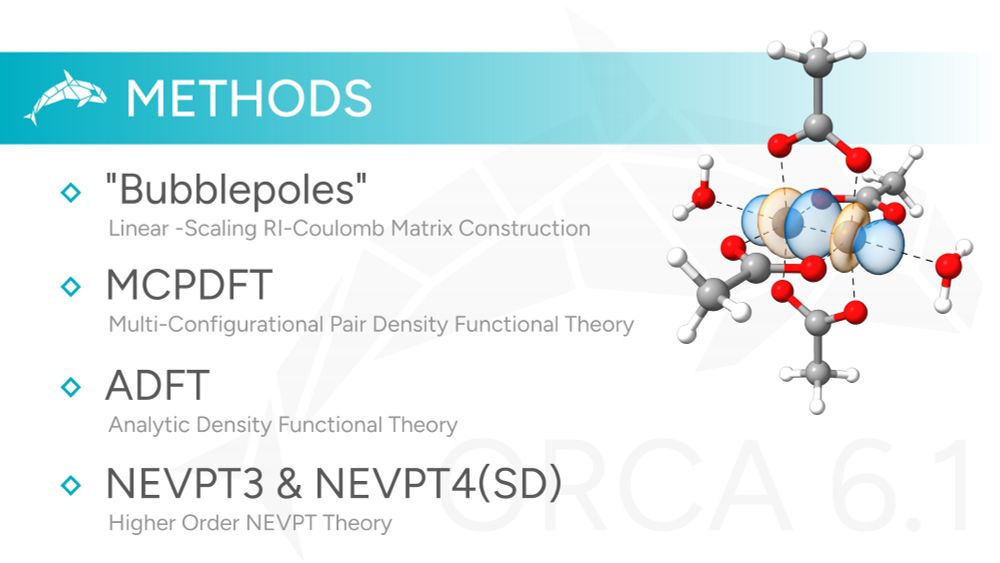
ORCA 6.1 will be released tomorrow after the online event to which you are all invited! As a final appetiser, we have a sneak preview of some new methods that will be available in the new version.
#ORCA61 #ORCAqc #CompChem #QuantumChem #TheoChem #FACCTs #MPIKOFO #ChemSky #CompChemSky
#ORCA61 #ORCAqc #CompChem #QuantumChem #TheoChem #FACCTs #MPIKOFO #ChemSky #CompChemSky
June 16, 2025 at 11:03 AM
ORCA 6.1 will be released tomorrow after the online event to which you are all invited! As a final appetiser, we have a sneak preview of some new methods that will be available in the new version.
#ORCA61 #ORCAqc #CompChem #QuantumChem #TheoChem #FACCTs #MPIKOFO #ChemSky #CompChemSky
#ORCA61 #ORCAqc #CompChem #QuantumChem #TheoChem #FACCTs #MPIKOFO #ChemSky #CompChemSky
The accessibility of state-of-the-art quantum chemistry is a core aspect of ORCA. We are therefore particularly proud that ORCA (@FACCTs & @orca-qc-official.bsky.social) is being used in such innovative projects as El Agente. Check it out!
#ORCAqc #CompChem #LLM #QuantumChem #ChemSky
#ORCAqc #CompChem #LLM #QuantumChem #ChemSky
👋 🤖 Meet El Agente–an autonomous AI for performing computational chemistry, made by the Matter Lab @uoft.bsky.social. This #LLM-powered multi-agent system making computational chemistry more accessible will soon be available worldwide. Sign up 4 the launch: acceleration.utoronto.ca/news/meet-el...
May 8, 2025 at 7:17 AM
The accessibility of state-of-the-art quantum chemistry is a core aspect of ORCA. We are therefore particularly proud that ORCA (@FACCTs & @orca-qc-official.bsky.social) is being used in such innovative projects as El Agente. Check it out!
#ORCAqc #CompChem #LLM #QuantumChem #ChemSky
#ORCAqc #CompChem #LLM #QuantumChem #ChemSky
Join us for the ORCA 6.1 online release event!
ZOOM Webinar
ORCA 6.1 Release Event - Jun 17, 2025 12:00 AM Amsterdam, Berlin, Rome, Stockholm, Vienna (CEST)
Link: eu02web.zoom-x.de/j/6815327020...
Passcode: 297206
#ORCA61 #ORCAqc #FACCTs #CompChem #QuantumChem #ChemSky #CompChemSky
ZOOM Webinar
ORCA 6.1 Release Event - Jun 17, 2025 12:00 AM Amsterdam, Berlin, Rome, Stockholm, Vienna (CEST)
Link: eu02web.zoom-x.de/j/6815327020...
Passcode: 297206
#ORCA61 #ORCAqc #FACCTs #CompChem #QuantumChem #ChemSky #CompChemSky

June 13, 2025 at 7:50 AM
Join us for the ORCA 6.1 online release event!
ZOOM Webinar
ORCA 6.1 Release Event - Jun 17, 2025 12:00 AM Amsterdam, Berlin, Rome, Stockholm, Vienna (CEST)
Link: eu02web.zoom-x.de/j/6815327020...
Passcode: 297206
#ORCA61 #ORCAqc #FACCTs #CompChem #QuantumChem #ChemSky #CompChemSky
ZOOM Webinar
ORCA 6.1 Release Event - Jun 17, 2025 12:00 AM Amsterdam, Berlin, Rome, Stockholm, Vienna (CEST)
Link: eu02web.zoom-x.de/j/6815327020...
Passcode: 297206
#ORCA61 #ORCAqc #FACCTs #CompChem #QuantumChem #ChemSky #CompChemSky
New year, new science! This great collaboration underlines the vast potential of predictive quantum chemistry powered by ORCA (MPI Kofo & @faccts-orca.bsky.social) and its computational spectroscopy toolkit.
doi.org/10.1021/jacs...
www.chemie.de/news/1185223...
#ORCAqc #CompChem #ChemSky #EPR
doi.org/10.1021/jacs...
www.chemie.de/news/1185223...
#ORCAqc #CompChem #ChemSky #EPR
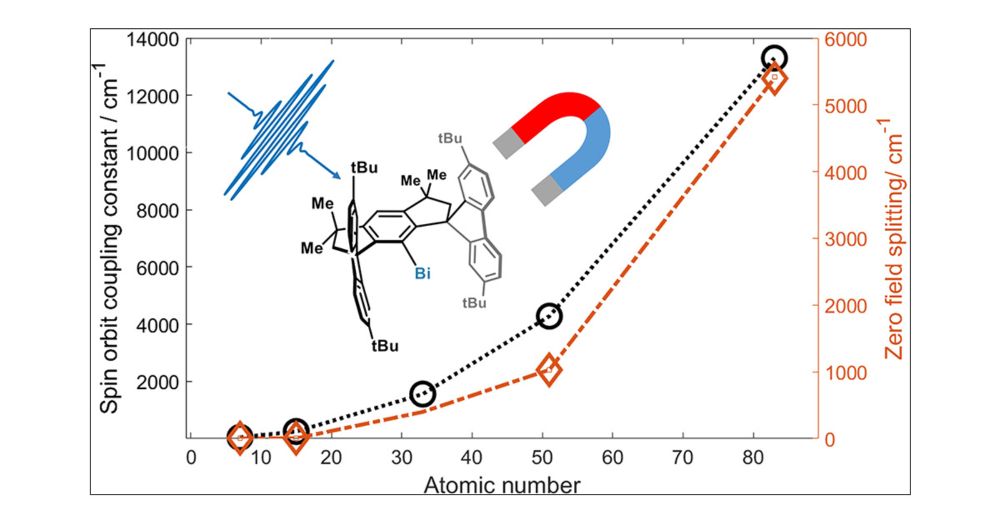
Direct Determination of a Giant Zero-Field Splitting of 5422 cm–1 in a Triplet Organobismuthinidene by Infrared Electron Paramagnetic Resonance
Stable monocoordinated organobismuthinidenes were only recently isolated and analyzed toward their chemical and electronic structure. Quantum chemical calculations on tBu-MSFluind-Bi(I) (2) predicted ...
doi.org
January 6, 2025 at 8:28 AM
New year, new science! This great collaboration underlines the vast potential of predictive quantum chemistry powered by ORCA (MPI Kofo & @faccts-orca.bsky.social) and its computational spectroscopy toolkit.
doi.org/10.1021/jacs...
www.chemie.de/news/1185223...
#ORCAqc #CompChem #ChemSky #EPR
doi.org/10.1021/jacs...
www.chemie.de/news/1185223...
#ORCAqc #CompChem #ChemSky #EPR
Check out the latest release of QCxMS2 by @jogorges.bsky.social (@grimmelab.bsky.social) introducing CID. Thank you, Johannes, for interfacing it with ORCA as a QM engine!
#ORCAqc #ORCA6 #massspectrometry #CID #CompChem #ChemSky #CompChemSky
#ORCAqc #ORCA6 #massspectrometry #CID #CompChem #ChemSky #CompChemSky

QCxMS2 can now also simulate CID mass spectra.
Just published in #JASMS : doi.org/10.1021/jasms.5c00234
Grateful to my coauthors Stefan Grimme @grimmelab.bsky.social & Marianne Engeser @unibonn.bsky.social - this is the last project of my PhD and completes my work on QCxMS2!
#MassSpec #compchem
Just published in #JASMS : doi.org/10.1021/jasms.5c00234
Grateful to my coauthors Stefan Grimme @grimmelab.bsky.social & Marianne Engeser @unibonn.bsky.social - this is the last project of my PhD and completes my work on QCxMS2!
#MassSpec #compchem
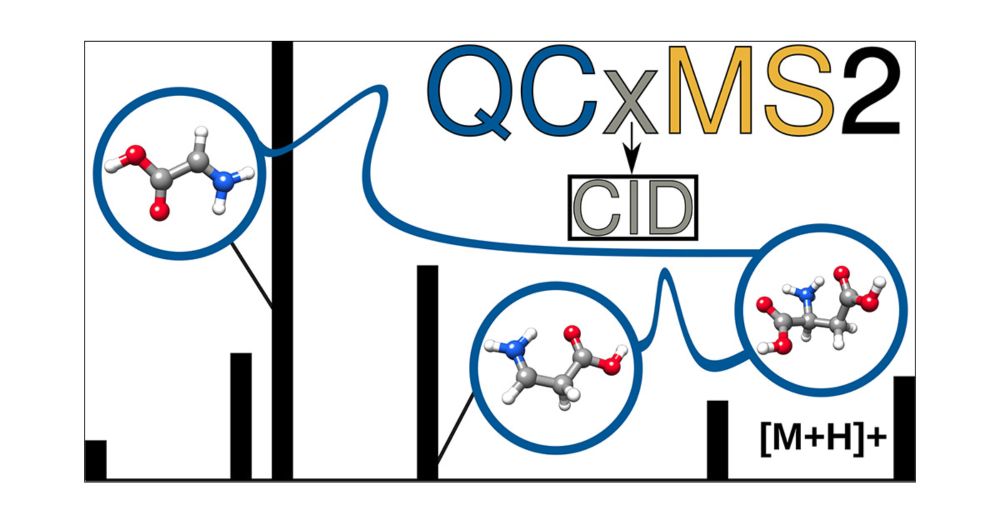
Evaluation of the QCxMS2 Method for the Calculation of Collision-Induced Dissociation Spectra via Automated Reaction Network Exploration
Collision-induced dissociation mass spectrometry (CID-MS) is an important tool in analytical chemistry for the structural elucidation of unknown compounds. The theoretical prediction of the CID spectra plays a critical role in supporting and accelerating this process. To this end, we adapt the recently developed QCxMS2 program originally designed for the calculation of electron ionization (EI) spectra to enable the computation of CID-MS. To account for the fragmentation conditions characteristic of CID within the automated reaction network discovery approach of QCxMS2 we adapted the internal energy distribution to match the experimental conditions. This distribution can be adjusted via a single parameter to approximate various activation settings, thereby eliminating the need for explicit simulations of the collisional process. We evaluate our approach on a test set of 13 organic molecules with diverse functional groups, compiled specifically for this study. All reference spectra were recorded consistently under the same measurement conditions, including both CID and higher-energy collisional dissociation (HCD) modes. Overall, QCxMS2 achieves a good average entropy similarity score (ESS) of 0.687 for the HCD spectra and 0.773 for the CID spectra. The direct comparison to experimental data demonstrates that the QCxMS2 approach, even without explicit modeling of collisions, is generally capable of computing both CID and HCD spectra with reasonable accuracy and robustness. This highlights its potential as a valuable tool for integration into structure elucidation workflows in analytical mass spectrometry.
doi.org
September 9, 2025 at 11:53 AM
Check out the latest release of QCxMS2 by @jogorges.bsky.social (@grimmelab.bsky.social) introducing CID. Thank you, Johannes, for interfacing it with ORCA as a QM engine!
#ORCAqc #ORCA6 #massspectrometry #CID #CompChem #ChemSky #CompChemSky
#ORCAqc #ORCA6 #massspectrometry #CID #CompChem #ChemSky #CompChemSky
March 10, 2025 at 9:11 AM
Save the date! ORCA 6.1 (@faccts.de & @orca-qc-official.bsky.social) will be released on 17 June 2025.
#ORCA61 #ORCAqc #CompChem #CompChemSky #ChemSky
#ORCA61 #ORCAqc #CompChem #CompChemSky #ChemSky
May 12, 2025 at 8:32 AM
Save the date! ORCA 6.1 (@faccts.de & @orca-qc-official.bsky.social) will be released on 17 June 2025.
#ORCA61 #ORCAqc #CompChem #CompChemSky #ChemSky
#ORCA61 #ORCAqc #CompChem #CompChemSky #ChemSky
NMR properties are an important part of the spectroscopic toolbox of ORCA 6 (@faccts-orca.bsky.social & MPI Kofo). Jackson, Otting and coworkers recently used calculated 19F NMR properties to study structural effects in proteins.
doi.org/10.1021/acs....
#ORCAqc #ORCA6 #NMR #ChemSky #CompChem
doi.org/10.1021/acs....
#ORCAqc #ORCA6 #NMR #ChemSky #CompChem
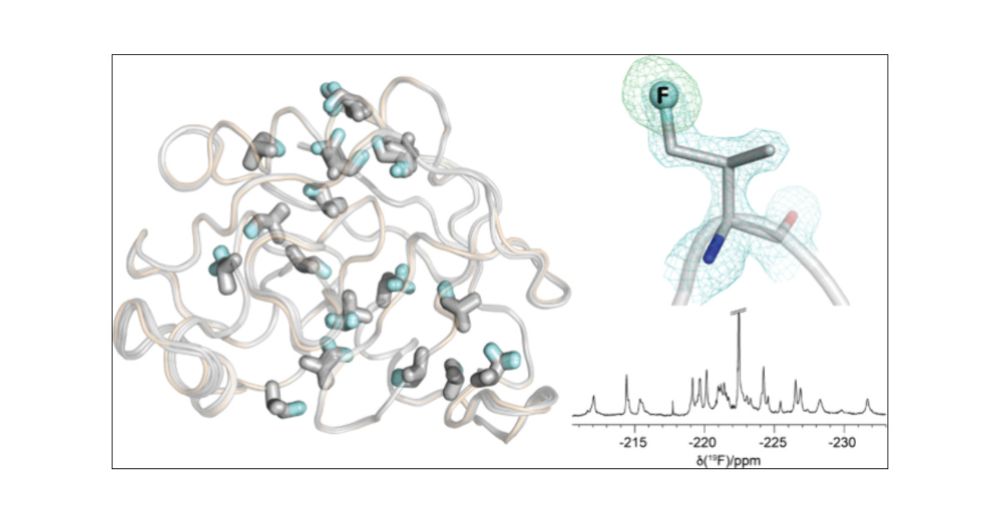
1.3 Å Crystal Structure of E. coli Peptidyl–Prolyl Isomerase B with Uniform Substitution of Valine by (2S,3S)-4-Fluorovaline Reveals Structure Conservation and Multiple Staggered Rotamers of CH2F Groups
(2S,3S)-4-Fluorovaline (FVal) is an analogue of valine, where a single CH3 group is substituted by a CH2F group. In the absence of valine, E. coli valyl-tRNA synthetase uses FVal as a substitute, enabling the production of proteins uniformly labeled with FVal. Here, we describe the production and analysis of E. coli peptidyl–prolyl isomerase B where all 16 valine residues have been replaced by FVal synthesized with a 13C-labeled CH2F group. Although the melting temperature is lower by about 11 °C relative to the wild-type protein, the three-dimensional protein structure is almost completely conserved, as shown by X-ray crystallography. The CH2F groups invariably populate staggered rotamers. Most CH2F groups populate two different rotamers. The increased space requirement of fluorine versus hydrogen does not prohibit rotamers that position fluorine next to a backbone carbonyl carbon. 19F NMR spectra show a signal dispersion over 25 ppm. The most high-field shifted 19F resonances correlate with large 3JHF coupling constants, confirming the impact of the γ-gauche effect on the signal dispersion. The present work is the second experimental verification of the effect and extends its validity to fluorovaline. The abundance of valine in proteins and structural conservation with FVal renders this valine analogue attractive for probing proteins by 19F NMR spectroscopy.
doi.org
September 26, 2024 at 3:37 PM
NMR properties are an important part of the spectroscopic toolbox of ORCA 6 (@faccts-orca.bsky.social & MPI Kofo). Jackson, Otting and coworkers recently used calculated 19F NMR properties to study structural effects in proteins.
doi.org/10.1021/acs....
#ORCAqc #ORCA6 #NMR #ChemSky #CompChem
doi.org/10.1021/acs....
#ORCAqc #ORCA6 #NMR #ChemSky #CompChem