



Vishal Rawji
@vishrawji.bsky.social
1) Post-doctoral fellow at Imperial College London; 2) NIHR Academic Clinical Fellow in Neurology at King's College London
MBPhD from University College London
Interests in human motor control including disease, neuromotor interfacing
MBPhD from University College London
Interests in human motor control including disease, neuromotor interfacing
Exactly, he couldn’t not write (or use his hands for activities of daily living)! That said, he could make complex actions like number drawing… they attributed his deficits to the inability to correct errors.
P.S. David Marsden’s patient, not mine 😅
P.S. David Marsden’s patient, not mine 😅
December 5, 2025 at 3:23 PM
Exactly, he couldn’t not write (or use his hands for activities of daily living)! That said, he could make complex actions like number drawing… they attributed his deficits to the inability to correct errors.
P.S. David Marsden’s patient, not mine 😅
P.S. David Marsden’s patient, not mine 😅

Indeed… movement can be surprisingly good without proprioceptive feedback
academic.oup.com/brain/articl...
academic.oup.com/brain/articl...

MANUAL MOTOR PERFORMANCE IN A DEAFFERENTED MAN
Abstract. We have studied manual motor function in a man deafferented by a severe peripheral sensory neuropathy. Motor power was almost unaffected. Our pat
academic.oup.com
December 5, 2025 at 2:58 PM
Indeed… movement can be surprisingly good without proprioceptive feedback
academic.oup.com/brain/articl...
academic.oup.com/brain/articl...
This work was co-supervised by @juangallego.bsky.social and Dario Farina, and sponsored in part by Meta.
We're extremely grateful for our participants, their carers, Aspire, the Spinal Injuries Association and Hillingdon Hospital for their patience and support.
We're extremely grateful for our participants, their carers, Aspire, the Spinal Injuries Association and Hillingdon Hospital for their patience and support.
July 18, 2025 at 6:56 PM
This work was co-supervised by @juangallego.bsky.social and Dario Farina, and sponsored in part by Meta.
We're extremely grateful for our participants, their carers, Aspire, the Spinal Injuries Association and Hillingdon Hospital for their patience and support.
We're extremely grateful for our participants, their carers, Aspire, the Spinal Injuries Association and Hillingdon Hospital for their patience and support.
In sum, we provide proof-of-concept of an implantable system that uses high-density intramuscular microelectrode arrays to enable accurate control in individuals with tetraplegic SCI 11/n
July 18, 2025 at 6:56 PM
In sum, we provide proof-of-concept of an implantable system that uses high-density intramuscular microelectrode arrays to enable accurate control in individuals with tetraplegic SCI 11/n
We then re-routed the activity of a single motoneuron to control a wearable, soft exoskeleton that uses motors and wires to pull on rings placed on joints. In doing so, this participant could grasp a pen and deform a sponge 10/n
July 18, 2025 at 6:56 PM
We then re-routed the activity of a single motoneuron to control a wearable, soft exoskeleton that uses motors and wires to pull on rings placed on joints. In doing so, this participant could grasp a pen and deform a sponge 10/n
One could also use two independent motoneurons to control a cursor in 2D (one controlling the x-axis position and the other controlling the y-axis position) 9/n
July 18, 2025 at 6:56 PM
One could also use two independent motoneurons to control a cursor in 2D (one controlling the x-axis position and the other controlling the y-axis position) 9/n
And could control a single motoneuron to play Pong! 8/n
July 18, 2025 at 6:56 PM
And could control a single motoneuron to play Pong! 8/n
Excitingly, both participants were able to proportionally control the activity of single motoneurons 7/n
July 18, 2025 at 6:56 PM
Excitingly, both participants were able to proportionally control the activity of single motoneurons 7/n
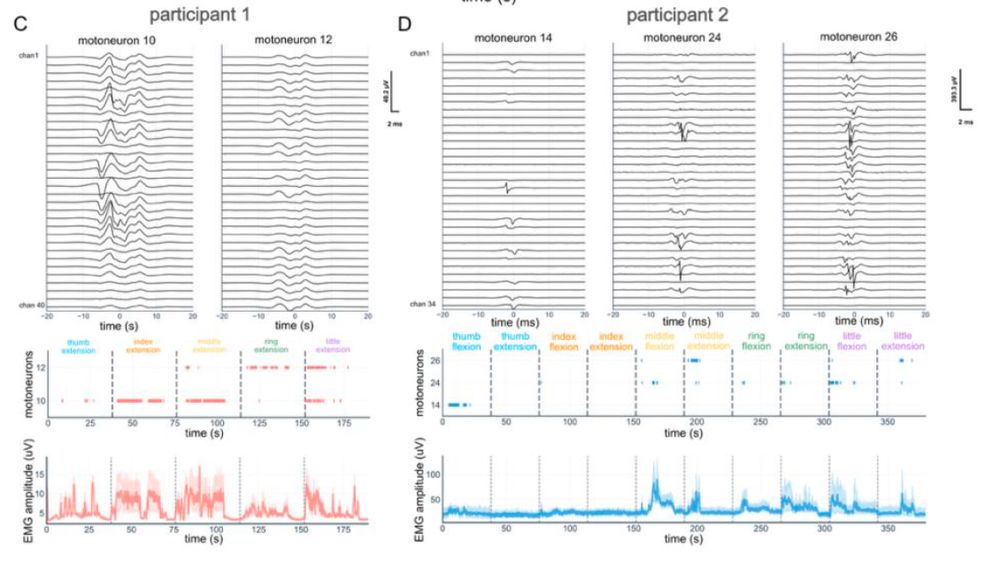
Interestingly, there were pairs (and even a triplet) of motoneurons that fired independently of one another, suggesting multiple degree-of-freedom control from a single array 6/n
July 18, 2025 at 6:56 PM
Interestingly, there were pairs (and even a triplet) of motoneurons that fired independently of one another, suggesting multiple degree-of-freedom control from a single array 6/n
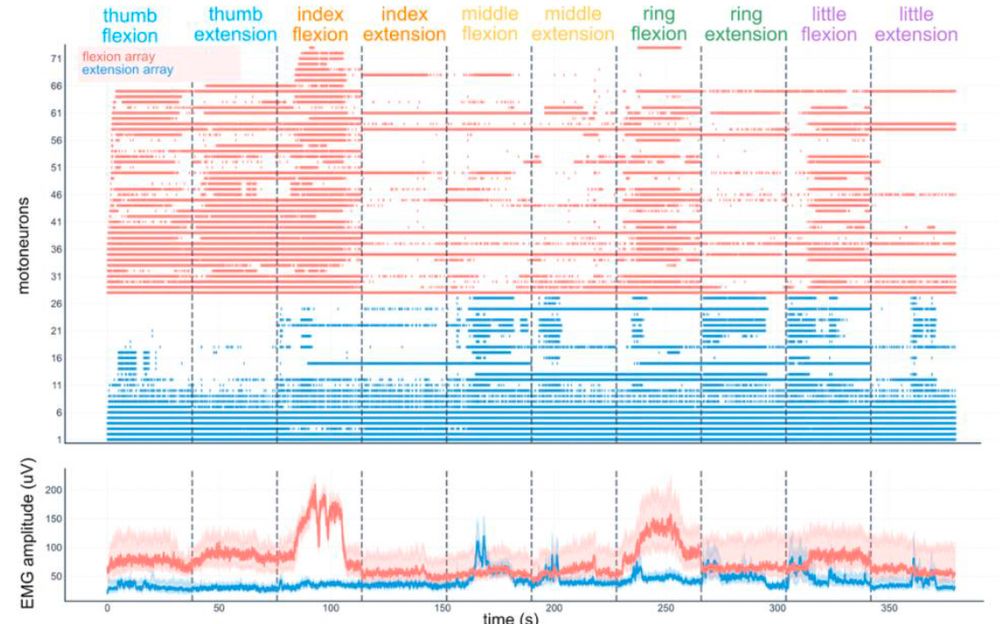
We identified up to 46 motoneurons during attempted movements, despite lack of movement. Some motoneurons fired continuously (during rest and movement), likely due to spasticity. Others fired only during attempted movements.
We found far fewer with surface grids, despite having more electrodes 5/n
We found far fewer with surface grids, despite having more electrodes 5/n
July 18, 2025 at 6:56 PM
We identified up to 46 motoneurons during attempted movements, despite lack of movement. Some motoneurons fired continuously (during rest and movement), likely due to spasticity. Others fired only during attempted movements.
We found far fewer with surface grids, despite having more electrodes 5/n
We found far fewer with surface grids, despite having more electrodes 5/n
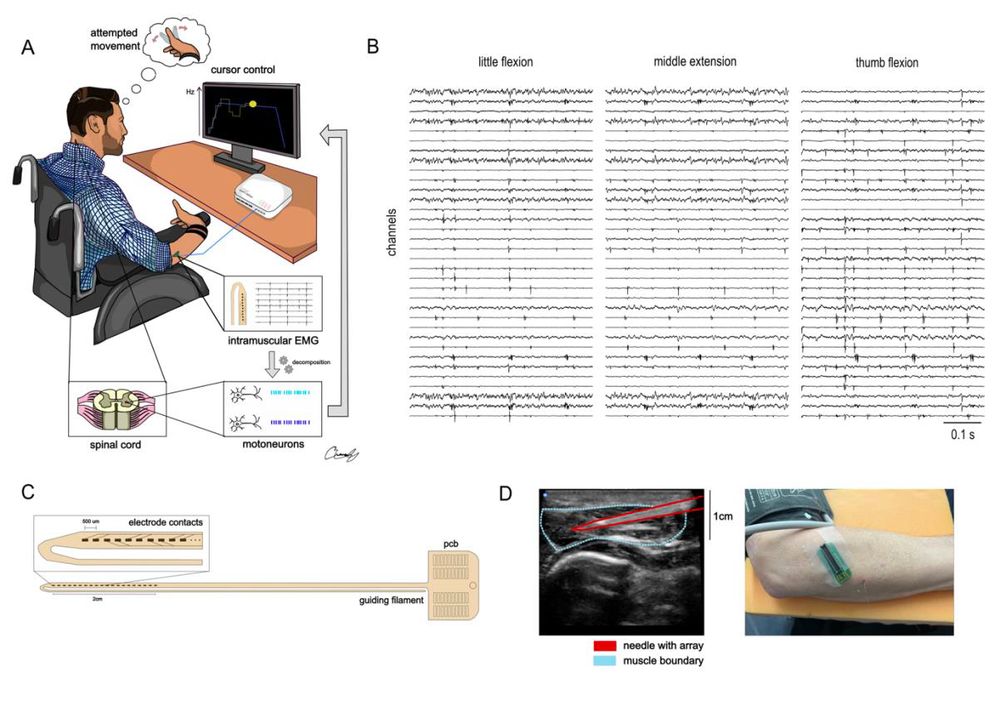
In two people with tetraplegic SCI, we use ultrasound to identify regions of spared muscle activity, then insert 40 channel microelectrode arrays to sample residual muscle activity over a large region 4/n
July 18, 2025 at 6:56 PM
In two people with tetraplegic SCI, we use ultrasound to identify regions of spared muscle activity, then insert 40 channel microelectrode arrays to sample residual muscle activity over a large region 4/n
Invasive electrodes improve the signal-to-noise ratio but only sample amount of muscle and hence reduces the likelihood of detecting residual activity 3/n
July 18, 2025 at 6:56 PM
Invasive electrodes improve the signal-to-noise ratio but only sample amount of muscle and hence reduces the likelihood of detecting residual activity 3/n
Harnessing residual signals after SCI is a promising approach to restoring functionality. Whilst EMG (from muscles) is often detectable after SCI, it is too small and sparse to be used for control, especially when measured with surface electrodes 2/n
July 18, 2025 at 6:56 PM
Harnessing residual signals after SCI is a promising approach to restoring functionality. Whilst EMG (from muscles) is often detectable after SCI, it is too small and sparse to be used for control, especially when measured with surface electrodes 2/n