



Vishal Rawji
@vishrawji.bsky.social
1) Post-doctoral fellow at Imperial College London; 2) NIHR Academic Clinical Fellow in Neurology at King's College London
MBPhD from University College London
Interests in human motor control including disease, neuromotor interfacing
MBPhD from University College London
Interests in human motor control including disease, neuromotor interfacing
We then re-routed the activity of a single motoneuron to control a wearable, soft exoskeleton that uses motors and wires to pull on rings placed on joints. In doing so, this participant could grasp a pen and deform a sponge 10/n
July 18, 2025 at 6:56 PM
We then re-routed the activity of a single motoneuron to control a wearable, soft exoskeleton that uses motors and wires to pull on rings placed on joints. In doing so, this participant could grasp a pen and deform a sponge 10/n
One could also use two independent motoneurons to control a cursor in 2D (one controlling the x-axis position and the other controlling the y-axis position) 9/n
July 18, 2025 at 6:56 PM
One could also use two independent motoneurons to control a cursor in 2D (one controlling the x-axis position and the other controlling the y-axis position) 9/n
And could control a single motoneuron to play Pong! 8/n
July 18, 2025 at 6:56 PM
And could control a single motoneuron to play Pong! 8/n
Excitingly, both participants were able to proportionally control the activity of single motoneurons 7/n
July 18, 2025 at 6:56 PM
Excitingly, both participants were able to proportionally control the activity of single motoneurons 7/n
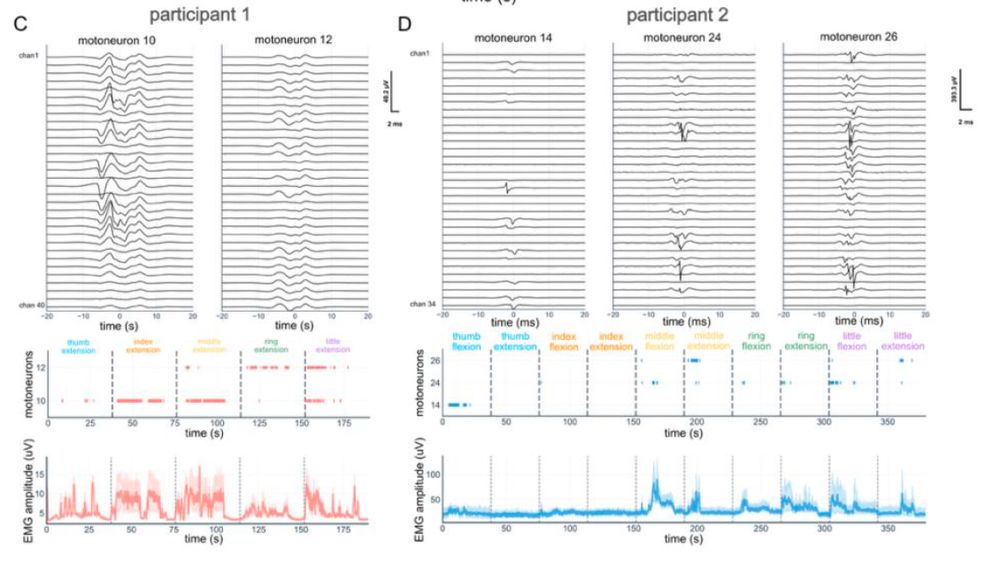
Interestingly, there were pairs (and even a triplet) of motoneurons that fired independently of one another, suggesting multiple degree-of-freedom control from a single array 6/n
July 18, 2025 at 6:56 PM
Interestingly, there were pairs (and even a triplet) of motoneurons that fired independently of one another, suggesting multiple degree-of-freedom control from a single array 6/n
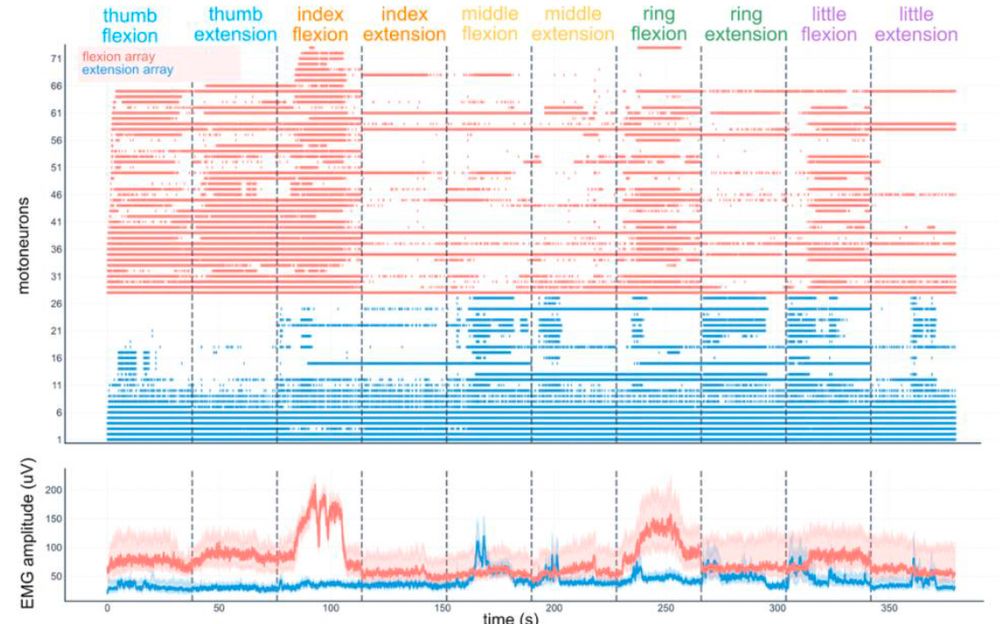
We identified up to 46 motoneurons during attempted movements, despite lack of movement. Some motoneurons fired continuously (during rest and movement), likely due to spasticity. Others fired only during attempted movements.
We found far fewer with surface grids, despite having more electrodes 5/n
We found far fewer with surface grids, despite having more electrodes 5/n
July 18, 2025 at 6:56 PM
We identified up to 46 motoneurons during attempted movements, despite lack of movement. Some motoneurons fired continuously (during rest and movement), likely due to spasticity. Others fired only during attempted movements.
We found far fewer with surface grids, despite having more electrodes 5/n
We found far fewer with surface grids, despite having more electrodes 5/n
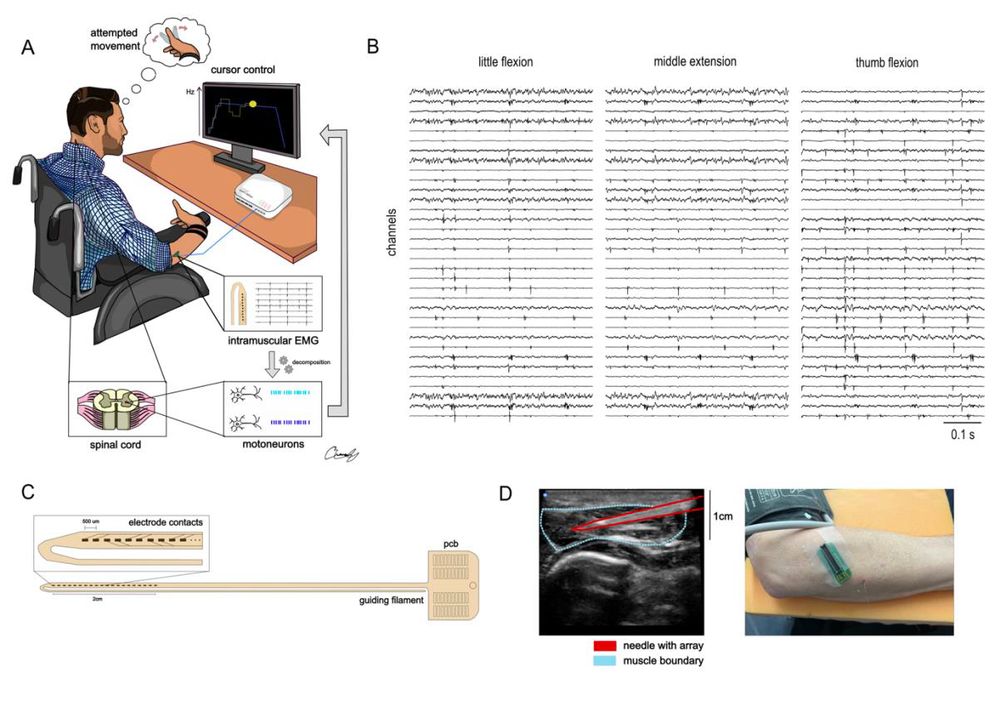
In two people with tetraplegic SCI, we use ultrasound to identify regions of spared muscle activity, then insert 40 channel microelectrode arrays to sample residual muscle activity over a large region 4/n
July 18, 2025 at 6:56 PM
In two people with tetraplegic SCI, we use ultrasound to identify regions of spared muscle activity, then insert 40 channel microelectrode arrays to sample residual muscle activity over a large region 4/n