




Tobias Raisch
@traisch.bsky.social
Biochemist and Structural Biologist | Project group leader MPI Dortmund | He/him | Vegan bike punk #LeaveNoOneBehind
Besides the really cool science, this was a fun collaboration within the @maxplanck.de between @mpiib-berlin.mpg.de and @mpi-dortmund.bsky.social.
And I guess it is only the beginning, as there are still many mysteries of NETs that @garth-burn.bsky.social, Sebastian and I want to uncover...
And I guess it is only the beginning, as there are still many mysteries of NETs that @garth-burn.bsky.social, Sebastian and I want to uncover...
September 18, 2025 at 3:39 PM
Besides the really cool science, this was a fun collaboration within the @maxplanck.de between @mpiib-berlin.mpg.de and @mpi-dortmund.bsky.social.
And I guess it is only the beginning, as there are still many mysteries of NETs that @garth-burn.bsky.social, Sebastian and I want to uncover...
And I guess it is only the beginning, as there are still many mysteries of NETs that @garth-burn.bsky.social, Sebastian and I want to uncover...
As a final note, this whole process is highly relevant not only for killing pathogens, but also in autoimmune diseases.
We could also show that sputum of cystic fibrosis patients contains high levels of MPO functionalised NET-like structures.
We could also show that sputum of cystic fibrosis patients contains high levels of MPO functionalised NET-like structures.

September 18, 2025 at 3:39 PM
As a final note, this whole process is highly relevant not only for killing pathogens, but also in autoimmune diseases.
We could also show that sputum of cystic fibrosis patients contains high levels of MPO functionalised NET-like structures.
We could also show that sputum of cystic fibrosis patients contains high levels of MPO functionalised NET-like structures.
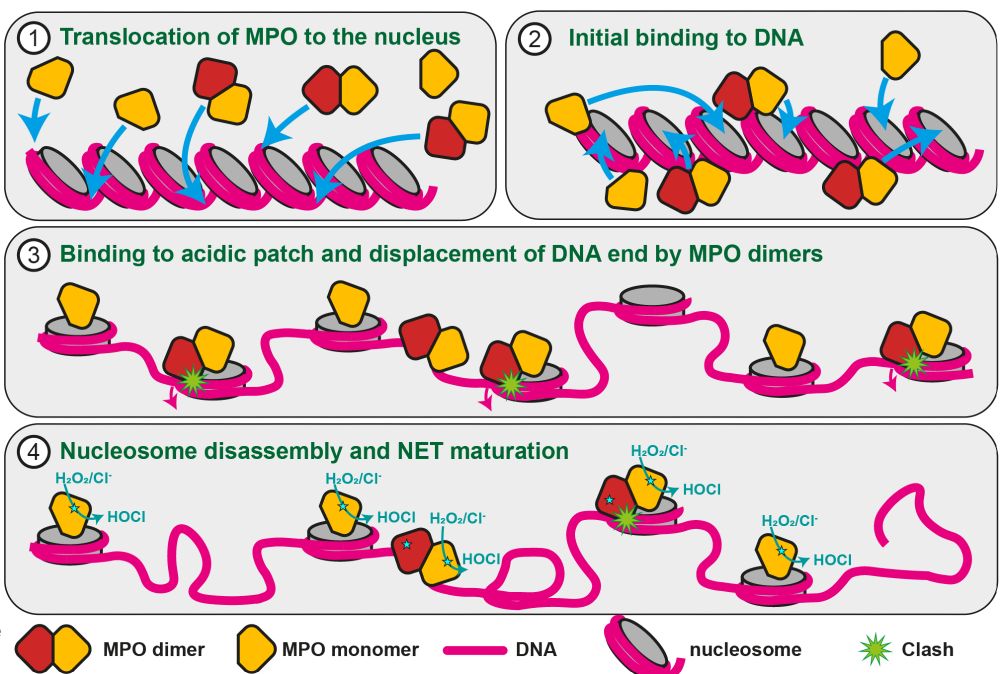
MPO monomers, a minor fraction of the native MPO pool, can also bind to nucleosomes.
But, unlike dimers, they cannot disassemble the nucleosomes and remain stably associated.
This means that most nucleosomes will be evicted during NETosis, but some are protected by MPO monomers and end up in NETs
But, unlike dimers, they cannot disassemble the nucleosomes and remain stably associated.
This means that most nucleosomes will be evicted during NETosis, but some are protected by MPO monomers and end up in NETs
September 18, 2025 at 3:39 PM
MPO monomers, a minor fraction of the native MPO pool, can also bind to nucleosomes.
But, unlike dimers, they cannot disassemble the nucleosomes and remain stably associated.
This means that most nucleosomes will be evicted during NETosis, but some are protected by MPO monomers and end up in NETs
But, unlike dimers, they cannot disassemble the nucleosomes and remain stably associated.
This means that most nucleosomes will be evicted during NETosis, but some are protected by MPO monomers and end up in NETs
Taken together, our data explain how MPO can achieve its dual role in NETosis (i.e. the generation of NETs) and be also a constitutent of mature NETs. The key lies in the dimerization!
MPO dimers, which are most abundant in neutrophils, will destabilized the nucleosome's DNA and lead to disassembly
MPO dimers, which are most abundant in neutrophils, will destabilized the nucleosome's DNA and lead to disassembly
September 18, 2025 at 3:39 PM
Taken together, our data explain how MPO can achieve its dual role in NETosis (i.e. the generation of NETs) and be also a constitutent of mature NETs. The key lies in the dimerization!
MPO dimers, which are most abundant in neutrophils, will destabilized the nucleosome's DNA and lead to disassembly
MPO dimers, which are most abundant in neutrophils, will destabilized the nucleosome's DNA and lead to disassembly
Finally, we went back into "real" NETs and saw by #CryoET that (1) NETs are highly complex and contain more than just decondensed chromatin, and (2) that they contain nucleosomes decorated with something that might be MPO.

September 18, 2025 at 3:39 PM
Finally, we went back into "real" NETs and saw by #CryoET that (1) NETs are highly complex and contain more than just decondensed chromatin, and (2) that they contain nucleosomes decorated with something that might be MPO.
We see this disorder of the DNA terminus in all our reconstructions when MPO dimers are present, and only then. A strong indication that this is what actually destabilises the nucleosome!
Indeed, only MPO dimers and not monomers can lead to unwrapping of DNA, making it accessible for nucleases:
Indeed, only MPO dimers and not monomers can lead to unwrapping of DNA, making it accessible for nucleases:

September 18, 2025 at 3:39 PM
We see this disorder of the DNA terminus in all our reconstructions when MPO dimers are present, and only then. A strong indication that this is what actually destabilises the nucleosome!
Indeed, only MPO dimers and not monomers can lead to unwrapping of DNA, making it accessible for nucleases:
Indeed, only MPO dimers and not monomers can lead to unwrapping of DNA, making it accessible for nucleases:
A tiny difference in the nucleosome structures is that once the second MPO unit is present, there would be a clash with the DNA terminus.
As a consequence, in the presence of MPO dimer the DNA has to locally unwrap and becomes disordered, as visible in this morph:
As a consequence, in the presence of MPO dimer the DNA has to locally unwrap and becomes disordered, as visible in this morph:
September 18, 2025 at 3:39 PM
A tiny difference in the nucleosome structures is that once the second MPO unit is present, there would be a clash with the DNA terminus.
As a consequence, in the presence of MPO dimer the DNA has to locally unwrap and becomes disordered, as visible in this morph:
As a consequence, in the presence of MPO dimer the DNA has to locally unwrap and becomes disordered, as visible in this morph:
MPO dimers bind to the nucleosome in an identical way as the monomers we had seen before.
But the second MPO unit contacts the DNA at several positions. And this is important for understanding how it can destabilise the nucleosome.
But the second MPO unit contacts the DNA at several positions. And this is important for understanding how it can destabilise the nucleosome.

September 18, 2025 at 3:39 PM
MPO dimers bind to the nucleosome in an identical way as the monomers we had seen before.
But the second MPO unit contacts the DNA at several positions. And this is important for understanding how it can destabilise the nucleosome.
But the second MPO unit contacts the DNA at several positions. And this is important for understanding how it can destabilise the nucleosome.
After changing experimental conditions, we could determine intermediate structures of native MPO with nucleosomes. And we found several molecular species in these samples:
1. Free nucleosomes and MPO
2. MPO monomers bound to nucleosome
3. MPO dimers bound to nucleosome
1. Free nucleosomes and MPO
2. MPO monomers bound to nucleosome
3. MPO dimers bound to nucleosome
September 18, 2025 at 3:39 PM
After changing experimental conditions, we could determine intermediate structures of native MPO with nucleosomes. And we found several molecular species in these samples:
1. Free nucleosomes and MPO
2. MPO monomers bound to nucleosome
3. MPO dimers bound to nucleosome
1. Free nucleosomes and MPO
2. MPO monomers bound to nucleosome
3. MPO dimers bound to nucleosome
Okay, great. But what about native MPO? Does it behave similarly as the recombinant one?
Not exactly! Instead, it rapidly disassembles nucleosomes when we reconstitute both, leaving behind only MPO bound to DNA! That was a surprise, since we did not add any other factors such as ATP.
Not exactly! Instead, it rapidly disassembles nucleosomes when we reconstitute both, leaving behind only MPO bound to DNA! That was a surprise, since we did not add any other factors such as ATP.

September 18, 2025 at 3:39 PM
Okay, great. But what about native MPO? Does it behave similarly as the recombinant one?
Not exactly! Instead, it rapidly disassembles nucleosomes when we reconstitute both, leaving behind only MPO bound to DNA! That was a surprise, since we did not add any other factors such as ATP.
Not exactly! Instead, it rapidly disassembles nucleosomes when we reconstitute both, leaving behind only MPO bound to DNA! That was a surprise, since we did not add any other factors such as ATP.
We then reconstituted nucleosomes with a recombinant MPO that resembles a monomeric precursor of native (dimeric) MPO.
By #CryoEM, we saw that MPO stably binds to the acidic patch of the nucleosome, an a binding mode similar to many other nucleosome interactors.
By #CryoEM, we saw that MPO stably binds to the acidic patch of the nucleosome, an a binding mode similar to many other nucleosome interactors.
September 18, 2025 at 3:39 PM
We then reconstituted nucleosomes with a recombinant MPO that resembles a monomeric precursor of native (dimeric) MPO.
By #CryoEM, we saw that MPO stably binds to the acidic patch of the nucleosome, an a binding mode similar to many other nucleosome interactors.
By #CryoEM, we saw that MPO stably binds to the acidic patch of the nucleosome, an a binding mode similar to many other nucleosome interactors.
The first thing we found is that MPO associates with nucleosomes in mature NETs.
This interaction is direct and requires intact nucleosomes.
This interaction is direct and requires intact nucleosomes.

September 18, 2025 at 3:39 PM
The first thing we found is that MPO associates with nucleosomes in mature NETs.
This interaction is direct and requires intact nucleosomes.
This interaction is direct and requires intact nucleosomes.
Intriguingly, #myeloperoxidase (MPO) is a key player both for the chromatin decondensation during NETosis and it also decorates mature NETs.
It produces reactive oxygen species and is one of the most important bactericidal enzymes of neutrophils.
It produces reactive oxygen species and is one of the most important bactericidal enzymes of neutrophils.

September 18, 2025 at 3:39 PM
Intriguingly, #myeloperoxidase (MPO) is a key player both for the chromatin decondensation during NETosis and it also decorates mature NETs.
It produces reactive oxygen species and is one of the most important bactericidal enzymes of neutrophils.
It produces reactive oxygen species and is one of the most important bactericidal enzymes of neutrophils.
So, in essence, neutrophils transform their own chromatin into a weapon against pathogens.
But how exactly does this work? This is where we came into play.
Together with our colleagues (and now good friends) from @mpiib-berlin.mpg.de, we uncovered important steps in NETosis.
But how exactly does this work? This is where we came into play.
Together with our colleagues (and now good friends) from @mpiib-berlin.mpg.de, we uncovered important steps in NETosis.
September 18, 2025 at 3:39 PM
So, in essence, neutrophils transform their own chromatin into a weapon against pathogens.
But how exactly does this work? This is where we came into play.
Together with our colleagues (and now good friends) from @mpiib-berlin.mpg.de, we uncovered important steps in NETosis.
But how exactly does this work? This is where we came into play.
Together with our colleagues (and now good friends) from @mpiib-berlin.mpg.de, we uncovered important steps in NETosis.
During #NETosis, neutrophils decondense their #chromatin by disassembling #nucleosomes. Then, their nucleus breaks down and the cells burst open. The decondensed chomatin then forms the NET.
As #NETs are sticky and functionalised with bactericidal enzymes, they can trap and kill bacteria.
As #NETs are sticky and functionalised with bactericidal enzymes, they can trap and kill bacteria.

September 18, 2025 at 3:39 PM
During #NETosis, neutrophils decondense their #chromatin by disassembling #nucleosomes. Then, their nucleus breaks down and the cells burst open. The decondensed chomatin then forms the NET.
As #NETs are sticky and functionalised with bactericidal enzymes, they can trap and kill bacteria.
As #NETs are sticky and functionalised with bactericidal enzymes, they can trap and kill bacteria.
Neutrophils are the master killers of the innate immune response. They can hunt down bacteria and eliminate them using a wide range of mechanisms, including phagocytosis and the release of ROS-generating enzymes including.
And they can form so-called Neutrophil Extracellular Traps (NETs).
And they can form so-called Neutrophil Extracellular Traps (NETs).

September 18, 2025 at 3:39 PM
Neutrophils are the master killers of the innate immune response. They can hunt down bacteria and eliminate them using a wide range of mechanisms, including phagocytosis and the release of ROS-generating enzymes including.
And they can form so-called Neutrophil Extracellular Traps (NETs).
And they can form so-called Neutrophil Extracellular Traps (NETs).
Main focus of the job will be Cryo-EM of membrane protein comolexes as well as protein/nucleic acid complexes involved in innate immunity.
For more information, check this:
www.mpi-dortmund.mpg.de/news/jobs/po...
For more information, check this:
www.mpi-dortmund.mpg.de/news/jobs/po...

PostDoc Position (m/f/d) in Structural Biology of Membrane Protein Complexes
www.mpi-dortmund.mpg.de
July 1, 2025 at 7:47 PM
Main focus of the job will be Cryo-EM of membrane protein comolexes as well as protein/nucleic acid complexes involved in innate immunity.
For more information, check this:
www.mpi-dortmund.mpg.de/news/jobs/po...
For more information, check this:
www.mpi-dortmund.mpg.de/news/jobs/po...
Reminds me of something that happened a long, long time ago in Tübingen 🙈
November 21, 2024 at 10:37 PM
Reminds me of something that happened a long, long time ago in Tübingen 🙈
Yes, indeed. Thank you!
November 4, 2023 at 5:23 PM
Yes, indeed. Thank you!