



@steber2.bsky.social
The current position makes no sense; a pensions tax break, but only if you structure the contributions in a specific arbitrary way which not everyone does.
A better fix is abolishing NICs on all pension contributions and removing pensioners' NIC exemption (best fix: combine NI & income tax).
A better fix is abolishing NICs on all pension contributions and removing pensioners' NIC exemption (best fix: combine NI & income tax).
November 26, 2025 at 6:50 PM
The current position makes no sense; a pensions tax break, but only if you structure the contributions in a specific arbitrary way which not everyone does.
A better fix is abolishing NICs on all pension contributions and removing pensioners' NIC exemption (best fix: combine NI & income tax).
A better fix is abolishing NICs on all pension contributions and removing pensioners' NIC exemption (best fix: combine NI & income tax).
The least surprising announcement you'll hear all year.


November 26, 2025 at 1:03 PM
The least surprising announcement you'll hear all year.
Automatically reimbursing NI on all pension savings, but then charging NI on pension withdrawals, would seem the best approach.
November 22, 2025 at 6:29 PM
Automatically reimbursing NI on all pension savings, but then charging NI on pension withdrawals, would seem the best approach.
Will they?
Lowest earners are better off with pensioner than non-pensioner benefits.
A couple needs ~full state pensions + ~£140k pension pot each at retirement to hit median after housing costs living standards. Median 55 y/o pension wealth is ~£80k; ~on track, even with no more pension savings?
Lowest earners are better off with pensioner than non-pensioner benefits.
A couple needs ~full state pensions + ~£140k pension pot each at retirement to hit median after housing costs living standards. Median 55 y/o pension wealth is ~£80k; ~on track, even with no more pension savings?
November 22, 2025 at 6:26 PM
Will they?
Lowest earners are better off with pensioner than non-pensioner benefits.
A couple needs ~full state pensions + ~£140k pension pot each at retirement to hit median after housing costs living standards. Median 55 y/o pension wealth is ~£80k; ~on track, even with no more pension savings?
Lowest earners are better off with pensioner than non-pensioner benefits.
A couple needs ~full state pensions + ~£140k pension pot each at retirement to hit median after housing costs living standards. Median 55 y/o pension wealth is ~£80k; ~on track, even with no more pension savings?
Median household income (after housing costs) is ~£19k per person per year for a couple. Setting the minimum pensioner income at that level would result in a lot of the country being much worse off before retirement than after, even if they didn't save a penny into a pension. Seems a bad idea to me.
November 20, 2025 at 7:17 PM
Median household income (after housing costs) is ~£19k per person per year for a couple. Setting the minimum pensioner income at that level would result in a lot of the country being much worse off before retirement than after, even if they didn't save a penny into a pension. Seems a bad idea to me.
Looking ahead, those on the lowest / no earnings will be better off after retirement than they are before, given that significant gap in benefits' generosity.
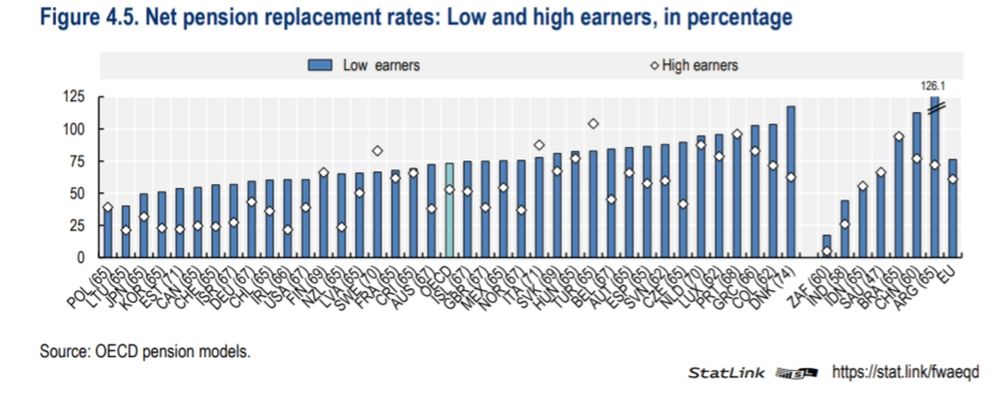
You can also compare UK state pension provision for low earners to other countries; they compare more favourably than median earners.
You can also compare UK state pension provision for low earners to other countries; they compare more favourably than median earners.
November 20, 2025 at 5:28 PM
Looking ahead, those on the lowest / no earnings will be better off after retirement than they are before, given that significant gap in benefits' generosity.
You can also compare UK state pension provision for low earners to other countries; they compare more favourably than median earners.
You can also compare UK state pension provision for low earners to other countries; they compare more favourably than median earners.
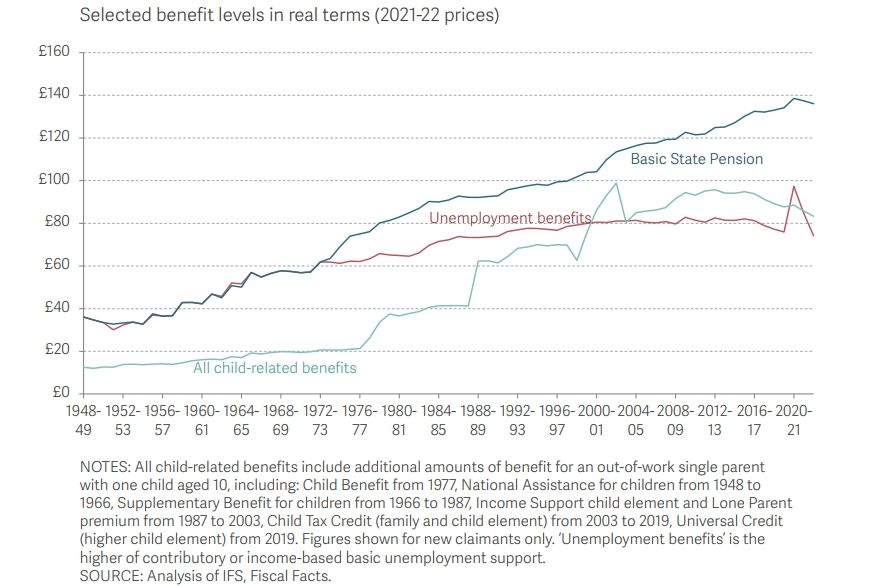
For today's retirees? To understand if their benefits are too low (and should be prioritised for an increase), you can just compare them to working age benefits. Pensioners' benefits are much higher (even excluding SERPS); not a sensible priority for more Government spending.
November 20, 2025 at 5:26 PM
For today's retirees? To understand if their benefits are too low (and should be prioritised for an increase), you can just compare them to working age benefits. Pensioners' benefits are much higher (even excluding SERPS); not a sensible priority for more Government spending.
They would (or actively chosen to opt out) where it's a requirement of the state.
November 20, 2025 at 10:49 AM
They would (or actively chosen to opt out) where it's a requirement of the state.
Which people are presumably free to save for how they wish.
If they don't have greater needs than someone a few years younger, they shouldn't be provided with a more generous safety net: those relying on the safety net shouldn't receive lower payments until they hit an arbitrary "retirement age".
If they don't have greater needs than someone a few years younger, they shouldn't be provided with a more generous safety net: those relying on the safety net shouldn't receive lower payments until they hit an arbitrary "retirement age".
November 20, 2025 at 10:48 AM
Which people are presumably free to save for how they wish.
If they don't have greater needs than someone a few years younger, they shouldn't be provided with a more generous safety net: those relying on the safety net shouldn't receive lower payments until they hit an arbitrary "retirement age".
If they don't have greater needs than someone a few years younger, they shouldn't be provided with a more generous safety net: those relying on the safety net shouldn't receive lower payments until they hit an arbitrary "retirement age".
The extra payment for the elderly is odd; if it's due to ill health, they'd presumably already benefit from the extra payments for those with disabilities. Otherwise, no reason they should receive more than other age groups.
But overall, great news to see a move away from means testing!
But overall, great news to see a move away from means testing!
November 20, 2025 at 8:11 AM
The extra payment for the elderly is odd; if it's due to ill health, they'd presumably already benefit from the extra payments for those with disabilities. Otherwise, no reason they should receive more than other age groups.
But overall, great news to see a move away from means testing!
But overall, great news to see a move away from means testing!
Only to the extent they're required by the state (including opt-outable ones). Purely voluntary schemes, even with eg tax benefits for participants, aren't included.
November 19, 2025 at 8:46 PM
Only to the extent they're required by the state (including opt-outable ones). Purely voluntary schemes, even with eg tax benefits for participants, aren't included.
I didn't mention working more/longer, I just spoke about forcing people to produce more (since you said you don't believe there's currently limits to how much we can produce, apparently Government can give people unlimited amounts of stuff to consume with no trade offs).
November 17, 2025 at 9:45 PM
I didn't mention working more/longer, I just spoke about forcing people to produce more (since you said you don't believe there's currently limits to how much we can produce, apparently Government can give people unlimited amounts of stuff to consume with no trade offs).
We could try to force people to produce more, as you say. Putting aside personal wellbeing, the issue at a national level is that either people refuse or at best productivity drops and production doesn't rise as much as you'd expected.
November 17, 2025 at 7:38 PM
We could try to force people to produce more, as you say. Putting aside personal wellbeing, the issue at a national level is that either people refuse or at best productivity drops and production doesn't rise as much as you'd expected.
It's a benefit, funded by taxes in the same way as other benefits.
If I had to choose, I'd much rather live off £1,000 a month, than £400 a month on Universal Credit's standard allowance.
I'm not arguing for more inequality, I'm arguing against prioritising better off groups for more Gov spending.
If I had to choose, I'd much rather live off £1,000 a month, than £400 a month on Universal Credit's standard allowance.
I'm not arguing for more inequality, I'm arguing against prioritising better off groups for more Gov spending.
November 17, 2025 at 7:30 PM
It's a benefit, funded by taxes in the same way as other benefits.
If I had to choose, I'd much rather live off £1,000 a month, than £400 a month on Universal Credit's standard allowance.
I'm not arguing for more inequality, I'm arguing against prioritising better off groups for more Gov spending.
If I had to choose, I'd much rather live off £1,000 a month, than £400 a month on Universal Credit's standard allowance.
I'm not arguing for more inequality, I'm arguing against prioritising better off groups for more Gov spending.
Pensioners renting with just a full new state pension will generally be eligible for housing benefit as well.
There's less poverty among pensioners than non-pensioners. Pensioner-only benefits just aren't a sensible priority for more Government spending.
There's less poverty among pensioners than non-pensioners. Pensioner-only benefits just aren't a sensible priority for more Government spending.
November 17, 2025 at 5:39 PM
Pensioners renting with just a full new state pension will generally be eligible for housing benefit as well.
There's less poverty among pensioners than non-pensioners. Pensioner-only benefits just aren't a sensible priority for more Government spending.
There's less poverty among pensioners than non-pensioners. Pensioner-only benefits just aren't a sensible priority for more Government spending.
The state pension's as much of a benefit as e.g. jobseekers' allowance. We all pay our taxes for others' benefits, and hope that others will pay for ours when we're eligible for them.
November 17, 2025 at 5:38 PM
The state pension's as much of a benefit as e.g. jobseekers' allowance. We all pay our taxes for others' benefits, and hope that others will pay for ours when we're eligible for them.
It's the production that's limited, I imagine most people would consume more if they could.
November 17, 2025 at 5:37 PM
It's the production that's limited, I imagine most people would consume more if they could.
Is that from the same study? It doesn't seem to tie-in with the graph I shared.
The result for low-earners (which is most relevant for pensioner benefits discussions) is slightly above average in any case, so for simplicity "around average" seems about right.
The result for low-earners (which is most relevant for pensioner benefits discussions) is slightly above average in any case, so for simplicity "around average" seems about right.
November 17, 2025 at 5:36 PM
Is that from the same study? It doesn't seem to tie-in with the graph I shared.
The result for low-earners (which is most relevant for pensioner benefits discussions) is slightly above average in any case, so for simplicity "around average" seems about right.
The result for low-earners (which is most relevant for pensioner benefits discussions) is slightly above average in any case, so for simplicity "around average" seems about right.
We have limited resources/production. The more consumption we transfer to pensioners, the less is available for non-pensioners.
These trade-offs exist, we're not in a utopia of limitless consumption yet sadly.
These trade-offs exist, we're not in a utopia of limitless consumption yet sadly.
November 17, 2025 at 2:39 PM
We have limited resources/production. The more consumption we transfer to pensioners, the less is available for non-pensioners.
These trade-offs exist, we're not in a utopia of limitless consumption yet sadly.
These trade-offs exist, we're not in a utopia of limitless consumption yet sadly.
I'm not necessarily saying cut pensioner benefits, I'm saying stop widening and start narrowing the gap between pensioner and non-pensioner benefits.
November 17, 2025 at 9:30 AM
I'm not necessarily saying cut pensioner benefits, I'm saying stop widening and start narrowing the gap between pensioner and non-pensioner benefits.
If you think there's an easy way to raise more revenue, do it, then prioritise spending it on those who need it the most (non-pensioners' benefits).
November 17, 2025 at 9:29 AM
If you think there's an easy way to raise more revenue, do it, then prioritise spending it on those who need it the most (non-pensioners' benefits).
If you think there's an easy way to raise more revenue, do it, then spend it on those who need it the most (non-pensioners' benefits).
November 17, 2025 at 9:29 AM
If you think there's an easy way to raise more revenue, do it, then spend it on those who need it the most (non-pensioners' benefits).
The triple "lock" ratchet doesn't mean that the state pension "keeps pace" with wage increases, it actively means that the state pension rises faster than both average earnings and inflation over time, increasing its generosity.
Which isn't a sensible priority, when non-pensioner benefits are lower
Which isn't a sensible priority, when non-pensioner benefits are lower
November 17, 2025 at 8:47 AM
The triple "lock" ratchet doesn't mean that the state pension "keeps pace" with wage increases, it actively means that the state pension rises faster than both average earnings and inflation over time, increasing its generosity.
Which isn't a sensible priority, when non-pensioner benefits are lower
Which isn't a sensible priority, when non-pensioner benefits are lower
If you're a pensioner who's renting, you'll also be eligible for housing benefit.
I'd certainly much rather live off ~£1,000 per month, than universal credit's standard allowance of ~£400 per month for a single person.
I'd certainly much rather live off ~£1,000 per month, than universal credit's standard allowance of ~£400 per month for a single person.
November 17, 2025 at 8:46 AM
If you're a pensioner who's renting, you'll also be eligible for housing benefit.
I'd certainly much rather live off ~£1,000 per month, than universal credit's standard allowance of ~£400 per month for a single person.
I'd certainly much rather live off ~£1,000 per month, than universal credit's standard allowance of ~£400 per month for a single person.