




Simon Sch.
@simonrecyclable.bsky.social
🔬PhD research in cell biology on the regulation of mitochondrial DNA copy number in yeast🔍Scientist in R&D💡aims for a peaceful world that is everyones's sanctuary for humanity and nature 🌈🌍 views are my own
Thank you, Arun! 😀
February 16, 2025 at 8:39 PM
Thank you, Arun! 😀
Special thanks to Giada and Serena from the LMU MS facility, as well as Lea and Hannes @herrmannlab.bsky.social for their pulldown experiment with catalytically inactive Pim1. Also grateful for the Dean’s support in making this research public! Thanks to @osman-lab.bsky.social for the experience!
February 16, 2025 at 2:09 PM
Special thanks to Giada and Serena from the LMU MS facility, as well as Lea and Hannes @herrmannlab.bsky.social for their pulldown experiment with catalytically inactive Pim1. Also grateful for the Dean’s support in making this research public! Thanks to @osman-lab.bsky.social for the experience!
It was a particular pleasure to supervise and include undergraduate students Charlotte, Sebastian and Romina in our exciting journey through the project.
February 16, 2025 at 2:02 PM
It was a particular pleasure to supervise and include undergraduate students Charlotte, Sebastian and Romina in our exciting journey through the project.
Reposted by Simon Sch.

One big advantage of laser induction is you can cause pearling whenever you want, in just the mitochondrial tube that you want, so it is very precise and controllable. Combined with STED imaging it has been possible to get some beautiful images of cristae and nucleoids during pearling

December 23, 2024 at 5:49 PM
One big advantage of laser induction is you can cause pearling whenever you want, in just the mitochondrial tube that you want, so it is very precise and controllable. Combined with STED imaging it has been possible to get some beautiful images of cristae and nucleoids during pearling
Reposted by Simon Sch.
The transient nature of pearling makes it hard to detect - in normal cells you might need to sit and watch one spot for a long time and then, if you blink, you'll miss it
December 23, 2024 at 5:49 PM
The transient nature of pearling makes it hard to detect - in normal cells you might need to sit and watch one spot for a long time and then, if you blink, you'll miss it
Reposted by Simon Sch.
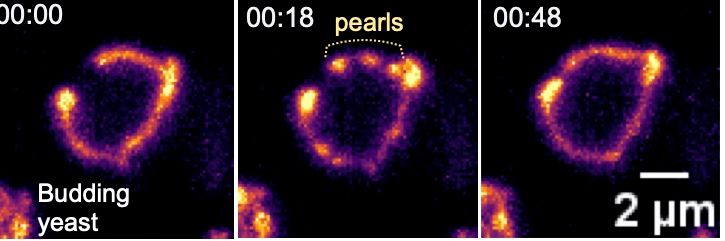
He found that pearling was ubiquitous, occurring in every cell type that he has looked at, including: U2OS, Hek293, COS7, RPE1, Jurkat, primary human fibroblasts primary CD8 T-cells, iPSC derived neurons, and budding yeast (shown here).
December 23, 2024 at 5:49 PM
He found that pearling was ubiquitous, occurring in every cell type that he has looked at, including: U2OS, Hek293, COS7, RPE1, Jurkat, primary human fibroblasts primary CD8 T-cells, iPSC derived neurons, and budding yeast (shown here).