




Patrick Mellacher
@pmellacher.bsky.social
Assistant Professor and Deputy Head of the Graz Schumpeter Centre of the University of Graz. Modelling economic & social dynamics (mainly with ABMs)
"So viel Gutes" steht bei meinen ganz weit oben :)
September 19, 2025 at 12:51 PM
"So viel Gutes" steht bei meinen ganz weit oben :)
Die bekanntesten Methoden sind VPI und BIP-Deflator. Zumindest der VPI auf Basis 2010 ist oberhalb dieser Range, aber nur leicht. I'll see myself out. 2/2
August 26, 2025 at 10:53 AM
Die bekanntesten Methoden sind VPI und BIP-Deflator. Zumindest der VPI auf Basis 2010 ist oberhalb dieser Range, aber nur leicht. I'll see myself out. 2/2
Naja, es gibt im Prinzip unendlich viele Möglichkeiten, die Inflation zu berechnen, weil sich immer die Frage stellt, wie einzelne Produkte im betrachteten Warenkorb gewichtet werden. 1/2
August 26, 2025 at 10:53 AM
Naja, es gibt im Prinzip unendlich viele Möglichkeiten, die Inflation zu berechnen, weil sich immer die Frage stellt, wie einzelne Produkte im betrachteten Warenkorb gewichtet werden. 1/2
Schaut mir jetzt auf den ersten Blick nicht so schlecht aus, wenn man nicht nach einem Bild verlangt (trotz Tippfehler im Prompt :') ).
ChatGPT ist einfach extrem schlecht darin, Logik in Bildern zu erkennen.
chatgpt.com/share/689c62...
ChatGPT ist einfach extrem schlecht darin, Logik in Bildern zu erkennen.
chatgpt.com/share/689c62...

ChatGPT - Liste der BundeskanzlerInnen
Shared via ChatGPT
chatgpt.com
August 13, 2025 at 10:02 AM
Schaut mir jetzt auf den ersten Blick nicht so schlecht aus, wenn man nicht nach einem Bild verlangt (trotz Tippfehler im Prompt :') ).
ChatGPT ist einfach extrem schlecht darin, Logik in Bildern zu erkennen.
chatgpt.com/share/689c62...
ChatGPT ist einfach extrem schlecht darin, Logik in Bildern zu erkennen.
chatgpt.com/share/689c62...
I am puzzled by this strong initial happiness boost. But this may be due to IVF treatment (i.e., happy because lucky/unhappy because unlucky).
August 6, 2025 at 9:55 AM
I am puzzled by this strong initial happiness boost. But this may be due to IVF treatment (i.e., happy because lucky/unhappy because unlucky).
Final note at the end: We also wanted to study Germany. However, they told us (months after the election) that it would take some more months to release the data. Now, more than one year after the election, they still have not released the data on the municipal-level.... 12/12
July 22, 2025 at 11:57 AM
Final note at the end: We also wanted to study Germany. However, they told us (months after the election) that it would take some more months to release the data. Now, more than one year after the election, they still have not released the data on the municipal-level.... 12/12
Our results must be treated with caution: this is an observational study and there are likely important factors that are unobservable and that we thus cannot control for. Nevertheless, it is striking to see these differences in outcomes. More results here: unipub.uni-graz.at/obvugrveroef... 11/12
unipub.uni-graz.at
July 22, 2025 at 11:57 AM
Our results must be treated with caution: this is an observational study and there are likely important factors that are unobservable and that we thus cannot control for. Nevertheless, it is striking to see these differences in outcomes. More results here: unipub.uni-graz.at/obvugrveroef... 11/12
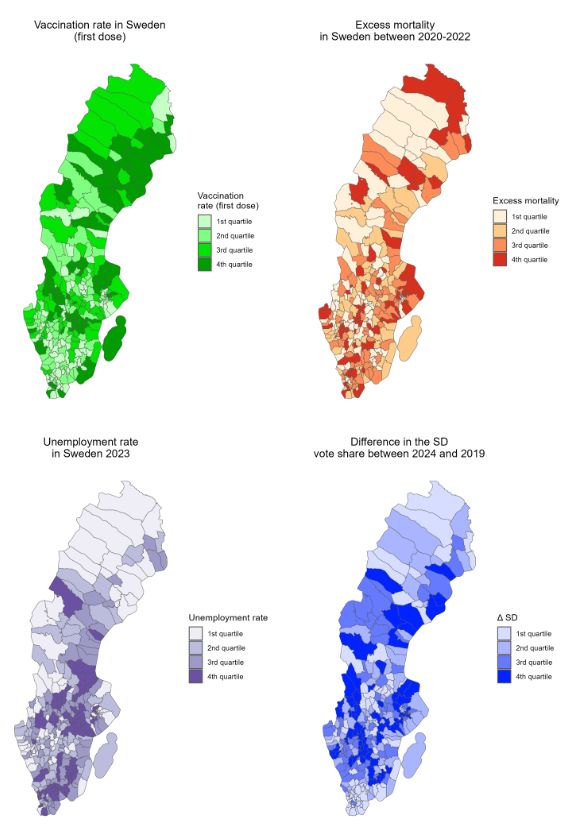
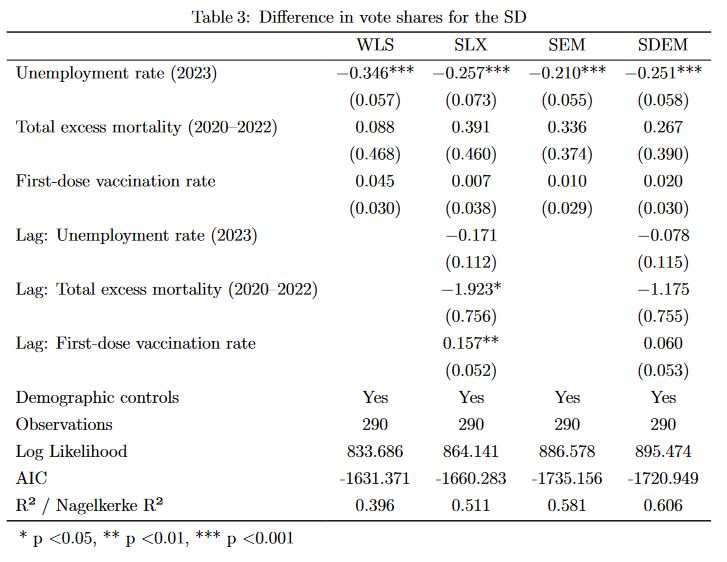
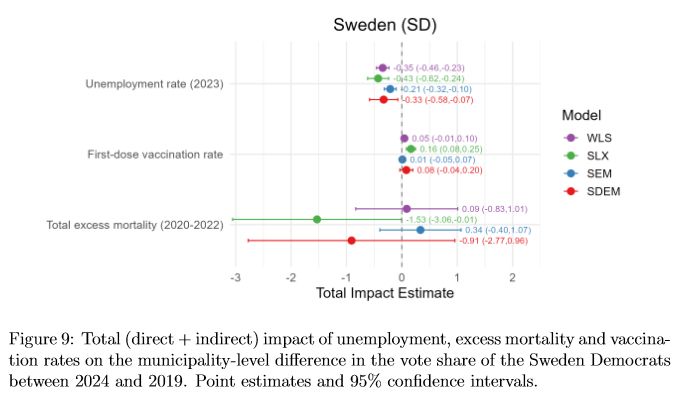
We only observe one significant impact: the SD won in areas with low post-pandemic unemployment (in contrast to Austria, Italy). 10/12
July 22, 2025 at 11:57 AM
We only observe one significant impact: the SD won in areas with low post-pandemic unemployment (in contrast to Austria, Italy). 10/12
Finally, Sweden contrasts Italy and Austria, because i) the Swedish government had a much more lax approach to Covid-19, and ii) the Swedish major right-wing party SD demanded stricter containment policies. 9/12
July 22, 2025 at 11:57 AM
Finally, Sweden contrasts Italy and Austria, because i) the Swedish government had a much more lax approach to Covid-19, and ii) the Swedish major right-wing party SD demanded stricter containment policies. 9/12
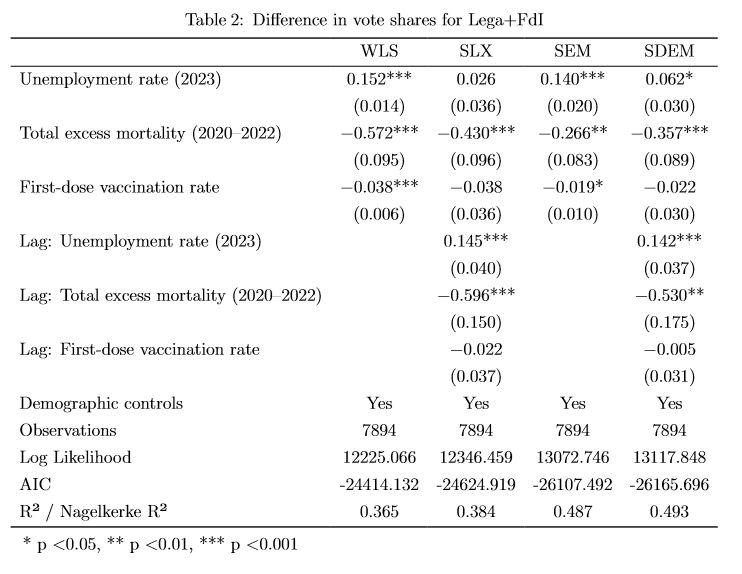
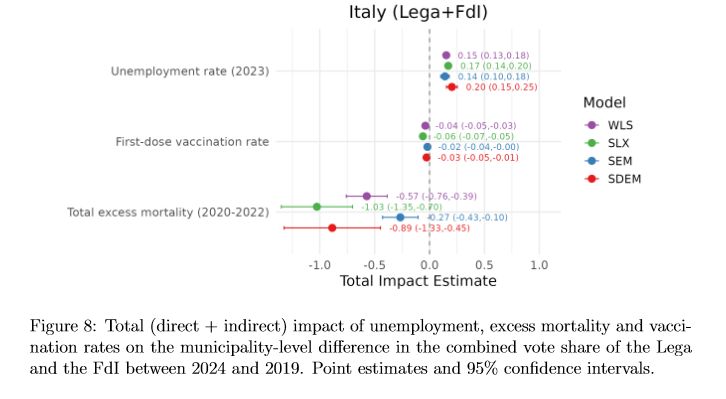
This may partly explain the aggregate-level differences between the two countries (strong gains for the FPÖ vs. minor losses for Lega+FdI), even though the particular national context is important (e.g., right-wing coalition in Italy, "Ibiza" scandal in Austria in 2019 etc.) 8/12
July 22, 2025 at 11:57 AM
This may partly explain the aggregate-level differences between the two countries (strong gains for the FPÖ vs. minor losses for Lega+FdI), even though the particular national context is important (e.g., right-wing coalition in Italy, "Ibiza" scandal in Austria in 2019 etc.) 8/12
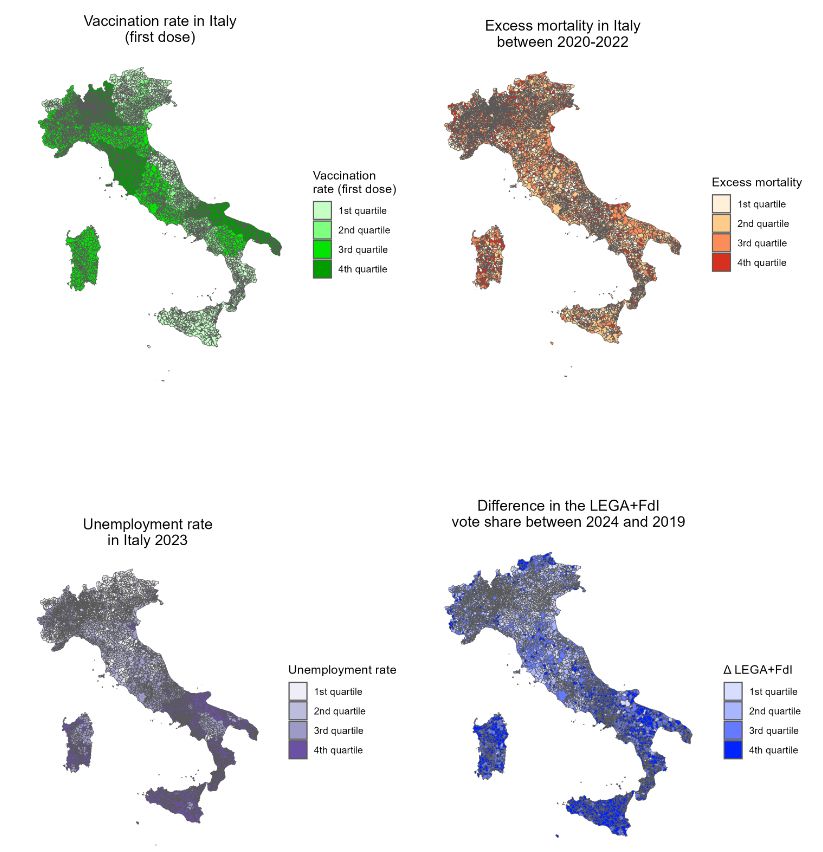
of excess mortality. This means that the Italian right-wing parties performed worse where a lot of people died from Covid-19. Apparently, Italian voters held these parties accountable for their experience with the health risks of Covid-19. Austrians did not. 7/12
July 22, 2025 at 11:57 AM
of excess mortality. This means that the Italian right-wing parties performed worse where a lot of people died from Covid-19. Apparently, Italian voters held these parties accountable for their experience with the health risks of Covid-19. Austrians did not. 7/12
Italy saw a dramatic shift of votes between Salvini's Lega and Meloni's FdI, both being skeptical of containment policies. Together, they won compared to 2019, where unemployment was high and vaccination coverage low (as in Austria). In contrast to Austria, we also see a negative direct impact 6/12
July 22, 2025 at 11:57 AM
Italy saw a dramatic shift of votes between Salvini's Lega and Meloni's FdI, both being skeptical of containment policies. Together, they won compared to 2019, where unemployment was high and vaccination coverage low (as in Austria). In contrast to Austria, we also see a negative direct impact 6/12
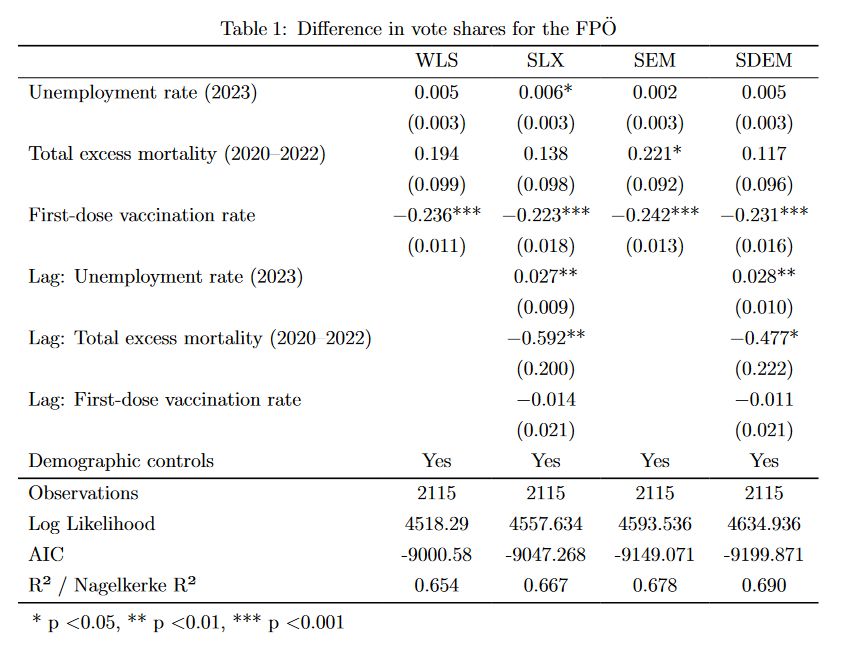
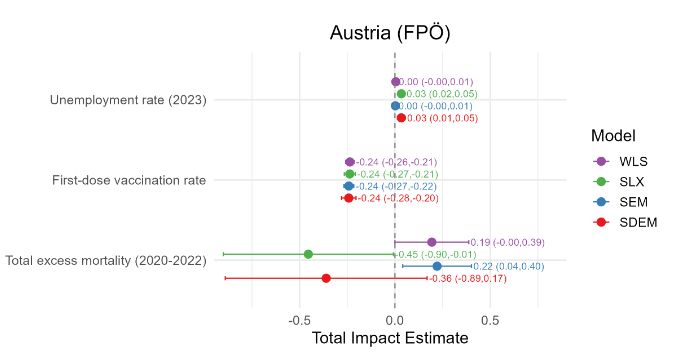
correlated with FPÖ performance), which is the level of skepticism in a given municipality. One specification (SEM) finds a positive (direct) association, but SLX and SDEM a negative indirect impact. This means that the FPÖ fared worse if a lot of people died in a neighboring municipality. 5/12
July 22, 2025 at 11:57 AM
correlated with FPÖ performance), which is the level of skepticism in a given municipality. One specification (SEM) finds a positive (direct) association, but SLX and SDEM a negative indirect impact. This means that the FPÖ fared worse if a lot of people died in a neighboring municipality. 5/12
Furthermore, we look at excess mortality rates. This is most difficult to interpret, as, on the one hand, higher excess mortality rates may scare off voters from "skeptical" parties. On the other hand, there is likely a positive correlation with an unobservable variable (that is also positively 4/12
July 22, 2025 at 11:57 AM
Furthermore, we look at excess mortality rates. This is most difficult to interpret, as, on the one hand, higher excess mortality rates may scare off voters from "skeptical" parties. On the other hand, there is likely a positive correlation with an unobservable variable (that is also positively 4/12
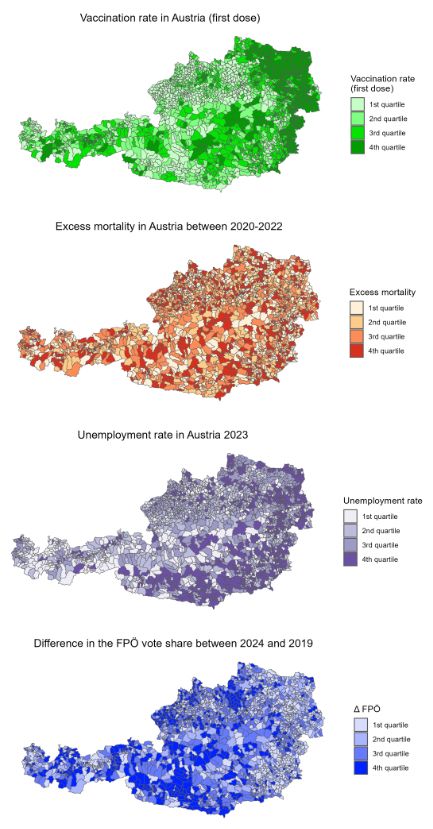
In Austria, the FPÖ staged a strong campaign against Covid-19 measures after performing a U-turn after the first wave of the pandemic (see my JEBO paper (www.sciencedirect.com/science/arti...). The party gained particularly in areas with high post-pandemic unemployment and low vaccination rates 3/12
July 22, 2025 at 11:57 AM
In Austria, the FPÖ staged a strong campaign against Covid-19 measures after performing a U-turn after the first wave of the pandemic (see my JEBO paper (www.sciencedirect.com/science/arti...). The party gained particularly in areas with high post-pandemic unemployment and low vaccination rates 3/12
We use OLS and three different types of spatial regressions (SLX, SEM and SDEM) and control for age, education, degree of urbanization and GRP in the municipalities. Our analysis suggests that the pandemic had a significant impact on voting behavior even years after the last lockdown 2/12
July 22, 2025 at 11:57 AM
We use OLS and three different types of spatial regressions (SLX, SEM and SDEM) and control for age, education, degree of urbanization and GRP in the municipalities. Our analysis suggests that the pandemic had a significant impact on voting behavior even years after the last lockdown 2/12
Gibt dazu tatsächlich ein Nature-Paper (Stichprobe= 1) :D www.nature.com/articles/226...
Effects of Sexual Activity on Beard Growth in Man - Nature
Nature - Effects of Sexual Activity on Beard Growth in Man
www.nature.com
July 22, 2025 at 5:57 AM
Gibt dazu tatsächlich ein Nature-Paper (Stichprobe= 1) :D www.nature.com/articles/226...
Obwohl dieses Ziel anfangs propagiert wurde, ging es später durch den Erfolg der Maßnahmen während der ersten Welle aus meiner Sicht eher darum, so lange durchzuhalten, bis alle die Möglichkeit hatten, sich zu impfen.
March 5, 2025 at 12:04 PM
Obwohl dieses Ziel anfangs propagiert wurde, ging es später durch den Erfolg der Maßnahmen während der ersten Welle aus meiner Sicht eher darum, so lange durchzuhalten, bis alle die Möglichkeit hatten, sich zu impfen.
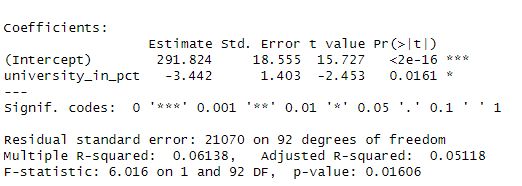
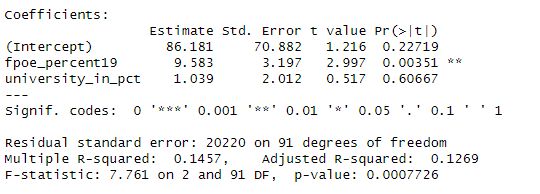
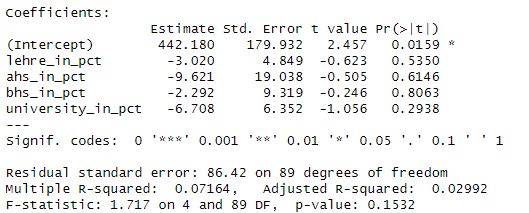
Es ist aber auch so, dass das Bildungsniveau die Differenzen in den Sterberaten weniger gut vorhersagen können, als Unterschiede im FPÖ-Anteil 2019. Hierzu ein paar Modelle mit und ohne FPÖ (bitte ALT-Text für eine Beschreibung lesen) 2/2
February 27, 2025 at 9:14 AM
Es ist aber auch so, dass das Bildungsniveau die Differenzen in den Sterberaten weniger gut vorhersagen können, als Unterschiede im FPÖ-Anteil 2019. Hierzu ein paar Modelle mit und ohne FPÖ (bitte ALT-Text für eine Beschreibung lesen) 2/2
Warum der Fokus auf die FPÖ und nicht auf Bildung? Das formale Bildungsniveau der Bevölkerung hat sich zwischen März/April 2020 und Herbst/Winter 2020/21 nicht maßgeblich verändert. Daher ist dieser Faktor nicht dafür geeignet, Differenzen in den Sterberaten zwischen den Wellen zu erklären. 1/2
February 27, 2025 at 9:14 AM
Warum der Fokus auf die FPÖ und nicht auf Bildung? Das formale Bildungsniveau der Bevölkerung hat sich zwischen März/April 2020 und Herbst/Winter 2020/21 nicht maßgeblich verändert. Daher ist dieser Faktor nicht dafür geeignet, Differenzen in den Sterberaten zwischen den Wellen zu erklären. 1/2