




Paul Goldsmith-Pinkham
@paulgp.com
Yale SOM professor & Bulls fan. I study consumer finance, and econometrics is a big part of my research identity. He/him/his
Damn, I hadn't realized how dominate QJE was in terms of impact (calculations using OpenAlex)

December 3, 2025 at 6:17 PM
Damn, I hadn't realized how dominate QJE was in terms of impact (calculations using OpenAlex)
Alright alright alright

December 3, 2025 at 5:41 PM
Alright alright alright
Alexa what is a forty year with two kids

December 3, 2025 at 5:41 PM
Alexa what is a forty year with two kids


Please enjoy this blog post based on my colleague Kyle Jensen's talk surveying different approaches to AI coding abilities
paulgp.com/ai-coding/20...
paulgp.com/ai-coding/20...

December 2, 2025 at 8:01 PM
Please enjoy this blog post based on my colleague Kyle Jensen's talk surveying different approaches to AI coding abilities
paulgp.com/ai-coding/20...
paulgp.com/ai-coding/20...
Interesting paper highlight that binning can be misspecified in panel settings - this drives misinterpretation of extreme temperature shocks. #linkoftheday
www.dropbox.com/scl/fi/1ya6z...
www.dropbox.com/scl/fi/1ya6z...


November 29, 2025 at 1:34 PM
Interesting paper highlight that binning can be misspecified in panel settings - this drives misinterpretation of extreme temperature shocks. #linkoftheday
www.dropbox.com/scl/fi/1ya6z...
www.dropbox.com/scl/fi/1ya6z...
When people see high PE ratios, they apparently predict higher stock returns -- new NBER WP using experimental info treatments #linkoftheday
www.nber.org/system/files...
www.nber.org/system/files...

November 26, 2025 at 4:08 PM
When people see high PE ratios, they apparently predict higher stock returns -- new NBER WP using experimental info treatments #linkoftheday
www.nber.org/system/files...
www.nber.org/system/files...
Any algorithmic decision-making has both a prediction/inference AND a preference function over errors -- new NBER wp highlights how preference alignment can be too narrow within a given setting #linkoftheday
www.nber.org/system/files...
www.nber.org/system/files...

November 26, 2025 at 4:05 PM
Any algorithmic decision-making has both a prediction/inference AND a preference function over errors -- new NBER wp highlights how preference alignment can be too narrow within a given setting #linkoftheday
www.nber.org/system/files...
www.nber.org/system/files...
Could you describe your counterfactual experiment to me please?

November 24, 2025 at 8:18 PM
Could you describe your counterfactual experiment to me please?
European Econ Job market appears to pull from EJM, which has this:

November 24, 2025 at 8:17 PM
European Econ Job market appears to pull from EJM, which has this:
I found this buried deep: econjobmarket.org/marketState/...
November 24, 2025 at 8:15 PM
I found this buried deep: econjobmarket.org/marketState/...
Hard to read, here's with all and then just 2015, 2020, 2034, 2024 and 2025


November 24, 2025 at 6:25 PM
Hard to read, here's with all and then just 2015, 2020, 2034, 2024 and 2025
Looks like we're in the worst year in since 2015.

November 24, 2025 at 3:53 PM
Looks like we're in the worst year in since 2015.
This Pope guy has some bangers
November 22, 2025 at 1:05 AM
This Pope guy has some bangers
Wrote a new paper on the econometrics of financial event studies, would value feedback! It's very new.
With my amazing grad student Tianshu Lyu www.tianshulyu.com, who is on the market. You should hire him!
paulgp.com/papers/finan...
With my amazing grad student Tianshu Lyu www.tianshulyu.com, who is on the market. You should hire him!
paulgp.com/papers/finan...


November 19, 2025 at 4:43 AM
Wrote a new paper on the econometrics of financial event studies, would value feedback! It's very new.
With my amazing grad student Tianshu Lyu www.tianshulyu.com, who is on the market. You should hire him!
paulgp.com/papers/finan...
With my amazing grad student Tianshu Lyu www.tianshulyu.com, who is on the market. You should hire him!
paulgp.com/papers/finan...
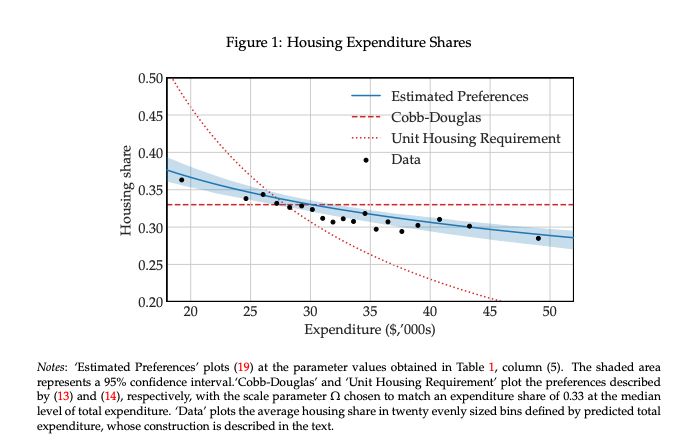
They're using PSID data

November 18, 2025 at 7:27 PM
They're using PSID data
This paper claims housing is not homothetic: trevorcwilliams.github.io/files/submis...
November 18, 2025 at 7:26 PM
This paper claims housing is not homothetic: trevorcwilliams.github.io/files/submis...
We also tackle inference. Our argument: if assignment is truly random at the individual level, heteroskedasticity-robust (non-clustered) SEs are appropriate. The assignment mechanism should guide your inference. And UJIVE's default SEs properly account for many-instrument corrections.

November 17, 2025 at 3:06 PM
We also tackle inference. Our argument: if assignment is truly random at the individual level, heteroskedasticity-robust (non-clustered) SEs are appropriate. The assignment mechanism should guide your inference. And UJIVE's default SEs properly account for many-instrument corrections.
We show a nice test for average monotonicity using UJIVE, similar to the original Kitagawa test, but valid under many instruments and controls. doi.org/10.3982/ECTA...

November 17, 2025 at 3:06 PM
We show a nice test for average monotonicity using UJIVE, similar to the original Kitagawa test, but valid under many instruments and controls. doi.org/10.3982/ECTA...
The standard monotonicity assumption (all examiners rank cases identically) is probably too strong, as Imbens and Angrist (1994) pointed out in their original paper. But "average monotonicity" (Frandsen et al. (2023)) is more plausible and sufficient.

November 17, 2025 at 3:06 PM
The standard monotonicity assumption (all examiners rank cases identically) is probably too strong, as Imbens and Angrist (1994) pointed out in their original paper. But "average monotonicity" (Frandsen et al. (2023)) is more plausible and sufficient.
The paper also guides how to think about heterogeneous treatment effects in many IV settings. It turns out that you can write the overall estimand as a set of pairwise IV regressions where the weights are proportional to the squared leniency distances between pairs of examiners.


November 17, 2025 at 3:06 PM
The paper also guides how to think about heterogeneous treatment effects in many IV settings. It turns out that you can write the overall estimand as a set of pairwise IV regressions where the weights are proportional to the squared leniency distances between pairs of examiners.
The UJIVE estimator gets the order right: residualize the instruments first, then do leave-one-out estimation. This properly constructs relative leniency without own-observation contamination. With 100+ fixed effects, this difference between JIVE and UJIVE matters.

November 17, 2025 at 3:06 PM
The UJIVE estimator gets the order right: residualize the instruments first, then do leave-one-out estimation. This properly constructs relative leniency without own-observation contamination. With 100+ fixed effects, this difference between JIVE and UJIVE matters.
(As an aside, we have a really lovely Appendix section that formally combines all these results together, mainly thanks to Michal, which I really encourage you to read if you like metrics!)

November 17, 2025 at 3:06 PM
(As an aside, we have a really lovely Appendix section that formally combines all these results together, mainly thanks to Michal, which I really encourage you to read if you like metrics!)
It turns out having many controls also creates this issue – intuitively, this makes sense that the same “own observation” problem shows up in estimation for control variables just like for excluded instruments. And in this setting, JIVE is actually biased in the opposite direction!

November 17, 2025 at 3:06 PM
It turns out having many controls also creates this issue – intuitively, this makes sense that the same “own observation” problem shows up in estimation for control variables just like for excluded instruments. And in this setting, JIVE is actually biased in the opposite direction!