
Mike Henderson
banner
mhender.bsky.social
Mike Henderson
@mhender.bsky.social
Retired Applied Mathematician. Computational Dynamical Systems.
Still trying to understand how things work.
https://multifario.sourceforge.io/henderson/

I might be wrong.
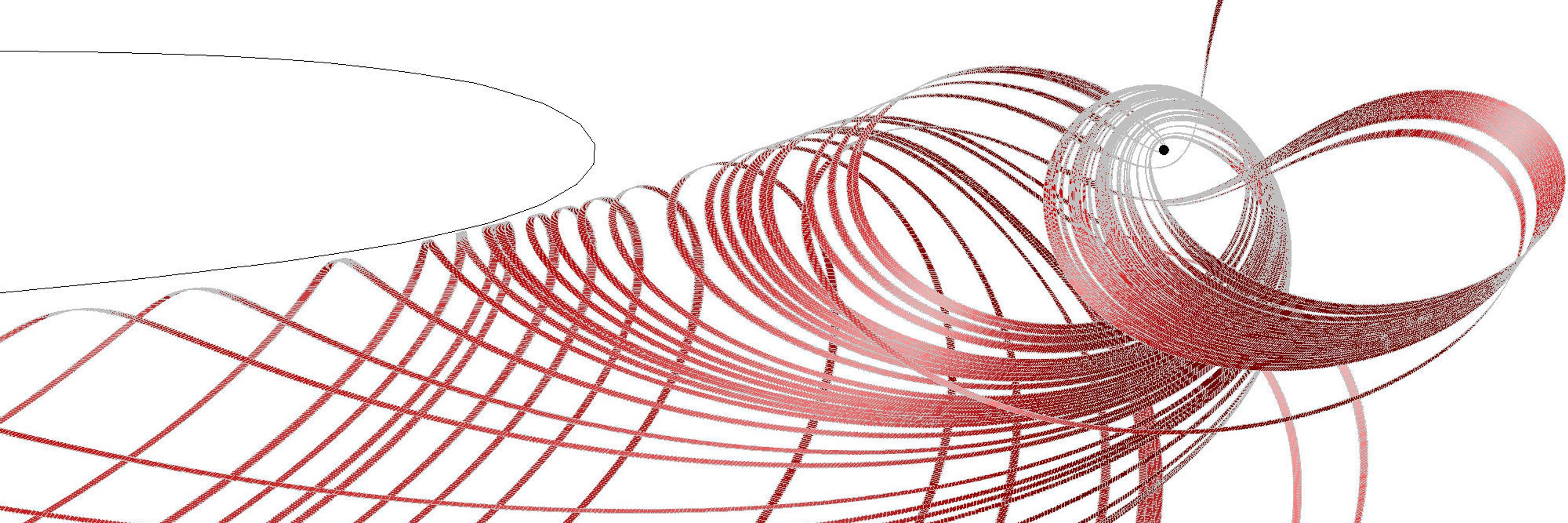
Longer positive time. 53K points.

More interesting than I thought. System is z'=1, so there are no fixed points. It's like a nonautonomous system that's been suspended (t'=1 added).
January 27, 2026 at 10:28 PM
Not any more profound, but more interesting (I think).
January 27, 2026 at 7:15 PM
Not sure one ever finishes debugging, but I found the bug I was looking for. So here's another image.
January 26, 2026 at 5:03 PM
Another snow day. Much more snow day.

Another image. An old one.

If I cut a torus with three planes, how many pieces can I get?

I think Cliff Pickover asked me this one back in 1987 or so. I had access to CATIA, so ...
January 26, 2026 at 4:58 PM
Just got a copy of Mantaldi's book on Singularity Theory. Have only skimmed it so far. I'm looking for the computational side of this. I've read a lot about the idea - contact equiv. transverse crossings, and know bif theory. The book seems to be descriptive of the results. But the day is young.
Singularities, Bifurcations and Catastrophes | Cambridge Aspire website
Discover Singularities, Bifurcations and Catastrophes, 1st Edition, James Montaldi, HB ISBN: 9781107151642 on Cambridge Aspire website
www.cambridge.org
January 22, 2026 at 4:20 PM
So for curve the interpolation I'm looking for take points along the curve with local approximations x[i](s)=x[i]+x_s[i] s + 1/2 x_ss[i] s^2 and "blends" between them. The usual approach uses polynomial blending functions.

Helps to have a global parameterization. That's the first problem for k>1.
Cubic Hermite spline - Wikipedia
en.wikipedia.org
January 17, 2026 at 8:20 PM
A good morning image. It snowed a bit last night. When that happens one of us bakes - I guess the other makes images.
January 17, 2026 at 3:49 PM
Is anyone out there an interpolation expert?

I have a smooth manifold, so local Taylor series R^k->R^n at the vertices of a k-d simplicial complex.

A piecewise linear interpolant for any k is so easy. But even k=2 cont. derivatives is so hard. I see lot of claims in the lit, but ...
January 16, 2026 at 5:18 PM
Because of Verizon's struggle yesterday (and today?) I'm acutely aware of the amount of communication that a simple web page load requires. It's amazing that anything works. Who designed/chose this?
January 15, 2026 at 7:42 PM
I just got a copy of Jane Cronin's Fixed Points and Topological Degree in Nonlinear Analysis". For F(x)=0 I'm used to the integral defn, and she casts it as the orientation of a simplex about the preimage of zero relative to it's image. It's very simple geometrically. Applies to higher dimensions.
January 9, 2026 at 2:30 AM
Thank goodness Computer Science has focused on fixing these problems and hasn't wasted huge amounts of effort doing whatever it is they're doing.
Pluralistic: Code is a liability (not an asset) (06 Jan 2026)
Today's links Code is a liability (not an asset): AI psychosis, tech boss edition. Hey look at this: Delights to delectate. Object permanence: Coldplay CD DRM; Star Wars Wars; Digital manorialism vs neofeudalism; Transvaginal foetal sonic bombardment: woo-tunes for your hoo-hah. Upcoming appearances: Where to find me. Recent appearances: Where I've been. Latest books: You keep readin' em, I'll keep writin' 'em. Upcoming books: Like I said, I'll keep writin' 'em. Colophon: All the rest. Code is a liability (not an asset) (permalink) Code is a liability (not an asset). Tech bosses don't understand this. They think AI is great because it produces 10,000 times more code than a programmer, but that just means it's producing 10,000 times more liabilities. AI is the asbestos we're shoveling into the walls of our high-tech society: https://pluralistic.net/2025/09/27/econopocalypse/#subprime-intelligence Code is a liability. Code's capabilities are assets. The goal of a tech shop is to have code whose capabilities generate more revenue than the costs associated with keeping that code running. For a long time, firms have nurtured a false belief that code costs less to run over time: after an initial shakedown period in which the bugs in the code are found and addressed, code ceases to need meaningful maintenance. After all, code is a machine without moving parts – it does not wear out; it doesn't even wear down. This is the thesis of Paul Mason's 2015 book Postcapitalism, a book that has aged remarkably poorly (though not, perhaps, as poorly as Mason's own political credibility): code is not an infinitely reproducible machine that requires no labor inputs to operate. Rather, it is a brittle machine that requires increasingly heroic measures to keep it in good working order, and which eventually does "wear out" (in the sense of needing a top-to-bottom refactoring). To understand why code is a liability, you have to understand the difference between "writing code" and "software engineering." "Writing code" is an incredibly useful, fun, and engrossing pastime. It involves breaking down complex tasks into discrete steps that are so precisely described that a computer can reliably perform them, and optimising that performance by finding clever ways of minimizing the demands the code puts on the computer's resources, such as RAM and processor cycles. Meanwhile, "software engineering" is a discipline that subsumes "writing code," but with a focus on the long-term operations of the system the code is part of. Software engineering concerns itself with the upstream processes that generate the data the system receives. It concerns itself with the downstream processes that the system emits processed information to. It concerns itself with the adjacent systems that are receiving data from the same upstream processes and/or emitting data to the same downstream processes the system is emitting to. "Writing code" is about making code that runs well. "Software engineering" is about making code that fails well. It's about making code that is legible – whose functions can be understood by third parties who might be asked to maintain it, or might be asked to adapt the processes downstream, upstream or adjacent to the system to keep the system from breaking. It's about making code that can be adapted, for example, when the underlying computer architecture it runs on is retired and has to be replaced, either with a new kind of computer, or with an emulated version of the old computer: https://www.theregister.com/2026/01/05/hpux_end_of_life/ Because that's the thing: any nontrivial code has to interact with the outside world, and the outside world isn't static, it's dynamic. The outside world busts through the assumptions made by software authors all the time and every time it does, the software needs to be fixed. Remember Y2K? That was a day when perfectly functional code, running on perfectly functional hardware, would stop functioning – not because the code changed, but because time marched on. We're 12 years away from the Y2038 problem, when 32-bit flavors of Unix will all cease to work, because they, too, will have run out of computable seconds. These computers haven't changed, their software hasn't changed, but the world – by dint of ticking over, a second at a time, for 68 years – will wear through their seams, and they will rupture: https://www.theregister.com/2025/08/23/the_unix_epochalypse_might_be/ The existence of "the world" is an inescapable factor that wears out software and requires it to be rebuilt, often at enormous expense. The longer code is in operation, the more likely it is that it will encounter "the world." Take the code that devices use to report on their physical location. Originally, this was used for things like billing – determining which carrier or provider's network you were using and whether you were roaming. Then, our mobile devices used this code to help determine your location in order to give you turn-by-turn directions in navigation apps. Then, this code was repurposed again to help us find our lost devices. This, in turn, became a way to locate stolen devices, a use-case that sharply diverges from finding lost devices in important ways – for example, when locating a lost device, you don't have to contend with the possibility that a malicious actor has disabled the "find my lost device" facility. These additional use cases – upstream, downstream and adjacent – exposed bugs in the original code that never surfaced in the earlier applications. For example, all location services must have some kind of default behavior in the (very common) event that they're not really sure where they are. Maybe they have a general fix – for example, they know which cellular mast they're connected to, or they know where they were the last time they got an accurate location fix – or maybe they're totally lost. It turns out that in many cases, location apps drew a circle around all the places they could be and then set their location to the middle of that circle. That's fine if the circle is only a few feet in diameter, or if the app quickly replaces this approximation with a more precise location. But what if the location is miles and miles across, and the location fix never improves? What if the location for any IP address without a defined location is given as the center of the continental USA and any app that doesn't know where it is reports that it is in a house in Kansas, sending dozens of furious (occasionally armed) strangers to that house, insisting that the owners are in possession of their stolen phones and tablets? https://theweek.com/articles/624040/how-internet-mapping-glitch-turned-kansas-farm-into-digital-hell You don't just have to fix this bug once – you have to fix it over and over again. In Georgia: https://www.jezebel.com/why-lost-phones-keep-pointing-at-this-atlanta-couples-h-1793854491 In Texas: https://abc7chicago.com/post/find-my-iphone-apple-error-strangers-at-texas-familys-home-scott-schuster/13096627/ And in my town of Burbank, where Google's location-sharing service once told us that our then-11-year-old daughter (whose phone we couldn't reach) was 12 miles away, on a freeway ramp in an unincorporated area of LA county (she was at a nearby park, but out of range, and the app estimated her location as the center of the region it had last fixed her in) (it was a rough couple hours). The underlying code – the code that uses some once-harmless default to fudge unknown locations – needs to be updated constantly, because the upstream, downstream and adjacent processes connected to it are changing constantly. The longer that code sits there, the more superannuated its original behaviors become, and the more baroque, crufty and obfuscated the patches layered atop of it become. Code is not an asset – it's a liability. The longer a computer system has been running, the more tech debt it represents. The more important the system is, the harder it is to bring down and completely redo. Instead, new layers of code are slathered atop of it, and wherever the layers of code meet, there are fissures in which these systems behave in ways that don't exactly match up. Worse still: when two companies are merged, their seamed, fissured IT systems are smashed together, so that now there are adjacent sources of tech debt, as well as upstream and downstream cracks: https://pluralistic.net/2024/06/28/dealer-management-software/#antonin-scalia-stole-your-car That's why giant companies are so susceptible to ransomware attacks – they're full of incompatible systems that have been coaxed into a facsimile of compatibility with various forms of digital silly putty, string and baling wire. They are not watertight and they cannot be made watertight. Even if they're not taken down by hackers, they sometimes just fall over and can't be stood back up again – like when Southwest Airlines' computers crashed for all of Christmas week 2022, stranding millions of travelers: https://pluralistic.net/2023/01/16/for-petes-sake/#unfair-and-deceptive Airlines are especially bad, because they computerized early, and can't ever shut down the old computers to replace them with new ones. This is why their apps are such dogshit – and why it's so awful that they've fired their customer service personnel and require fliers to use the apps for everything, even though the apps do. not. work. These apps won't ever work. The reason that British Airways' app displays "An unknown error has occurred" 40-80% of the time isn't (just) that they fired all their IT staff and outsourced to low bidders overseas. It's that, sure – but also that BA's first computers ran on electromechanical valves, and everything since has to be backwards-compatible with a system that one of Alan Turing's proteges gnawed out of a whole log with his very own front teeth. Code is a liability, not an asset (BA's new app is years behind schedule). Code is a liability. The servers for the Bloomberg terminals that turned Michael Bloomberg into a billionaire run on RISC chips, meaning that the company is locked into using a dwindling number of specialist hardware and data-center vendors, paying specialized programmers, and building brittle chains of code to connect these RISC systems to their less exotic equivalents in the world. Code isn't an asset. AI can write code, but AI can't do software engineering. Software engineering is all about thinking through context – what will come before this system? What will come after it? What will sit alongside of it? How will the world change? Software engineering requires a very wide "context window," the thing that AI does not, and cannot have. AI has a very narrow and shallow context window, and linear expansions to AI's context window requires geometric expansions in the amount of computational resources the AI consumes: https://pluralistic.net/2025/10/29/worker-frightening-machines/#robots-stole-your-jerb-kinda Writing code that works, without consideration of how it will fail, is a recipe for catastrophe. It is a way to create tech debt at scale. It is shoveling asbestos into the walls of our technological society. Bosses do not know that code is a liability, not an asset. That's why they won't shut the fuck up about the chatbots that shit out 10,000 times more code than any human programmer. They think they've found a machine that produces assets at 10,000 times the rate of a human programmer. They haven't. They've found a machine that produces liability at 10,000 times the rate of any human programmer. Maintainability isn't just a matter of hard-won experience teaching you where the pitfalls are. It also requires the cultivation of "Fingerspitzengefühl" – the "fingertip feeling" that lets you make reasonable guesses about where never before seen pitfalls might emerge. It's a form of process knowledge. It is ineluctable. It is not latent in even the largest corpus of code that you could use as training data: https://pluralistic.net/2025/09/08/process-knowledge/#dance-monkey-dance Boy do tech bosses not get this. Take Microsoft. Their big bet right now is on "agentic AI." They think that if they install spyware on your computer that captures every keystroke, every communication, every screen you see and sends it to Microsoft's cloud and give a menagerie of chatbots access to it, that you'll be able to tell your computer, "Book me a train to Cardiff and find that hotel Cory mentioned last year and book me a room there" and it will do it. This is an incredibly unworkable idea. No chatbot is remotely capable of doing all these things, something that Microsoft freely stipulates. Rather than doing this with one chatbot, Microsoft proposes to break this down among dozens of chatbots, each of which Microsoft hopes to bring up to 95% reliability. That's an utterly implausible chatbot standard in and of itself, but consider this: probabilities are multiplicative. A system containing two processes that operate at 95% reliability has a net reliability of 90.25% (0.95 * 0.95). Break a task down among a couple dozen 95% accurate bots and the chance that this task will be accomplished correctly rounds to zero. Worse, Microsoft is on record as saying that they will grant the Trump administration secret access to all the data in its cloud: https://www.forbes.com/sites/emmawoollacott/2025/07/22/microsoft-cant-keep-eu-data-safe-from-us-authorities/ So – as Signal's Meredith Whittaker and Udbhav Tiwari put it in their incredible 39C3 talk last week in Hamburg – Microsoft is about to abolish the very idea of privacy for any data on personal and corporate computers, in order to ship AI agents that cannot ever work: https://www.youtube.com/watch?v=0ANECpNdt-4 Meanwhile, a Microsoft exec got into trouble last December when he posted to Linkedin announcing his intention to have AI rewrite all of Microsoft's code. Refactoring Microsoft's codebase makes lots of sense. Microsoft – like British Airways and other legacy firms – has lots of very old code that represents unsustainable tech debt. But using AI to rewrite that code is a way to start with tech debt that will only accumulate as time goes by: https://www.windowslatest.com/2025/12/24/microsoft-denies-rewriting-windows-11-using-ai-after-an-employees-one-engineer-one-month-one-million-code-post-on-linkedin-causes-outrage/ Now, some of you reading this have heard software engineers extolling the incredible value of using a chatbot to write code for them. Some of you are software engineers who have found chatbots incredibly useful in writing code for you. This is a common AI paradox: why do some people who use AI find it really helpful, while others loathe it? Is it that the people who don't like AI are "bad at AI?" Is it that the AI fans are lazy and don't care about the quality of their work? There's doubtless some of both going on, but even if you teach everyone to be an AI expert, and cull everyone who doesn't take pride in their work out of the sample, the paradox will still remain. The true solution to the AI paradox lies in automation theory, and the concept of "centaurs" and "reverse centaurs": https://pluralistic.net/2025/09/11/vulgar-thatcherism/#there-is-an-alternative In automation theory, a "centaur" is a person who is assisted by a machine. A "reverse centaur" is someone who has been conscripted into assisting a machine. If you're a software engineer who uses AI to write routine code that you have the time and experience to validate, deploying your Fingerspitzengefühl and process knowledge to ensure that it's fit for purpose, it's easy to see why you might find using AI (when you choose to, in ways you choose to, at a pace you choose to go at) to be useful. But if you're a software engineer who's been ordered to produce code at 10x, or 100x, or 10,000x your previous rate, and the only way to do that is via AI, and there is no human way that you could possibly review that code and ensure that it will not break on first contact with the world, you'll hate it (you'll hate it even more if you've been turned into the AI's accountability sink, personally on the hook for the AI's mistakes): https://pluralistic.net/2025/05/27/rancid-vibe-coding/#class-war There's another way in which software engineers find AI-generated code to be incredibly helpful: when that code is isolated. If you're doing a single project – say, converting one batch of files to another format, just once – you don't have to worry about downstream, upstream or adjacent processes. There aren't any. You're writing code to do something once, without interacting with any other systems. A lot of coding is this kind of utility project. It's tedious, thankless, and ripe for automation. Lots of personal projects fall into this bucket, and of course, by definition, a personal project is a centaur project. No one forces you to use AI in a personal project – it's always your choice how and when you make personal use of any tool. But the fact that software engineers can sometimes make their work better with AI doesn't invalidate the fact that code is a liability, not an asset, and that AI code represents liability production at scale. In the story of technological unemployment, there's the idea that new technology creates new jobs even as it makes old ones obsolete: for every blacksmith put out of work by the automobile, there's a job waiting as a mechanic. In the years since the AI bubble began inflating, we've heard lots of versions of this: AI would create jobs for "prompt engineers" – or even create jobs that we can't imagine, because they won't exist until AI has changed the world beyond recognition. I wouldn't bank on getting work in a fanciful trade that literally can't be imagined because our consciousnesses haven't so altered by AI that they've acquired the capacity to conceptualize of these new modes of work. But if you are looking for a job that AI will definitely create, by the millions, I have a suggestion: digital asbestos removal. For if AI code – written at 10,000 times the speed of any human coder, designed to work well, but not to fail gracefully – is the digital asbestos we're filling our walls with, then our descendants will spend generations digging that asbestos out of the walls. There will be plenty of work fixing the things that we broke thanks to the most dangerous AI psychosis of all – the hallucinatory belief that "writing code" is the same thing as "software engineering." At the rate we're going, we'll have full employment for generations of asbestos removers. (Image: Cryteria, CC BY 3.0, modified) Hey look at this (permalink) The State of Anti-Surveillance Design https://www.404media.co/the-state-of-anti-surveillance-design/ Ancient Everyday Weirdness https://bruces.medium.com/ancient-everyday-weirdness-591955f40a2d Norman Podhoretz, 1930-2025 https://coreyrobin.com/2025/12/18/norman-podhoretz-1930-2025/ A Cultural Disease: Enshittificationitis https://aboutsomething.substack.com/p/a-cultural-disease-enshittificationitis?triedRedirect=true Object permanence (permalink) #20yrsago Coldplay CD DRM — more information https://memex.craphound.com/2006/01/05/coldplay-cd-drm-more-information/ #20yrsago Sony sued for spyware and rootkits in Canada https://web.archive.org/web/20060103051129/http://sonysuit.com/ #20yrsago What if pizzas came with licenses like the ones in DRM CDs? https://web.archive.org/web/20110108164548/http://www.groklaw.net/article.php?story=20060104161112858 #10yrsago Star Wars Wars: the first six movies, overlaid https://starwarswars.com/ #10yrsago Transvaginal foetal sonic bombardment: woo-tunes for your hoo-hah https://babypod.net/en/ #10yrsago Of Oz the Wizard: all the dialog in alphabetical order https://vimeo.com/150423718?fl=pl&fe=vl #5yrsago Pavilions replacing union workers with "gig workers" https://pluralistic.net/2021/01/05/manorialism-feudalism-cycle/#prop22 #5yrsago South Carolina GOP moots modest improvements to "magistrate judges" https://pluralistic.net/2021/01/05/manorialism-feudalism-cycle/#karolina-klown-kar #5yrsago Digital manorialism vs neofeudalism https://pluralistic.net/2021/01/05/manorialism-feudalism-cycle/#to-the-manor #5yrsago My Fellow Americans https://pluralistic.net/2021/01/05/manorialism-feudalism-cycle/#my-fellow-americans Upcoming appearances (permalink) Denver: Enshittification at Tattered Cover Colfax, Jan 22 https://www.eventbrite.com/e/cory-doctorow-live-at-tattered-cover-colfax-tickets-1976644174937 Colorado Springs: Guest of Honor at COSine, Jan 23-25 https://www.firstfridayfandom.org/cosine/ Ottawa: Enshittification at Perfect Books, Jan 28 https://www.instagram.com/p/DS2nGiHiNUh/ Toronto: Enshittification and the Age of Extraction with Tim Wu, Jan 30 https://nowtoronto.com/event/cory-doctorow-and-tim-wu-enshittification-and-extraction/ Victoria: 28th Annual Victoria International Privacy & Security Summit, Mar 3-5 https://www.rebootcommunications.com/event/vipss2026/ Recent appearances (permalink) A post-American, enshittification-resistant internet (39c3) https://media.ccc.de/v/39c3-a-post-american-enshittification-resistant-internet Enshittification with Plutopia https://plutopia.io/cory-doctorow-enshittification/ "can't make Big Tech better; make them less powerful" (Get Subversive) https://www.youtube.com/watch?v=X1EzM9_6eLE The Enshitification Life Cycle with David Dayen (Organized Money) https://www.buzzsprout.com/2412334/episodes/18399894 Enshittificaition on The Last Show With David Cooper: https://www.iheart.com/podcast/256-the-last-show-with-david-c-31145360/episode/cory-doctorow-enshttification-december-16-2025-313385767 Latest books (permalink) "Canny Valley": A limited edition collection of the collages I create for Pluralistic, self-published, September 2025 "Enshittification: Why Everything Suddenly Got Worse and What to Do About It," Farrar, Straus, Giroux, October 7 2025 https://us.macmillan.com/books/9780374619329/enshittification/ "Picks and Shovels": a sequel to "Red Team Blues," about the heroic era of the PC, Tor Books (US), Head of Zeus (UK), February 2025 (https://us.macmillan.com/books/9781250865908/picksandshovels). "The Bezzle": a sequel to "Red Team Blues," about prison-tech and other grifts, Tor Books (US), Head of Zeus (UK), February 2024 (thebezzle.org). "The Lost Cause:" a solarpunk novel of hope in the climate emergency, Tor Books (US), Head of Zeus (UK), November 2023 (http://lost-cause.org). "The Internet Con": A nonfiction book about interoperability and Big Tech (Verso) September 2023 (http://seizethemeansofcomputation.org). Signed copies at Book Soup (https://www.booksoup.com/book/9781804291245). "Red Team Blues": "A grabby, compulsive thriller that will leave you knowing more about how the world works than you did before." Tor Books http://redteamblues.com. "Chokepoint Capitalism: How to Beat Big Tech, Tame Big Content, and Get Artists Paid, with Rebecca Giblin", on how to unrig the markets for creative labor, Beacon Press/Scribe 2022 https://chokepointcapitalism.com Upcoming books (permalink) "Unauthorized Bread": a middle-grades graphic novel adapted from my novella about refugees, toasters and DRM, FirstSecond, 2026 "Enshittification, Why Everything Suddenly Got Worse and What to Do About It" (the graphic novel), Firstsecond, 2026 "The Memex Method," Farrar, Straus, Giroux, 2026 "The Reverse-Centaur's Guide to AI," a short book about being a better AI critic, Farrar, Straus and Giroux, June 2026 Colophon (permalink) Today's top sources: Currently writing: "The Reverse Centaur's Guide to AI," a short book for Farrar, Straus and Giroux about being an effective AI critic. LEGAL REVIEW AND COPYEDIT COMPLETE. "The Post-American Internet," a short book about internet policy in the age of Trumpism. PLANNING. A Little Brother short story about DIY insulin PLANNING This work – excluding any serialized fiction – is licensed under a Creative Commons Attribution 4.0 license. That means you can use it any way you like, including commercially, provided that you attribute it to me, Cory Doctorow, and include a link to pluralistic.net. https://creativecommons.org/licenses/by/4.0/ Quotations and images are not included in this license; they are included either under a limitation or exception to copyright, or on the basis of a separate license. Please exercise caution. How to get Pluralistic: Blog (no ads, tracking, or data-collection): Pluralistic.net Newsletter (no ads, tracking, or data-collection): https://pluralistic.net/plura-list Mastodon (no ads, tracking, or data-collection): https://mamot.fr/@pluralistic Medium (no ads, paywalled): https://doctorow.medium.com/ Twitter (mass-scale, unrestricted, third-party surveillance and advertising): https://twitter.com/doctorow Tumblr (mass-scale, unrestricted, third-party surveillance and advertising): https://mostlysignssomeportents.tumblr.com/tagged/pluralistic "When life gives you SARS, you make sarsaparilla" -Joey "Accordion Guy" DeVilla READ CAREFULLY: By reading this, you agree, on behalf of your employer, to release me from all obligations and waivers arising from any and all NON-NEGOTIATED agreements, licenses, terms-of-service, shrinkwrap, clickwrap, browsewrap, confidentiality, non-disclosure, non-compete and acceptable use policies ("BOGUS AGREEMENTS") that I have entered into with your employer, its partners, licensors, agents and assigns, in perpetuity, without prejudice to my ongoing rights and privileges. You further represent that you have the authority to release me from any BOGUS AGREEMENTS on behalf of your employer. ISSN: 3066-764X
pluralistic.net
January 6, 2026 at 5:58 PM
I read a history of Newcastle a little while ago. Pics of harbors reminded me of it.

They'd ship coal south, and the returning ships couldn't sail empty - so they loaded them with rocks. To get rid of the rocks they dumped the rocks in the harbor, made long jetties and "reclaimed" mud flats.
Ballast Hills | sitelines.newcastle.gov.uk
sitelines.newcastle.gov.uk
January 5, 2026 at 5:39 PM
If I have a flow u'=F(u), and a local analysis of F_u at u(0) gives an invariant subspace Phi(u(0)), then it propagates as Phi'=F_u Phi. Am I guaranteed that evolving Phi(u(0)) to Phi(u(t)) gives the same invariant subspace as a local analysis of F_u(u(t))?
December 29, 2025 at 11:21 PM
Got a new computer. Sure. Faster M.2 drive? Sounds good. Windows 11 install can't find it. Nope. Not there.

So - Linux, and suffer LibreOffice's brain dead math in presentation editor, or waste (yet more) time trying to get Window to install?

It's the old machines for me.
December 29, 2025 at 9:19 PM
I've been using our library's ebook offering. I have discovered that you can only take out five books (total) per month.

I'm back to the books on my shelves until the new year.
December 27, 2025 at 9:43 PM
Is this the Mid-Atlantic Ridge or a neuron?
December 18, 2025 at 10:32 PM
I learned in my physics class for non majors that Hamilton did great things and then wasted the end of his life on quaternions. I always thought that was terribly unfair. 3d rotations are a pain to deal with. I try to avoid them, but quaterions are clever if you really have to.
December 14, 2025 at 9:43 PM
I'm reading (snacking on?) Courant and Robbins' "What is Mathematics" I really like their presentation. Just now read their explanation of the "can't trisect an angle" proofs and how the compass and ruler constructions build an algebra. I think I may have read this before.
December 14, 2025 at 5:29 PM
I've always liked the notion that math notation is like magic - to know the name of something is to be able to manipulate it.

So vector notation is magic because if you know they're "names" you can add vectors, find norms, dot products.

(1,2) + (2,3) = (1+2,2+3)
December 13, 2025 at 6:00 PM
Reading Mandelbrot's memoir. Hoped he had his side of some history of Math Sci at IBM. Boy he had an ego. Mentions Gomry and Bryant Tuckerman, and Voss and Alan Norton from outside, but not much else. I skipped most of the book. A genius, if he does say so himself (many many times).
December 13, 2025 at 4:23 PM
I watched a movie last night and they had some dialog in German. I know a few words, but they could be saying almost anything. Obviously if whoever made the film wanted me to understand it they would have provided subtitles or dubbed it.

One of the things Math is is a language. Many languages.
December 10, 2025 at 4:56 PM
I'm back to the library to look things up.

We put a lot of knowledge in print, and the internet had the potential to search of it all. Except it's not there. Copyright goes back forever, even if out of print. Big holes in content. Then what's in people's heads. It was going to be easy to publish.
December 9, 2025 at 9:41 PM
Argh. I picked up this book: epubs.siam.org/doi/book/10.... when I was in college. I'm finally where I can read it (thanks R. Courant!). It seems almost to be trying to obscure a relatively simple idea. The notation is awful.
Lie-Bäcklund Transformations in Applications | SIAM Publications Library
epubs.siam.org
December 6, 2025 at 9:51 PM
One of the things about Lagrangian Descriptors is that it seems to go against the conv. wisdom that finding every trajectory in (part of) phase space is too expensive.
Things are different now, and there are situations where that's no longer true. And hey, look what you can do.
November 28, 2025 at 4:12 PM
I've been reading about Lagrangian Descriptors.
champsproject.github.io/lagrangian_d...
Seems expensive, but makes intriguing pics
www.researchgate.net/profile/Fabi...
The Method of Lagrangian Descriptors — Lagrangian Descriptors
champsproject.github.io
November 26, 2025 at 4:29 PM