


Lili Niu
@liliniu.bsky.social
Interested in proteomics technologies, pQTLs, proteome variation in health and diseases. Views are my own.
Reposted by Lili Niu
Fantastic time at #HUPO2025 in Toronto! Congratulations to our talented Early Career researchers! Proud winners: Oeller Marc Oeller🥇 1st Place Poster, Kathrin Korff 🥈 Runner-up Poster, and @carolineweiss.bsky.social 🎤 3-Minute Thesis award! The future of #proteomics research is bright!

November 13, 2025 at 12:01 PM
Fantastic time at #HUPO2025 in Toronto! Congratulations to our talented Early Career researchers! Proud winners: Oeller Marc Oeller🥇 1st Place Poster, Kathrin Korff 🥈 Runner-up Poster, and @carolineweiss.bsky.social 🎤 3-Minute Thesis award! The future of #proteomics research is bright!
Reposted by Lili Niu

Scaling plasma proteomics to 6400 patients?
Hear Lili Niu at our #HUPO2025 breakfast on how 1152 samples/day and a 200 SPD Evosep Eno + Orbitrap Astral workflow quantified >400 proteins per sample.
Register: www.evosep.com/hupo2025/
Hear Lili Niu at our #HUPO2025 breakfast on how 1152 samples/day and a 200 SPD Evosep Eno + Orbitrap Astral workflow quantified >400 proteins per sample.
Register: www.evosep.com/hupo2025/

November 4, 2025 at 2:59 PM
Scaling plasma proteomics to 6400 patients?
Hear Lili Niu at our #HUPO2025 breakfast on how 1152 samples/day and a 200 SPD Evosep Eno + Orbitrap Astral workflow quantified >400 proteins per sample.
Register: www.evosep.com/hupo2025/
Hear Lili Niu at our #HUPO2025 breakfast on how 1152 samples/day and a 200 SPD Evosep Eno + Orbitrap Astral workflow quantified >400 proteins per sample.
Register: www.evosep.com/hupo2025/
This #hupo2025 marks the first HUPO since I became a group leader last month at Shenzhen Bay Laboratory in Shenzhen, China. I will be presenting a talk and a poster👇 Looking very much forward to connecting with old friends and meeting new ones!
November 8, 2025 at 12:05 PM
This #hupo2025 marks the first HUPO since I became a group leader last month at Shenzhen Bay Laboratory in Shenzhen, China. I will be presenting a talk and a poster👇 Looking very much forward to connecting with old friends and meeting new ones!
Reposted by Lili Niu
If you are at HUPO 2025, catch up with our team @mannlab.bsky.social to hear about our exciting work in single-cell proteomics, immunopeptidomics, spatial proteomics, and the latest advances in mass spectrometry technology!

November 7, 2025 at 1:20 PM
If you are at HUPO 2025, catch up with our team @mannlab.bsky.social to hear about our exciting work in single-cell proteomics, immunopeptidomics, spatial proteomics, and the latest advances in mass spectrometry technology!
Reposted by Lili Niu

🎉 Congratulations to Matthias Mann on 20 years leading Proteomics & Signal Transduction at MPI of Biochemistry! Two decades of groundbreaking mass spectrometry research and training excellent future scientists.
#MS #Proteomics #Science @mannlab.bsky.social
#MS #Proteomics #Science @mannlab.bsky.social
July 1, 2025 at 1:33 PM
🎉 Congratulations to Matthias Mann on 20 years leading Proteomics & Signal Transduction at MPI of Biochemistry! Two decades of groundbreaking mass spectrometry research and training excellent future scientists.
#MS #Proteomics #Science @mannlab.bsky.social
#MS #Proteomics #Science @mannlab.bsky.social
Reposted by Lili Niu

Very excited that our work describing hu.MAP3.0 is published in @molsystbiol.org. Here we use machine learning to integrate >25k mass spectrometry experiments to place ~70% of human proteins into 15k protein complexes.
www.embopress.org/doi/full/10....
www.embopress.org/doi/full/10....
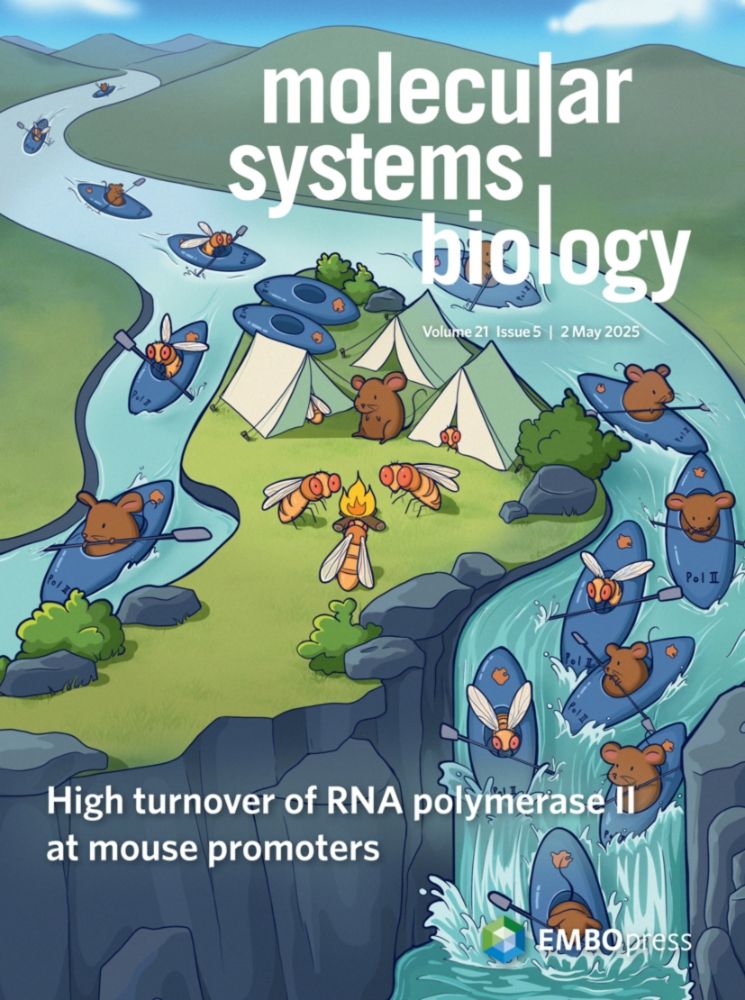
hu.MAP3.0: atlas of human protein complexes by integration of >25,000 proteomic experiments | Molecular Systems Biology
imageimagehu.MAP3.0 integrates mass spectrometry experiments to identify human protein complexes.
Using this resource, this study characterizes covariation of complexes, identifies
mutually exclusive ...
www.embopress.org
May 29, 2025 at 11:24 PM
Very excited that our work describing hu.MAP3.0 is published in @molsystbiol.org. Here we use machine learning to integrate >25k mass spectrometry experiments to place ~70% of human proteins into 15k protein complexes.
www.embopress.org/doi/full/10....
www.embopress.org/doi/full/10....
Reposted by Lili Niu

New from @mannlab.bsky.social Champions of Europe! 1200+ proteins from plasma. More of this please.
bsky.app/profile/mann...
bsky.app/profile/mann...
Out today in Nature Genetics: Using MS-based proteomics, we mapped 1,200+ plasma proteins in 2,100+ children, showing how genetics & development shape blood protein levels during childhood.
nature.com/articles/s41588-025-02089-2
#PediatricProteomics #pQTL
First author @liliniu.bsky.social explains ⬇️
nature.com/articles/s41588-025-02089-2
#PediatricProteomics #pQTL
First author @liliniu.bsky.social explains ⬇️
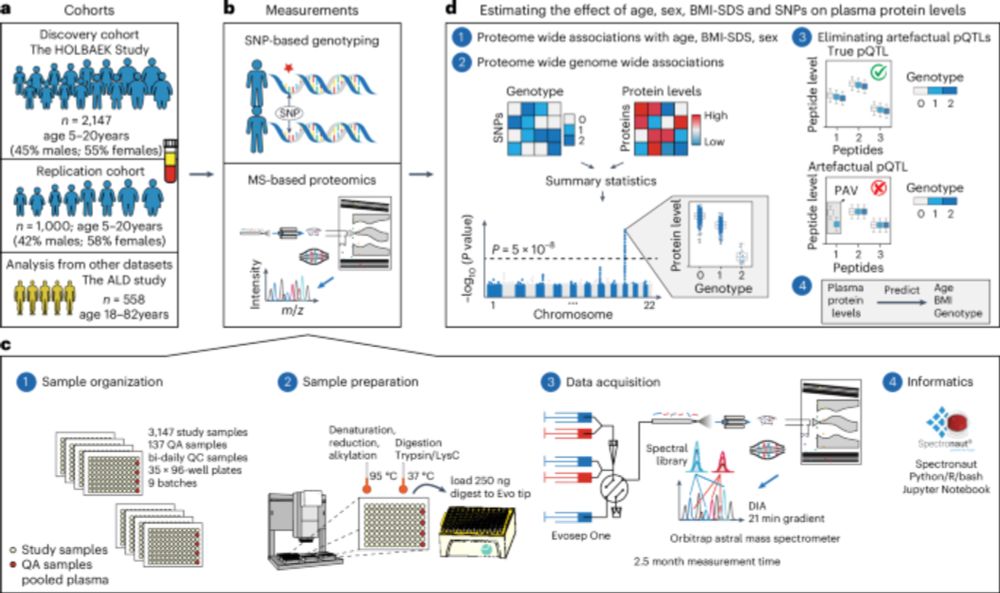
Plasma proteome variation and its genetic determinants in children and adolescents - Nature Genetics
This mass spectrometry-based proteomic study profiles the plasma proteome in 2,147 children and adolescents and reveals its association with age, sex, puberty, body mass index and genetics.
nature.com
February 19, 2025 at 4:45 PM
New from @mannlab.bsky.social Champions of Europe! 1200+ proteins from plasma. More of this please.
bsky.app/profile/mann...
bsky.app/profile/mann...
Reposted by Lili Niu
Neat plasma from yielding 1200+ proteins from a >3000 samples study is phenomenal.. Even more phenomenal is demonstrating the feasibility of linear comparisons across samples acquired over 2.5 months of instrument time.. Awesome..
Out today in Nature Genetics: Using MS-based proteomics, we mapped 1,200+ plasma proteins in 2,100+ children, showing how genetics & development shape blood protein levels during childhood.
nature.com/articles/s41588-025-02089-2
#PediatricProteomics #pQTL
First author @liliniu.bsky.social explains ⬇️
nature.com/articles/s41588-025-02089-2
#PediatricProteomics #pQTL
First author @liliniu.bsky.social explains ⬇️
Plasma proteome variation and its genetic determinants in children and adolescents - Nature Genetics
This mass spectrometry-based proteomic study profiles the plasma proteome in 2,147 children and adolescents and reveals its association with age, sex, puberty, body mass index and genetics.
nature.com
February 19, 2025 at 7:13 PM
Neat plasma from yielding 1200+ proteins from a >3000 samples study is phenomenal.. Even more phenomenal is demonstrating the feasibility of linear comparisons across samples acquired over 2.5 months of instrument time.. Awesome..
Reposted by Lili Niu
Out today in Nature Genetics: Using MS-based proteomics, we mapped 1,200+ plasma proteins in 2,100+ children, showing how genetics & development shape blood protein levels during childhood.
nature.com/articles/s41588-025-02089-2
#PediatricProteomics #pQTL
First author @liliniu.bsky.social explains ⬇️
nature.com/articles/s41588-025-02089-2
#PediatricProteomics #pQTL
First author @liliniu.bsky.social explains ⬇️
Plasma proteome variation and its genetic determinants in children and adolescents - Nature Genetics
This mass spectrometry-based proteomic study profiles the plasma proteome in 2,147 children and adolescents and reveals its association with age, sex, puberty, body mass index and genetics.
nature.com
February 19, 2025 at 10:44 AM
Out today in Nature Genetics: Using MS-based proteomics, we mapped 1,200+ plasma proteins in 2,100+ children, showing how genetics & development shape blood protein levels during childhood.
nature.com/articles/s41588-025-02089-2
#PediatricProteomics #pQTL
First author @liliniu.bsky.social explains ⬇️
nature.com/articles/s41588-025-02089-2
#PediatricProteomics #pQTL
First author @liliniu.bsky.social explains ⬇️
Reposted by Lili Niu

A perturbation proteomics-based foundation model for virtual cell construction https://www.biorxiv.org/content/10.1101/2025.02.07.637070v1
February 10, 2025 at 10:04 PM
A perturbation proteomics-based foundation model for virtual cell construction https://www.biorxiv.org/content/10.1101/2025.02.07.637070v1
Reposted by Lili Niu

Not every analysis of multiple () requires multiplicity adjustments (correcting p-values for multiple testing):
www.sciencedirect.com/science/arti...
www.sciencedirect.com/science/arti...
Inconsistent multiple testing corrections: The fallacy of using family-based error rates to make inferences about individual hypotheses
During multiple testing, researchers often adjust their alpha level to control the familywise error rate for a statistical inference about a joint uni…
www.sciencedirect.com
January 6, 2025 at 8:49 AM
Not every analysis of multiple () requires multiplicity adjustments (correcting p-values for multiple testing):
www.sciencedirect.com/science/arti...
www.sciencedirect.com/science/arti...
Reposted by Lili Niu

A Chinese-built large language model called DeepSeek-R1 is thrilling scientists as an affordable and open rival to ‘reasoning’ models such as OpenAI’s o1
https://go.nature.com/3WroTb1
https://go.nature.com/3WroTb1

China’s cheap, open AI model DeepSeek thrills scientists
DeepSeek-R1 performs reasoning tasks at the same level as OpenAI’s o1 — and is open for researchers to examine.
go.nature.com
January 23, 2025 at 4:25 PM
A Chinese-built large language model called DeepSeek-R1 is thrilling scientists as an affordable and open rival to ‘reasoning’ models such as OpenAI’s o1
https://go.nature.com/3WroTb1
https://go.nature.com/3WroTb1
Reposted by Lili Niu

Nice review of plasma proteomics methods by Josh Coon and his group . However the perchloric acid treatment of plasma will lead to the formation of cysteic acid and methionine sulphone which is not mentioned for the DIA search. .https://www.biorxiv.org/content/10.1101/2025.01.08.632035v1
A Technical Evaluation of Plasma Proteomics Technologies
Plasma proteomic technologies are rapidly evolving and of critical importance to the field of biomedical research. Here we report a technical evaluation of six notable plasma proteomic technologies - ...
www.biorxiv.org
January 14, 2025 at 10:19 AM
Nice review of plasma proteomics methods by Josh Coon and his group . However the perchloric acid treatment of plasma will lead to the formation of cysteic acid and methionine sulphone which is not mentioned for the DIA search. .https://www.biorxiv.org/content/10.1101/2025.01.08.632035v1