




Ilkka Rauvola
@jukka235.bsky.social
Covid-19. In God we trust, all others must bring data.
X: @jukka235 or https://x.com/jukka235
X: @jukka235 or https://x.com/jukka235

However, from 2022 onwards, patient counts have started to grow in all age groups older than 15 years. For total population, annual growth rate is 15.2% per year (10x in 16 years).
3/x
3/x

December 19, 2025 at 4:23 AM
However, from 2022 onwards, patient counts have started to grow in all age groups older than 15 years. For total population, annual growth rate is 15.2% per year (10x in 16 years).
3/x
3/x
Rosacea (L71) showed no growth before 2022 in total population.
2/x
2/x

December 19, 2025 at 4:17 AM
Rosacea (L71) showed no growth before 2022 in total population.
2/x
2/x
If the current 2025 growth rate continues, 50% of 7-14 year olds will get a hyperkinetic disorder diagnosis in 12 year's time (in 2037).
- in 2024, 5.04 % of 7-14 year olds received this diagnosis
- in 2025, y/y patient growth is expected to be 19 percent
8/x
- in 2024, 5.04 % of 7-14 year olds received this diagnosis
- in 2025, y/y patient growth is expected to be 19 percent
8/x

December 18, 2025 at 2:58 PM
If the current 2025 growth rate continues, 50% of 7-14 year olds will get a hyperkinetic disorder diagnosis in 12 year's time (in 2037).
- in 2024, 5.04 % of 7-14 year olds received this diagnosis
- in 2025, y/y patient growth is expected to be 19 percent
8/x
- in 2024, 5.04 % of 7-14 year olds received this diagnosis
- in 2025, y/y patient growth is expected to be 19 percent
8/x
The one circadian rhythm related disorder showing strongest patient growth is hyperkinetic disorders (incl. ADHD).
- 32% average patient growth in total population (10x in 8.3 years)
- highest incidence among 7-14 year olds (6.0%), and growing 28% per year (10x in 9.1 years)
7/x
- 32% average patient growth in total population (10x in 8.3 years)
- highest incidence among 7-14 year olds (6.0%), and growing 28% per year (10x in 9.1 years)
7/x


December 18, 2025 at 2:50 PM
The one circadian rhythm related disorder showing strongest patient growth is hyperkinetic disorders (incl. ADHD).
- 32% average patient growth in total population (10x in 8.3 years)
- highest incidence among 7-14 year olds (6.0%), and growing 28% per year (10x in 9.1 years)
7/x
- 32% average patient growth in total population (10x in 8.3 years)
- highest incidence among 7-14 year olds (6.0%), and growing 28% per year (10x in 9.1 years)
7/x
Sleep disorders (G47) have been growing at a rate of 23% per year (10x in 11.1 years) for the total population.
- 7-14 year olds: up 5.6 times from 2020 (41% per year = 10x in 6.6 years)
- 15-24 year olds: up 4.4 times from 2020 (34% per year = 10x in 7.8 years)
6/x
- 7-14 year olds: up 5.6 times from 2020 (41% per year = 10x in 6.6 years)
- 15-24 year olds: up 4.4 times from 2020 (34% per year = 10x in 7.8 years)
6/x


December 18, 2025 at 12:40 PM
Sleep disorders (G47) have been growing at a rate of 23% per year (10x in 11.1 years) for the total population.
- 7-14 year olds: up 5.6 times from 2020 (41% per year = 10x in 6.6 years)
- 15-24 year olds: up 4.4 times from 2020 (34% per year = 10x in 7.8 years)
6/x
- 7-14 year olds: up 5.6 times from 2020 (41% per year = 10x in 6.6 years)
- 15-24 year olds: up 4.4 times from 2020 (34% per year = 10x in 7.8 years)
6/x
Obesity (E66) has been growing at an average rate of 18.2% per year (2020-2025e). From 2022 on, all age groups are showing similar growth rates which have doubled in 2025e to 36% for total population.
5/x
5/x


December 18, 2025 at 8:57 AM
Obesity (E66) has been growing at an average rate of 18.2% per year (2020-2025e). From 2022 on, all age groups are showing similar growth rates which have doubled in 2025e to 36% for total population.
5/x
5/x
Among total population, the following circadian rhythm related diseases and conditions are showing fastest patient growth:
- hyperkinetic disorders (incl. ADHD) (31% per year in 2019-2025e)
- sleep disorders (G47) (20.4%)
- obesity (E66) (14% in 2019-2025e, 37% in 2024-2025e)
4/x
- hyperkinetic disorders (incl. ADHD) (31% per year in 2019-2025e)
- sleep disorders (G47) (20.4%)
- obesity (E66) (14% in 2019-2025e, 37% in 2024-2025e)
4/x


December 18, 2025 at 7:23 AM
Among total population, the following circadian rhythm related diseases and conditions are showing fastest patient growth:
- hyperkinetic disorders (incl. ADHD) (31% per year in 2019-2025e)
- sleep disorders (G47) (20.4%)
- obesity (E66) (14% in 2019-2025e, 37% in 2024-2025e)
4/x
- hyperkinetic disorders (incl. ADHD) (31% per year in 2019-2025e)
- sleep disorders (G47) (20.4%)
- obesity (E66) (14% in 2019-2025e, 37% in 2024-2025e)
4/x
Sleep disorders & circadian rhythm related diseases:
- 7-14 and 15-24 year olds are leading in terms of patient growth
- there was little or no growth before 2020
3/x
- 7-14 and 15-24 year olds are leading in terms of patient growth
- there was little or no growth before 2020
3/x


December 17, 2025 at 11:24 PM
Sleep disorders & circadian rhythm related diseases:
- 7-14 and 15-24 year olds are leading in terms of patient growth
- there was little or no growth before 2020
3/x
- 7-14 and 15-24 year olds are leading in terms of patient growth
- there was little or no growth before 2020
3/x
A brief backgrounder.
- primary circadian rhythm sleep–wake disorders (G47)
- conditions linked to circadian rhythm (29 in total)
2/x
- primary circadian rhythm sleep–wake disorders (G47)
- conditions linked to circadian rhythm (29 in total)
2/x


December 17, 2025 at 8:19 AM
A brief backgrounder.
- primary circadian rhythm sleep–wake disorders (G47)
- conditions linked to circadian rhythm (29 in total)
2/x
- primary circadian rhythm sleep–wake disorders (G47)
- conditions linked to circadian rhythm (29 in total)
2/x

Other malformations (<1 year olds):
- average growth 29.2% per year (10x in 9.0 years)
- #1: other congenital malformations of skin: 30.2% average growth (2022-2025e)
- malformations affecting multiple organs (Q87) showing strong growth (24.8% per year in 2022-2025e)
18/x
- average growth 29.2% per year (10x in 9.0 years)
- #1: other congenital malformations of skin: 30.2% average growth (2022-2025e)
- malformations affecting multiple organs (Q87) showing strong growth (24.8% per year in 2022-2025e)
18/x


December 15, 2025 at 2:27 PM
Other malformations (<1 year olds):
- average growth 29.2% per year (10x in 9.0 years)
- #1: other congenital malformations of skin: 30.2% average growth (2022-2025e)
- malformations affecting multiple organs (Q87) showing strong growth (24.8% per year in 2022-2025e)
18/x
- average growth 29.2% per year (10x in 9.0 years)
- #1: other congenital malformations of skin: 30.2% average growth (2022-2025e)
- malformations affecting multiple organs (Q87) showing strong growth (24.8% per year in 2022-2025e)
18/x
Bones and muscles (<1 year olds):
- average growth 25.0% per year (10x in 10.3 years) (2022-2025e)
- fastest growth: congenital deformities of hip (Q65): 55% per year (10x in (2022-2025e)
- polydactyly (Q69) has reappeared in 2025
17/x
- average growth 25.0% per year (10x in 10.3 years) (2022-2025e)
- fastest growth: congenital deformities of hip (Q65): 55% per year (10x in (2022-2025e)
- polydactyly (Q69) has reappeared in 2025
17/x


December 15, 2025 at 2:06 PM
Bones and muscles (<1 year olds):
- average growth 25.0% per year (10x in 10.3 years) (2022-2025e)
- fastest growth: congenital deformities of hip (Q65): 55% per year (10x in (2022-2025e)
- polydactyly (Q69) has reappeared in 2025
17/x
- average growth 25.0% per year (10x in 10.3 years) (2022-2025e)
- fastest growth: congenital deformities of hip (Q65): 55% per year (10x in (2022-2025e)
- polydactyly (Q69) has reappeared in 2025
17/x
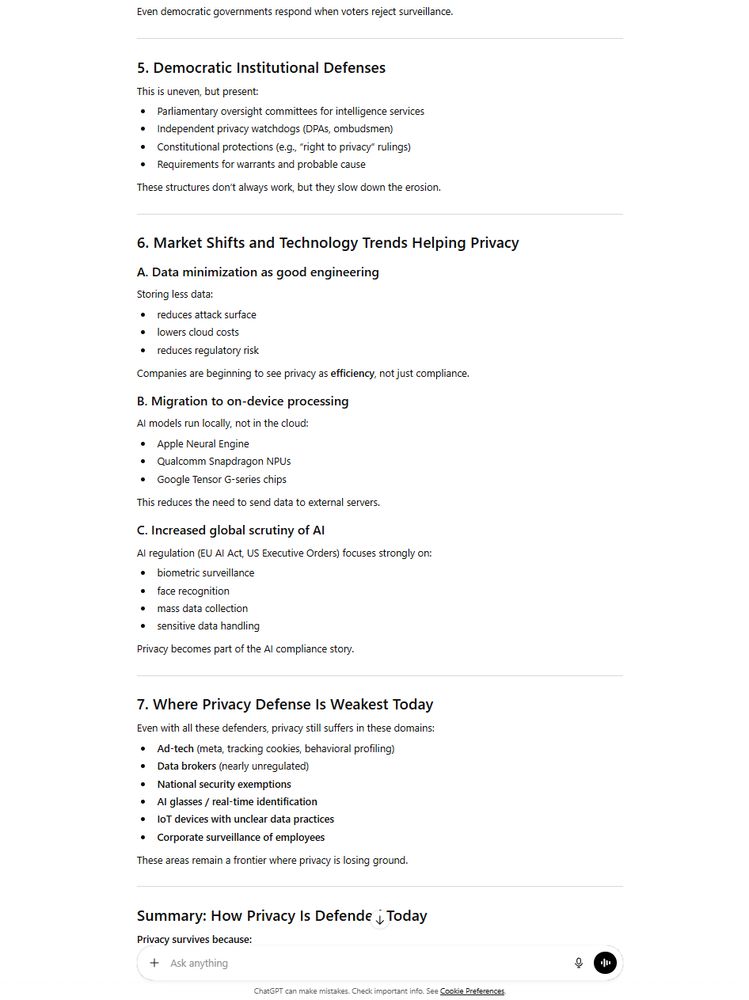
How privacy is defended (part 2): privacy survives through a patchwork of legal frameworks, technical safeguards, market pressures, cultural norms, civil-society activism, and even strategic calculations by companies.
11/x
11/x


December 7, 2025 at 6:14 PM
How privacy is defended (part 2): privacy survives through a patchwork of legal frameworks, technical safeguards, market pressures, cultural norms, civil-society activism, and even strategic calculations by companies.
11/x
11/x
How privacy is defended (part 1): not by a single factor or mechanism. An uneasy balance of forces pushing back against the erosion of privacy.
10/x
10/x


December 7, 2025 at 6:12 PM
How privacy is defended (part 1): not by a single factor or mechanism. An uneasy balance of forces pushing back against the erosion of privacy.
10/x
10/x
The democratic system is a loser in the long term. No chance.
Democracy cannot exist without privacy:
- anonymity in thought
- freedom in communication
- safety in dissent
- equality of information
- the inability of any one actor to know everything
9/x
Democracy cannot exist without privacy:
- anonymity in thought
- freedom in communication
- safety in dissent
- equality of information
- the inability of any one actor to know everything
9/x


December 7, 2025 at 5:45 PM
The democratic system is a loser in the long term. No chance.
Democracy cannot exist without privacy:
- anonymity in thought
- freedom in communication
- safety in dissent
- equality of information
- the inability of any one actor to know everything
9/x
Democracy cannot exist without privacy:
- anonymity in thought
- freedom in communication
- safety in dissent
- equality of information
- the inability of any one actor to know everything
9/x
Winners and losers from eroding privacy:
- winners:
governments, large corporations, law enforcement, censorship, cybercriminals
- losers:
ordinary citizens
democratic institutions
market competition
future generations: children
8/x
- winners:
governments, large corporations, law enforcement, censorship, cybercriminals
- losers:
ordinary citizens
democratic institutions
market competition
future generations: children
8/x


December 7, 2025 at 5:25 PM
Winners and losers from eroding privacy:
- winners:
governments, large corporations, law enforcement, censorship, cybercriminals
- losers:
ordinary citizens
democratic institutions
market competition
future generations: children
8/x
- winners:
governments, large corporations, law enforcement, censorship, cybercriminals
- losers:
ordinary citizens
democratic institutions
market competition
future generations: children
8/x
There are powerful forces working against privacy.
- they operate at multiple layers: technological, economic, political, social, and even psychological
- understanding who benefits and who loses reveals why privacy erodes even when societies claim to value it.
7/x
- they operate at multiple layers: technological, economic, political, social, and even psychological
- understanding who benefits and who loses reveals why privacy erodes even when societies claim to value it.
7/x


December 7, 2025 at 5:16 PM
There are powerful forces working against privacy.
- they operate at multiple layers: technological, economic, political, social, and even psychological
- understanding who benefits and who loses reveals why privacy erodes even when societies claim to value it.
7/x
- they operate at multiple layers: technological, economic, political, social, and even psychological
- understanding who benefits and who loses reveals why privacy erodes even when societies claim to value it.
7/x
Privacy is one of 25 foundational forces. Privacy provides conditions for a cohesive society. Privacy, with the other foundational forces, shape whether societies stay cohesive, fragment, stagnate, or transform. These are underlying dynamics that run through every human civilization.
6/x
6/x


December 7, 2025 at 5:09 PM
Privacy is one of 25 foundational forces. Privacy provides conditions for a cohesive society. Privacy, with the other foundational forces, shape whether societies stay cohesive, fragment, stagnate, or transform. These are underlying dynamics that run through every human civilization.
6/x
6/x
Privacy, according to AI, belongs to the next set of "Foundational Social Forces" that hold societies together.
Foundational social forces are deep structural conditions that shape whether societies stay cohesive, fragment, stagnate, or transform.
5/x
Foundational social forces are deep structural conditions that shape whether societies stay cohesive, fragment, stagnate, or transform.
5/x


December 7, 2025 at 4:56 PM
Privacy, according to AI, belongs to the next set of "Foundational Social Forces" that hold societies together.
Foundational social forces are deep structural conditions that shape whether societies stay cohesive, fragment, stagnate, or transform.
5/x
Foundational social forces are deep structural conditions that shape whether societies stay cohesive, fragment, stagnate, or transform.
5/x
According to AI, there are 9 forces ("binding forces", set 1) that actively hold societies together right now. They capture the mechanisms that directly maintain social order. They are the ropes, cables and pylons that keep "the bridge of society" standing day to day.
4/x
4/x


December 7, 2025 at 4:51 PM
According to AI, there are 9 forces ("binding forces", set 1) that actively hold societies together right now. They capture the mechanisms that directly maintain social order. They are the ropes, cables and pylons that keep "the bridge of society" standing day to day.
4/x
4/x