



Joop Adema
@jopieboy.bsky.social
Post-doc @ University of Innsbruck -- https://jopieadema.github.io/
Ook interessant voor NL sociaalwetenschappers: @saskiabonjour.bsky.social @leol.bsky.social @tomlouwerse.nl @leoniedejonge.bsky.social @catherinedevries.bsky.social @simonotjes.bsky.social @tamardewaal.bsky.social @tomwgvdmeer.bsky.social @jvanslageren.bsky.social
December 3, 2025 at 7:04 PM
Ook interessant voor NL sociaalwetenschappers: @saskiabonjour.bsky.social @leol.bsky.social @tomlouwerse.nl @leoniedejonge.bsky.social @catherinedevries.bsky.social @simonotjes.bsky.social @tamardewaal.bsky.social @tomwgvdmeer.bsky.social @jvanslageren.bsky.social
@andreassteinmayr.net
@meulensimon.bsky.social
@sschneiderstraw.bsky.social
@joelmachado.eu @jeromevalette.bsky.social @matteogamalerio.bsky.social @ffasani.bsky.social @tomfratti.bsky.social @pbose.bsky.social @rghidoni.bsky.social @ollefolke.bsky.social @johannarickne.bsky.social
@meulensimon.bsky.social
@sschneiderstraw.bsky.social
@joelmachado.eu @jeromevalette.bsky.social @matteogamalerio.bsky.social @ffasani.bsky.social @tomfratti.bsky.social @pbose.bsky.social @rghidoni.bsky.social @ollefolke.bsky.social @johannarickne.bsky.social
December 3, 2025 at 7:00 PM
Read the paper here:
jopieadema.github.io/papers/Adema...
jopieadema.github.io/papers/Adema...
December 3, 2025 at 7:00 PM
Read the paper here:
jopieadema.github.io/papers/Adema...
jopieadema.github.io/papers/Adema...
The Act also provided a unique opportunity to study the effect of expectations without arrival: the effect size I find (+1.2 pp FR voting for 1 pp of expected refugees) is larger than effect sizes of actual (refugee) inflows from the literature (see onlinelibrary.wiley.com/doi/10.1111/...)

American Journal of Political Science | MPSA Journal | Wiley Online Library
Does the share of immigrants in a community influence whether people vote for anti-immigration parties? We conduct a systematic review of the causal inference literature studying this question. We co...
onlinelibrary.wiley.com
December 3, 2025 at 7:00 PM
The Act also provided a unique opportunity to study the effect of expectations without arrival: the effect size I find (+1.2 pp FR voting for 1 pp of expected refugees) is larger than effect sizes of actual (refugee) inflows from the literature (see onlinelibrary.wiley.com/doi/10.1111/...)
This also shows that aligning with the FR on a previously supported policy may be a strategical mistake of the center-right VVD, relating to the debate on accommodation of centrist parties in political science.
@akoustov.bsky.social @tabouchadi.bsky.social @casmudde.bsky.social
@akoustov.bsky.social @tabouchadi.bsky.social @casmudde.bsky.social
December 3, 2025 at 7:00 PM
This also shows that aligning with the FR on a previously supported policy may be a strategical mistake of the center-right VVD, relating to the debate on accommodation of centrist parties in political science.
@akoustov.bsky.social @tabouchadi.bsky.social @casmudde.bsky.social
@akoustov.bsky.social @tabouchadi.bsky.social @casmudde.bsky.social
This shows that a pretty sensible dispersal policy (fairly spreading the burden) in a heavily politicized environment can fuel the migration backlash: such reforms are better implemented before large shortages in hosting capacity.
December 3, 2025 at 7:00 PM
This shows that a pretty sensible dispersal policy (fairly spreading the burden) in a heavily politicized environment can fuel the migration backlash: such reforms are better implemented before large shortages in hosting capacity.
Heterogeneity further indicate that the effect of expectations is muted in places with (past) intergroup contact. In affected placed, protests appeared and online search for information about AZCs increases. I am planning to work more on mechanisms using surveys.
December 3, 2025 at 7:00 PM
Heterogeneity further indicate that the effect of expectations is muted in places with (past) intergroup contact. In affected placed, protests appeared and online search for information about AZCs increases. I am planning to work more on mechanisms using surveys.
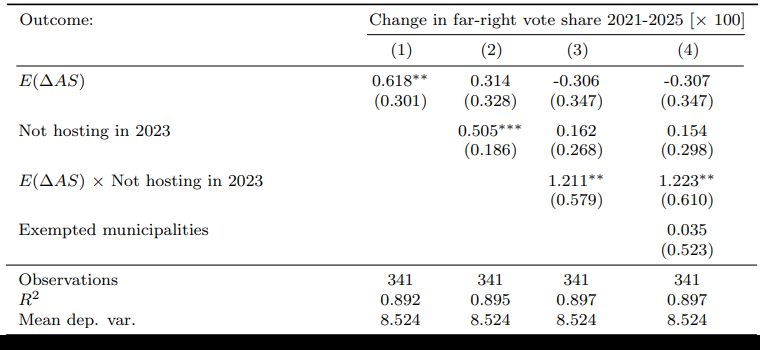
Among already-hosters, the intensive margin does not matter much, suggesting that effectd are NOT driven by less FR voting among already hosters. Among not-yet hosters the intensive margin does matter: a 1 pp higher future migrant share increased FR voting by 1.2 percentage point.
December 3, 2025 at 7:00 PM
Among already-hosters, the intensive margin does not matter much, suggesting that effectd are NOT driven by less FR voting among already hosters. Among not-yet hosters the intensive margin does matter: a 1 pp higher future migrant share increased FR voting by 1.2 percentage point.
Are these effects relative or absolute? Under the Act, there's a mechanism to periodically allocate of capacity. The first allocation was published in dec '24, allowing me to separate extensive (whether a municipality has to host) and intensive margin (how much a municipality starts to host).

December 3, 2025 at 7:00 PM
Are these effects relative or absolute? Under the Act, there's a mechanism to periodically allocate of capacity. The first allocation was published in dec '24, allowing me to separate extensive (whether a municipality has to host) and intensive margin (how much a municipality starts to host).
I find that far-right voting increased with 0.6 percentage points in affected municipalities, no pretrends. Mostly PVV, but also FVD and JA21 benefited. This went at the expense of the conservative-liberal VVD whose minister proposed the law, but opposed it since the parliamentary vote.


December 3, 2025 at 7:00 PM
I find that far-right voting increased with 0.6 percentage points in affected municipalities, no pretrends. Mostly PVV, but also FVD and JA21 benefited. This went at the expense of the conservative-liberal VVD whose minister proposed the law, but opposed it since the parliamentary vote.
I compare changes in FR voting ('21-'25) in municipalities who did not to those that did already host asylum seekers (voluntarily) in October '23, conditional on municipal characteristics. This is important as baseline FR voting was higher in non-hosting regions and FR voting increased strongly:

December 3, 2025 at 7:00 PM
I compare changes in FR voting ('21-'25) in municipalities who did not to those that did already host asylum seekers (voluntarily) in October '23, conditional on municipal characteristics. This is important as baseline FR voting was higher in non-hosting regions and FR voting increased strongly:
Because elections followed soon after the Act, affected municipalities hadn’t started hosting yet, so I can isolate expectation effects from actual hosting effects. Only 20% started hosting by '25. The Act’s fate looked shaky after the ’23 FR win but appeared secure by the ’25 elections.
December 3, 2025 at 7:00 PM
Because elections followed soon after the Act, affected municipalities hadn’t started hosting yet, so I can isolate expectation effects from actual hosting effects. Only 20% started hosting by '25. The Act’s fate looked shaky after the ’23 FR win but appeared secure by the ’25 elections.
The literature on group threat in soc. psych. poses that minority group size increases perceived threat and more hostile attitudes by the majority. Expectations about future inflows could matter; scope for perceived threat is large when the out-group is faceless and no contact is possible.
December 3, 2025 at 7:00 PM
The literature on group threat in soc. psych. poses that minority group size increases perceived threat and more hostile attitudes by the majority. Expectations about future inflows could matter; scope for perceived threat is large when the out-group is faceless and no contact is possible.
After capacity problems in asylum seeker centers (AZCs) in NL, the gvt. proposed the Dispersal Act, which obliged municipalities to host AZCs. When the Act passed parliament Oct '23, voters in the 65% of municipalities who weren't hosting yet expected to have to host asylum seekers soon.

December 3, 2025 at 7:00 PM
After capacity problems in asylum seeker centers (AZCs) in NL, the gvt. proposed the Dispersal Act, which obliged municipalities to host AZCs. When the Act passed parliament Oct '23, voters in the 65% of municipalities who weren't hosting yet expected to have to host asylum seekers soon.
How to end the vicious circle?
December 2, 2025 at 7:40 PM
How to end the vicious circle?
(11/10) PPL who’d be interested:
@plvezina.bsky.social @rlandersoe.bsky.social @mclem.org @ffasani.bsky.social @tomfratti.bsky.social @andreassteinmayr.net
@plvezina.bsky.social @rlandersoe.bsky.social @mclem.org @ffasani.bsky.social @tomfratti.bsky.social @andreassteinmayr.net
August 18, 2025 at 9:42 AM
(11/10) PPL who’d be interested:
@plvezina.bsky.social @rlandersoe.bsky.social @mclem.org @ffasani.bsky.social @tomfratti.bsky.social @andreassteinmayr.net
@plvezina.bsky.social @rlandersoe.bsky.social @mclem.org @ffasani.bsky.social @tomfratti.bsky.social @andreassteinmayr.net
(10/10) This is not our last study of Ukrainian refugees: we observationally study the effect of conflict on mobility, future plans and integration www.ifo.de/cesifo/publi... (update soon!) and experimentally macro-level drivers of return to Ukraine (paper soon!).
August 18, 2025 at 9:42 AM
(10/10) This is not our last study of Ukrainian refugees: we observationally study the effect of conflict on mobility, future plans and integration www.ifo.de/cesifo/publi... (update soon!) and experimentally macro-level drivers of return to Ukraine (paper soon!).
(9/10) Based on our estimates, we can calculate a migration elasticity w.r.t. social and child benefits of about 0.11 (and 0.67 w.r.t. wages). This is in line with most of the literature, except Agersnap et al. (2020, AERI). See my concern about that paper here: Joop Adema: bsky.app/profile/jopi...
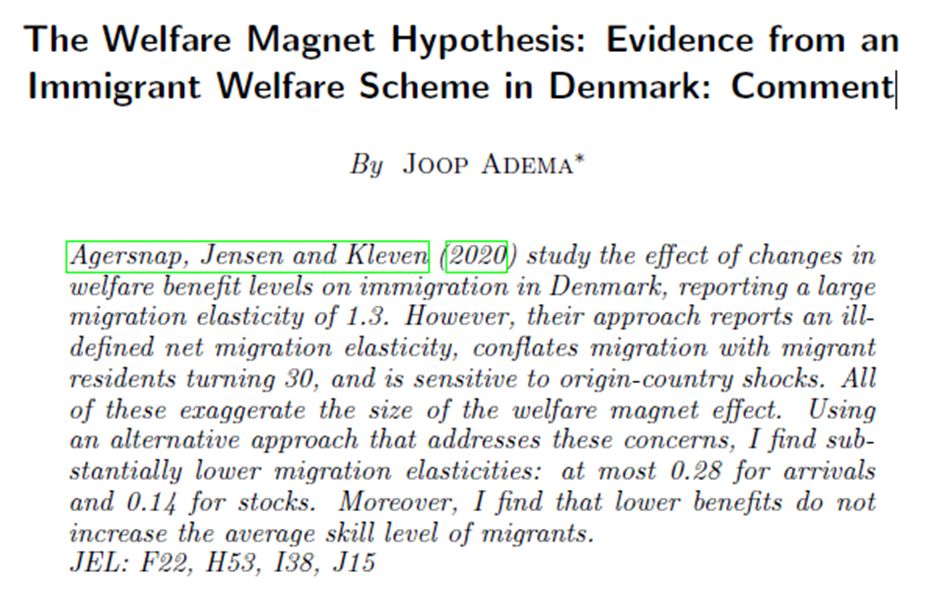
🧵Replication: Can refugee flows be lowered by reducing welfare? Agersnap et al. (2020, AER:I) study this in Denmark, reporting lower benefits strongly reduce migration flows. I reanalyze this paper, finding a much more nuanced result.
August 18, 2025 at 9:42 AM
(9/10) Based on our estimates, we can calculate a migration elasticity w.r.t. social and child benefits of about 0.11 (and 0.67 w.r.t. wages). This is in line with most of the literature, except Agersnap et al. (2020, AERI). See my concern about that paper here: Joop Adema: bsky.app/profile/jopi...
(7/10) Heterogeneities: Men prefer to be further away; women strongly prefer networks. Those planning to return prefer to be closer to Ukraine, have a weaker preference for economic opportunities and a somewhat stronger preference for social assistance.


August 18, 2025 at 9:42 AM
(7/10) Heterogeneities: Men prefer to be further away; women strongly prefer networks. Those planning to return prefer to be closer to Ukraine, have a weaker preference for economic opportunities and a somewhat stronger preference for social assistance.