



Joop Adema
@jopieboy.bsky.social
Post-doc @ University of Innsbruck -- https://jopieadema.github.io/
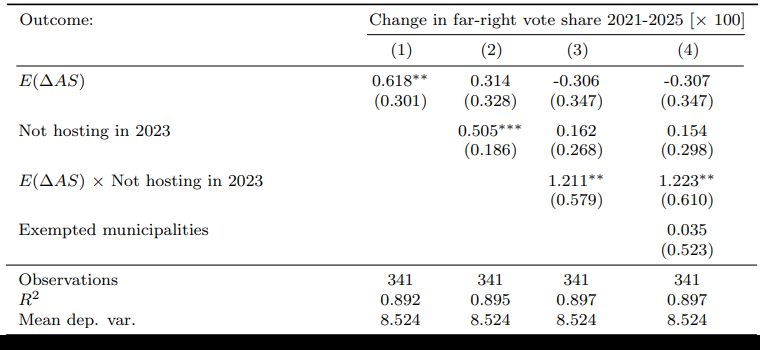
Among already-hosters, the intensive margin does not matter much, suggesting that effectd are NOT driven by less FR voting among already hosters. Among not-yet hosters the intensive margin does matter: a 1 pp higher future migrant share increased FR voting by 1.2 percentage point.
December 3, 2025 at 7:00 PM
Among already-hosters, the intensive margin does not matter much, suggesting that effectd are NOT driven by less FR voting among already hosters. Among not-yet hosters the intensive margin does matter: a 1 pp higher future migrant share increased FR voting by 1.2 percentage point.
Are these effects relative or absolute? Under the Act, there's a mechanism to periodically allocate of capacity. The first allocation was published in dec '24, allowing me to separate extensive (whether a municipality has to host) and intensive margin (how much a municipality starts to host).

December 3, 2025 at 7:00 PM
Are these effects relative or absolute? Under the Act, there's a mechanism to periodically allocate of capacity. The first allocation was published in dec '24, allowing me to separate extensive (whether a municipality has to host) and intensive margin (how much a municipality starts to host).
I find that far-right voting increased with 0.6 percentage points in affected municipalities, no pretrends. Mostly PVV, but also FVD and JA21 benefited. This went at the expense of the conservative-liberal VVD whose minister proposed the law, but opposed it since the parliamentary vote.


December 3, 2025 at 7:00 PM
I find that far-right voting increased with 0.6 percentage points in affected municipalities, no pretrends. Mostly PVV, but also FVD and JA21 benefited. This went at the expense of the conservative-liberal VVD whose minister proposed the law, but opposed it since the parliamentary vote.
I compare changes in FR voting ('21-'25) in municipalities who did not to those that did already host asylum seekers (voluntarily) in October '23, conditional on municipal characteristics. This is important as baseline FR voting was higher in non-hosting regions and FR voting increased strongly:

December 3, 2025 at 7:00 PM
I compare changes in FR voting ('21-'25) in municipalities who did not to those that did already host asylum seekers (voluntarily) in October '23, conditional on municipal characteristics. This is important as baseline FR voting was higher in non-hosting regions and FR voting increased strongly:
After capacity problems in asylum seeker centers (AZCs) in NL, the gvt. proposed the Dispersal Act, which obliged municipalities to host AZCs. When the Act passed parliament Oct '23, voters in the 65% of municipalities who weren't hosting yet expected to have to host asylum seekers soon.

December 3, 2025 at 7:00 PM
After capacity problems in asylum seeker centers (AZCs) in NL, the gvt. proposed the Dispersal Act, which obliged municipalities to host AZCs. When the Act passed parliament Oct '23, voters in the 65% of municipalities who weren't hosting yet expected to have to host asylum seekers soon.
(7/10) Heterogeneities: Men prefer to be further away; women strongly prefer networks. Those planning to return prefer to be closer to Ukraine, have a weaker preference for economic opportunities and a somewhat stronger preference for social assistance.


August 18, 2025 at 9:42 AM
(7/10) Heterogeneities: Men prefer to be further away; women strongly prefer networks. Those planning to return prefer to be closer to Ukraine, have a weaker preference for economic opportunities and a somewhat stronger preference for social assistance.
(5/10) Our main results indicate that work opportunities and wages are the prime determinants of destination choice; networks and knowing the language also play a large role. Social and child benefits are considerably less important.

August 18, 2025 at 9:42 AM
(5/10) Our main results indicate that work opportunities and wages are the prime determinants of destination choice; networks and knowing the language also play a large role. Social and child benefits are considerably less important.
(4/n) We include 8 relevant factors for destination choice based on prior literature and relevance for the Ukrainian refugee situation. We express monetary dimensions in terms one standard deviation across European destinations (population-weighted).

August 18, 2025 at 9:42 AM
(4/n) We include 8 relevant factors for destination choice based on prior literature and relevance for the Ukrainian refugee situation. We express monetary dimensions in terms one standard deviation across European destinations (population-weighted).
(1/10) New paper at PNAS: what predicts Ukrainian refugees’ destination choice? We experimentally study the drivers of location choice in a conjoint design: we find that job opportunities, wages and networks are most important, much more so than welfare benefits.

August 18, 2025 at 9:42 AM
(1/10) New paper at PNAS: what predicts Ukrainian refugees’ destination choice? We experimentally study the drivers of location choice in a conjoint design: we find that job opportunities, wages and networks are most important, much more so than welfare benefits.
Update #2, RETRACTED: 15 months after we (w @ollefolke.bsky.social and @johannarickne.bsky.social ) submitted the initial comment to the Journal, we've noticed the paper was ultimately retracted. Retraction note here: link.springer.com/article/10.1...


July 1, 2025 at 6:21 AM
Update #2, RETRACTED: 15 months after we (w @ollefolke.bsky.social and @johannarickne.bsky.social ) submitted the initial comment to the Journal, we've noticed the paper was ultimately retracted. Retraction note here: link.springer.com/article/10.1...
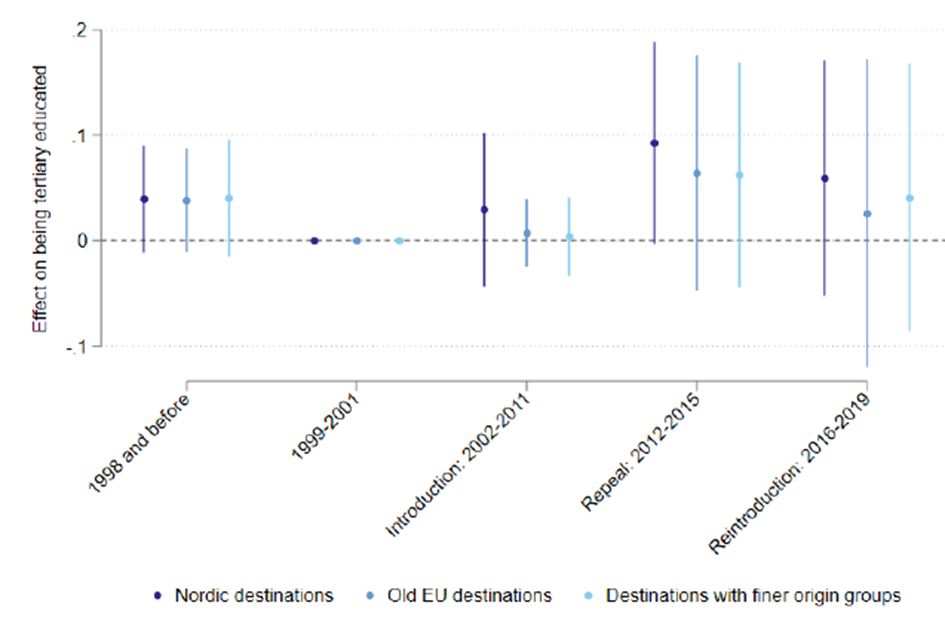
Another prediction of the welfare magnet hypothesis is that benefit cuts also predict an increase in the skill level of migrants. Using the EU LFS I find that lower benefits do NOT lower the skill levels of newly arriving migrants.
June 18, 2025 at 11:24 AM
Another prediction of the welfare magnet hypothesis is that benefit cuts also predict an increase in the skill level of migrants. Using the EU LFS I find that lower benefits do NOT lower the skill levels of newly arriving migrants.
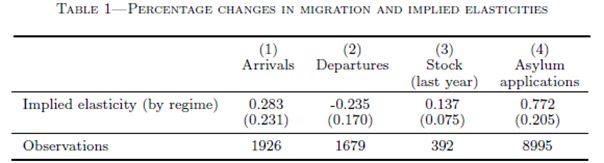
I re-analyze the case using an origin-specific approach, finding much smaller max. elasticity estimates: only 0.14 for stocks, 0.28 for inflows and 0.77 for asylum applications. However, the variability of refugee flows (esp. the 2015/2016 crisis) makes these estimates imprecise.
June 18, 2025 at 11:24 AM
I re-analyze the case using an origin-specific approach, finding much smaller max. elasticity estimates: only 0.14 for stocks, 0.28 for inflows and 0.77 for asylum applications. However, the variability of refugee flows (esp. the 2015/2016 crisis) makes these estimates imprecise.
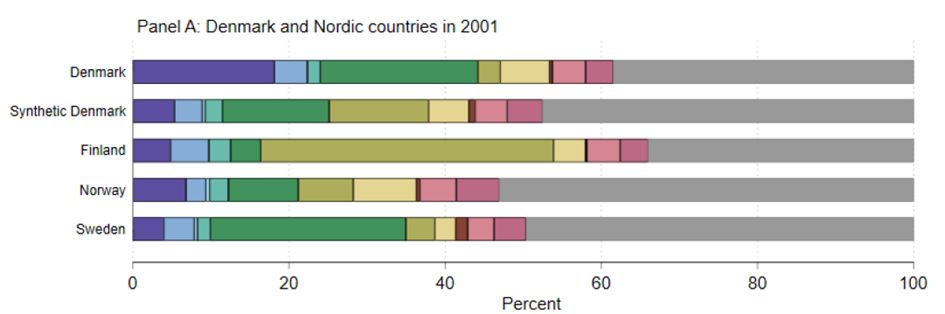
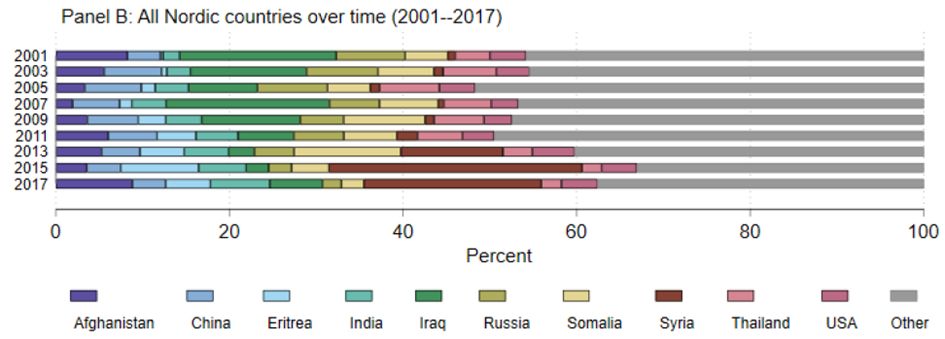
e.g. DK received overproportionally many asylum seekers from Syria and Afghanistan in 2001, but total asylum flows from these countries to Europe decreased simultaneously with benefit cuts in 2002. I account for origin-specific shocks in my re-analysis below.
June 18, 2025 at 11:24 AM
e.g. DK received overproportionally many asylum seekers from Syria and Afghanistan in 2001, but total asylum flows from these countries to Europe decreased simultaneously with benefit cuts in 2002. I account for origin-specific shocks in my re-analysis below.
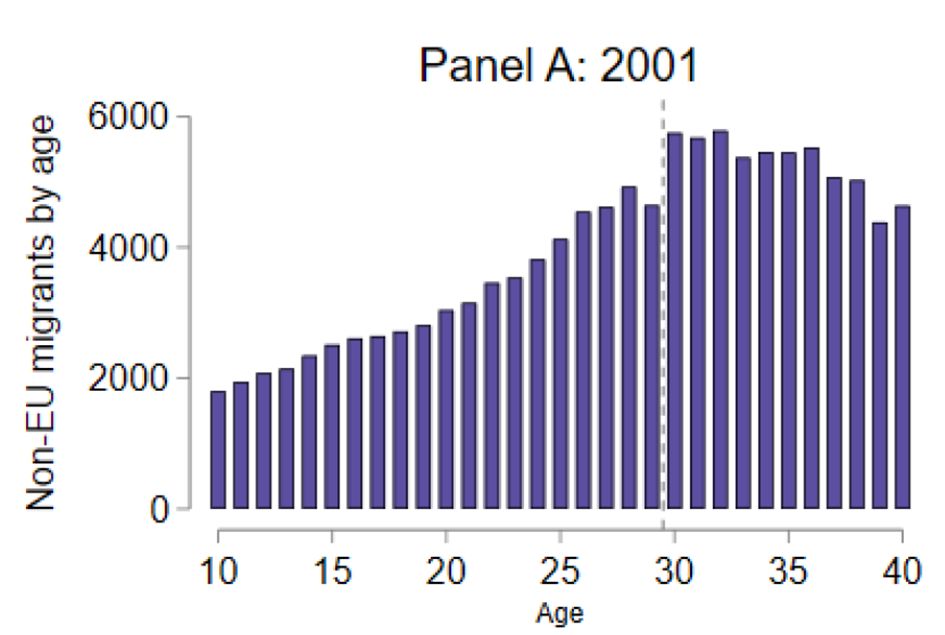
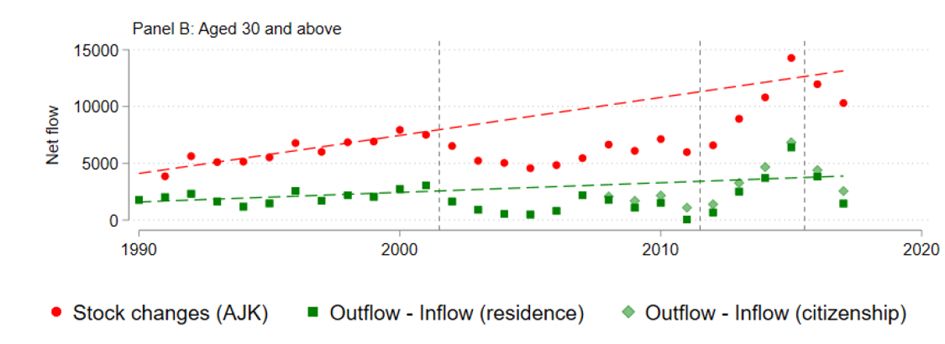
This is driven by the age distribution of migrant residents in 2001, as many turned 30 just before 2002 but much fewer after. As they estimate effects relative to a counterfactual based on a pre-2002 trend, the large increase in migrants turning 30 in the 1990s strongly inflates the effect.
June 18, 2025 at 11:24 AM
This is driven by the age distribution of migrant residents in 2001, as many turned 30 just before 2002 but much fewer after. As they estimate effects relative to a counterfactual based on a pre-2002 trend, the large increase in migrants turning 30 in the 1990s strongly inflates the effect.
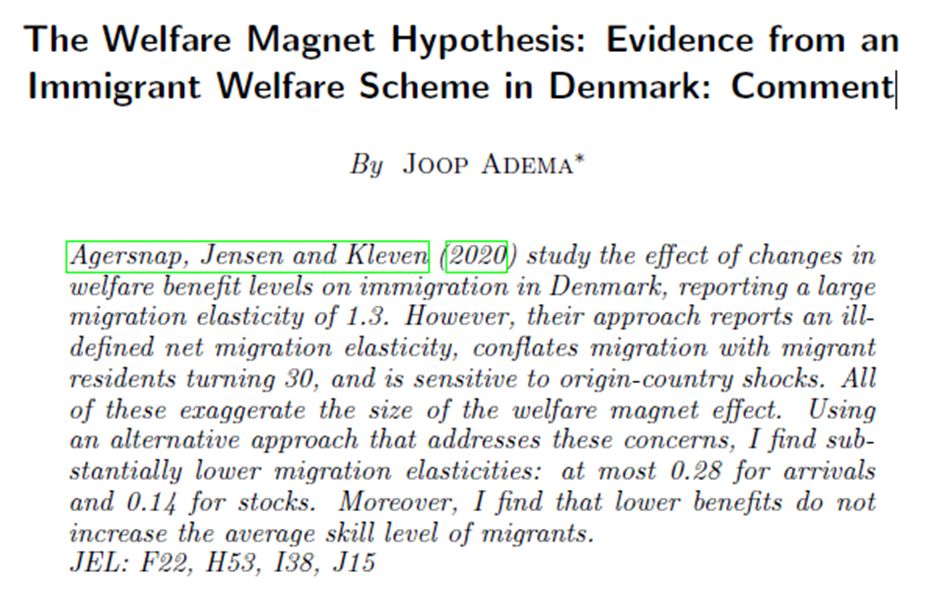
🧵Replication: Can refugee flows be lowered by reducing welfare? Agersnap et al. (2020, AER:I) study this in Denmark, reporting lower benefits strongly reduce migration flows. I reanalyze this paper, finding a much more nuanced result.
June 18, 2025 at 11:24 AM
🧵Replication: Can refugee flows be lowered by reducing welfare? Agersnap et al. (2020, AER:I) study this in Denmark, reporting lower benefits strongly reduce migration flows. I reanalyze this paper, finding a much more nuanced result.