


TarableCode
@tarableco.de
Tara.
I write weird code that does weird things sometimes.
Toronto smells weird.
I write weird code that does weird things sometimes.
Toronto smells weird.
I got a little better, I think.

December 14, 2025 at 10:03 PM
I got a little better, I think.
28c64 (to avoid getting out the uv eraser)
61c64
61c64
December 14, 2025 at 10:02 PM
28c64 (to avoid getting out the uv eraser)
61c64
61c64
I’ll have to add the 8255 when I understand how it all fits together.
December 14, 2025 at 8:11 PM
I’ll have to add the 8255 when I understand how it all fits together.
I haven’t set up the brownout circuit yet, but I do make use of a gpio for a 10ms reset pulse.
I think I’ll be okay once I understand the bus architecture; it’s a bit confusing to have peripherals not be memory mapped like I’m used to.
I guess step one is just an eeprom containing NOPs?
I think I’ll be okay once I understand the bus architecture; it’s a bit confusing to have peripherals not be memory mapped like I’m used to.
I guess step one is just an eeprom containing NOPs?
December 14, 2025 at 8:11 PM
I haven’t set up the brownout circuit yet, but I do make use of a gpio for a 10ms reset pulse.
I think I’ll be okay once I understand the bus architecture; it’s a bit confusing to have peripherals not be memory mapped like I’m used to.
I guess step one is just an eeprom containing NOPs?
I think I’ll be okay once I understand the bus architecture; it’s a bit confusing to have peripherals not be memory mapped like I’m used to.
I guess step one is just an eeprom containing NOPs?
Do you mind sharing your z80 schematic?
Just at a glance it seems more intimidating than the 6502, and I'm a bit lost as to where to start.
I did program an ATTiny85 to provide a 512KHz clock that can be divided based on the state of a few pins down to ~128KHz.
Just at a glance it seems more intimidating than the 6502, and I'm a bit lost as to where to start.
I did program an ATTiny85 to provide a 512KHz clock that can be divided based on the state of a few pins down to ~128KHz.
December 14, 2025 at 7:33 PM
Do you mind sharing your z80 schematic?
Just at a glance it seems more intimidating than the 6502, and I'm a bit lost as to where to start.
I did program an ATTiny85 to provide a 512KHz clock that can be divided based on the state of a few pins down to ~128KHz.
Just at a glance it seems more intimidating than the 6502, and I'm a bit lost as to where to start.
I did program an ATTiny85 to provide a 512KHz clock that can be divided based on the state of a few pins down to ~128KHz.
I'll start by getting it fed into a 74'393 and move on when I get something within spec. Gotta desolder the crystal and caps first though, so that'll be a few.
December 7, 2025 at 8:35 PM
I'll start by getting it fed into a 74'393 and move on when I get something within spec. Gotta desolder the crystal and caps first though, so that'll be a few.
Looking at the Z8400PS you gave me, and the internet is telling me it's a 2.5MHz part, is it going to mind that 7MHz crystal?
December 7, 2025 at 8:21 PM
Looking at the Z8400PS you gave me, and the internet is telling me it's a 2.5MHz part, is it going to mind that 7MHz crystal?
Maybe it's time for me to actually just start hooking things up rather than thinking about external clock generation and the like.
I probably have everything I need: z80, '74138, roms, srams, and that 8255 should be good enough for blinky.
I probably have everything I need: z80, '74138, roms, srams, and that 8255 should be good enough for blinky.
December 7, 2025 at 8:10 PM
Maybe it's time for me to actually just start hooking things up rather than thinking about external clock generation and the like.
I probably have everything I need: z80, '74138, roms, srams, and that 8255 should be good enough for blinky.
I probably have everything I need: z80, '74138, roms, srams, and that 8255 should be good enough for blinky.
Those 80c31 boards I have might have a UART friendly crystal, I’d have to try powering it up to find out cause they soldered over the markings.
December 7, 2025 at 7:32 PM
Those 80c31 boards I have might have a UART friendly crystal, I’d have to try powering it up to find out cause they soldered over the markings.
Dang, I don't have any oscillators kicking around of that frequency unless I look on junk boards.
Why 9.216MHz though?
9600*16 = 153,600
Just trying to wrap my head around this; I'm not used to getting this far into clocking yet.
Why 9.216MHz though?
9600*16 = 153,600
Just trying to wrap my head around this; I'm not used to getting this far into clocking yet.
December 7, 2025 at 5:50 PM
Dang, I don't have any oscillators kicking around of that frequency unless I look on junk boards.
Why 9.216MHz though?
9600*16 = 153,600
Just trying to wrap my head around this; I'm not used to getting this far into clocking yet.
Why 9.216MHz though?
9600*16 = 153,600
Just trying to wrap my head around this; I'm not used to getting this far into clocking yet.
YES!
That's going to be so much easier than trying to understand the ch32v003 reference manual this late.
I wonder if I should generate TXCLK/RXCLK and CLK separately, or just divide CLK by something using a '393?
That's going to be so much easier than trying to understand the ch32v003 reference manual this late.
I wonder if I should generate TXCLK/RXCLK and CLK separately, or just divide CLK by something using a '393?
December 7, 2025 at 3:59 AM
YES!
That's going to be so much easier than trying to understand the ch32v003 reference manual this late.
I wonder if I should generate TXCLK/RXCLK and CLK separately, or just divide CLK by something using a '393?
That's going to be so much easier than trying to understand the ch32v003 reference manual this late.
I wonder if I should generate TXCLK/RXCLK and CLK separately, or just divide CLK by something using a '393?
Looking into generating clocks for the i8251 clone I extracted.
December 7, 2025 at 3:53 AM
Looking into generating clocks for the i8251 clone I extracted.
Bah!
Those 3 pins on the left are really holding it in place.
Those 3 pins on the left are really holding it in place.

December 6, 2025 at 6:26 PM
Bah!
Those 3 pins on the left are really holding it in place.
Those 3 pins on the left are really holding it in place.
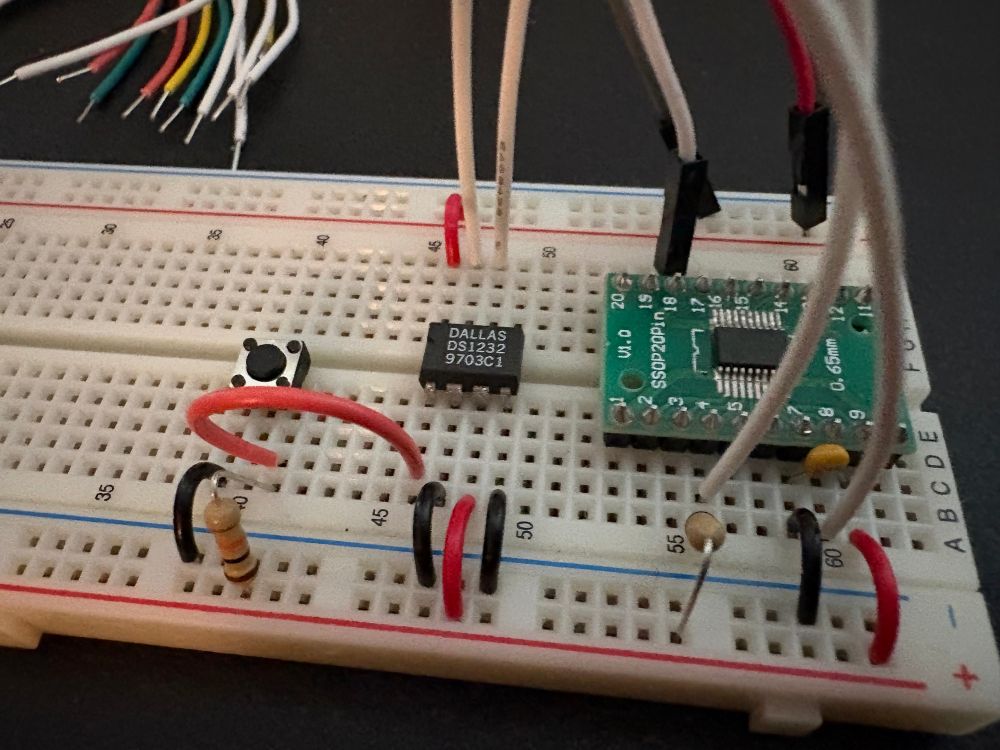
Tested and working: DS1232 MicroMonitor chip
December 6, 2025 at 4:48 PM
Tested and working: DS1232 MicroMonitor chip
Source + schematic:
github.com/TaraHoleInIt...
github.com/TaraHoleInIt...
GitHub - TaraHoleInIt/i8255_Blinky: Simple blinky for i8255 driven by ch32v003
Simple blinky for i8255 driven by ch32v003. Contribute to TaraHoleInIt/i8255_Blinky development by creating an account on GitHub.
github.com
December 6, 2025 at 2:42 AM
Source + schematic:
github.com/TaraHoleInIt...
github.com/TaraHoleInIt...
NEC D71055C (i8255) blinky with ch32v003.
December 5, 2025 at 11:02 PM
NEC D71055C (i8255) blinky with ch32v003.
What if the legs aren’t straight and were soldered at weird angles?
December 5, 2025 at 4:50 PM
What if the legs aren’t straight and were soldered at weird angles?
There's a V20 on there too, but I'm nervous about it because of a few bent pins on the back. I might have to handle those manually.
December 4, 2025 at 5:35 PM
There's a V20 on there too, but I'm nervous about it because of a few bent pins on the back. I might have to handle those manually.
That's way more elegant than setting the heat gun to 450c and giving it a few thwacks, but I don't have a hot plate.
I need to find a way to get under the chip and apply a pulling force on it.
I need to find a way to get under the chip and apply a pulling force on it.
December 4, 2025 at 5:34 PM
That's way more elegant than setting the heat gun to 450c and giving it a few thwacks, but I don't have a hot plate.
I need to find a way to get under the chip and apply a pulling force on it.
I need to find a way to get under the chip and apply a pulling force on it.
Scavenged parts round 2:
NEC D71051C - Serial control unit
NEC D71055C - Parallel interface unit
NEC D720010 - Multi-protocol serial controller
NEC D71059C - Interrupt control unit
NEC D71054C - Programmable timer/counter
1x 74HC04
2x 74HC373
NEC D71051C - Serial control unit
NEC D71055C - Parallel interface unit
NEC D720010 - Multi-protocol serial controller
NEC D71059C - Interrupt control unit
NEC D71054C - Programmable timer/counter
1x 74HC04
2x 74HC373
December 4, 2025 at 5:28 PM
Scavenged parts round 2:
NEC D71051C - Serial control unit
NEC D71055C - Parallel interface unit
NEC D720010 - Multi-protocol serial controller
NEC D71059C - Interrupt control unit
NEC D71054C - Programmable timer/counter
1x 74HC04
2x 74HC373
NEC D71051C - Serial control unit
NEC D71055C - Parallel interface unit
NEC D720010 - Multi-protocol serial controller
NEC D71059C - Interrupt control unit
NEC D71054C - Programmable timer/counter
1x 74HC04
2x 74HC373
Any tips for getting the big 40-pin DIPs using hot air?
They're pretty densely packed, so I can't really get a wedge in there to pry them out.
Percussion works, but I feel there's gotta be a better way since I don't want to damage anything.
They're pretty densely packed, so I can't really get a wedge in there to pry them out.
Percussion works, but I feel there's gotta be a better way since I don't want to damage anything.
December 4, 2025 at 4:44 PM
Any tips for getting the big 40-pin DIPs using hot air?
They're pretty densely packed, so I can't really get a wedge in there to pry them out.
Percussion works, but I feel there's gotta be a better way since I don't want to damage anything.
They're pretty densely packed, so I can't really get a wedge in there to pry them out.
Percussion works, but I feel there's gotta be a better way since I don't want to damage anything.
So far I’ve scavenged a couple of ‘74245s, ‘74373s, and one of MANY 128K SRAMs.
I’ve barely scratched the surface, there are lots of io chips remaining and a few V20s.
I’m going to extract more today, all of the chips I got out tested fine in my t48 so I’m hopeful doing more.
I’ve barely scratched the surface, there are lots of io chips remaining and a few V20s.
I’m going to extract more today, all of the chips I got out tested fine in my t48 so I’m hopeful doing more.
December 4, 2025 at 2:03 PM
So far I’ve scavenged a couple of ‘74245s, ‘74373s, and one of MANY 128K SRAMs.
I’ve barely scratched the surface, there are lots of io chips remaining and a few V20s.
I’m going to extract more today, all of the chips I got out tested fine in my t48 so I’m hopeful doing more.
I’ve barely scratched the surface, there are lots of io chips remaining and a few V20s.
I’m going to extract more today, all of the chips I got out tested fine in my t48 so I’m hopeful doing more.
Sounds like an idea that could eventually happen. I'm still at the gathering scrap stage though.
Still getting used to hot air desoldering; a good thwack loosens the chip, but there's a chance of leaving solder blobs everywhere on the chip.
Still getting used to hot air desoldering; a good thwack loosens the chip, but there's a chance of leaving solder blobs everywhere on the chip.
December 4, 2025 at 2:09 AM
Sounds like an idea that could eventually happen. I'm still at the gathering scrap stage though.
Still getting used to hot air desoldering; a good thwack loosens the chip, but there's a chance of leaving solder blobs everywhere on the chip.
Still getting used to hot air desoldering; a good thwack loosens the chip, but there's a chance of leaving solder blobs everywhere on the chip.
Idea: build a 6502/z80/v20 computer using at least 80% scavenged components.
Not sure about passives, I'd probably use new, but I have a TON of boards with neat stuff on them just waiting for a harvest.
Not sure about passives, I'd probably use new, but I have a TON of boards with neat stuff on them just waiting for a harvest.
December 4, 2025 at 12:25 AM
Idea: build a 6502/z80/v20 computer using at least 80% scavenged components.
Not sure about passives, I'd probably use new, but I have a TON of boards with neat stuff on them just waiting for a harvest.
Not sure about passives, I'd probably use new, but I have a TON of boards with neat stuff on them just waiting for a harvest.