




Ludvig Daae Bjørndal
@ludvigdb.bsky.social
Clinical psychologist, PhD. Interested in mental health, environmental adversity, and their causes.
http://www.ludvigbjorndal.com
PROMENTA Research Center, University of Oslo
PsychGen, Lovisenberg Diaconal Hospital / Norwegian Institute of Public Health
http://www.ludvigbjorndal.com
PROMENTA Research Center, University of Oslo
PsychGen, Lovisenberg Diaconal Hospital / Norwegian Institute of Public Health
www.aftenposten.no/foreldreliv/...
Jeg ble nylig intervjuet av Aftenposten om vår nye artikkel om symptomer på unngående restriktiv spiseforstyrrelse (ARFID)
Jeg ble nylig intervjuet av Aftenposten om vår nye artikkel om symptomer på unngående restriktiv spiseforstyrrelse (ARFID)

Ny studie: Nesten hvert fjerde barn viser symptomer på spiseforstyrrelser
– For et mindretall er dette ikke vanlig kresenhet, men en spiseforstyrrelse som kan ha negative konsekvenser for både fysisk og psykisk utvikling, sier forsker Ludvig Daae Bjørndal.
www.aftenposten.no
December 11, 2025 at 9:43 AM
www.aftenposten.no/foreldreliv/...
Jeg ble nylig intervjuet av Aftenposten om vår nye artikkel om symptomer på unngående restriktiv spiseforstyrrelse (ARFID)
Jeg ble nylig intervjuet av Aftenposten om vår nye artikkel om symptomer på unngående restriktiv spiseforstyrrelse (ARFID)
Reposted by Ludvig Daae Bjørndal
Who wants to join us in Oslo to study how health influences educational underperformance? We are hiring PhDs postdocs candidates for our funded project. We will follow children from birth to emerging adulthood, using behavioural genetic methods and large datasets 945000.webcruiter.no/Main/Recruit...

Two positions as either PhD or postdoctoral fellow on health determinants of education
Do you want to research how health influences school performance and leads to intergenerational inequality? We have two vacant 3-year positions as a PhD fellow or postdoctoral research fellow in the p...
945000.webcruiter.no
December 5, 2025 at 8:58 AM
Who wants to join us in Oslo to study how health influences educational underperformance? We are hiring PhDs postdocs candidates for our funded project. We will follow children from birth to emerging adulthood, using behavioural genetic methods and large datasets 945000.webcruiter.no/Main/Recruit...
Nice summary of our new paper on avoidant restrictive eating in Newsweek
www.newsweek.com/new-risks-pi...
www.newsweek.com/new-risks-pi...

New risks of picky eating in kids revealed
The study of over 35,000 children found that restricted eating has serious nutritional consequences for about 2–3 percent of kids.
www.newsweek.com
December 3, 2025 at 9:13 AM
Nice summary of our new paper on avoidant restrictive eating in Newsweek
www.newsweek.com/new-risks-pi...
www.newsweek.com/new-risks-pi...
Excited to share our new paper on avoidant/restrictive food intake, a core symptom of ARFID, just out in @jamapediatrics.com
We highlight its prevalence, associated developmental characteristics from 6 months through 14 years, and genetic associations.
doi.org/10.1001/jama...
We highlight its prevalence, associated developmental characteristics from 6 months through 14 years, and genetic associations.
doi.org/10.1001/jama...

December 1, 2025 at 2:36 PM
Excited to share our new paper on avoidant/restrictive food intake, a core symptom of ARFID, just out in @jamapediatrics.com
We highlight its prevalence, associated developmental characteristics from 6 months through 14 years, and genetic associations.
doi.org/10.1001/jama...
We highlight its prevalence, associated developmental characteristics from 6 months through 14 years, and genetic associations.
doi.org/10.1001/jama...
Reposted by Ludvig Daae Bjørndal

A large population-based study in Norway found substantial prevalence of avoidant/restrictive food intake patterns, with affected children at higher risk for developmental challenges and neurodevelopmental diagnoses. ja.ma/4p8ZQ8s

November 25, 2025 at 7:45 PM
A large population-based study in Norway found substantial prevalence of avoidant/restrictive food intake patterns, with affected children at higher risk for developmental challenges and neurodevelopmental diagnoses. ja.ma/4p8ZQ8s
I have just launched my Substack, 'Minds in Context', where I explore risk and resilience in current mental health research. More to come!
open.substack.com/pub/ludvigdb...
open.substack.com/pub/ludvigdb...

Who am I? And what is this?
Welcome to Minds in Context
open.substack.com
November 19, 2025 at 1:40 AM
I have just launched my Substack, 'Minds in Context', where I explore risk and resilience in current mental health research. More to come!
open.substack.com/pub/ludvigdb...
open.substack.com/pub/ludvigdb...
Reposted by Ludvig Daae Bjørndal

Results from study of mental health in 92 countries (n>53,000): People are not doing well.
- U-shape for age is gone: Young adults lowest health, highest illness
- Education still matters (a lot)
- 45% of older people live alone
- Hybrid work > 100% remote or in-person
Preprint: osf.io/3jyda_v1
- U-shape for age is gone: Young adults lowest health, highest illness
- Education still matters (a lot)
- 45% of older people live alone
- Hybrid work > 100% remote or in-person
Preprint: osf.io/3jyda_v1


November 12, 2025 at 12:47 PM
Results from study of mental health in 92 countries (n>53,000): People are not doing well.
- U-shape for age is gone: Young adults lowest health, highest illness
- Education still matters (a lot)
- 45% of older people live alone
- Hybrid work > 100% remote or in-person
Preprint: osf.io/3jyda_v1
- U-shape for age is gone: Young adults lowest health, highest illness
- Education still matters (a lot)
- 45% of older people live alone
- Hybrid work > 100% remote or in-person
Preprint: osf.io/3jyda_v1
We have a new preprint out examining symptom-specific polygenic associations with maternal mental health during pregnancy and postpartum in up to 59,000 MoBa mothers 🧬🌧️☀️
osf.io/preprints/ps...
osf.io/preprints/ps...

October 25, 2025 at 7:24 AM
Excited to share this work led by @cktamnes.bsky.social (and featuring many colleagues from PROMENTA at @unioslo-svfak.bsky.social) exploring the links between psychological wellbeing and illbeing across biological, developmental, societal and intervention perspectives

The nature of the relation between mental well-being and ill-being
www.nature.com/articles/s41...
www.nature.com/articles/s41...

The nature of the relation between mental well-being and ill-being - Nature Human Behaviour
Tamnes et al. explore the complex relationship between ill-being—including mental and behavioural disorders—and mental well-being.
www.nature.com
October 16, 2025 at 3:55 PM
Excited to share this work led by @cktamnes.bsky.social (and featuring many colleagues from PROMENTA at @unioslo-svfak.bsky.social) exploring the links between psychological wellbeing and illbeing across biological, developmental, societal and intervention perspectives
Reposted by Ludvig Daae Bjørndal

I'm hiring! ✨ Looking for a Research Fellow to study environmental factors that mitigate intergenerational transmission of mental health.
3-year post at UCL @uclbrainscience.bsky.social with great opportunities for training, collaboration & exciting science!
🔗 Apply: www.jobs.ac.uk/job/DOZ633/r...
3-year post at UCL @uclbrainscience.bsky.social with great opportunities for training, collaboration & exciting science!
🔗 Apply: www.jobs.ac.uk/job/DOZ633/r...

Research Fellow in Mental Health at UCL
Apply for the Research Fellow in Mental Health role on jobs.ac.uk, the top job board for academic positions in higher education. View details and apply now.
www.jobs.ac.uk
October 10, 2025 at 9:41 AM
I'm hiring! ✨ Looking for a Research Fellow to study environmental factors that mitigate intergenerational transmission of mental health.
3-year post at UCL @uclbrainscience.bsky.social with great opportunities for training, collaboration & exciting science!
🔗 Apply: www.jobs.ac.uk/job/DOZ633/r...
3-year post at UCL @uclbrainscience.bsky.social with great opportunities for training, collaboration & exciting science!
🔗 Apply: www.jobs.ac.uk/job/DOZ633/r...
Reposted by Ludvig Daae Bjørndal

I had the pleasure of publishing an introduction to instrumental variables co-authored with Henrik Daae Zachrisson for the #JClinEpi key concepts in clinical epidemiology series! 🔬📖
www.jclinepi.com/article/S089...
www.jclinepi.com/article/S089...
September 4, 2025 at 8:45 AM
I had the pleasure of publishing an introduction to instrumental variables co-authored with Henrik Daae Zachrisson for the #JClinEpi key concepts in clinical epidemiology series! 🔬📖
www.jclinepi.com/article/S089...
www.jclinepi.com/article/S089...
Now published in JCPP Advances! 📜
acamh.onlinelibrary.wiley.com/doi/10.1002/...
With @omidvebrahimi.bsky.social and Sarah Bauermeister
acamh.onlinelibrary.wiley.com/doi/10.1002/...
With @omidvebrahimi.bsky.social and Sarah Bauermeister
August 21, 2025 at 6:48 AM
Now published in JCPP Advances! 📜
acamh.onlinelibrary.wiley.com/doi/10.1002/...
With @omidvebrahimi.bsky.social and Sarah Bauermeister
acamh.onlinelibrary.wiley.com/doi/10.1002/...
With @omidvebrahimi.bsky.social and Sarah Bauermeister
New paper! 📜 In nearly 50,000 individuals randomly sampled from the general population, we apply a symptom-specific perspective to examine which anxiety and depressive symptoms are most strongly associated with various aspects of financial adversity
doi.org/10.1016/j.ss...
doi.org/10.1016/j.ss...

August 17, 2025 at 2:34 PM
New paper! 📜 In nearly 50,000 individuals randomly sampled from the general population, we apply a symptom-specific perspective to examine which anxiety and depressive symptoms are most strongly associated with various aspects of financial adversity
doi.org/10.1016/j.ss...
doi.org/10.1016/j.ss...
Reposted by Ludvig Daae Bjørndal

An abbreviation (ABB) in a journal article (JA) or Grant Application (GA) is rarely worth the words it saves. Every ABB requires cognitive resources (CR) and at my age by the time I'm halfway through a JA or GA I no longer have the CR to remember what your ABB stood for.
August 15, 2025 at 9:39 AM
An abbreviation (ABB) in a journal article (JA) or Grant Application (GA) is rarely worth the words it saves. Every ABB requires cognitive resources (CR) and at my age by the time I'm halfway through a JA or GA I no longer have the CR to remember what your ABB stood for.
Reposted by Ludvig Daae Bjørndal

Childhood bereavement was associated with an increased risk of psychiatric disorders in adulthood, partly due to changes in stress resilience measured in late adolescence. https://ja.ma/44jTkEo

July 9, 2025 at 5:00 PM
Childhood bereavement was associated with an increased risk of psychiatric disorders in adulthood, partly due to changes in stress resilience measured in late adolescence. https://ja.ma/44jTkEo
Reposted by Ludvig Daae Bjørndal

How Accurate & Consistent are Self-Report responses via Visual Analogue Scales (VAS) in Ecological Momentary Assessment & Digital Studies?
Examined in a massive EMA study (N = 3,761), our new #OpenAccess piece on this is just out:
online.ucpress.edu/collabra/art...
#PsychSciSky #AcademicSky
🧵:
Examined in a massive EMA study (N = 3,761), our new #OpenAccess piece on this is just out:
online.ucpress.edu/collabra/art...
#PsychSciSky #AcademicSky
🧵:
Accuracy and Consistency of Visual Analog Scales in Ecological Momentary Assessment and Digital Studies
The ubiquity of digital technologies has increased assessments of thoughts, behaviors, and experiences via electronic devices. Surveys on smartphones or laptops often implement Visual Analogue Scales ...
online.ucpress.edu
August 7, 2025 at 9:52 AM
How Accurate & Consistent are Self-Report responses via Visual Analogue Scales (VAS) in Ecological Momentary Assessment & Digital Studies?
Examined in a massive EMA study (N = 3,761), our new #OpenAccess piece on this is just out:
online.ucpress.edu/collabra/art...
#PsychSciSky #AcademicSky
🧵:
Examined in a massive EMA study (N = 3,761), our new #OpenAccess piece on this is just out:
online.ucpress.edu/collabra/art...
#PsychSciSky #AcademicSky
🧵:
📢 Super excited to share this work: We examine how childhood bereavement is linked to an increased risk of psychiatric disorders, and identify altered stress resilience as a mediating mechanism, using data from 1.7 million individuals followed for up to 34 years (!)
jamanetwork.com/journals/jam...
jamanetwork.com/journals/jam...

Stress Resilience and Risk of Psychiatric Disorders After Childhood Bereavement
This cohort study evaluates whether stress resilience mediates the association between childhood bereavement and psychiatric disorder risk in adulthood.
jamanetwork.com
July 9, 2025 at 6:35 PM
📢 Super excited to share this work: We examine how childhood bereavement is linked to an increased risk of psychiatric disorders, and identify altered stress resilience as a mediating mechanism, using data from 1.7 million individuals followed for up to 34 years (!)
jamanetwork.com/journals/jam...
jamanetwork.com/journals/jam...
New paper! 📜
Most of my work relies on large cohort datasets. But how can we ensure transparency and robust research findings using such data?
Here, we present a case study of reproducible practices in epi (with MoBa) and a practical example showing how these practices can be applied.
Most of my work relies on large cohort datasets. But how can we ensure transparency and robust research findings using such data?
Here, we present a case study of reproducible practices in epi (with MoBa) and a practical example showing how these practices can be applied.

New paper out 🚨 in BMC Medical Research Methodology
We assessed the prevalence of transparency-related practices in epidemiological secondary analyses for the Norwegian mother, father, and child cohort (MoBa).
shorturl.at/604hn
We assessed the prevalence of transparency-related practices in epidemiological secondary analyses for the Norwegian mother, father, and child cohort (MoBa).
shorturl.at/604hn

Transparency in epidemiological analyses of cohort data a case study of the Norwegian mother, father, and child cohort study (MoBa) - BMC Medical Research Methodology
Background Epidemiological research is central to our understanding of health and disease. Secondary analysis of cohort data is an important tool in epidemiological research but is vulnerable to pract...
bmcmedresmethodol.biomedcentral.com
July 2, 2025 at 1:47 PM
New paper! 📜
Most of my work relies on large cohort datasets. But how can we ensure transparency and robust research findings using such data?
Here, we present a case study of reproducible practices in epi (with MoBa) and a practical example showing how these practices can be applied.
Most of my work relies on large cohort datasets. But how can we ensure transparency and robust research findings using such data?
Here, we present a case study of reproducible practices in epi (with MoBa) and a practical example showing how these practices can be applied.
Hvordan har du det? Vi samler inn data fra hele verden gjennom en kort spørreundersøkelse (3–4 min). Vi ser på hvordan folk har det – psykisk, sosialt og økonomisk – og hva de tror om fremtiden ett år fra nå. Delta gjerne via denne lenken (English available):
cumc.co1.qualtrics.com/jfe/form/SV_...
cumc.co1.qualtrics.com/jfe/form/SV_...
Spørreundersøkelse om mental helse
En kort spørreundersøkelse om mental helse for alle, hvor som helst (vel, for alle over 18...)
cumc.co1.qualtrics.com
June 19, 2025 at 7:20 AM
Hvordan har du det? Vi samler inn data fra hele verden gjennom en kort spørreundersøkelse (3–4 min). Vi ser på hvordan folk har det – psykisk, sosialt og økonomisk – og hva de tror om fremtiden ett år fra nå. Delta gjerne via denne lenken (English available):
cumc.co1.qualtrics.com/jfe/form/SV_...
cumc.co1.qualtrics.com/jfe/form/SV_...
We have a new paper in Behaviour Research and Therapy highlighting direct and indirect effects of a digital wellbeing intervention in a large RCT.
Led by Monica Beer Prydz, with @espenr.bsky.social, Nikolai Czajkowski, and Ragnhild Bang Nes.
www.sciencedirect.com/science/arti...
Led by Monica Beer Prydz, with @espenr.bsky.social, Nikolai Czajkowski, and Ragnhild Bang Nes.
www.sciencedirect.com/science/arti...

Direct and Indirect Effects of a Digital Five Ways to Wellbeing Intervention: A Network Intervention Analysis
While digital positive psychology interventions demonstrate effectiveness in promoting wellbeing and reducing illbeing in the general population, thei…
www.sciencedirect.com
May 24, 2025 at 11:01 AM
We have a new paper in Behaviour Research and Therapy highlighting direct and indirect effects of a digital wellbeing intervention in a large RCT.
Led by Monica Beer Prydz, with @espenr.bsky.social, Nikolai Czajkowski, and Ragnhild Bang Nes.
www.sciencedirect.com/science/arti...
Led by Monica Beer Prydz, with @espenr.bsky.social, Nikolai Czajkowski, and Ragnhild Bang Nes.
www.sciencedirect.com/science/arti...
New PhD position available in our group focused on exercise interventions for depression and anxiety: www.finn.no/job/fulltime...

PhD Research Fellowship to study exercise interventions for depression and anxiety | FINN.no
A three-year PhD-position in study exercise interventions for depression and anxiety is available in the Psychiatric Epidemology Group (PaGE) at Lovisenberg
www.finn.no
May 20, 2025 at 2:44 PM
New PhD position available in our group focused on exercise interventions for depression and anxiety: www.finn.no/job/fulltime...
Excited to share this new preprint! Here, we provide new knowledge on avoidant and restrictive eating (ARFI) phenotypes in childhood, developmental characteristics of affected children, and genetic underpinnings of ARFI, using data from MoBa in a large pre-registered study
osf.io/preprints/ps...
osf.io/preprints/ps...

May 14, 2025 at 10:30 AM
Excited to share this new preprint! Here, we provide new knowledge on avoidant and restrictive eating (ARFI) phenotypes in childhood, developmental characteristics of affected children, and genetic underpinnings of ARFI, using data from MoBa in a large pre-registered study
osf.io/preprints/ps...
osf.io/preprints/ps...
Reposted by Ludvig Daae Bjørndal
@eikofried.bsky.social being as kind and supportive as ever about our collab work on perceptions of social determinants months before i got my act together on bluesky. preprint accessible here: osf.io/preprints/ps...
May 9, 2025 at 1:02 PM
@eikofried.bsky.social being as kind and supportive as ever about our collab work on perceptions of social determinants months before i got my act together on bluesky. preprint accessible here: osf.io/preprints/ps...
Reposted by Ludvig Daae Bjørndal
Want to opt out of the next 3 years? Do a postdoc in Oslo! PATHWAY will study mental health in persons with autism using #MoBa and Nordic registers. It's a collaboration between #Ahus, @uio.no and @ki.se Please share! Apply here:
2411.webcruiter.no/Main2/Recrui...
2411.webcruiter.no/Main2/Recrui...

Postdoctor
About the positionThe Department of Research and Development, part of the Division of mental health services at Akershus University Hospital, Norway, has an open a 3-year, 100 % position for a postdoc...
2411.webcruiter.no
April 12, 2025 at 1:54 PM
Want to opt out of the next 3 years? Do a postdoc in Oslo! PATHWAY will study mental health in persons with autism using #MoBa and Nordic registers. It's a collaboration between #Ahus, @uio.no and @ki.se Please share! Apply here:
2411.webcruiter.no/Main2/Recrui...
2411.webcruiter.no/Main2/Recrui...
Reposted by Ludvig Daae Bjørndal

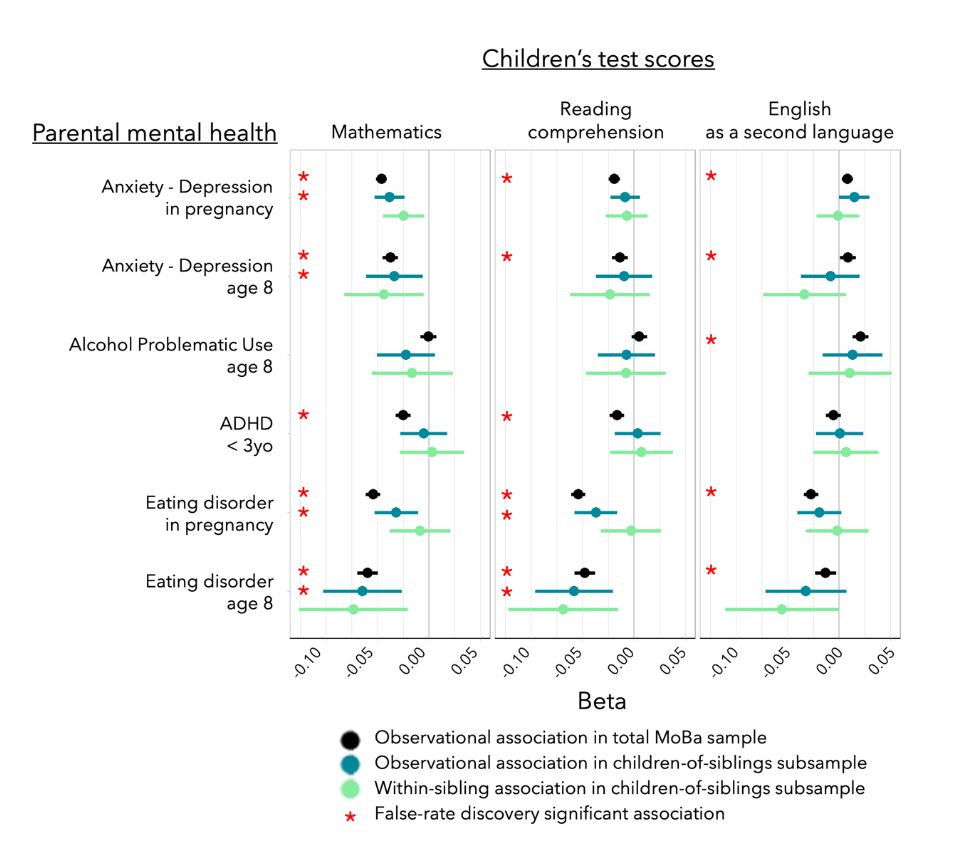
New preprint!
We find no evidence that parental mental health influences children's academic achievement when comparing families in the Norwegian MoBa study.
osf.io/preprints/ps...
Quick thread 👇
We find no evidence that parental mental health influences children's academic achievement when comparing families in the Norwegian MoBa study.
osf.io/preprints/ps...
Quick thread 👇
April 16, 2025 at 10:35 AM
New preprint!
We find no evidence that parental mental health influences children's academic achievement when comparing families in the Norwegian MoBa study.
osf.io/preprints/ps...
Quick thread 👇
We find no evidence that parental mental health influences children's academic achievement when comparing families in the Norwegian MoBa study.
osf.io/preprints/ps...
Quick thread 👇