


Krizler C. Tanalgo
banner
tkrizler.bsky.social
Krizler C. Tanalgo
@tkrizler.bsky.social

Full Professor and Chair @ USM BioDept 👨🏻‍💻• Bats 🦇 • Conservation • Ecology• Biodiversity synthesis • Chinese Academy of Sciences 🇨🇳• Zukunftskolleg fellow 🇩🇪

Environmental science 44%
Biology 20%

Fantastic work led by @dlobo-wildlife.bsky.social it wonderful to see how bcvi and citizen science was integrated to this work
Third chapter of my thesis finally out ‼🦇

"Prioritizing bat roosts for conservation with a global multicriteria bat roost priority index based on community science"

Reposted by Krizler C. Tanalgo
Third chapter of my thesis finally out ‼🦇

"Prioritizing bat roosts for conservation with a global multicriteria bat roost priority index based on community science"

My (not so) side project is now out in @cp-iscience.bsky.social! Here, I tackle key gaps in traits in Philippine species, and its potential conservation implications.

www.cell.com/iscience/ful...
The second paper of the Current Perspectives on Biosphere Research Initiative is available as a preprint and constructive comments are welcome during the open review process, which ends on 6 November.

Preprint: doi.org/10.5194/egus...
First Paper: bg.copernicus.org/articles/22/...

#climate #nature

@biotropica.bsky.social Strong El Niño drought in PH 🇵🇭reshaped predator–prey dynamics w/ predation plunged, arthropods rebounded, vertebrates lagged. Findings stress the need for long-term, standardised monitoring to understand ecosystems under climate extremes.

Reposted by Krizler C. Tanalgo

Across living and extinct primate species, longer thumbs predict bigger brains, highlighting the neural cost of dexterity, according to a paper in Communications Biology. 🧪
Human dexterity and brains evolved hand in hand - Communications Biology
Thumbs and brains coevolved in primates. Across living and extinct species, longer thumbs predict bigger brains, highlighting the neural cost of dexterity.
go.nature.com

In our new paper, we showed that 15–23% of Philippine terrestrial vertebrates face extinction, especially larger-bodied & narrowly distributed species. Alarmingly, threatened & endemic species remain understudied and poorly documented. authors.elsevier.com/a/1lgTS_17Gg... #extinction

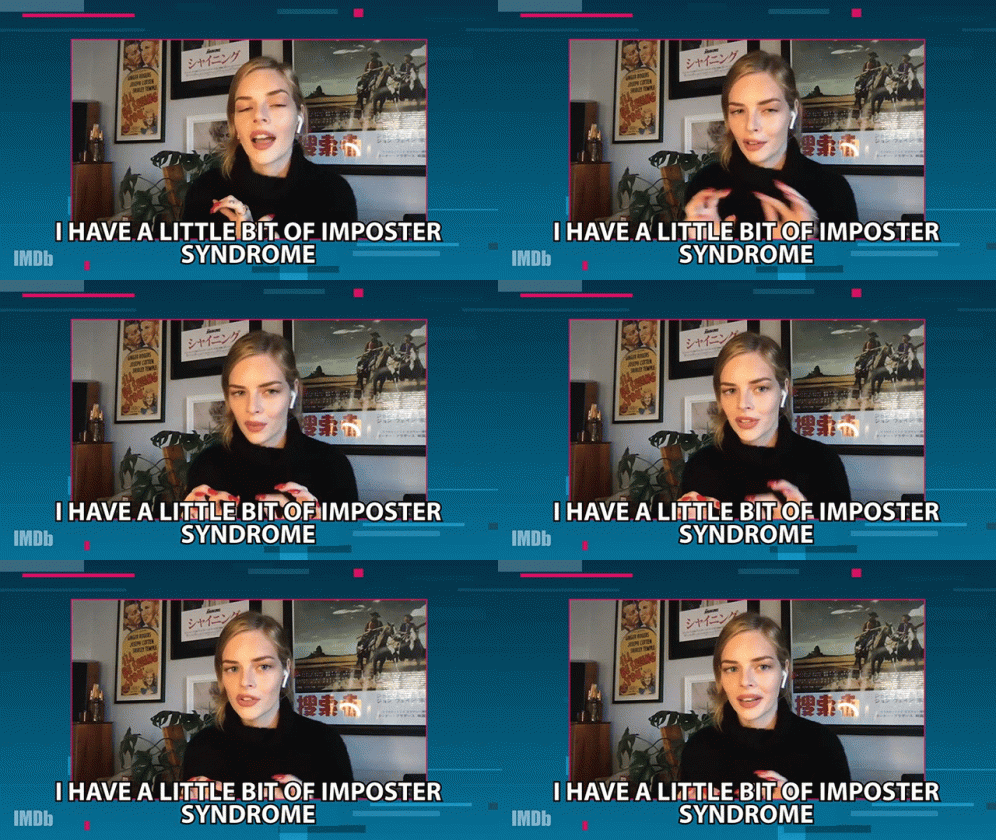
Turns out, pushing myself into ambitious research work isn’t just about chasing bold ideas. It’s about babysitting them with rigour, honesty, and care, while simultaneously battling imposter syndrome and every challenge the universe throws in. Fun times.
a woman singing with the words i have a little bit of imposter syndrome
ALT: a woman singing with the words i have a little bit of imposter syndrome
media.tenor.com

Excited to share that I’ll be at UC Louvain this October as a Visiting Professor/Researcher —-my first since being promoted to Full Professor, and hopefully the first of many!

Reposted by Krizler C. Tanalgo

Reposted by Krizler C. Tanalgo

When you think you have seen it all, then this: increasing trend of co-authorships for sale:

www.nature.com/articles/d41...
Authorship for sale: Nature investigates how paper mills work
Companies selling authorship slots thrive in a culture that equates success with a strong publication record. Customers, sleuths and the shadowy owner of a paper mill explain why.
www.nature.com

Trait-based extinction analysis helps pinpoint species needing urgent protection, but many still lack key trait data (Raunkiæran shortfall)—a major issue in megadiverse countries like the Philippines. Sharing a sneak peek of my short piece exploring this in the Philippine context and beyond.

Normal academic life

What can the human population learn from bats?
Read our feature in Animal Ecology in Focus, based on our paper published in @animalecology.bsky.social

animalecologyinfocus.com/2025/05/22/d...
Does Being Too Close Hurt Us? Lessons on Overpopulation from Bats
This blog post is provided by Krizler Tanalgo and tells the #StoryBehindThePaper for the article “The behavioural costs of overcrowding for gregarious cave-dwelling bats”, which was published last …
animalecologyinfocus.com
The planet is changing—some of it is inevitable, but some of it is on us. 🔍 Researcher Jonathan Chase and podcast host Volker Hahn take on one of the biggest scientific challenges: distinguishing between detection (what’s changing) and attribution (why it’s changing) 📊 1/2
New study by @idiv-research.bsky.social in @cellpress.bsky.social finds 44% of 563 environmental research faced “Gollum effect”: territorial behavior limiting access to data/sites or collaboration, often by senior or competing researchers.

👉 www.cell.com/one-earth/fu...

Today tested me as the department's chair, but a rough manuscript draft still knows how to test my patience harder ;)

These gaps in knowledge and conservation efforts put the country’s unique biodiversity at greater risk, emphasising the urgent need for targeted research and protection measure

Our findings also highlight a significant spatial bias in research and species observations, with certain regions receiving disproportionate attention while others remain underexplored. s.

Alarmingly, many of these threatened species are poorly studied, despite being well-represented in global databases like GBIF.

The Philippines, a megadiverse hotspot, may lose 15–23% of its terrestrial vertebrates. Our preprint shows larger endemic species in restricted habitats face the greatest risk www.researchsquare.com/article/rs-6...
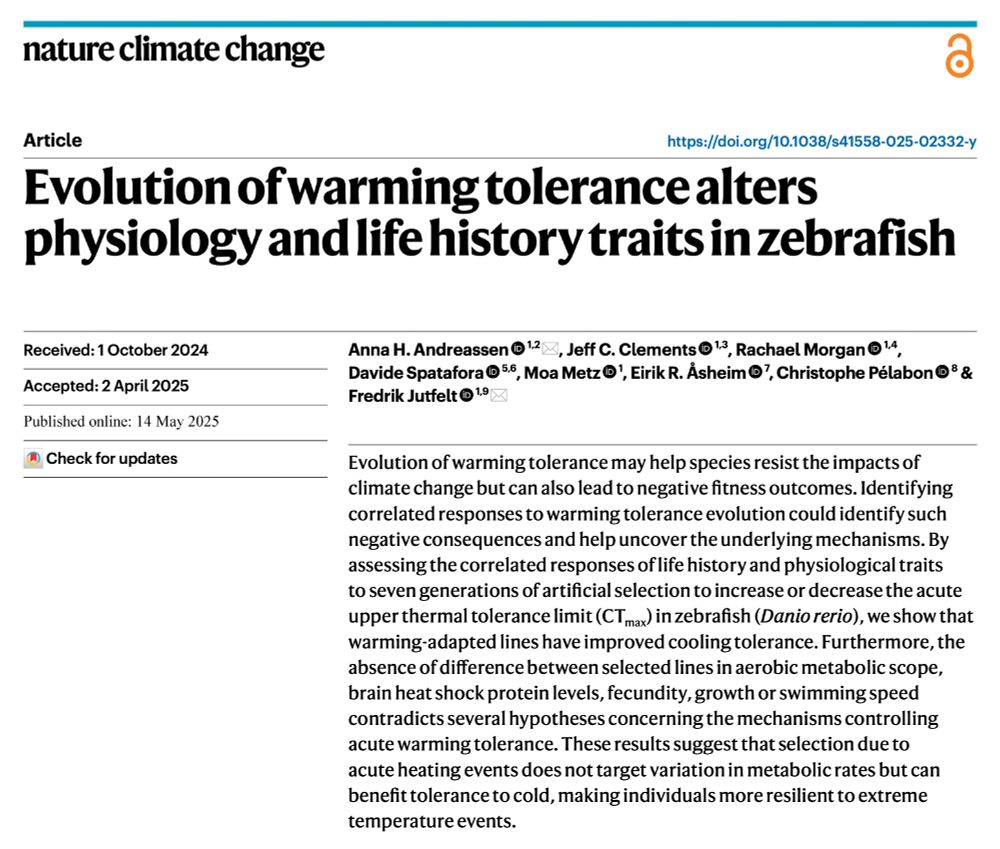
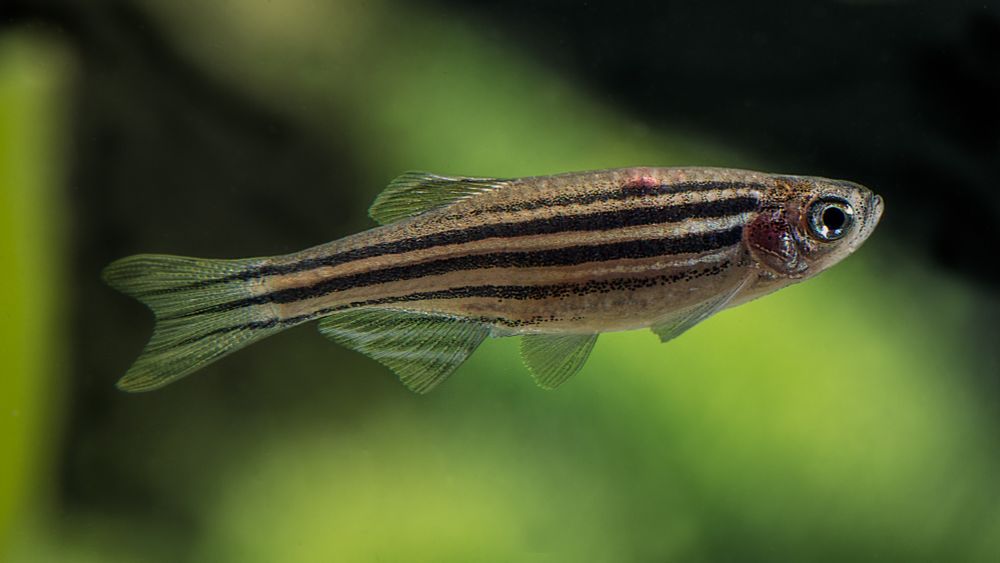
How do fish evolve to tolerate higher temperatures, and are there trade-offs? We explore these questions in our new paper
@natclimate.nature.com led by Anna Andreassen
@annahandreassen.bsky.social

www.nature.com/articles/s41...
🧪🐟🦑

7/ Understanding these mechanisms is essential to safeguarding bats and their vital ecological roles. Conservation must adapt to prevent unintended harm. 🦇🌿#Conservation #Bats #EcologicalTraps

6/ With habitat loss, fragmentation, and climate change already pressuring bats, refining conservation strategies to address EETs is critical.

5/ Crucially, conservation efforts may inadvertently prioritise high-density bat habitats that function as ecological traps, potentially undermining species recovery.

4/ Our study examined taxonomic traits, geographical distribution, and key risk drivers, finding that widespread insectivorous bats with highly social behaviours are particularly vulnerable.

3/ A new study reveals that at least 318 bat species are at risk of falling into EETs, highlighting the impact of human-induced environmental changes on bat populations worldwide.

2/ These traps mislead bats into selecting seemingly favourable habitats e.g., urban areas, energy development zones, and agricultural landscapes that ultimately reduce survival or reproductive success.