Our lab's cover in @angewandtechemie.bsky.social! It showcases our work on photocatalytic proximity techniques using localized catalysts. This includes precise drug release with miniature photoenzymes and bioorthogonal protein labeling via ketyl radicals.

Inside Back Cover: Miniature Photoenzyme Enables Organelle‐Specific Cellular Control via Deboronative Hydroxylation
A compact, genetically encoded photoenzyme, miniSOG, enables spatiotemporally controlled bioorthogonal deboronative hydroxylation of diverse organoboronates in live cells by producing localized super....
onlinelibrary.wiley.com
November 30, 2025 at 4:02 AM
Our lab's cover in @angewandtechemie.bsky.social! It showcases our work on photocatalytic proximity techniques using localized catalysts. This includes precise drug release with miniature photoenzymes and bioorthogonal protein labeling via ketyl radicals.

Enantioselective energy transfer catalysis compartmentalized by triplet photoenzymes
->Nature | More from Lil Dr Glen EcoChat at BigEarthData.ai
->Nature | More from Lil Dr Glen EcoChat at BigEarthData.ai

Enantioselective energy transfer catalysis compartmentalized by triplet photoenzymes
Akiyama, T. & Ojima, I. Catalytic Asymmetric Synthesis (John Wiley, 2022). Brimioulle, R., Lenhart, D., Maturi, M. M. & Bach, T. Enantioselective catalysis of photochemical reactions. Angew. Chem. Int. Ed. 54, 3872–3890 (2015). Silvi, M. & Melchiorre, P. Enhancing the...
www.nature.com
October 25, 2025 at 2:26 PM

New online! Enantioselective energy transfer catalysis compartmentalized by triplet photoenzymes

Enantioselective energy transfer catalysis compartmentalized by triplet photoenzymes
Nature Catalysis, Published online: 24 October 2025; doi:10.1038/s41929-025-01433-3Artificial photobiocatalytic reactions are appealing but sometimes suffer from non-enzymatic side reactions. Now a photoenzyme for enantioselective [2 + 2] photocycloaddition of 2-naphthyl derivatives is reported and combined with designed quenchers that shut down the competing enzyme-free racemic reaction.
bit.ly
October 24, 2025 at 6:12 PM
New online! Enantioselective energy transfer catalysis compartmentalized by triplet photoenzymes
New online! An NAD⁺ analogue enables assembly of structurally diverse artificial photoenzymes for enantiodivergent [2 + 2] cycloadditions

An NAD⁺ analogue enables assembly of structurally diverse artificial photoenzymes for enantiodivergent [2 + 2] cycloadditions
Nature Catalysis, Published online: 12 August 2025; doi:10.1038/s41929-025-01390-xExpanding the methods for constructing artificial enzymes is of high interest. Now a photoactive cofactor is designed that mimics NAD+, allowing its insertion into a range of NAD+-binding protein scaffolds to catalyse inter- and intramolecular [2 + 2] cycloaddition reactions.
bit.ly
August 12, 2025 at 4:59 PM
New online! An NAD⁺ analogue enables assembly of structurally diverse artificial photoenzymes for enantiodivergent [2 + 2] cycloadditions
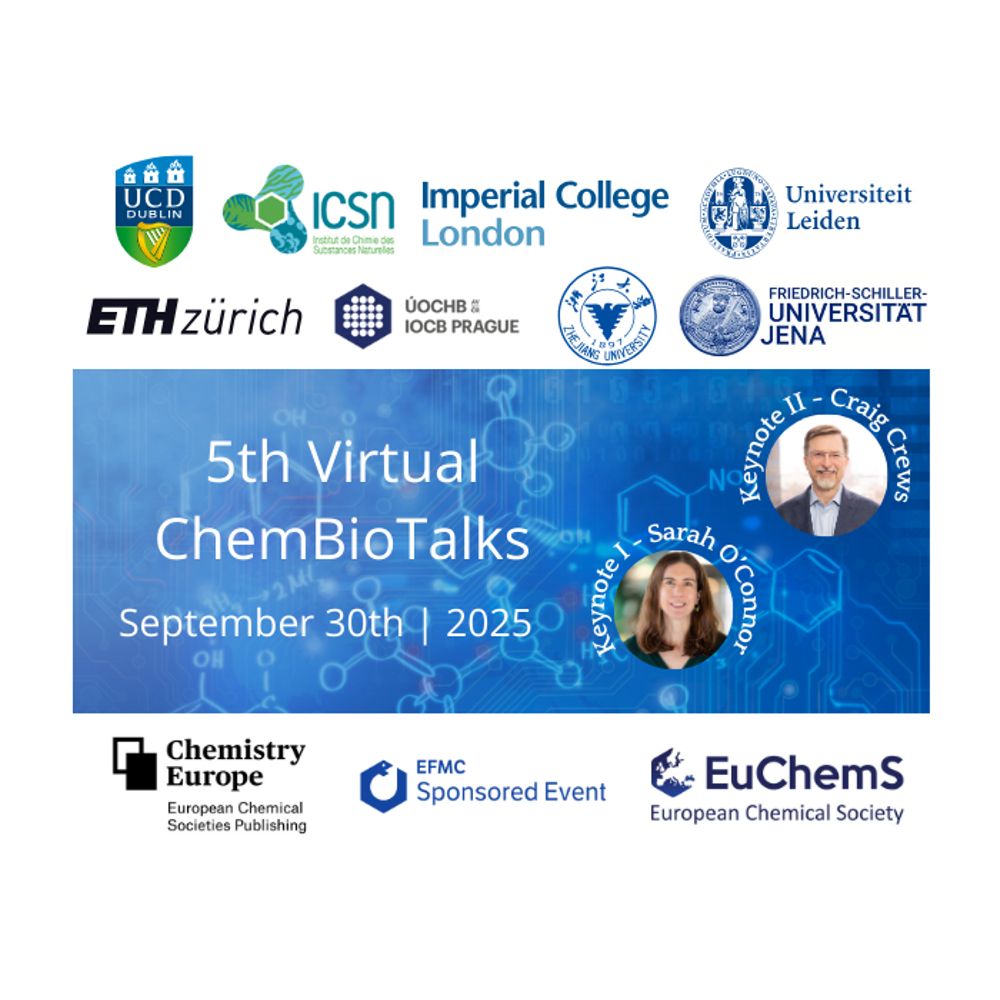
The fourth talk of the 5th Virtual ChemBioTalks will be given by @cathleenzeymer.bsky.social. She will talk about her group’s exciting research under the title “Design and directed evolution of artificial photoenzymes”.
Make sure to register for free: https://cvent.me/G1geWW
Make sure to register for free: https://cvent.me/G1geWW

July 24, 2025 at 10:51 AM
The fourth talk of the 5th Virtual ChemBioTalks will be given by @cathleenzeymer.bsky.social. She will talk about her group’s exciting research under the title “Design and directed evolution of artificial photoenzymes”.
Make sure to register for free: https://cvent.me/G1geWW
Make sure to register for free: https://cvent.me/G1geWW

Really neat, very cool work! ...Though I'm not sure I agree with the definitive statement about the incapability of photoenzymes 😄
June 6, 2025 at 6:42 PM
Really neat, very cool work! ...Though I'm not sure I agree with the definitive statement about the incapability of photoenzymes 😄
Efficient and selective energy transfer photoenzymes powered by visible light
->Nature | More info from EcoSearch
->Nature | More info from EcoSearch

Efficient and selective energy transfer photoenzymes powered by visible light
Substrates and products were chemically synthesized according to procedures reported in the ‘Chemical procedures’ section of the Supplementary Information. All other chemicals and biological materials were obtained from commercial suppliers. Lysozyme, DNase I, chloramphenicol and kanamycin were purchased from Sigma-Aldrich...
www.nature.com
May 11, 2025 at 10:58 AM

🚨 Don’t miss your chance to apply for the 3 open PhD positions in our group!
🌞 Project I : #computationaldesign of #photoenzymes for solar-driven nitrogen reduction to ammonia.
🧪 Apply now! Screening starts April 1
🔗 mpg.de/24336572/phd...
@mpimicrobiomarburg.bsky.social @maxplanck.de
🌞 Project I : #computationaldesign of #photoenzymes for solar-driven nitrogen reduction to ammonia.
🧪 Apply now! Screening starts April 1
🔗 mpg.de/24336572/phd...
@mpimicrobiomarburg.bsky.social @maxplanck.de

March 25, 2025 at 8:52 AM
🚨 Don’t miss your chance to apply for the 3 open PhD positions in our group!
🌞 Project I : #computationaldesign of #photoenzymes for solar-driven nitrogen reduction to ammonia.
🧪 Apply now! Screening starts April 1
🔗 mpg.de/24336572/phd...
@mpimicrobiomarburg.bsky.social @maxplanck.de
🌞 Project I : #computationaldesign of #photoenzymes for solar-driven nitrogen reduction to ammonia.
🧪 Apply now! Screening starts April 1
🔗 mpg.de/24336572/phd...
@mpimicrobiomarburg.bsky.social @maxplanck.de
A huge thanks to my past and present group members, mentors, and collaborators who have supported this journey!
#Biocatalysis #EnzymeEngineering #Photoenzymes #SustainableChemistry #DirectedEvolution #ComputationalBiology #ProteinDesign #Hiring #PhDPositions
#Biocatalysis #EnzymeEngineering #Photoenzymes #SustainableChemistry #DirectedEvolution #ComputationalBiology #ProteinDesign #Hiring #PhDPositions
March 16, 2025 at 7:39 AM
A huge thanks to my past and present group members, mentors, and collaborators who have supported this journey!
#Biocatalysis #EnzymeEngineering #Photoenzymes #SustainableChemistry #DirectedEvolution #ComputationalBiology #ProteinDesign #Hiring #PhDPositions
#Biocatalysis #EnzymeEngineering #Photoenzymes #SustainableChemistry #DirectedEvolution #ComputationalBiology #ProteinDesign #Hiring #PhDPositions
🔬 Join us! We are hiring three PhD students to advance enzyme design and develop photoenzymes for carbon capture and nitrogen fixation. If you are passionate about protein engineering, computational modeling, or synthetic biology, check out the job openings!
📌 www.mpg.de/24336572/phd...
📌 www.mpg.de/24336572/phd...

Three PhD positions | Computational protein design
Three PhD postiions in computational protein design
www.mpg.de
March 16, 2025 at 7:39 AM
🔬 Join us! We are hiring three PhD students to advance enzyme design and develop photoenzymes for carbon capture and nitrogen fixation. If you are passionate about protein engineering, computational modeling, or synthetic biology, check out the job openings!
📌 www.mpg.de/24336572/phd...
📌 www.mpg.de/24336572/phd...
🌍 Exciting news! This summer, my group joins @mpimicrobiomarburg.bsky.social l to create photoenzymes for solar energy conversion & carbon capture. With #ProteinDesign 🖥️ & #DirectedEvolution 🧬, we’ll push enzyme design to new limits for a sustainable future!
#Hiring www.mpg.de/24336572/phd...
#Hiring www.mpg.de/24336572/phd...
Three PhD positions | Computational protein design
Three PhD postiions in computational protein design
www.mpg.de
March 16, 2025 at 7:39 AM
🌍 Exciting news! This summer, my group joins @mpimicrobiomarburg.bsky.social l to create photoenzymes for solar energy conversion & carbon capture. With #ProteinDesign 🖥️ & #DirectedEvolution 🧬, we’ll push enzyme design to new limits for a sustainable future!
#Hiring www.mpg.de/24336572/phd...
#Hiring www.mpg.de/24336572/phd...

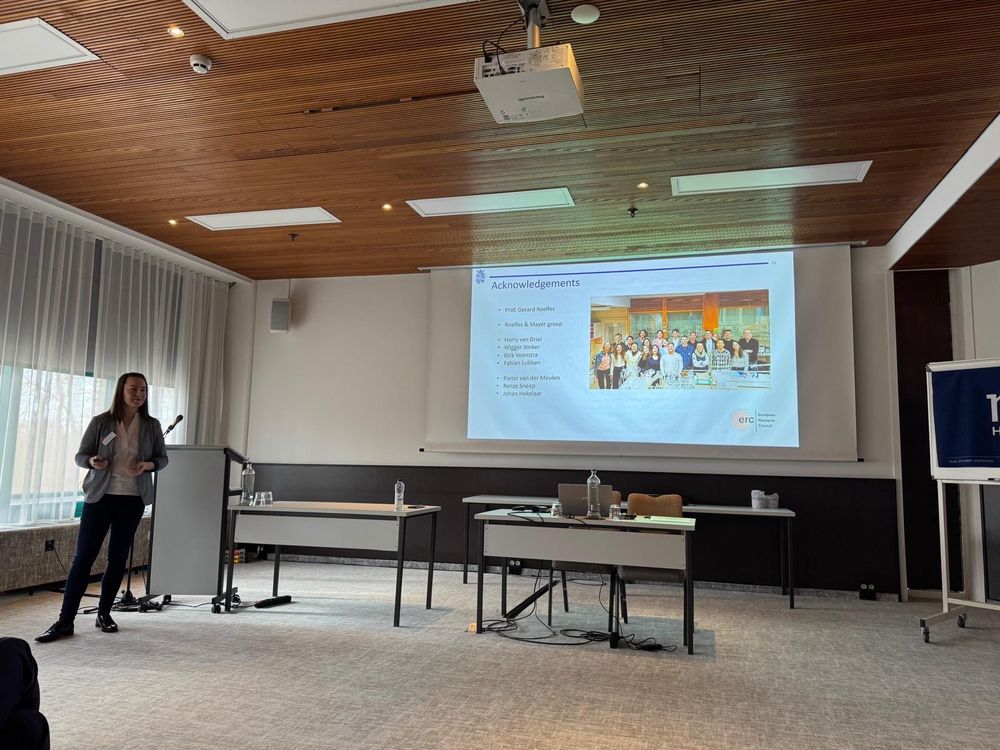
Tanja presented her work on metallaphotoredox catalysis in designer photoenzymes.
Congrats to both of you!
@stratinghinst.bsky.social @unigroningen.bsky.social
Congrats to both of you!
@stratinghinst.bsky.social @unigroningen.bsky.social
March 11, 2025 at 7:01 PM
Tanja presented her work on metallaphotoredox catalysis in designer photoenzymes.
Congrats to both of you!
@stratinghinst.bsky.social @unigroningen.bsky.social
Congrats to both of you!
@stratinghinst.bsky.social @unigroningen.bsky.social