




Yash Mehta
@yashsmehta.bsky.social
Cognitive Science PhD student, Johns Hopkins 🧠
Previously: HHMI Janelia 🇺🇸, AutoML Lab 🇩🇪, Gatsby Unit UCL 🇬🇧
www.yashsmehta.com 🇮🇳
Previously: HHMI Janelia 🇺🇸, AutoML Lab 🇩🇪, Gatsby Unit UCL 🇬🇧
www.yashsmehta.com 🇮🇳
Pinned
Yash Mehta
@yashsmehta.bsky.social
· Nov 18
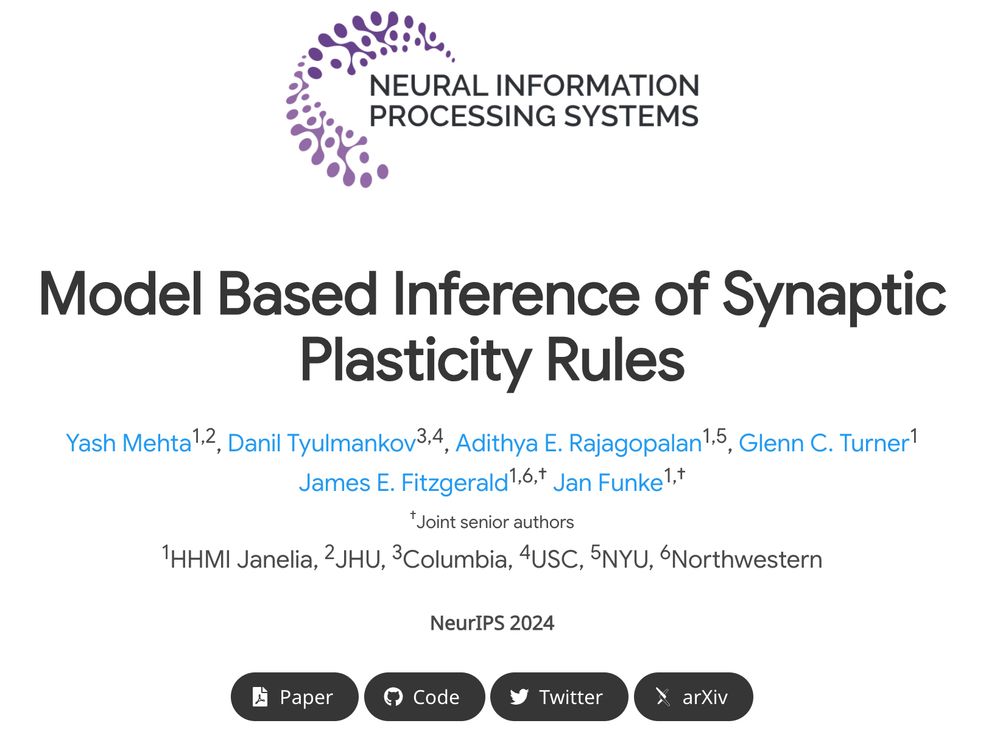
🚀 Excited to share our paper has been accepted at #NeurIPS! 🎉 We developed a deep learning framework that infers local learning algorithms in the brain by fitting behavioral or neural activity trajectories during learning. We validate on synthetic data and tested on 🪰 behavioral data (1/5 🧵)
Reposted by Yash Mehta

Human visual cortex representations may be much higher-dimensional than earlier work suggested, but are these higher dimensions of cortical activity actually relevant to behavior? Our new paper tackles this by studying how different people experience the same movies. 🧵 www.cell.com/current-biol...

High-dimensional structure underlying individual differences in naturalistic visual experience
Han and Bonner reveal that individual visual experience arises from high-dimensional
neural geometry distributed across multiple representational scales. By characterizing
the full dimensional spectru...
www.cell.com
January 30, 2026 at 6:53 PM
Human visual cortex representations may be much higher-dimensional than earlier work suggested, but are these higher dimensions of cortical activity actually relevant to behavior? Our new paper tackles this by studying how different people experience the same movies. 🧵 www.cell.com/current-biol...
High dimensional representations in the visual cortex, new paper from our lab, check it out!
Dimensionality reduction may be the wrong approach to understanding neural representations. Our new paper shows that across human visual cortex, dimensionality is unbounded and scales with dataset size—we show this across nearly four orders of magnitude. journals.plos.org/ploscompbiol...

December 12, 2025 at 10:07 PM
High dimensional representations in the visual cortex, new paper from our lab, check it out!
Reposted by Yash Mehta

Dimensionality reduction may be the wrong approach to understanding neural representations. Our new paper shows that across human visual cortex, dimensionality is unbounded and scales with dataset size—we show this across nearly four orders of magnitude. journals.plos.org/ploscompbiol...
December 11, 2025 at 3:32 PM
Dimensionality reduction may be the wrong approach to understanding neural representations. Our new paper shows that across human visual cortex, dimensionality is unbounded and scales with dataset size—we show this across nearly four orders of magnitude. journals.plos.org/ploscompbiol...
🚀 Excited to share our paper has been accepted at #NeurIPS! 🎉 We developed a deep learning framework that infers local learning algorithms in the brain by fitting behavioral or neural activity trajectories during learning. We validate on synthetic data and tested on 🪰 behavioral data (1/5 🧵)
November 18, 2024 at 6:18 PM
🚀 Excited to share our paper has been accepted at #NeurIPS! 🎉 We developed a deep learning framework that infers local learning algorithms in the brain by fitting behavioral or neural activity trajectories during learning. We validate on synthetic data and tested on 🪰 behavioral data (1/5 🧵)
Reposted by Yash Mehta

Interesting approach to estimate the physiological update rules of synapses: yashsmehta.com/plasticity-p...
NeurIPS 2024: Model-Based Inference of Synaptic Plasticity Rules
Inferring the synaptic plasticity rules that govern learning in the brain is a key challenge in neuroscience. We present a novel computational method to infer these rules from experimental data, appli...
yashsmehta.com
November 18, 2024 at 1:53 PM
Interesting approach to estimate the physiological update rules of synapses: yashsmehta.com/plasticity-p...