



Vasudeva Ramaswamy
@vramaswamy.bsky.social
Postdoctoral Fellow at the Institute for Macroeconomic Policy & Analysis. Econ PhD Job Market Candidate from American University. Macroeconomics, Inequality, Economic History, Financial Markets. https://vasudeva-ram.github.io.
Do the data support this mechanism? Yes.
We estimate our model using Bayesian IRF matching and find a very good fit for key variables to MP shocks.
Bottom line: NK models with capacity utilization can potentially explain both recent as well as historical inflation behavior
We estimate our model using Bayesian IRF matching and find a very good fit for key variables to MP shocks.
Bottom line: NK models with capacity utilization can potentially explain both recent as well as historical inflation behavior

November 27, 2024 at 7:15 PM
Do the data support this mechanism? Yes.
We estimate our model using Bayesian IRF matching and find a very good fit for key variables to MP shocks.
Bottom line: NK models with capacity utilization can potentially explain both recent as well as historical inflation behavior
We estimate our model using Bayesian IRF matching and find a very good fit for key variables to MP shocks.
Bottom line: NK models with capacity utilization can potentially explain both recent as well as historical inflation behavior
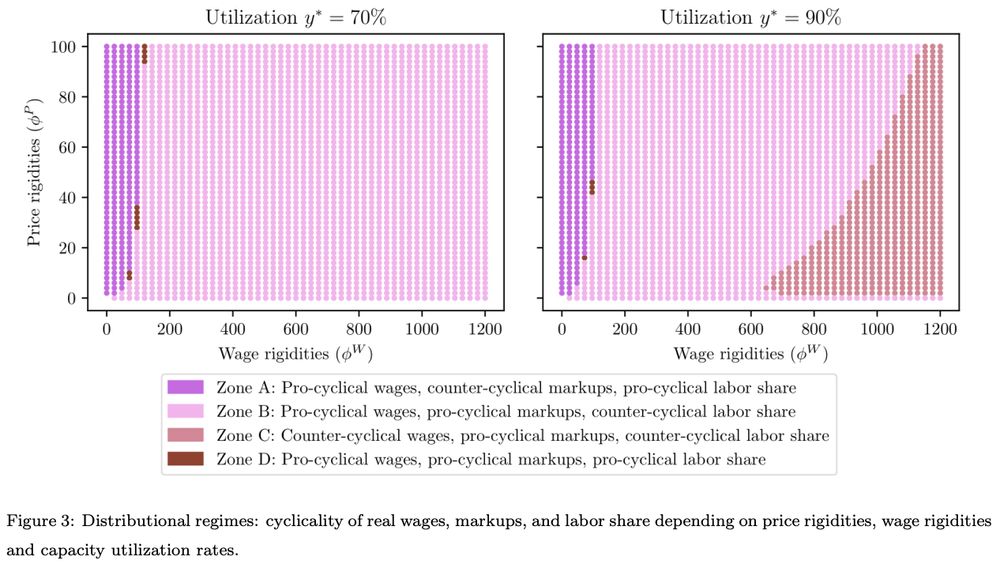
Do markups always increase following expansionary shocks? Not necessarily!
Procyclical markups are more likely when:
➡️ High utilization rate y* when shock occurs
➡️ Prices have relatively lower nominal rigidities than wages
Procyclical markups are more likely when:
➡️ High utilization rate y* when shock occurs
➡️ Prices have relatively lower nominal rigidities than wages
November 27, 2024 at 7:15 PM
Do markups always increase following expansionary shocks? Not necessarily!
Procyclical markups are more likely when:
➡️ High utilization rate y* when shock occurs
➡️ Prices have relatively lower nominal rigidities than wages
Procyclical markups are more likely when:
➡️ High utilization rate y* when shock occurs
➡️ Prices have relatively lower nominal rigidities than wages
In technical terms, the linearized Phillips Curve depends on the point around which it is linearized
⭐️ Capacity utilization rate y* appears as a state variable in the linearized PC
⭐️ Reflects nonlinearities due to *product market* tightness
⭐️ Capacity utilization rate y* appears as a state variable in the linearized PC
⭐️ Reflects nonlinearities due to *product market* tightness

November 27, 2024 at 7:15 PM
In technical terms, the linearized Phillips Curve depends on the point around which it is linearized
⭐️ Capacity utilization rate y* appears as a state variable in the linearized PC
⭐️ Reflects nonlinearities due to *product market* tightness
⭐️ Capacity utilization rate y* appears as a state variable in the linearized PC
⭐️ Reflects nonlinearities due to *product market* tightness
⭐️When y* is low → productivity effects dominate, inflation displays typical "hump-shaped" response (left panel)
⭐️When y* is high → inflation responds immediately, driven primarily by higher markups and muted productivity effects (right panel)
⭐️When y* is high → inflation responds immediately, driven primarily by higher markups and muted productivity effects (right panel)

November 27, 2024 at 7:15 PM
⭐️When y* is low → productivity effects dominate, inflation displays typical "hump-shaped" response (left panel)
⭐️When y* is high → inflation responds immediately, driven primarily by higher markups and muted productivity effects (right panel)
⭐️When y* is high → inflation responds immediately, driven primarily by higher markups and muted productivity effects (right panel)
What we do: introduce capacity utilization in standard NK model
Firms set capacity before observing variable demand → optimal to hold some "precautionary" capacity
When demand manifests, firms produce by utilizing capacity (ala labor effort in Burnside 93)-*upto max capacity*!
Firms set capacity before observing variable demand → optimal to hold some "precautionary" capacity
When demand manifests, firms produce by utilizing capacity (ala labor effort in Burnside 93)-*upto max capacity*!

November 27, 2024 at 7:15 PM
What we do: introduce capacity utilization in standard NK model
Firms set capacity before observing variable demand → optimal to hold some "precautionary" capacity
When demand manifests, firms produce by utilizing capacity (ala labor effort in Burnside 93)-*upto max capacity*!
Firms set capacity before observing variable demand → optimal to hold some "precautionary" capacity
When demand manifests, firms produce by utilizing capacity (ala labor effort in Burnside 93)-*upto max capacity*!
On the #EconJobMarket!
When does inflation increase slowly ("hump-shaped") vs rapidly? When do different drivers (wages, markups, etc) play bigger roles?
My #JMP explores these Qs by bringing a key variable back to the center of the debate: capacity utilization
A thread 🧵👇
When does inflation increase slowly ("hump-shaped") vs rapidly? When do different drivers (wages, markups, etc) play bigger roles?
My #JMP explores these Qs by bringing a key variable back to the center of the debate: capacity utilization
A thread 🧵👇

November 27, 2024 at 7:15 PM
On the #EconJobMarket!
When does inflation increase slowly ("hump-shaped") vs rapidly? When do different drivers (wages, markups, etc) play bigger roles?
My #JMP explores these Qs by bringing a key variable back to the center of the debate: capacity utilization
A thread 🧵👇
When does inflation increase slowly ("hump-shaped") vs rapidly? When do different drivers (wages, markups, etc) play bigger roles?
My #JMP explores these Qs by bringing a key variable back to the center of the debate: capacity utilization
A thread 🧵👇