




TulipRoses
@tuliproses.bsky.social
23 | they/them | polyglot, linguistics + amateur photography

#conlangnovember Ngoaqona* (soft launching a name change) has a ‘to say’ v ‘to speak’ distinction
on(a): to say
mya: to speak
when ona is used as an auxiliary to mya, it means ‘to give a speech’ or ‘to rally’
Caeser ona myarome
Caeser say speak-Rome
“Caeser rallied Rome”
on(a): to say
mya: to speak
when ona is used as an auxiliary to mya, it means ‘to give a speech’ or ‘to rally’
Caeser ona myarome
Caeser say speak-Rome
“Caeser rallied Rome”
#ConlangNovember 28: This week's prompt is 'say'. Your choice how to interpret. You could give the translation, use it in a sentence in your conlang, or just take it as a starting point for inspiration for something conlang-related to discuss.
#Writing #WritingPrompt #Conlangs #Worldbuilding
#Writing #WritingPrompt #Conlangs #Worldbuilding

November 28, 2025 at 2:29 PM
#conlangnovember Ngoaqona* (soft launching a name change) has a ‘to say’ v ‘to speak’ distinction
on(a): to say
mya: to speak
when ona is used as an auxiliary to mya, it means ‘to give a speech’ or ‘to rally’
Caeser ona myarome
Caeser say speak-Rome
“Caeser rallied Rome”
on(a): to say
mya: to speak
when ona is used as an auxiliary to mya, it means ‘to give a speech’ or ‘to rally’
Caeser ona myarome
Caeser say speak-Rome
“Caeser rallied Rome”
#conlangnovember #worldbuilding
Ngoaq create coded songs, or ‘Khuann,’ with hidden references to the best hunting grounds, water accessibility & safety. The codes are subtle so that an outsider wouldn’t be able to find them. They often have a lesson, like a fable, relating to the hidden location.
Ngoaq create coded songs, or ‘Khuann,’ with hidden references to the best hunting grounds, water accessibility & safety. The codes are subtle so that an outsider wouldn’t be able to find them. They often have a lesson, like a fable, relating to the hidden location.
#ConlangNovember 26: What are some important compositions in your language that have been preserved or passed on? We're talking stories, historical accounts, songs, scriptures and the like that are important to its speakers' culture.
#Writing #WritingPrompt #Conlangs #Worldbuilding
#Writing #WritingPrompt #Conlangs #Worldbuilding

November 26, 2025 at 4:02 PM
#conlangnovember #worldbuilding
Ngoaq create coded songs, or ‘Khuann,’ with hidden references to the best hunting grounds, water accessibility & safety. The codes are subtle so that an outsider wouldn’t be able to find them. They often have a lesson, like a fable, relating to the hidden location.
Ngoaq create coded songs, or ‘Khuann,’ with hidden references to the best hunting grounds, water accessibility & safety. The codes are subtle so that an outsider wouldn’t be able to find them. They often have a lesson, like a fable, relating to the hidden location.
#conlangnovember a midtier swear in Ngoaqona:
Anet-sedef
eye.dl-shut
literally means ‘shut eyed,’ as in, a mouse pup born with their eyes closed. figuratively meaning ‘dumbass, idiot’ or as an offensive way to call someone ‘juvenile’
Anet-sedef
eye.dl-shut
literally means ‘shut eyed,’ as in, a mouse pup born with their eyes closed. figuratively meaning ‘dumbass, idiot’ or as an offensive way to call someone ‘juvenile’
#ConlangNovember 25: Today's topic is taboos. What words or phrases in your language are considered inappropriate, repugnant or sacrilegious to say in the culture of its speakers? (Totally not asking you to teach us how to swear in your conlang…)
#Writing #WritingPrompt #Conlangs #Worldbuilding
#Writing #WritingPrompt #Conlangs #Worldbuilding

November 25, 2025 at 3:44 PM
#conlangnovember a midtier swear in Ngoaqona:
Anet-sedef
eye.dl-shut
literally means ‘shut eyed,’ as in, a mouse pup born with their eyes closed. figuratively meaning ‘dumbass, idiot’ or as an offensive way to call someone ‘juvenile’
Anet-sedef
eye.dl-shut
literally means ‘shut eyed,’ as in, a mouse pup born with their eyes closed. figuratively meaning ‘dumbass, idiot’ or as an offensive way to call someone ‘juvenile’
#conlangnovember Ngoaqona only has one idiom so far (redefining sentence structure a bit)
Hauki-q le-heja-mikhanileho
Tree.PL NEG-grow-summit
“Trees dont grow (on) the summit,” meaning something is too good to be true
Hauki-q le-heja-mikhanileho
Tree.PL NEG-grow-summit
“Trees dont grow (on) the summit,” meaning something is too good to be true
#ConlangNovember 24: How does your language reflect the culture of its speakers? For example, are there certain idioms that reference a particular aspect of their culture?
#Writing #WritingPrompt #Conlangs #Worldbuilding
#Writing #WritingPrompt #Conlangs #Worldbuilding

November 24, 2025 at 8:44 PM
#conlangnovember Ngoaqona only has one idiom so far (redefining sentence structure a bit)
Hauki-q le-heja-mikhanileho
Tree.PL NEG-grow-summit
“Trees dont grow (on) the summit,” meaning something is too good to be true
Hauki-q le-heja-mikhanileho
Tree.PL NEG-grow-summit
“Trees dont grow (on) the summit,” meaning something is too good to be true
#conlangnovember
my click consonants evolved from happy rat noises so I try to use them in
1. words with positive conotations 😆
2. baby talk (often onomatopeias) 🧸
Spanish baby talk:
niño (baby) becomes wawa (baby)
Ngoaqona bt:
neni (baby) becomes kǂakǂa (baby)
the onomatopeia is baby babble
my click consonants evolved from happy rat noises so I try to use them in
1. words with positive conotations 😆
2. baby talk (often onomatopeias) 🧸
Spanish baby talk:
niño (baby) becomes wawa (baby)
Ngoaqona bt:
neni (baby) becomes kǂakǂa (baby)
the onomatopeia is baby babble
#ConlangNovember 23: Today's subject is onomatopoeias. What words in your language were formed to resemble the thing they describe? I'll also open it up to pictograms in your language's script, if you want to discuss that.
#Writing #WritingPrompt #Conlangs #Worldbuilding
#Writing #WritingPrompt #Conlangs #Worldbuilding

November 23, 2025 at 2:29 PM
#conlangnovember
my click consonants evolved from happy rat noises so I try to use them in
1. words with positive conotations 😆
2. baby talk (often onomatopeias) 🧸
Spanish baby talk:
niño (baby) becomes wawa (baby)
Ngoaqona bt:
neni (baby) becomes kǂakǂa (baby)
the onomatopeia is baby babble
my click consonants evolved from happy rat noises so I try to use them in
1. words with positive conotations 😆
2. baby talk (often onomatopeias) 🧸
Spanish baby talk:
niño (baby) becomes wawa (baby)
Ngoaqona bt:
neni (baby) becomes kǂakǂa (baby)
the onomatopeia is baby babble
Reposted by TulipRoses
Meus parentes se preparando pra me encontrar no Natal

November 21, 2025 at 9:29 PM
Meus parentes se preparando pra me encontrar no Natal
#conlangnovember basic phrases in Ngoaqona. There is a plural form for everything listed, but all is singular here:
Naxettevuk /n̪̟aᵏǂeθ̟evuk/
1-to.greet-2
I greet you, “hello”
Naqaqavuk /n̪̟acacavuk/
1-to.leave-2
I leave you, “goodbye”
Nalingakho /n̪̟al̪̟iŋaɦo/
1-to.regret-DET
I regret that, “i’m sorry”
Naxettevuk /n̪̟aᵏǂeθ̟evuk/
1-to.greet-2
I greet you, “hello”
Naqaqavuk /n̪̟acacavuk/
1-to.leave-2
I leave you, “goodbye”
Nalingakho /n̪̟al̪̟iŋaɦo/
1-to.regret-DET
I regret that, “i’m sorry”
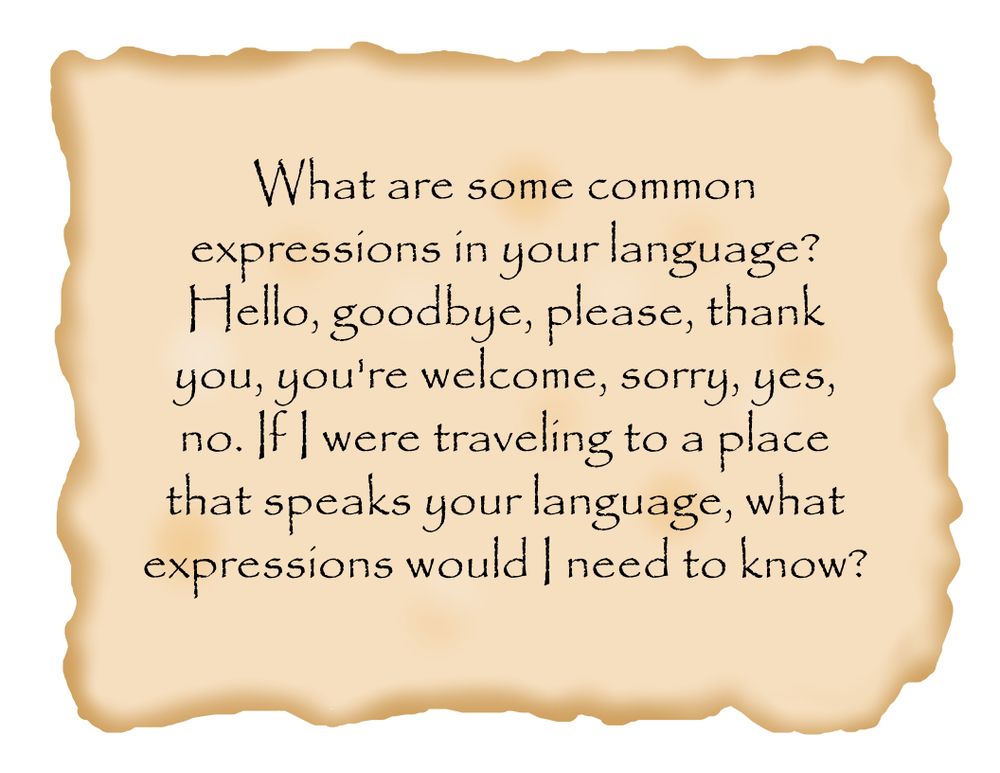
#ConlangNovember 20: What are some common expressions in your language? Hello, goodbye, please, thank you, you're welcome, sorry, yes, no. If I were traveling to a place that speaks your language, what expressions would I need to know?
#Writing #WritingPrompt #Conlangs #Worldbuilding
#Writing #WritingPrompt #Conlangs #Worldbuilding
November 20, 2025 at 1:56 PM
#conlangnovember basic phrases in Ngoaqona. There is a plural form for everything listed, but all is singular here:
Naxettevuk /n̪̟aᵏǂeθ̟evuk/
1-to.greet-2
I greet you, “hello”
Naqaqavuk /n̪̟acacavuk/
1-to.leave-2
I leave you, “goodbye”
Nalingakho /n̪̟al̪̟iŋaɦo/
1-to.regret-DET
I regret that, “i’m sorry”
Naxettevuk /n̪̟aᵏǂeθ̟evuk/
1-to.greet-2
I greet you, “hello”
Naqaqavuk /n̪̟acacavuk/
1-to.leave-2
I leave you, “goodbye”
Nalingakho /n̪̟al̪̟iŋaɦo/
1-to.regret-DET
I regret that, “i’m sorry”
#conlangnovember
As a direct-inverse, Ngoaqona has a hierarchy. There are ways to both raise the hierarchal status of the adressee and humble the speaker, based on formality. Aka: formality triggers the inverse
ex.
devukonaqukul
POL-you-to.speak.PST-INV-me
“I (humbly) finished talking to you”
As a direct-inverse, Ngoaqona has a hierarchy. There are ways to both raise the hierarchal status of the adressee and humble the speaker, based on formality. Aka: formality triggers the inverse
ex.
devukonaqukul
POL-you-to.speak.PST-INV-me
“I (humbly) finished talking to you”
#ConlangNovember 18: Today, we're talking about formality and registers. Are there different varieties of your language used in different situations or by people of different classes? When would you use them, and how are they perceived by society?
#Writing #WritingPrompt #Conlangs #Worldbuilding
#Writing #WritingPrompt #Conlangs #Worldbuilding

November 18, 2025 at 4:36 PM
#conlangnovember
As a direct-inverse, Ngoaqona has a hierarchy. There are ways to both raise the hierarchal status of the adressee and humble the speaker, based on formality. Aka: formality triggers the inverse
ex.
devukonaqukul
POL-you-to.speak.PST-INV-me
“I (humbly) finished talking to you”
As a direct-inverse, Ngoaqona has a hierarchy. There are ways to both raise the hierarchal status of the adressee and humble the speaker, based on formality. Aka: formality triggers the inverse
ex.
devukonaqukul
POL-you-to.speak.PST-INV-me
“I (humbly) finished talking to you”
#conlangnovember
Ngoaqona has two forms of negation: -la (general negation) and -uat (verb phrase negation ig?)
ex.
Nalasaktakvuk
I-NEG-to.stand-to.be.behind-you
“I didn’t stand behind you”
Nasakuattakvuk
I-to.stand-NEG-to.be.behind-you
“I didn’t stand *behind* you (I stood somewhere else)”
Ngoaqona has two forms of negation: -la (general negation) and -uat (verb phrase negation ig?)
ex.
Nalasaktakvuk
I-NEG-to.stand-to.be.behind-you
“I didn’t stand behind you”
Nasakuattakvuk
I-to.stand-NEG-to.be.behind-you
“I didn’t stand *behind* you (I stood somewhere else)”
#ConlangNovember 16: Questions, negations, orders. How does your language handle them? For questions, this includes both polar (yes/no) questions, as well as open questions.
#Writing #WritingPrompt #Conlangs #Worldbuilding
#Writing #WritingPrompt #Conlangs #Worldbuilding

November 16, 2025 at 4:30 PM
#conlangnovember
Ngoaqona has two forms of negation: -la (general negation) and -uat (verb phrase negation ig?)
ex.
Nalasaktakvuk
I-NEG-to.stand-to.be.behind-you
“I didn’t stand behind you”
Nasakuattakvuk
I-to.stand-NEG-to.be.behind-you
“I didn’t stand *behind* you (I stood somewhere else)”
Ngoaqona has two forms of negation: -la (general negation) and -uat (verb phrase negation ig?)
ex.
Nalasaktakvuk
I-NEG-to.stand-to.be.behind-you
“I didn’t stand behind you”
Nasakuattakvuk
I-to.stand-NEG-to.be.behind-you
“I didn’t stand *behind* you (I stood somewhere else)”
#conlangnovember
Ngoaqona is SVO, and complexly S(neg)V(T)O(MP) where
t is time, m is manner, and p is place. adjectives some after the noun in shape, quantity, size, origin order
Nalaonavuk
I-NEG-talk.PST-you
“I didn’t talk to you”
Naonajauvuk
I-talk.PST-yesterday-you
“I talked yesterday to you”
Ngoaqona is SVO, and complexly S(neg)V(T)O(MP) where
t is time, m is manner, and p is place. adjectives some after the noun in shape, quantity, size, origin order
Nalaonavuk
I-NEG-talk.PST-you
“I didn’t talk to you”
Naonajauvuk
I-talk.PST-yesterday-you
“I talked yesterday to you”
#ConlangNovember 14: Today, we're discussing word order. What order do the subject, object and verb appear in in a sentence? Does it vary? Do adjectives come before or after nouns, and adverbs before or after verbs? And so on.
#Writing #WritingPrompt #Conlangs #Worldbuilding
#Writing #WritingPrompt #Conlangs #Worldbuilding

November 15, 2025 at 2:53 PM
#conlangnovember
Ngoaqona is SVO, and complexly S(neg)V(T)O(MP) where
t is time, m is manner, and p is place. adjectives some after the noun in shape, quantity, size, origin order
Nalaonavuk
I-NEG-talk.PST-you
“I didn’t talk to you”
Naonajauvuk
I-talk.PST-yesterday-you
“I talked yesterday to you”
Ngoaqona is SVO, and complexly S(neg)V(T)O(MP) where
t is time, m is manner, and p is place. adjectives some after the noun in shape, quantity, size, origin order
Nalaonavuk
I-NEG-talk.PST-you
“I didn’t talk to you”
Naonajauvuk
I-talk.PST-yesterday-you
“I talked yesterday to you”
#conlangnovember
a quote from Stephen King’s “The Stand”
lunaqdaidaman sangdaida talanonn
just-person-to.attempt thing.just PRSMP-to.be.mad
“People who try hard to do the right thing always seem mad” (more lit. “just / fair people attempting the just / fair thing appear mad”)
a quote from Stephen King’s “The Stand”
lunaqdaidaman sangdaida talanonn
just-person-to.attempt thing.just PRSMP-to.be.mad
“People who try hard to do the right thing always seem mad” (more lit. “just / fair people attempting the just / fair thing appear mad”)
#ConlangNovember 14: This week's prompt is 'stand'. Your choice how to interpret. You could give the translation, use it in a sentence in your conlang, or just take it as a starting point for inspiration for something conlang-related to discuss.
#Writing #WritingPrompt #Conlangs #Worldbuilding
#Writing #WritingPrompt #Conlangs #Worldbuilding

November 14, 2025 at 4:10 PM
#conlangnovember
a quote from Stephen King’s “The Stand”
lunaqdaidaman sangdaida talanonn
just-person-to.attempt thing.just PRSMP-to.be.mad
“People who try hard to do the right thing always seem mad” (more lit. “just / fair people attempting the just / fair thing appear mad”)
a quote from Stephen King’s “The Stand”
lunaqdaidaman sangdaida talanonn
just-person-to.attempt thing.just PRSMP-to.be.mad
“People who try hard to do the right thing always seem mad” (more lit. “just / fair people attempting the just / fair thing appear mad”)
#conlangnovember
Ngoaqona has 5 cases that decline by suffixing: Genitive (of) Causal (because of), Ornative (with), Essesive (formerly), and Privative (without). There are two lexical cases: the possessed and possesive cases. Nouns can be incorporated.
ex.
Ngoaqona
mice + to-talk
“talking mice”
Ngoaqona has 5 cases that decline by suffixing: Genitive (of) Causal (because of), Ornative (with), Essesive (formerly), and Privative (without). There are two lexical cases: the possessed and possesive cases. Nouns can be incorporated.
ex.
Ngoaqona
mice + to-talk
“talking mice”
#ConlangNovember 13: Let's talk morphology. How does your language combine words, roots and affixes to form new words with a more complex meaning? Talk about how it forms compounds, introduce some derivational affixes or show us inflection tables!
#Writing #WritingPrompt #Conlangs #Worldbuilding
#Writing #WritingPrompt #Conlangs #Worldbuilding

November 13, 2025 at 11:31 PM
#conlangnovember
Ngoaqona has 5 cases that decline by suffixing: Genitive (of) Causal (because of), Ornative (with), Essesive (formerly), and Privative (without). There are two lexical cases: the possessed and possesive cases. Nouns can be incorporated.
ex.
Ngoaqona
mice + to-talk
“talking mice”
Ngoaqona has 5 cases that decline by suffixing: Genitive (of) Causal (because of), Ornative (with), Essesive (formerly), and Privative (without). There are two lexical cases: the possessed and possesive cases. Nouns can be incorporated.
ex.
Ngoaqona
mice + to-talk
“talking mice”
#conlangnovember
Ngoaqona two tenses — past and non-past. Semelfactive verbs aren’t explicitly marked as past. These are mostly animal behavior verbs (chirped, squeeked, pounced, etc.)
past:
ex. Naonavuk
na-on-a-vuk
“I talked (to) you”
semelfactive:
ex. Naselvuk
na-sel-vuk
“I chirped (at) you”
Ngoaqona two tenses — past and non-past. Semelfactive verbs aren’t explicitly marked as past. These are mostly animal behavior verbs (chirped, squeeked, pounced, etc.)
past:
ex. Naonavuk
na-on-a-vuk
“I talked (to) you”
semelfactive:
ex. Naselvuk
na-sel-vuk
“I chirped (at) you”
#ConlangNovember 12: How does your language conceive of time? What tenses and aspects does your language distinguish?
#Writing #WritingPrompt #Conlangs #Worldbuilding
#Writing #WritingPrompt #Conlangs #Worldbuilding

November 12, 2025 at 5:58 PM
#conlangnovember
Ngoaqona two tenses — past and non-past. Semelfactive verbs aren’t explicitly marked as past. These are mostly animal behavior verbs (chirped, squeeked, pounced, etc.)
past:
ex. Naonavuk
na-on-a-vuk
“I talked (to) you”
semelfactive:
ex. Naselvuk
na-sel-vuk
“I chirped (at) you”
Ngoaqona two tenses — past and non-past. Semelfactive verbs aren’t explicitly marked as past. These are mostly animal behavior verbs (chirped, squeeked, pounced, etc.)
past:
ex. Naonavuk
na-on-a-vuk
“I talked (to) you”
semelfactive:
ex. Naselvuk
na-sel-vuk
“I chirped (at) you”
my view tonight 🥺 so blessed to be alive #photography

November 12, 2025 at 3:15 AM
my view tonight 🥺 so blessed to be alive #photography
#conlangnovember
Ngoaqona has a direct-inverse alignment. The hierarchy is built on animacy, ie. direct: ngoaq > other animals; inverse other animals > ngoaq. it is not based on saliency. saliency however is grammatically important to the secondary proximate-obviate. 🐭
Ngoaqona has a direct-inverse alignment. The hierarchy is built on animacy, ie. direct: ngoaq > other animals; inverse other animals > ngoaq. it is not based on saliency. saliency however is grammatically important to the secondary proximate-obviate. 🐭
#ConlangNovember 11: Let's discuss morphosyntactic alignment. How does your language treat the agent and patient of a transitive verb compared to the sole argument of an intransitive verb? Also, what noun cases does your language distinguish?
#Writing #WritingPrompt #Conlangs #Worldbuilding
#Writing #WritingPrompt #Conlangs #Worldbuilding

November 11, 2025 at 8:08 PM
#conlangnovember
Ngoaqona has a direct-inverse alignment. The hierarchy is built on animacy, ie. direct: ngoaq > other animals; inverse other animals > ngoaq. it is not based on saliency. saliency however is grammatically important to the secondary proximate-obviate. 🐭
Ngoaqona has a direct-inverse alignment. The hierarchy is built on animacy, ie. direct: ngoaq > other animals; inverse other animals > ngoaq. it is not based on saliency. saliency however is grammatically important to the secondary proximate-obviate. 🐭
#conlangnovember
I have so much variation in Ngoaq… this is one of my favorite parts of conlanging. 🧵 1/?
I have so much variation in Ngoaq… this is one of my favorite parts of conlanging. 🧵 1/?
#ConlangNovember 9: What allophonic variation is there in your language? Are phonemes realised differently by speakers in different contexts? What about sandhi? Are words ever realised differently depending on the surrounding words?
#Writing #WritingPrompt #Conlangs #Worldbuilding
#Writing #WritingPrompt #Conlangs #Worldbuilding

November 9, 2025 at 2:36 PM
#conlangnovember
I have so much variation in Ngoaq… this is one of my favorite parts of conlanging. 🧵 1/?
I have so much variation in Ngoaq… this is one of my favorite parts of conlanging. 🧵 1/?
#conlangnovember the max syllable structure looks like:
(C)(L) V (V)(C)
C1= any consonant
L= l̪̟
V= any vowel or diphthong
V2= any vowel (hiatus)
C2: any pulmonic consonant, most often a plosive with exceptions
like all languages with clicks, a click can’t be in the coda nor end a word.
(C)(L) V (V)(C)
C1= any consonant
L= l̪̟
V= any vowel or diphthong
V2= any vowel (hiatus)
C2: any pulmonic consonant, most often a plosive with exceptions
like all languages with clicks, a click can’t be in the coda nor end a word.
#ConlangNovember 8: Some people discussed this a bit already, but today's topic is phonotactics. What are the allowable arrangements of phonemes in your conlang? For example, must syllables start with a consonant, or end in a vowel?
#Writing #WritingPrompt #Conlangs #Worldbuilding
#Writing #WritingPrompt #Conlangs #Worldbuilding

November 8, 2025 at 2:22 PM
#conlangnovember the max syllable structure looks like:
(C)(L) V (V)(C)
C1= any consonant
L= l̪̟
V= any vowel or diphthong
V2= any vowel (hiatus)
C2: any pulmonic consonant, most often a plosive with exceptions
like all languages with clicks, a click can’t be in the coda nor end a word.
(C)(L) V (V)(C)
C1= any consonant
L= l̪̟
V= any vowel or diphthong
V2= any vowel (hiatus)
C2: any pulmonic consonant, most often a plosive with exceptions
like all languages with clicks, a click can’t be in the coda nor end a word.