




Adam Rains
@spectraltypos.bsky.social
This one has spent a *long* time in the oven, so credit to Nikolai Piskunov (lead author), @nplinnspace.bsky.social (check out her paper on the real WASP-107b data here: bsky.app/profile/npli...), and the CRIRES+ Consortium.
Thanks for reading!
Thanks for reading!

Do you love WASP-107 b? Do you love making use of *both* ground VLT + space JWST obs to detect molecules in a "warm" (Teq<800K) #exoplanet in transmission, even in a crazy confusing cloudy atmosphere?!
🚨 It's PAPER* DAY! Which means #scicomm thread!
🧵⬇️🔭🪐🧪
*pre-print!
arxiv.org/abs/2508.18964
🚨 It's PAPER* DAY! Which means #scicomm thread!
🧵⬇️🔭🪐🧪
*pre-print!
arxiv.org/abs/2508.18964

VLT/CRIRES+ observations of warm Neptune WASP-107 b: Molecular detections and challenges in ground-based transmission spectroscopy of cooler and cloudy exoplanets
Atmospheres of transiting exoplanets can be studied spectroscopically using space-based or ground-based observations. Each has its own strengths and weaknesses, so there are benefits to both approache...
arxiv.org
September 17, 2025 at 3:05 PM
This one has spent a *long* time in the oven, so credit to Nikolai Piskunov (lead author), @nplinnspace.bsky.social (check out her paper on the real WASP-107b data here: bsky.app/profile/npli...), and the CRIRES+ Consortium.
Thanks for reading!
Thanks for reading!
Not a lot of plots here I'm afraid as they're best read in context lest I *really* bloat this thread, so I'll point you to the paper. I know I'm a little biased, but for a paper with this many equations (it is a methodology paper after all) it's very readable and we try to put our work in context!
September 17, 2025 at 3:05 PM
Not a lot of plots here I'm afraid as they're best read in context lest I *really* bloat this thread, so I'll point you to the paper. I know I'm a little biased, but for a paper with this many equations (it is a methodology paper after all) it's very readable and we try to put our work in context!
Summary: 1) New method to do exoplanet transmission spectroscopy that looks at the same data in a new way. 2) Some advantages to traditional methods, some disadvantages too—both very complementary. 3) TODO: future work fully testing the method on real data of benchmark hot Jupiter systems.
September 17, 2025 at 3:05 PM
Summary: 1) New method to do exoplanet transmission spectroscopy that looks at the same data in a new way. 2) Some advantages to traditional methods, some disadvantages too—both very complementary. 3) TODO: future work fully testing the method on real data of benchmark hot Jupiter systems.
The paper is largely based on simulated observations, but we did test on 2 nights of real data (WASP-107 b, a surprising complicated system) and saw comparable performance to 2 simulated nights. It's tricky to interpret though, as we don't actually *know* what WASP-107b's spectrum looks like!
September 17, 2025 at 3:05 PM
The paper is largely based on simulated observations, but we did test on 2 nights of real data (WASP-107 b, a surprising complicated system) and saw comparable performance to 2 simulated nights. It's tricky to interpret though, as we don't actually *know* what WASP-107b's spectrum looks like!
And it works remarkably well! Check the paper to see our results plots, but we see good reconstruction of the stellar and telluric features, and the planet reconstruction gets better with each additional transit we add.
September 17, 2025 at 3:05 PM
And it works remarkably well! Check the paper to see our results plots, but we see good reconstruction of the stellar and telluric features, and the planet reconstruction gets better with each additional transit we add.
This works better the more transits/spectra we have, as each new transit 'shuffles' the Doppler shifts of the three components relative to each other making for a more constrained/less degenerate optimisation problem. Put another way, overlapping spectra in transit #1 are distinct in transit #2.
September 17, 2025 at 3:05 PM
This works better the more transits/spectra we have, as each new transit 'shuffles' the Doppler shifts of the three components relative to each other making for a more constrained/less degenerate optimisation problem. Put another way, overlapping spectra in transit #1 are distinct in transit #2.
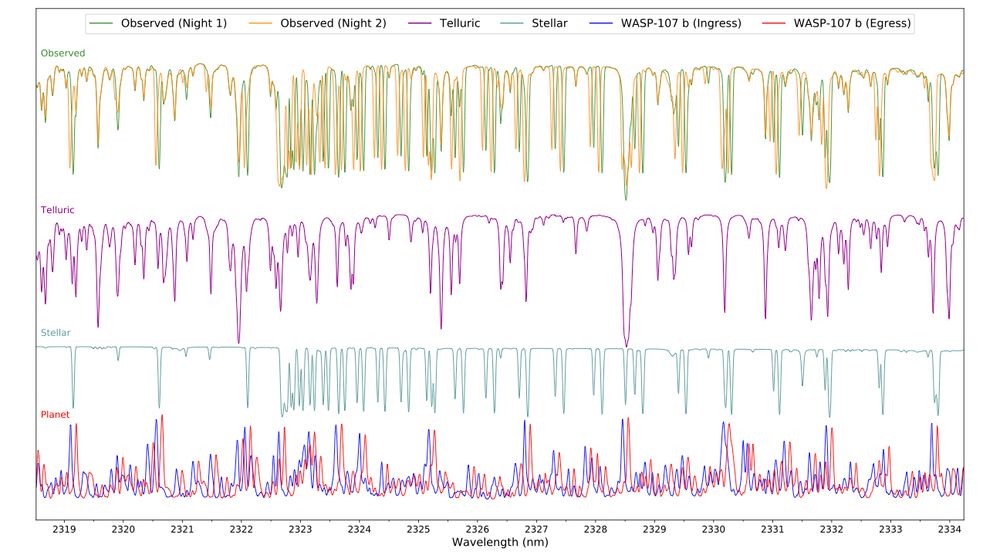
We use these known Doppler shifts to construct models of each component (star, telluric, planet) and use those to reconstruct our observations (some N spectra taken over a transit). These models are constructed from the data and RV shifts alone (i.e. no physical star/planet atmosphere models).
September 17, 2025 at 3:05 PM
We use these known Doppler shifts to construct models of each component (star, telluric, planet) and use those to reconstruct our observations (some N spectra taken over a transit). These models are constructed from the data and RV shifts alone (i.e. no physical star/planet atmosphere models).
Which is where our new inverse method comes in. What if instead of *detrending* the data, we tried *disentangling* it instead?
To do so, we take advantage of the 3x distinct and resolved Doppler shifts/frames I mentioned earlier—something only possible from the ground.
To do so, we take advantage of the 3x distinct and resolved Doppler shifts/frames I mentioned earlier—something only possible from the ground.
September 17, 2025 at 3:05 PM
Which is where our new inverse method comes in. What if instead of *detrending* the data, we tried *disentangling* it instead?
To do so, we take advantage of the 3x distinct and resolved Doppler shifts/frames I mentioned earlier—something only possible from the ground.
To do so, we take advantage of the 3x distinct and resolved Doppler shifts/frames I mentioned earlier—something only possible from the ground.
This isn't 100% true though, and such 'detrending' methods can and do destroy planet signal along with the stellar and telluric features—especially for less-massive planets on longer period orbits. They also don't 'converge' in a mathematical sense, which is one of the downsides of their simplicity.
September 17, 2025 at 3:05 PM
This isn't 100% true though, and such 'detrending' methods can and do destroy planet signal along with the stellar and telluric features—especially for less-massive planets on longer period orbits. They also don't 'converge' in a mathematical sense, which is one of the downsides of their simplicity.
Typically the field approaches the problem with a PCA-like method, where we make the (broadly correct) assumption that, exposure-to-exposure, stellar and telluric features don't change in wavelength, but the planet does, so iteratively removing per-wavelength trends in time 'cleans' the data.
September 17, 2025 at 3:05 PM
Typically the field approaches the problem with a PCA-like method, where we make the (broadly correct) assumption that, exposure-to-exposure, stellar and telluric features don't change in wavelength, but the planet does, so iteratively removing per-wavelength trends in time 'cleans' the data.
To step back, what do we observe? A spectrum has 3 parts: star, telluric (Earth's atmosphere), and planet. The first two dominate the signal, and all three have different Doppler shifts.
Space-based observations don't have tellurics ✅, but aren't high-res enough to resolve these Doppler shifts ❌.
Space-based observations don't have tellurics ✅, but aren't high-res enough to resolve these Doppler shifts ❌.
September 17, 2025 at 3:05 PM
To step back, what do we observe? A spectrum has 3 parts: star, telluric (Earth's atmosphere), and planet. The first two dominate the signal, and all three have different Doppler shifts.
Space-based observations don't have tellurics ✅, but aren't high-res enough to resolve these Doppler shifts ❌.
Space-based observations don't have tellurics ✅, but aren't high-res enough to resolve these Doppler shifts ❌.
TLDR:
1) Lots of chemical info to exploit in the optical—of interest for 🪐 host chemistry.
2) Beware of naively trusting M/K dwarf physical model spectra—they aren't (currently) a good match to reality & this affects recovered stellar properties.
3) I've helpfully quantified some of this mismatch!
1) Lots of chemical info to exploit in the optical—of interest for 🪐 host chemistry.
2) Beware of naively trusting M/K dwarf physical model spectra—they aren't (currently) a good match to reality & this affects recovered stellar properties.
3) I've helpfully quantified some of this mismatch!
February 23, 2024 at 4:02 PM
TLDR:
1) Lots of chemical info to exploit in the optical—of interest for 🪐 host chemistry.
2) Beware of naively trusting M/K dwarf physical model spectra—they aren't (currently) a good match to reality & this affects recovered stellar properties.
3) I've helpfully quantified some of this mismatch!
1) Lots of chemical info to exploit in the optical—of interest for 🪐 host chemistry.
2) Beware of naively trusting M/K dwarf physical model spectra—they aren't (currently) a good match to reality & this affects recovered stellar properties.
3) I've helpfully quantified some of this mismatch!