


Ruifeng Hu
@ruifenghu.bsky.social
I am not a guy in the field of cell death, but I like those figures.

The landscape of regulated cell death: It’s all downhill from here

The landscape of regulated cell death: It’s all downhill from here
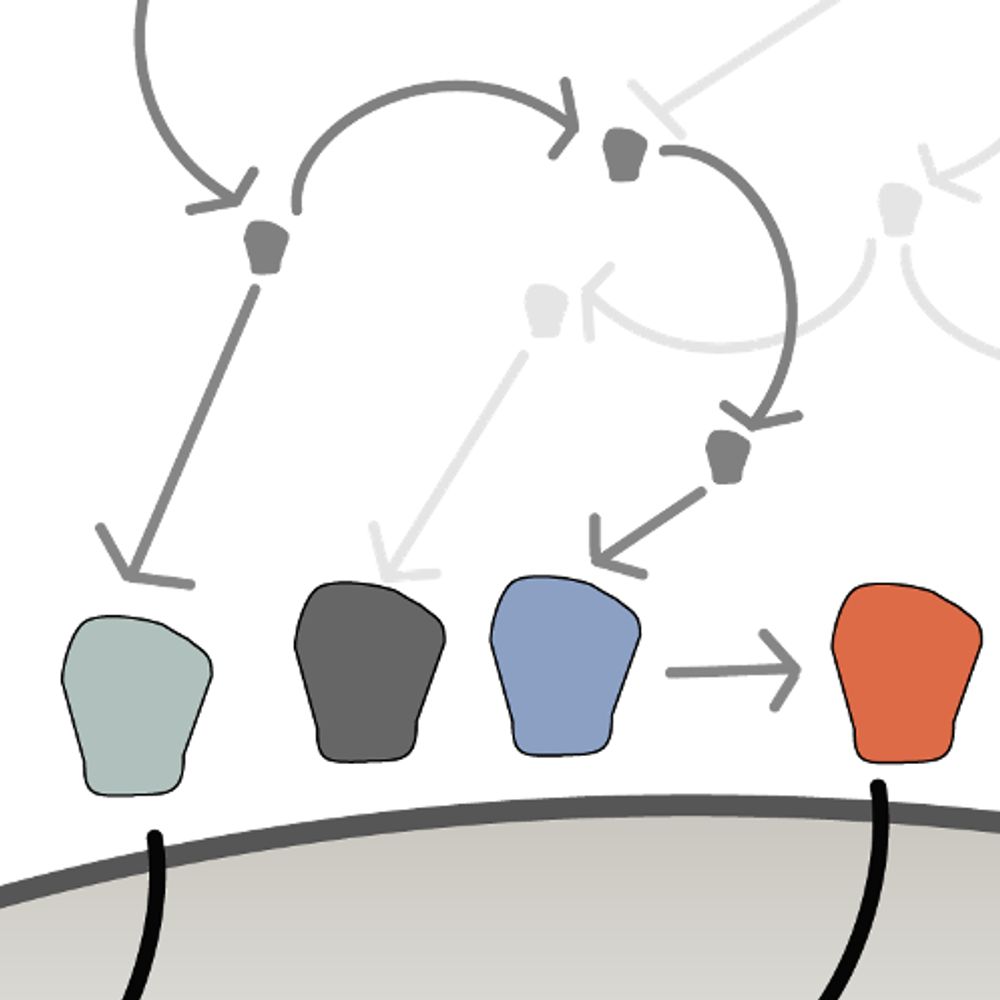
The regulated cell death pathways apoptosis, pyroptosis, and necroptosis are connected on multiple levels. To provide a novel and intuitive conceptual framework of the collaborative and complex nature of this interplay, we visualize cell death commitment as a landscape model, on which a cell can “roll” downhill from life toward death.
dlvr.it
February 5, 2026 at 10:52 PM
I am not a guy in the field of cell death, but I like those figures.
Reposted by Ruifeng Hu

🧬Appearing today @science.org a Review - From sequence to function: Bridging single-molecule kinetics and molecular diversity | Science 🔬https://www.science.org/doi/10.1126/science.adv4503

From sequence to function: Bridging single-molecule kinetics and molecular diversity
Biological function is fundamentally determined by nucleic acid and protein sequence. Beyond encoding genetic information, nucleic acids also display complex physicochemical parameters that shape stru...
www.science.org
January 29, 2026 at 7:44 PM
🧬Appearing today @science.org a Review - From sequence to function: Bridging single-molecule kinetics and molecular diversity | Science 🔬https://www.science.org/doi/10.1126/science.adv4503
Reposted by Ruifeng Hu

New lab paper!! We develop a technology for real-time, single-molecule visualization of proteasomal substrate degradation in cells. We find that the site of substrate engagement by the proteasome determines decay kinetics, efficiency and co-factor requirement.
www.biorxiv.org/content/10.6...
www.biorxiv.org/content/10.6...
In vivo kinetics of protein degradation by individual proteasomes
Protein degradation by the proteasome is central to cellular homeostasis and has been studied extensively using biochemical and structural studies. Despite an in-depth understanding of core proteolytic activity, it has remained largely unresolved how individual proteasomes process substrates inside living cells where many substrate types and co-factors exist. Here, we establish a live-cell single-molecule imaging approach that enables direct visualization and quantification of protein degradation by individual proteasomes. Using this approach, we find that substrate identity, folding and protein-protein interaction have a surprisingly modest impact on processing efficiency, whereas the mode of substrate engagement greatly impacts substrate processing; degradation initiated from protein termini typically proceeds rapidly and with high processivity, whereas internal engagement constitutes a distinct processing mode that exhibits poor processivity and a specific requirement for the AAA+ family ATPase p97/VCP. Furthermore, degradation initiated from opposite termini proceeds with asymmetric rates in a sequence-dependent manner, demonstrating that directionality is an important feature of proteasomal processing in vivo. Notably, poly-glutamine substrates associated with neurodegenerative disease are efficiently degraded from one terminus but resist degradation when engaged from the opposite terminus, highlighting the importance of substrate engagement mode. Together, our results show that different modes of substrate engagement lead to different proteasomal processing outcomes in vivo and revise the prevailing view of the proteasome as a uniform degradation machine. ### Competing Interest Statement The authors have declared no competing interest.
www.biorxiv.org
January 20, 2026 at 8:32 AM
New lab paper!! We develop a technology for real-time, single-molecule visualization of proteasomal substrate degradation in cells. We find that the site of substrate engagement by the proteasome determines decay kinetics, efficiency and co-factor requirement.
www.biorxiv.org/content/10.6...
www.biorxiv.org/content/10.6...
Reposted by Ruifeng Hu
Our paper on Stopless-ORF Circular RNAs (socRNAs) is now out in Cell. By high-res tracking and comparing translation by either single or multiple ribosomes, we find that ribosomes cooperate to overcome pausing to ensure fast and efficient translation
www.cell.com/cell/fulltex...
www.cell.com/cell/fulltex...
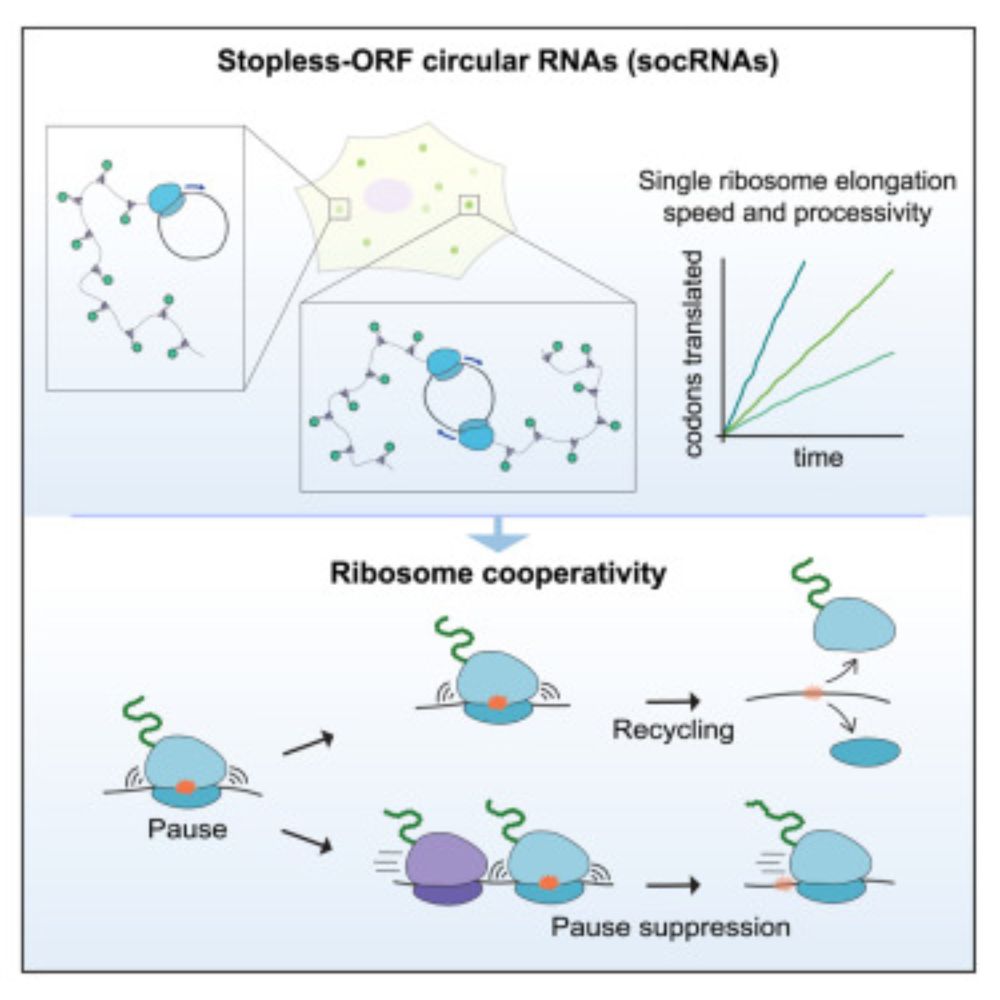
Long-term imaging of individual ribosomes reveals ribosome cooperativity in mRNA translation
Ribosomes cooperate through transient collisions to ensure efficient translation.
www.cell.com
February 3, 2025 at 7:38 AM
Our paper on Stopless-ORF Circular RNAs (socRNAs) is now out in Cell. By high-res tracking and comparing translation by either single or multiple ribosomes, we find that ribosomes cooperate to overcome pausing to ensure fast and efficient translation
www.cell.com/cell/fulltex...
www.cell.com/cell/fulltex...
Reposted by Ruifeng Hu
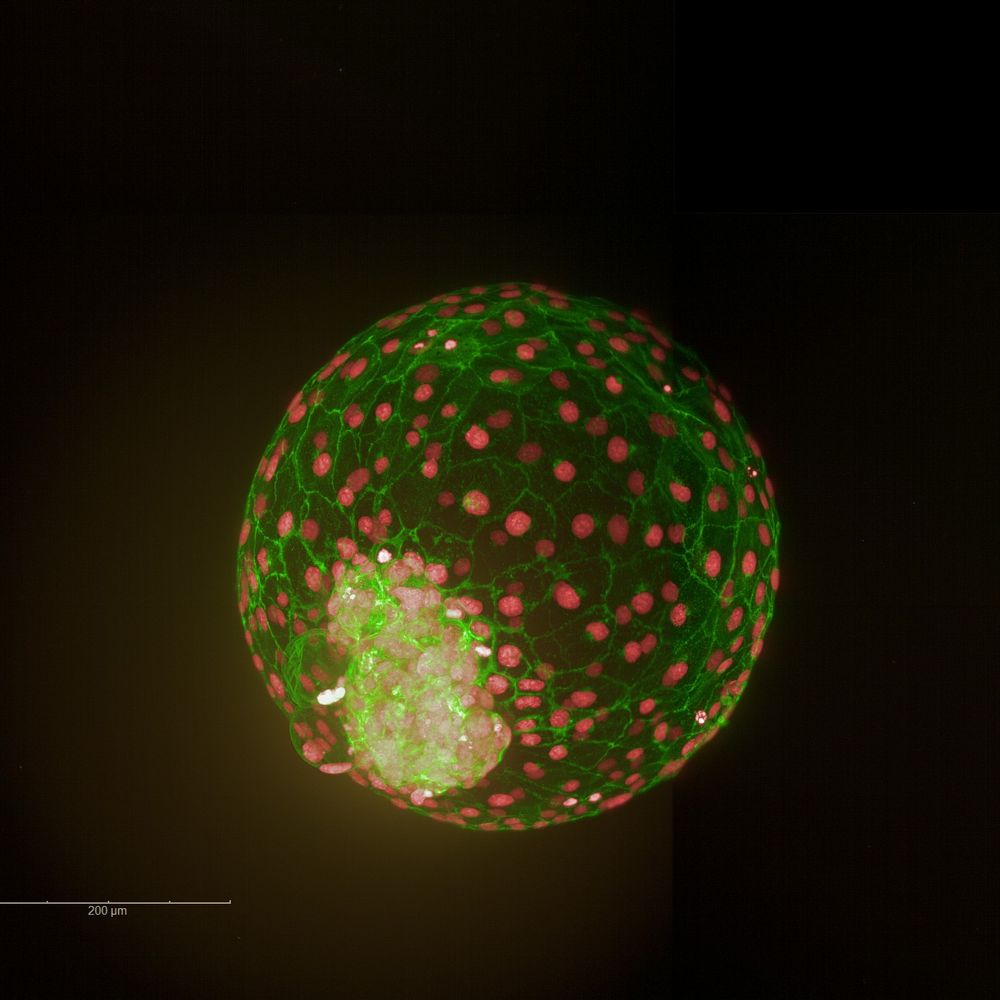
New paper: Remodeling of XIST regulatory landscape during primate evolution
We are glad to share with you our latest publication investigating the evolution of XIST regulation in primates ES cells.
urlr.me/eyG38M
@manucazottes.bsky.social @crougeulle.bsky.social @charbel-alfeghaly.bsky.social
We are glad to share with you our latest publication investigating the evolution of XIST regulation in primates ES cells.
urlr.me/eyG38M
@manucazottes.bsky.social @crougeulle.bsky.social @charbel-alfeghaly.bsky.social

January 19, 2026 at 8:42 AM
New paper: Remodeling of XIST regulatory landscape during primate evolution
We are glad to share with you our latest publication investigating the evolution of XIST regulation in primates ES cells.
urlr.me/eyG38M
@manucazottes.bsky.social @crougeulle.bsky.social @charbel-alfeghaly.bsky.social
We are glad to share with you our latest publication investigating the evolution of XIST regulation in primates ES cells.
urlr.me/eyG38M
@manucazottes.bsky.social @crougeulle.bsky.social @charbel-alfeghaly.bsky.social
Reposted by Ruifeng Hu

Nature research paper: A nowhere-to-hide mechanism ensures complete piRNA-directed DNA methylation
go.nature.com/49XAeGN
go.nature.com/49XAeGN

A nowhere-to-hide mechanism ensures complete piRNA-directed DNA methylation - Nature
In mice, a SPOCD1–TPR-dependent ‘nowhere-to-hide’ mechanism is required for complete non-stochastic piRNA-directed LINE1 DNA methylation by preventing transposons from escaping surveillance within heterochromatin.
go.nature.com
January 19, 2026 at 9:25 AM
Nature research paper: A nowhere-to-hide mechanism ensures complete piRNA-directed DNA methylation
go.nature.com/49XAeGN
go.nature.com/49XAeGN
Reposted by Ruifeng Hu
Nature research paper: Stress controls heterochromatin inheritance via histone H3 ubiquitylation
go.nature.com/4qNyxS8
go.nature.com/4qNyxS8

Stress controls heterochromatin inheritance via histone H3 ubiquitylation - Nature
A histone ubiquitin-dependent regulatory hub governs stimulus-dependent heterochromatin propagation, with important implications for understanding mechanisms governing rapid changes in the epigenetic landscape in physiology and disease.
go.nature.com
January 11, 2026 at 3:23 PM
Nature research paper: Stress controls heterochromatin inheritance via histone H3 ubiquitylation
go.nature.com/4qNyxS8
go.nature.com/4qNyxS8
Reposted by Ruifeng Hu

Very happy to share our paper rdcu.be/eUImj out today in @natcellbio.nature.com 🎉🎉🎉
We uncover an unexpected role for endogenous Xist RNA in regulating X-linked genes that escape X-inactivation.
We uncover an unexpected role for endogenous Xist RNA in regulating X-linked genes that escape X-inactivation.

Escape from X inactivation is directly modulated by Xist noncoding RNA
Nature Cell Biology - The authors show that increased Xist RNA levels can induce de novo silencing of genes that normally escape X inactivation. SPEN depletion prevents the silencing of escape...
rdcu.be
December 15, 2025 at 4:22 PM
Very happy to share our paper rdcu.be/eUImj out today in @natcellbio.nature.com 🎉🎉🎉
We uncover an unexpected role for endogenous Xist RNA in regulating X-linked genes that escape X-inactivation.
We uncover an unexpected role for endogenous Xist RNA in regulating X-linked genes that escape X-inactivation.
Reposted by Ruifeng Hu

A major output of the 4D Nucleome project appeared today. This is the joint effort of many scientists working together and (publicly) sharing data and results for several years. We hope this is of interest to many genome biologists!
www.nature.com/articles/s41...
www.nature.com/articles/s41...

An integrated view of the structure and function of the human 4D nucleome - Nature
The 4D Nucleome Project demonstrates the use of genomic assays and computational methods to measure genome folding and then predict genomic structure from DNA sequence, facilitatin...
www.nature.com
December 17, 2025 at 8:59 PM
A major output of the 4D Nucleome project appeared today. This is the joint effort of many scientists working together and (publicly) sharing data and results for several years. We hope this is of interest to many genome biologists!
www.nature.com/articles/s41...
www.nature.com/articles/s41...
Reposted by Ruifeng Hu
@science.org🧬Cohesin guides homology search during DNA repair using loops and sister chromatid linkages | Science www.science.org/doi/10.1126/... @fedeteloni.bsky.social @danielgerlich.bsky.social et al.

Cohesin guides homology search during DNA repair using loops and sister chromatid linkages
Accurate repair of DNA double-strand breaks (DSBs) is essential for genome stability, and defective repair underlies diseases such as cancer. Homologous recombination uses an intact homologous sequenc...
www.science.org
December 5, 2025 at 8:50 PM
@science.org🧬Cohesin guides homology search during DNA repair using loops and sister chromatid linkages | Science www.science.org/doi/10.1126/... @fedeteloni.bsky.social @danielgerlich.bsky.social et al.
Reposted by Ruifeng Hu

Our Science paper is out!
Huge congratulations to @huabin-zhou.bsky.social, Mike Rosen, and the brilliant @janhuemar.bsky.social @juliamaristany.bsky.social and @kieran-russell.bsky.social from our group
News: bit.ly/4avnkAr and bit.ly/3XBGVHS
Great perspective by @vram142.bsky.social +K Zhang
Huge congratulations to @huabin-zhou.bsky.social, Mike Rosen, and the brilliant @janhuemar.bsky.social @juliamaristany.bsky.social and @kieran-russell.bsky.social from our group
News: bit.ly/4avnkAr and bit.ly/3XBGVHS
Great perspective by @vram142.bsky.social +K Zhang
December 5, 2025 at 9:47 AM
Our Science paper is out!
Huge congratulations to @huabin-zhou.bsky.social, Mike Rosen, and the brilliant @janhuemar.bsky.social @juliamaristany.bsky.social and @kieran-russell.bsky.social from our group
News: bit.ly/4avnkAr and bit.ly/3XBGVHS
Great perspective by @vram142.bsky.social +K Zhang
Huge congratulations to @huabin-zhou.bsky.social, Mike Rosen, and the brilliant @janhuemar.bsky.social @juliamaristany.bsky.social and @kieran-russell.bsky.social from our group
News: bit.ly/4avnkAr and bit.ly/3XBGVHS
Great perspective by @vram142.bsky.social +K Zhang
Reposted by Ruifeng Hu
Thanks @pasquelab.bsky.social and his team for this collaboration.

𝐍𝐞𝐰 𝐩𝐫𝐞𝐩𝐫𝐢𝐧𝐭 𝐚𝐥𝐞𝐫𝐭! 🎉
“𝐗𝐈𝐒𝐓 𝐃𝐫𝐢𝐯𝐞𝐬 𝐗-𝐂𝐡𝐫𝐨𝐦𝐨𝐬𝐨𝐦𝐞 𝐈𝐧𝐚𝐜𝐭𝐢𝐯𝐚𝐭𝐢𝐨𝐧 𝐚𝐧𝐝 𝐒𝐚𝐟𝐞𝐠𝐮𝐚𝐫𝐝𝐬 𝐅𝐞𝐦𝐚𝐥𝐞 𝐄𝐱𝐭𝐫𝐚𝐞𝐦𝐛𝐫𝐲𝐨𝐧𝐢𝐜 𝐂𝐞𝐥𝐥𝐬 𝐢𝐧 𝐇𝐮𝐦𝐚𝐧𝐬” 𝐢𝐬 𝐧𝐨𝐰 𝐨𝐧 𝐛𝐢𝐨𝐑𝐱𝐢𝐯!
www.biorxiv.org/content/10.1...
“𝐗𝐈𝐒𝐓 𝐃𝐫𝐢𝐯𝐞𝐬 𝐗-𝐂𝐡𝐫𝐨𝐦𝐨𝐬𝐨𝐦𝐞 𝐈𝐧𝐚𝐜𝐭𝐢𝐯𝐚𝐭𝐢𝐨𝐧 𝐚𝐧𝐝 𝐒𝐚𝐟𝐞𝐠𝐮𝐚𝐫𝐝𝐬 𝐅𝐞𝐦𝐚𝐥𝐞 𝐄𝐱𝐭𝐫𝐚𝐞𝐦𝐛𝐫𝐲𝐨𝐧𝐢𝐜 𝐂𝐞𝐥𝐥𝐬 𝐢𝐧 𝐇𝐮𝐦𝐚𝐧𝐬” 𝐢𝐬 𝐧𝐨𝐰 𝐨𝐧 𝐛𝐢𝐨𝐑𝐱𝐢𝐯!
www.biorxiv.org/content/10.1...

XIST Drives X-Chromosome Inactivation and Safeguards Female Extraembryonic Cells in Humans
Dosage compensation of sex chromosomes through X-chromosome inactivation (XCI) is required for mice extra-embryonic tissue growth and embryo development. The species specificity in mechanisms and timi...
www.biorxiv.org
November 26, 2025 at 10:29 AM
Thanks @pasquelab.bsky.social and his team for this collaboration.
Reposted by Ruifeng Hu

A new and fascinating story from @bencarty.bsky.social and the group, with crucial help from the teams of @naltemose.bsky.social, Simona Giunta, and @dfachinetti.bsky.social. Many thanks to all for a fantastic collaboration.
www.nature.com/articles/s41...
www.nature.com/articles/s41...

November 25, 2025 at 12:16 PM
A new and fascinating story from @bencarty.bsky.social and the group, with crucial help from the teams of @naltemose.bsky.social, Simona Giunta, and @dfachinetti.bsky.social. Many thanks to all for a fantastic collaboration.
www.nature.com/articles/s41...
www.nature.com/articles/s41...
Reposted by Ruifeng Hu
Last week @science.org mRNA initiation and termination are spatially coordinated | Science www.science.org/doi/10.1126/... from @anafiszbein.bsky.social @athmapai.bsky.social et al.

October 13, 2025 at 2:03 AM
Last week @science.org mRNA initiation and termination are spatially coordinated | Science www.science.org/doi/10.1126/... from @anafiszbein.bsky.social @athmapai.bsky.social et al.
Reposted by Ruifeng Hu
@science.org ATP-dependent remodeling of #chromatin #condensates reveals distinct #mesoscale outcomes | Science www.science.org/doi/10.1126/...

October 13, 2025 at 1:50 AM
@science.org ATP-dependent remodeling of #chromatin #condensates reveals distinct #mesoscale outcomes | Science www.science.org/doi/10.1126/...
Reposted by Ruifeng Hu

⚠️ Paper alert: Using a novel CRISPR screening approach, we mapped the entire regulatory network controlling Xist—key for X-chromosome inactivation.
👉 We discover how sex and development signals are decoded at a single gene locus.
www.nature.com/articles/s41...
👇 Bluetorial
👉 We discover how sex and development signals are decoded at a single gene locus.
www.nature.com/articles/s41...
👇 Bluetorial

Reporter CRISPR screens decipher cis-regulatory and trans-regulatory principles at the Xist locus - Nature Structural & Molecular Biology
Here Schwämmle et al. develop CRISPR reporter screens to map transcription-factor-regulatory element interactions at the Xist locus, revealing a two-step mechanism integrating developmental and X-dosage signals to initiate X-chromosome inactivation.
www.nature.com
October 6, 2025 at 1:02 PM
⚠️ Paper alert: Using a novel CRISPR screening approach, we mapped the entire regulatory network controlling Xist—key for X-chromosome inactivation.
👉 We discover how sex and development signals are decoded at a single gene locus.
www.nature.com/articles/s41...
👇 Bluetorial
👉 We discover how sex and development signals are decoded at a single gene locus.
www.nature.com/articles/s41...
👇 Bluetorial
Reposted by Ruifeng Hu

💫NEW: @sarawickstrom.bsky.social @katemiro.bsky.social & co show that mechano-osmotic changes in the #nucleus induce general #transcriptional repression and prime #chromatin for cell fate transitions by relieving repression of specific differentiation genes. #pluripotency
bit.ly/3VMcyNZ
bit.ly/3VMcyNZ

Mechano-osmotic signals control chromatin state and fate transitions in pluripotent stem cells - Nature Cell Biology
McCreery, Stubb et al. show that mechano-osmotic changes in the nucleus induce general transcriptional repression and prime chromatin for cell fate transitions by relieving repression of specific differentiation genes.
bit.ly
October 4, 2025 at 2:40 PM
💫NEW: @sarawickstrom.bsky.social @katemiro.bsky.social & co show that mechano-osmotic changes in the #nucleus induce general #transcriptional repression and prime #chromatin for cell fate transitions by relieving repression of specific differentiation genes. #pluripotency
bit.ly/3VMcyNZ
bit.ly/3VMcyNZ
Reposted by Ruifeng Hu
Taking a snippet of genetic code that is unique to humans and inserting it into mice helps them grow bigger brains than usual
https://go.nature.com/3GOTQkz
https://go.nature.com/3GOTQkz

Mice grow bigger brains when given this stretch of human DNA
Finding adds to the bigger picture of how humans developed such large brains.
go.nature.com
May 14, 2025 at 3:41 PM
Taking a snippet of genetic code that is unique to humans and inserting it into mice helps them grow bigger brains than usual
https://go.nature.com/3GOTQkz
https://go.nature.com/3GOTQkz
Reposted by Ruifeng Hu
Nature research paper: A human-specific enhancer fine-tunes radial glia potency and corticogenesis
https://go.nature.com/4kfH6BC
https://go.nature.com/4kfH6BC

A human-specific enhancer fine-tunes radial glia potency and corticogenesis - Nature
HARE5, a human accelerated region enhancer, modulates cortical development by influencing neural progenitor cell behaviour, leading to an enlarged neocortex with increased functional independence between cortical regions through amplified WNT signalling.
go.nature.com
May 19, 2025 at 11:13 AM
Nature research paper: A human-specific enhancer fine-tunes radial glia potency and corticogenesis
https://go.nature.com/4kfH6BC
https://go.nature.com/4kfH6BC
Reposted by Ruifeng Hu

Collective challenges need collective solutions. Happy to share the insights we've gained from the way our cells handle this: www.nature.com/articles/s41... and its summary www.crick.ac.uk/news/2025-09....
LinkedIn
This link will take you to a page that’s not on LinkedIn
lnkd.in
September 24, 2025 at 4:25 PM
Collective challenges need collective solutions. Happy to share the insights we've gained from the way our cells handle this: www.nature.com/articles/s41... and its summary www.crick.ac.uk/news/2025-09....
Reposted by Ruifeng Hu
💫NEW: Djeghloul, Cheriyamkunnel et al. apply chromosome sorting to isolate active and inactive X chromosomes and report a role for Hbo1 and Msl histone acetyltransferase complexes in preserving active X #chromosomes in female cells during #mitosis.
bit.ly/4pIA0ta
bit.ly/4pIA0ta
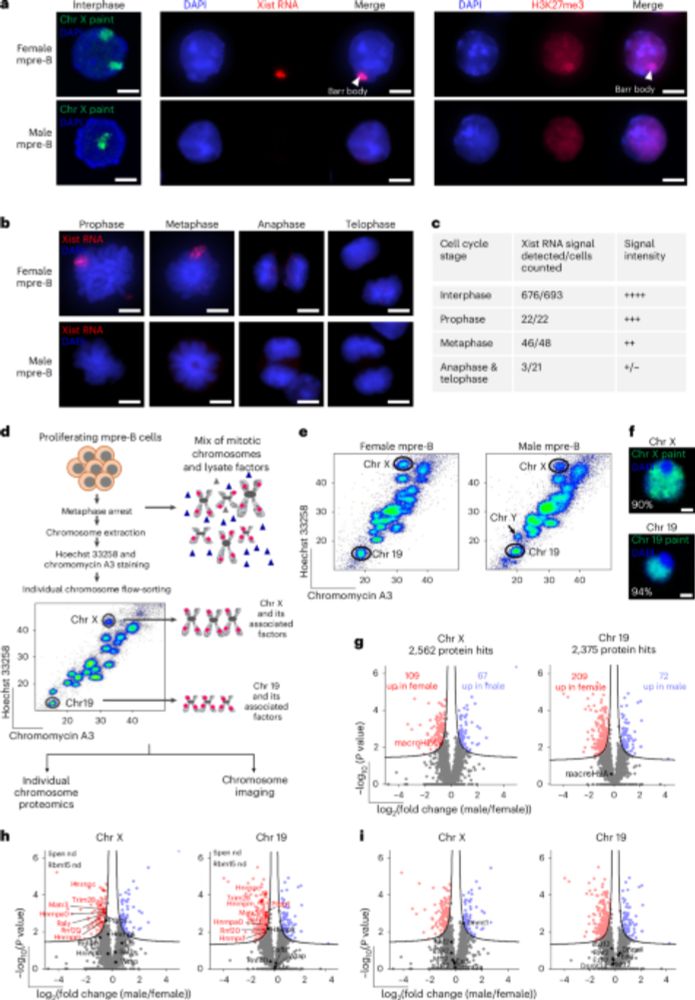
Hbo1 and Msl complexes preserve differential compaction and H3K27me3 marking of active and inactive X chromosomes during mitosis - Nature Cell Biology
Djeghloul, Cheriyamkunnel et al. apply chromosome sorting to isolate active and inactive X chromosomes and report a role for Hbo1 and Msl histone acetyltransferase complexes in preserving active X chromosomes in female cells during mitosis.
bit.ly
September 24, 2025 at 6:34 AM
💫NEW: Djeghloul, Cheriyamkunnel et al. apply chromosome sorting to isolate active and inactive X chromosomes and report a role for Hbo1 and Msl histone acetyltransferase complexes in preserving active X #chromosomes in female cells during #mitosis.
bit.ly/4pIA0ta
bit.ly/4pIA0ta
Reposted by Ruifeng Hu
Nature research paper: CRISPR activation for SCN2A-related neurodevelopmental disorders
go.nature.com/3VmV1vp
go.nature.com/3VmV1vp

CRISPR activation for SCN2A-related neurodevelopmental disorders - Nature
Using SCN2A haploinsufficiency as a proof-of-concept, upregulation of the existing functional gene copy through CRISPR activation was able to rescue neurological-associated phenotypes in Scn2a haploinsufficient mice and human neurons.
go.nature.com
September 24, 2025 at 7:34 AM
Nature research paper: CRISPR activation for SCN2A-related neurodevelopmental disorders
go.nature.com/3VmV1vp
go.nature.com/3VmV1vp
Reposted by Ruifeng Hu
Our reporter hopping scaled up to thousands of integrations in a single locus, to produce high-resolution functional maps, with plenty of interesting insights: www.science.org/doi/10.1126/...

Functional maps of a genomic locus reveal confinement of an enhancer by its target gene
Genes are often activated by enhancers located at large genomic distances, and the importance of this positioning is poorly understood. By relocating promoter-reporter constructs into thousands of alt...
www.science.org
September 24, 2025 at 8:56 AM
Our reporter hopping scaled up to thousands of integrations in a single locus, to produce high-resolution functional maps, with plenty of interesting insights: www.science.org/doi/10.1126/...
Reposted by Ruifeng Hu
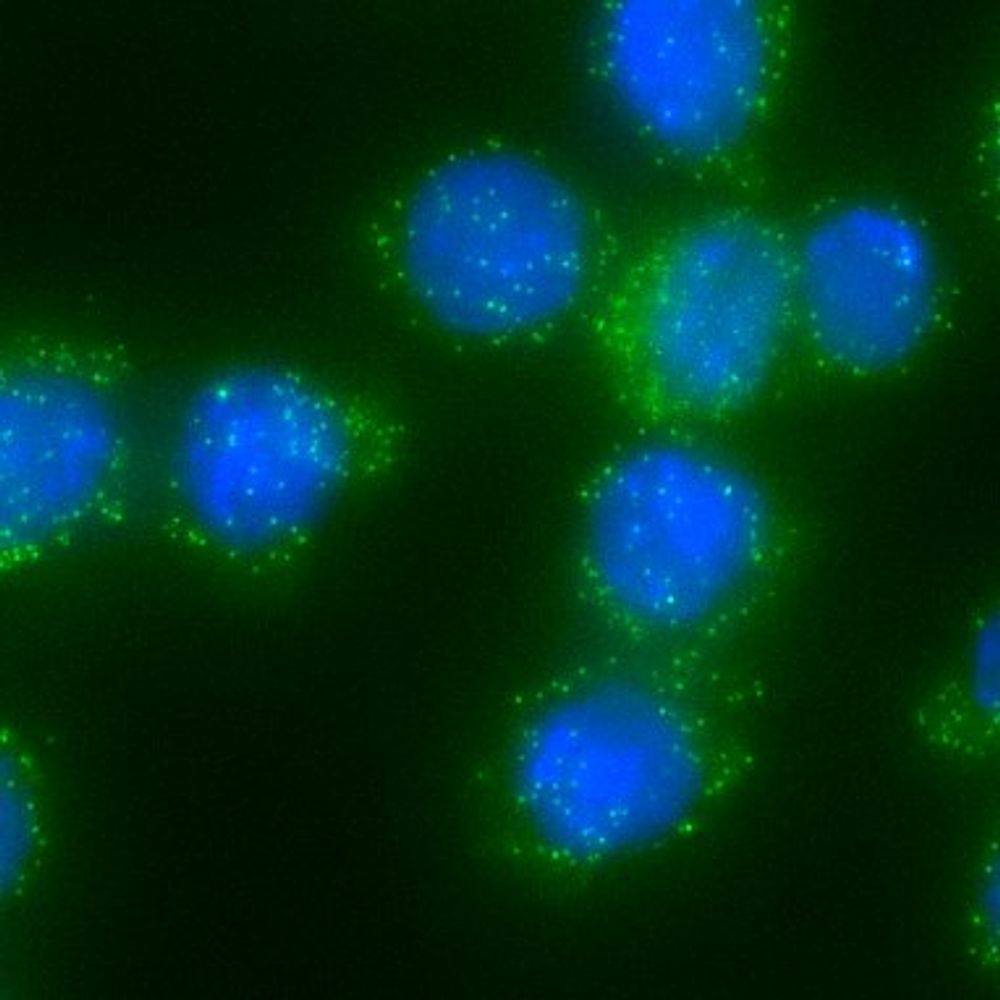
Really excited to share our latest work led by @mattiaubertini.bsky.social and @nesslfy.bsky.social: we report that cohesin loop extrusion creates rare but long-lived encounters between genomic sequences which underlie efficient enhancer-promoter communication.
www.biorxiv.org/content/10.1...
A🧵👇
www.biorxiv.org/content/10.1...
A🧵👇
September 24, 2025 at 9:45 PM
Really excited to share our latest work led by @mattiaubertini.bsky.social and @nesslfy.bsky.social: we report that cohesin loop extrusion creates rare but long-lived encounters between genomic sequences which underlie efficient enhancer-promoter communication.
www.biorxiv.org/content/10.1...
A🧵👇
www.biorxiv.org/content/10.1...
A🧵👇
Reposted by Ruifeng Hu
@science.org🧬🔬Kinetic organization of the #genome revealed by ultraresolution multiscale live #imaging | Science www.science.org/doi/10.1126/...

Kinetic organization of the genome revealed by ultraresolution multiscale live imaging
Genome function requires regulated genome motion. However, tools to directly observe this motion in vivo have been limited in coverage and resolution. Here we introduce an approach to tile mammalian c...
www.science.org
September 22, 2025 at 7:43 PM
@science.org🧬🔬Kinetic organization of the #genome revealed by ultraresolution multiscale live #imaging | Science www.science.org/doi/10.1126/...