



Ricard Alert Zenón
@ricardalert.bsky.social
ICREA Research Professor at Universitat de Barcelona. Research Group Leader at MPI-PKS and CSBD in Dresden. Theory of living matter. Collective phenomena in biology through the lens of active matter physics.
We’re excited to have explained a striking collective behavior in biology (rippling) as an active-matter phenomenon (surface waves on an active liquid crystal)!

December 2, 2025 at 8:02 PM
We’re excited to have explained a striking collective behavior in biology (rippling) as an active-matter phenomenon (surface waves on an active liquid crystal)!
Second, we varied the substrate polymer concentration and composition, which affects its affinity for water. The more polymer concentration (which also means a stiffer substrate), the higher the cost to extract water. And the wavelength again varies as expected.

December 2, 2025 at 8:02 PM
Second, we varied the substrate polymer concentration and composition, which affects its affinity for water. The more polymer concentration (which also means a stiffer substrate), the higher the cost to extract water. And the wavelength again varies as expected.
We tested these predictions in experiments in two ways: First, adding a surfactant to vary surface tension. As predicted, the wavelength increased with surface tension.

December 2, 2025 at 8:02 PM
We tested these predictions in experiments in two ways: First, adding a surfactant to vary surface tension. As predicted, the wavelength increased with surface tension.
Here, water provides restoring forces that compete with active stresses to produce to waves. We predict that the wavelength is controlled by the capillary length of the bacterial film’s interface, which depends on the surface tension of water and the energy cost of extracting it from the substrate.

December 2, 2025 at 8:02 PM
Here, water provides restoring forces that compete with active stresses to produce to waves. We predict that the wavelength is controlled by the capillary length of the bacterial film’s interface, which depends on the surface tension of water and the energy cost of extracting it from the substrate.
In recent work, we found that bacteria are covered by a meniscus of water, which is extracted from the underlying hydrogel substrate (agar gel).
www.nature.com/articles/s41...
www.nature.com/articles/s41...

Capillary interactions drive the self-organization of bacterial colonies - Nature Physics
Bacteria tend to live in thin layers of water on surfaces. Now the capillary forces in these layers are shown to help organize the bacteria into dense packs.
www.nature.com
December 2, 2025 at 8:02 PM
In recent work, we found that bacteria are covered by a meniscus of water, which is extracted from the underlying hydrogel substrate (agar gel).
www.nature.com/articles/s41...
www.nature.com/articles/s41...
So, we propose a new view of rippling as surface waves on an active nematic, similar to previous findings in microtubule-kinesin mixtures.
www.science.org/doi/10.1126/...
www.science.org/doi/10.1126/...

December 2, 2025 at 8:02 PM
So, we propose a new view of rippling as surface waves on an active nematic, similar to previous findings in microtubule-kinesin mixtures.
www.science.org/doi/10.1126/...
www.science.org/doi/10.1126/...
Previous work proposed that rippling arises from synchronized cell reversals occurring when two wave fronts collide. But we found no evidence for reversals happening preferentially at wave crests.

December 2, 2025 at 8:02 PM
Previous work proposed that rippling arises from synchronized cell reversals occurring when two wave fronts collide. But we found no evidence for reversals happening preferentially at wave crests.
We found that ripples are standing waves with a period of ~20 min, a wavelength of ~100 µm, and an amplitude of 6 to 20 cell widths on top of a thick film of cells (with many cell layers).

December 2, 2025 at 8:02 PM
We found that ripples are standing waves with a period of ~20 min, a wavelength of ~100 µm, and an amplitude of 6 to 20 cell widths on top of a thick film of cells (with many cell layers).
Aaron and Josh measured the height of the bacterial colony with a laser-scanning microscope called a profilometer, which reveals the waves very clearly.
December 2, 2025 at 8:02 PM
Aaron and Josh measured the height of the bacterial colony with a laser-scanning microscope called a profilometer, which reveals the waves very clearly.
Experiments by Aaron Bourque in Josh Shaevitz’s lab @princeton.edu and theory by Peter Hampshire at @mpipks.bsky.social and @csbdresden.bsky.social. Check the full thread below!
December 2, 2025 at 8:02 PM
Experiments by Aaron Bourque in Josh Shaevitz’s lab @princeton.edu and theory by Peter Hampshire at @mpipks.bsky.social and @csbdresden.bsky.social. Check the full thread below!
A thousand thank yous to all my mentors and collaborators, especially to Jaume Casademunt, @xaviertrepat.bsky.social, Ned Wingreen, Jean-François Joanny, and Frank Jülicher for their continued support over the years.
December 2, 2025 at 6:53 PM
A thousand thank yous to all my mentors and collaborators, especially to Jaume Casademunt, @xaviertrepat.bsky.social, Ned Wingreen, Jean-François Joanny, and Frank Jülicher for their continued support over the years.
Amazing story! Congrats!
November 16, 2025 at 7:11 PM
Amazing story! Congrats!
Awesome work! :)
October 17, 2025 at 9:54 AM
Awesome work! :)
Theory and data analysis work done by postdoc MJ Franco-Oñate in my group.
October 2, 2025 at 8:04 AM
Theory and data analysis work done by postdoc MJ Franco-Oñate in my group.
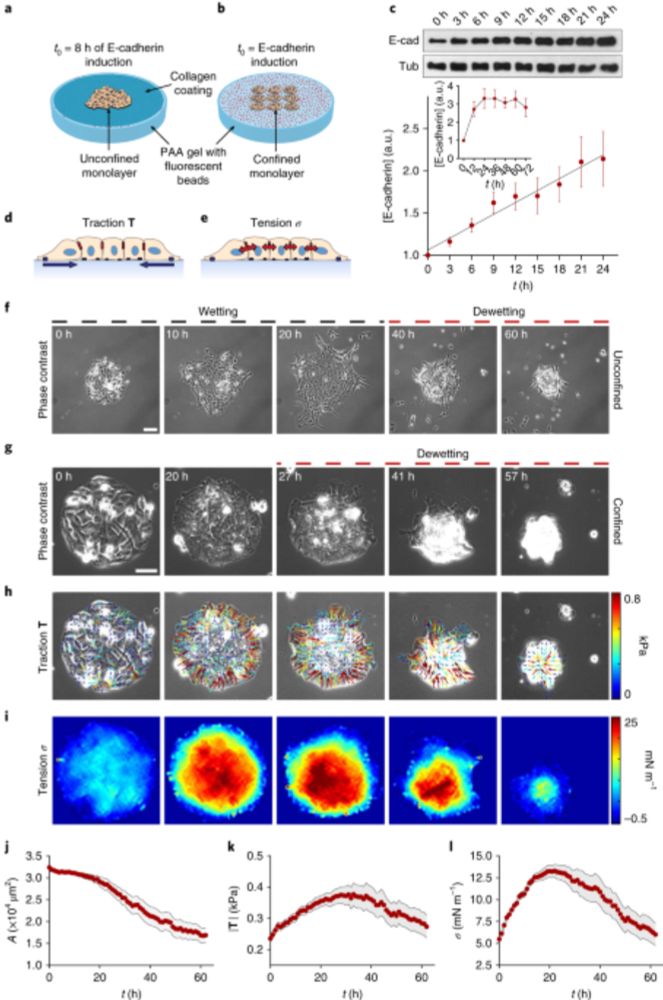
This collaboration led by @katecavanaugh.bsky.social from @oweinerlab.bsky.social was particularly inspiring for me: The ideas of active wetting that we developed some years ago actually helped us understand a key biological process. We could not have hoped for more!
www.nature.com/articles/s41...
www.nature.com/articles/s41...
Active wetting of epithelial tissues - Nature Physics
An analogy with wetting has proven apt for describing how groups of cells spread on a substrate. But cells are active: they polarize, generate forces and adhere to their surroundings. Experiments now find agreement with an active update to the theory.
www.nature.com
October 2, 2025 at 8:04 AM
This collaboration led by @katecavanaugh.bsky.social from @oweinerlab.bsky.social was particularly inspiring for me: The ideas of active wetting that we developed some years ago actually helped us understand a key biological process. We could not have hoped for more!
www.nature.com/articles/s41...
www.nature.com/articles/s41...