



Rodolfo Disi Pavlic
@rdisip.bsky.social
Associate Professor UAI - PhD UT Government - Poli Sci Notre Dame - Adjunct Researcher COES - Personal opinions
Such peace. Very Nobel. Wow explosion www.thetimes.com/world/latin-...

October 10, 2025 at 1:39 PM
Such peace. Very Nobel. Wow explosion www.thetimes.com/world/latin-...

October 10, 2025 at 1:19 PM
Pacific Palisades si trova in California non in Florida, però.

October 9, 2025 at 10:16 AM
Pacific Palisades si trova in California non in Florida, però.
For the children

October 7, 2025 at 1:03 AM
For the children


September 30, 2025 at 1:33 PM
Had to try it myself.

September 5, 2025 at 12:53 PM
Had to try it myself.

September 1, 2025 at 5:08 PM
I hope Anne Applebaum realizes she played a role in the lead-up to this massacre.

August 14, 2025 at 2:30 AM
I hope Anne Applebaum realizes she played a role in the lead-up to this massacre.
Anne Applebaum does seem to have a recurring theme about media ceasing to exist. It’s unclear whether this is always bad for her.
slate.com/news-and-pol...
slate.com/news-and-pol...

August 4, 2025 at 12:47 AM
Anne Applebaum does seem to have a recurring theme about media ceasing to exist. It’s unclear whether this is always bad for her.
slate.com/news-and-pol...
slate.com/news-and-pol...
Más personas ha muerto de hambre en lo últimos 11 días en Gaza que en los 21 meses anteriores. Esto es intencional

August 1, 2025 at 3:45 AM
Más personas ha muerto de hambre en lo últimos 11 días en Gaza que en los 21 meses anteriores. Esto es intencional

![Segal: There isn’t a single Israeli minister that wants to see babies die. You know how I know it? Because Israel has a nuclear weapon. If Israel really wanted to have a genocide, it would’ve done it already. I know it’s a waste of time to speak to a liberal news outlet in the United States about the numbers. You won’t find a single initiative by an Israeli cabinet minister that wants to kill babies on purpose.
Chotiner: You know about Ben-Gvir and the wedding.
Segal: Which one?
Chotiner: Where there was dancing.
Segal: Which one?
Chotiner: Pretending to stab Palestinians.
Segal: It was a disgusting event in which someone stabbed the picture of a baby. And it was disgusting. [In 2015, at a wedding that Ben-Gvir attended, dancing guests held up a photograph of a Palestinian baby who had been burned to death by right-wing Israeli extremists several months earlier, and one guest stabbed the picture with a knife. Ben-Gvir was the lead arsonist’s attorney. He later called the display at the wedding “stupidity.”] And there were indictments because Israel is a law-and-order state. Ben-Gvir didn’t do it. Maybe he participated. I wouldn’t have taken part in an event like this.
Chotiner: That’s good to know.](https://cdn.bsky.app/img/feed_thumbnail/plain/did:plc:qkapauifqf5xinmvdhr52uex/bafkreic6luyczmxd6y6xisazynfs5oxa2inihgd6qnjt2la6y6ra6f27hy@jpeg)

At this point, I can’t imagine what Zionists think they’re achieving by going on the record with Isaac Chotiner.
www.newyorker.com/news/q-and-a...
www.newyorker.com/news/q-and-a...
![Segal: I see. I beg to differ with the New York Times because the New York Times bases its reports on Hamas sources. The New York Times relies heavily on stringers in Gaza that have two options: either report what Hamas wants or die, and I blame the New York Times for this. The head of the legal department of the New York Times told me, How can you blame us for writing what Hamas wants? Our journalists died because in the past they reported things that Hamas didn’t like.
Chotiner: This person told you this on the record?
Segal: They wanted to sue me when I claimed that they relied on stringers who collaborated with Hamas.
Chotiner: So they told you this privately?
Segal: Yeah. You can quote it. [David McCraw, the lead newsroom lawyer at the Times, was identified to me later by Segal as the person who allegedly said this. McCraw told The New Yorker, “I never said any of that. We never threatened to sue him. And our journalists have not been killed by Hamas.” In 2023, McCraw asked Segal to make corrections to some statements he had made on social media, including that the Times employed “ISIS-embedded stringers.”] So even if we take into account the fact that twenty children died of dehydration, which I doubt and which the I.D.F. doubts, there is no way to double-check it. [In the past several days, a number of news organizations have called on Israel to allow international reporters to enter Gaza, something that it has thus far largely restricted them from doing.] What can make hunger in Gaza is the unholy coalition between the U.N. and Hamas. Each and every organization in Gaza has to pay at least fifteen to twenty per cent of the humanitarian aid directly to the pockets of Hamas.](https://cdn.bsky.app/img/feed_thumbnail/plain/did:plc:qkapauifqf5xinmvdhr52uex/bafkreih5ndagjjiuxgkftrxalu4xedkulc5y2hcq66yxp5c2arr5lav6ge@jpeg)
![Segal: Israel is behind this foundation, but the idea is noble and it is to keep humanitarian aid from becoming a weapon for the survival of Hamas. Now, here’s the question to you: Why is the U.N. obsessed with the G.H.F.?
Chotiner: The hundreds of people who have been killed at G.H.F. sites?
Segal: No. This is what Hamas claims and what the New York Times quotes. By the way, the vast majority of people killed in the G.H.F. were killed by Hamas. Hamas tried to kill and shoot people who came to take food from G.H.F. because the purpose is to save Hamas’s regime. [The vast majority of the deaths at or near G.H.F. sites have been attributed to the I.D.F.; Haaretz reported last month that the Army was deliberately firing at Palestinians seeking aid.] By the way, I’m not the only one to understand this. President Biden, in October of 2023, actually forced Israel to provide humanitarian aid, right? And then he said, and I quote, “If Hamas diverts or steals the assistance, they will have demonstrated once again that they have no concern for the welfare of the Palestinian people, and it will end. As a practical matter, it will—it will stop the international community from being able to provide this aid.”](https://cdn.bsky.app/img/feed_thumbnail/plain/did:plc:qkapauifqf5xinmvdhr52uex/bafkreic3ttjamxyjzlo2gul2tzkajugziambpt2yckns3wbotgfpmbtbaa@jpeg)
July 30, 2025 at 3:44 PM
At this point, I can’t imagine what Zionists think they’re achieving by going on the record with Isaac Chotiner.
www.newyorker.com/news/q-and-a...
www.newyorker.com/news/q-and-a...
July 27, 2025 at 2:37 PM
July 27, 2025 at 2:37 PM
July 27, 2025 at 2:34 PM
July 26, 2025 at 1:46 PM
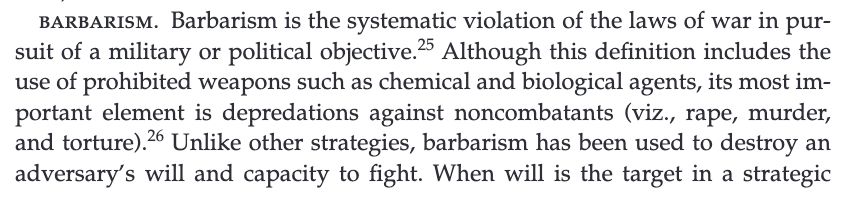
It's barbarism
direct.mit.edu/isec/article...
direct.mit.edu/isec/article...

July 15, 2025 at 2:52 AM
It's barbarism
direct.mit.edu/isec/article...
direct.mit.edu/isec/article...
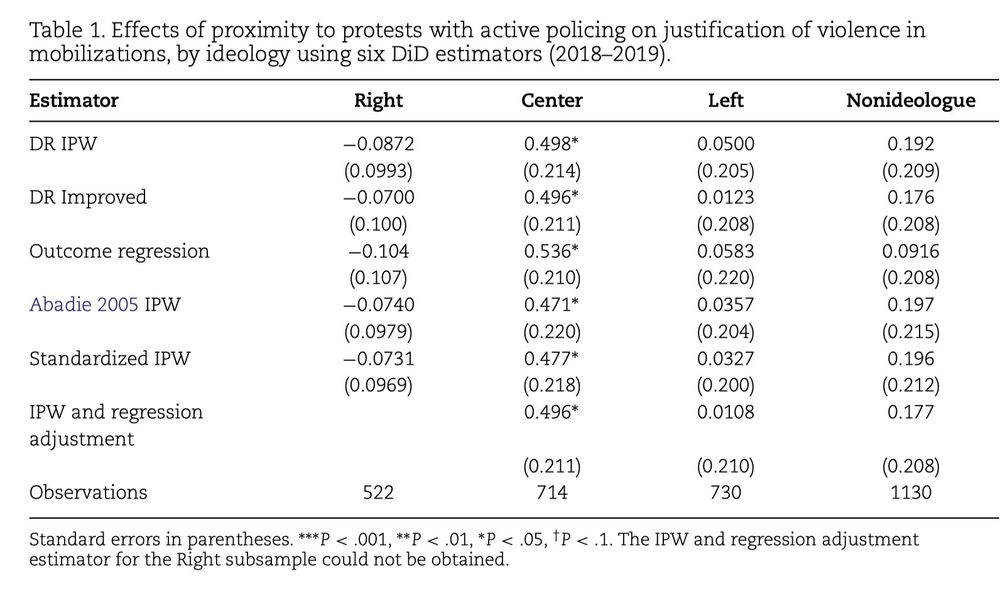
Oops, here I meant to show the results using 2017-2018 data (without large-scale repression). The effects of proximity to actively policed protests are not significant in this case.

July 10, 2025 at 2:42 AM
Oops, here I meant to show the results using 2017-2018 data (without large-scale repression). The effects of proximity to actively policed protests are not significant in this case.
8/11 Our findings are quite robust: they withstand placebo tests with 2017–2018 data (without large-scale repression), comparisons with non-repressed protests, and different geographic buffers.
The causal link between repression and attitudes remains pretty consistent.
The causal link between repression and attitudes remains pretty consistent.
July 10, 2025 at 2:12 AM
8/11 Our findings are quite robust: they withstand placebo tests with 2017–2018 data (without large-scale repression), comparisons with non-repressed protests, and different geographic buffers.
The causal link between repression and attitudes remains pretty consistent.
The causal link between repression and attitudes remains pretty consistent.
7/11 Centrists seem more sensitive to contextual cues like nearby repression than other ideological groups.
Descriptive data shows that leftists, for example, also increased their justification of violence against the police during the unrest - but this change seems to be driven by something else.
Descriptive data shows that leftists, for example, also increased their justification of violence against the police during the unrest - but this change seems to be driven by something else.

July 10, 2025 at 2:10 AM
7/11 Centrists seem more sensitive to contextual cues like nearby repression than other ideological groups.
Descriptive data shows that leftists, for example, also increased their justification of violence against the police during the unrest - but this change seems to be driven by something else.
Descriptive data shows that leftists, for example, also increased their justification of violence against the police during the unrest - but this change seems to be driven by something else.
6/11 But the effect is not the same for everyone.
People who identify with the political center show a significant attitudinal change.
The left, right, and nonideologues, on the other hand, show no significant variation.
People who identify with the political center show a significant attitudinal change.
The left, right, and nonideologues, on the other hand, show no significant variation.

July 10, 2025 at 2:03 AM
6/11 But the effect is not the same for everyone.
People who identify with the political center show a significant attitudinal change.
The left, right, and nonideologues, on the other hand, show no significant variation.
People who identify with the political center show a significant attitudinal change.
The left, right, and nonideologues, on the other hand, show no significant variation.
5/11 TL;DR: Proximity to actively policed protests increases justification of violence against the police.
Respondents within a 2 (and 6) km radius of a repressed protest showed a significant increase in their willingness to justify violence against the police. The effect fades over time.
Respondents within a 2 (and 6) km radius of a repressed protest showed a significant increase in their willingness to justify violence against the police. The effect fades over time.

July 10, 2025 at 2:01 AM
5/11 TL;DR: Proximity to actively policed protests increases justification of violence against the police.
Respondents within a 2 (and 6) km radius of a repressed protest showed a significant increase in their willingness to justify violence against the police. The effect fades over time.
Respondents within a 2 (and 6) km radius of a repressed protest showed a significant increase in their willingness to justify violence against the police. The effect fades over time.
4/11 To answer this question, we combined survey panel data (2018–2019) with over 6K georeferenced protest events across Chile.
We used a doubly robust difference-in-differences (DiD) design to compare attitudes of people exposed and not exposed to protests with active policing.
We used a doubly robust difference-in-differences (DiD) design to compare attitudes of people exposed and not exposed to protests with active policing.

July 10, 2025 at 1:55 AM
4/11 To answer this question, we combined survey panel data (2018–2019) with over 6K georeferenced protest events across Chile.
We used a doubly robust difference-in-differences (DiD) design to compare attitudes of people exposed and not exposed to protests with active policing.
We used a doubly robust difference-in-differences (DiD) design to compare attitudes of people exposed and not exposed to protests with active policing.