




Robert Rohde
@rarohde.bsky.social
Chief Scientist for @berkeleyearth.org.
Physics PhD & data nerd. Usually focused on climate change, fossil fuels, & air quality issues.
Physics PhD & data nerd. Usually focused on climate change, fossil fuels, & air quality issues.
Also, one should be aware of those large error bars, and though this is a 30-member ensemble, it is still just one weather model.
Probably not the last word, but likely the best model guidance we have right now. A small-to-moderate effect with a complicated time evolution.
Probably not the last word, but likely the best model guidance we have right now. A small-to-moderate effect with a complicated time evolution.
December 19, 2025 at 2:53 PM
Also, one should be aware of those large error bars, and though this is a 30-member ensemble, it is still just one weather model.
Probably not the last word, but likely the best model guidance we have right now. A small-to-moderate effect with a complicated time evolution.
Probably not the last word, but likely the best model guidance we have right now. A small-to-moderate effect with a complicated time evolution.
That's not an entirely insane outcome.
Stratospheric aerosols and water vapor evolve in different ways, with the warming water vapor persisting longer than the cooling aerosols. Even so, the model suggestion of a meaningful sign flip is a bit wild.
Stratospheric aerosols and water vapor evolve in different ways, with the warming water vapor persisting longer than the cooling aerosols. Even so, the model suggestion of a meaningful sign flip is a bit wild.
December 19, 2025 at 2:53 PM
That's not an entirely insane outcome.
Stratospheric aerosols and water vapor evolve in different ways, with the warming water vapor persisting longer than the cooling aerosols. Even so, the model suggestion of a meaningful sign flip is a bit wild.
Stratospheric aerosols and water vapor evolve in different ways, with the warming water vapor persisting longer than the cooling aerosols. Even so, the model suggestion of a meaningful sign flip is a bit wild.
Shifting solar from day-only to a full 24 hours isn't a complete solution. You still have to worry about weather and seasonality.
But it makes solar power much more flexible and easier to integrate into the grid.
But it makes solar power much more flexible and easier to integrate into the grid.
December 14, 2025 at 8:44 AM
Shifting solar from day-only to a full 24 hours isn't a complete solution. You still have to worry about weather and seasonality.
But it makes solar power much more flexible and easier to integrate into the grid.
But it makes solar power much more flexible and easier to integrate into the grid.
It's a bit unusual, but there have been longer gaps during the last 2000 years.
December 3, 2025 at 11:10 PM
It's a bit unusual, but there have been longer gaps during the last 2000 years.
There is a 2024 CRS report that notes that FEMA is now handling 150% more major disasters per year than in the first decade after it was founded.
That might have been misconstrued as FEMA doing 150% more now, though it isn't "faster" exactly.
That might have been misconstrued as FEMA doing 150% more now, though it isn't "faster" exactly.
December 2, 2025 at 11:14 PM
There is a 2024 CRS report that notes that FEMA is now handling 150% more major disasters per year than in the first decade after it was founded.
That might have been misconstrued as FEMA doing 150% more now, though it isn't "faster" exactly.
That might have been misconstrued as FEMA doing 150% more now, though it isn't "faster" exactly.
Often early weather data exists only on paper records in some obscure government or university storage facility.
Finding them and digitizing them for further use helps to open up new insights and data that would not be available in other ways.
6/6
Finding them and digitizing them for further use helps to open up new insights and data that would not be available in other ways.
6/6
December 2, 2025 at 12:09 PM
Often early weather data exists only on paper records in some obscure government or university storage facility.
Finding them and digitizing them for further use helps to open up new insights and data that would not be available in other ways.
6/6
Finding them and digitizing them for further use helps to open up new insights and data that would not be available in other ways.
6/6
The best way to reduce those large uncertainties would be to bring in more historical data for better global coverage.
Data rescue and digitizations efforts like HCLIM, can play a big role in trying to make more early weather data available.
5/
Data rescue and digitizations efforts like HCLIM, can play a big role in trying to make more early weather data available.
5/
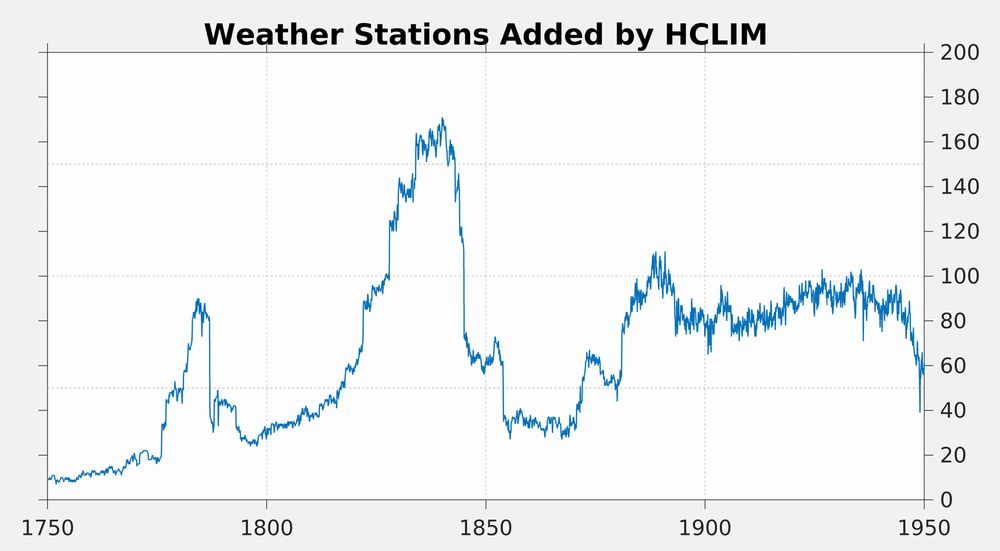
December 2, 2025 at 12:09 PM
The best way to reduce those large uncertainties would be to bring in more historical data for better global coverage.
Data rescue and digitizations efforts like HCLIM, can play a big role in trying to make more early weather data available.
5/
Data rescue and digitizations efforts like HCLIM, can play a big role in trying to make more early weather data available.
5/
Even with large uncertainties, early instrumental reconstructions can be useful in probing climate states that are different from what we experience today.
bsky.app/profile/raro...
4/
bsky.app/profile/raro...
4/
Early instrumental climate reconstructions (pre-1850) struggle with sparse measurements and have large uncertainties.
But they do provide some insights into a particularly interesting period.
Four major volcanic eruptions occurred 1780-1840, each larger than anything since.
1/
But they do provide some insights into a particularly interesting period.
Four major volcanic eruptions occurred 1780-1840, each larger than anything since.
1/

December 2, 2025 at 12:09 PM
Even with large uncertainties, early instrumental reconstructions can be useful in probing climate states that are different from what we experience today.
bsky.app/profile/raro...
4/
bsky.app/profile/raro...
4/
In very early instrumental reconstructions (pre-1850), one is often only sampling a small area, e.g. ~15% of the Earth.
Using modern weather patterns, one them estimates how different the other ~85% is likely to be from the part you can see, giving rise to an uncertainty.
3/
Using modern weather patterns, one them estimates how different the other ~85% is likely to be from the part you can see, giving rise to an uncertainty.
3/
December 2, 2025 at 12:09 PM
In very early instrumental reconstructions (pre-1850), one is often only sampling a small area, e.g. ~15% of the Earth.
Using modern weather patterns, one them estimates how different the other ~85% is likely to be from the part you can see, giving rise to an uncertainty.
3/
Using modern weather patterns, one them estimates how different the other ~85% is likely to be from the part you can see, giving rise to an uncertainty.
3/
Though accurate liquid-in-glass thermometers were invented in early 18th century, weather monitoring remained sparse for the next ~150 years.
2/
2/
December 2, 2025 at 12:09 PM
Though accurate liquid-in-glass thermometers were invented in early 18th century, weather monitoring remained sparse for the next ~150 years.
2/
2/
More generally, the heightened volcanism of the late 18th and early 19th century likely played a large role in why this era is remembered as the height of the Little Ice Age.
Since then fewer volcanoes and increasing carbon dioxide have helped to produce warming.
3/3
Since then fewer volcanoes and increasing carbon dioxide have helped to produce warming.
3/3
December 2, 2025 at 12:03 PM
More generally, the heightened volcanism of the late 18th and early 19th century likely played a large role in why this era is remembered as the height of the Little Ice Age.
Since then fewer volcanoes and increasing carbon dioxide have helped to produce warming.
3/3
Since then fewer volcanoes and increasing carbon dioxide have helped to produce warming.
3/3
Large volcanic eruptions inject sulfur and sulfur oxides into the stratosphere, where they reflect some sunlight and create a temporary cooling effect.
The eruption of Tambora in 1815 famously led to what some Europeans described as the Year Without A Summer in 1816.
2/
The eruption of Tambora in 1815 famously led to what some Europeans described as the Year Without A Summer in 1816.
2/
December 2, 2025 at 12:03 PM
Large volcanic eruptions inject sulfur and sulfur oxides into the stratosphere, where they reflect some sunlight and create a temporary cooling effect.
The eruption of Tambora in 1815 famously led to what some Europeans described as the Year Without A Summer in 1816.
2/
The eruption of Tambora in 1815 famously led to what some Europeans described as the Year Without A Summer in 1816.
2/
It doesn't get much attention from Americans or Europeans, but the Middle East has some of the worst rates for recent regional warming.
November 24, 2025 at 1:04 AM
It doesn't get much attention from Americans or Europeans, but the Middle East has some of the worst rates for recent regional warming.
That figure, from January, predates Hansen et al.
November 21, 2025 at 8:07 PM
That figure, from January, predates Hansen et al.
Your ERA5-land curve has very different absolute temperature values than than either my curve or the climate reanalyzer one. That suggests there might be an averaging problem.
November 21, 2025 at 3:37 PM
Your ERA5-land curve has very different absolute temperature values than than either my curve or the climate reanalyzer one. That suggests there might be an averaging problem.