



Jessie Peterson
@quothalinguist.bsky.social
Conlanger, co-host of LangTime Studio, and co-creator of languages appearing in Shadow and Bone, Dune, Elemental, and more
Àsèvúfawepésáhe. "Mix the dry ingredients together."
For #Lexember 5, I created two new words in my #conlang Nómàk'óla: "sáhe" meaning "to mix" and "èvúfawe", which can be used to refer to dry ingredients in baking.
www.quothalinguist.com/2025/12/05/l...
For #Lexember 5, I created two new words in my #conlang Nómàk'óla: "sáhe" meaning "to mix" and "èvúfawe", which can be used to refer to dry ingredients in baking.
www.quothalinguist.com/2025/12/05/l...

December 5, 2025 at 6:58 PM
Àsèvúfawepésáhe. "Mix the dry ingredients together."
For #Lexember 5, I created two new words in my #conlang Nómàk'óla: "sáhe" meaning "to mix" and "èvúfawe", which can be used to refer to dry ingredients in baking.
www.quothalinguist.com/2025/12/05/l...
For #Lexember 5, I created two new words in my #conlang Nómàk'óla: "sáhe" meaning "to mix" and "èvúfawe", which can be used to refer to dry ingredients in baking.
www.quothalinguist.com/2025/12/05/l...
Konàháíttapippelèkòkánelipéþólsìŋóču'o. "And sprinkle allspice and cinnamon over the flour."
This is my entry for #Lexember 4 in my Nómàk'óla language, a #conlang for nisse speakers.
www.quothalinguist.com/2025/12/04/l...
This is my entry for #Lexember 4 in my Nómàk'óla language, a #conlang for nisse speakers.
www.quothalinguist.com/2025/12/04/l...

December 4, 2025 at 6:50 PM
Konàháíttapippelèkòkánelipéþólsìŋóču'o. "And sprinkle allspice and cinnamon over the flour."
This is my entry for #Lexember 4 in my Nómàk'óla language, a #conlang for nisse speakers.
www.quothalinguist.com/2025/12/04/l...
This is my entry for #Lexember 4 in my Nómàk'óla language, a #conlang for nisse speakers.
www.quothalinguist.com/2025/12/04/l...
My Nómàk'óla sentence for #Lexember 3 is "Àhópžèllíssuuppéþólsìŋóču'o" ("Sprinkle a teaspoon of sugar over the flour."). You can read more about the sentence and the words I created today for its translation at www.quothalinguist.com/2025/12/03/l....
#conlang
#conlang

December 3, 2025 at 7:13 PM
My Nómàk'óla sentence for #Lexember 3 is "Àhópžèllíssuuppéþólsìŋóču'o" ("Sprinkle a teaspoon of sugar over the flour."). You can read more about the sentence and the words I created today for its translation at www.quothalinguist.com/2025/12/03/l....
#conlang
#conlang
My #Lexember entry for today: "Àséssetikèŋóčuppépóttiipàúho," which translates to "Pour two cups of flour onto a surface." I describe it in more detail on my website: www.quothalinguist.com/2025/12/02/l....
#conlang
#conlang

December 2, 2025 at 8:41 PM
My #Lexember entry for today: "Àséssetikèŋóčuppépóttiipàúho," which translates to "Pour two cups of flour onto a surface." I describe it in more detail on my website: www.quothalinguist.com/2025/12/02/l....
#conlang
#conlang

I received copies of my book, How to Create a Language, and couldn’t be happier! Thank you to the team at Cambridge University Press who made this dream a reality, and thank you to all my beautiful supporters! Especially thank you to @dedalvs.bsky.social for always encouraging me! #conlang

October 7, 2025 at 1:15 AM
I received copies of my book, How to Create a Language, and couldn’t be happier! Thank you to the team at Cambridge University Press who made this dream a reality, and thank you to all my beautiful supporters! Especially thank you to @dedalvs.bsky.social for always encouraging me! #conlang
Here @dedalvs.bsky.social looks less sickly… Here’s to hoping the scarf heals him. ❤️

January 6, 2025 at 4:57 AM
Here @dedalvs.bsky.social looks less sickly… Here’s to hoping the scarf heals him. ❤️
The final Vuochanad word for this year’s #Lexember is “liva” (“games”), from *liba. It has been a lot of fun to work on Vuochanad this month, and I look forward to expanding that work in the future.
“Mivu’e sadhi emwa’aña tèliva.” (“The friends play games together.”)
#conlang
“Mivu’e sadhi emwa’aña tèliva.” (“The friends play games together.”)
#conlang

December 31, 2024 at 9:24 PM
The Vuochanad word for #Lexember 30 is “emwa” (“friends”), from *ɛmwa “siblings.” In the sentence “Mivu’e sadhi emwa’aña tèliva” (“The friends play games together”), it occurs with a suffix marking a definite reading of the noun—the apostrophe indicates vowel hiatus.
#conlang
#conlang

December 30, 2024 at 8:36 PM


Today’s Vuochanad #Lexember word is “viov” (“dogs”). In the sentence “Miegen budani tèyovi” (“The child hugged these dogs”), it looks different: In intervocalic environments, [v] is deleted and [i] becomes [j]: tèviov > tèiov > tèyov. The “-i” suffix indicates a proximal demonstrative.
#conlang
#conlang

December 27, 2024 at 6:44 PM
Today’s Vuochanad #Lexember word is “bu” (“children”). In the sentence “Miegen budani tèyovi” (“The child hugged these dogs”), it occurs with the class-IV definite singulative suffix “-dani.” Vuochanad has four noun classes; nominal affixes marking definiteness reflect the noun’s class.
#conlang
#conlang

December 26, 2024 at 8:10 PM
Today's #Lexember Vuochanad word is “miem” (“to hug”), from *nwem “to hold.” In Vuochanad, an alveolar consonant followed by [w] becomes bilabial, and then the [w] is deleted, and a stressed [e] becomes the diphthong [ie].
“Miegen budani tèyovi.” (“The child hugged these dogs.")
#conlang
“Miegen budani tèyovi.” (“The child hugged these dogs.")
#conlang

December 26, 2024 at 4:32 AM
Today’s Vuochanad #Lexember word is “ñemi” (“brightness”), which completes the sentence “Ye alèle yehañ alègiha tèñemi” (“The nighttime stars shiny brightly in the sky”). A more literal translation of the sentence is “The stars at night have brightness in the sky.”
#conlang
#conlang

December 24, 2024 at 8:31 PM

Today’s Vuochanad #Lexember word is “yehañ” (“stars”), from Wóxtjanato *éxaɲe. While [ɲ] is not an allowable coda in Wóxtjanato, it is permissible in Vuochanad—a result of unstressed mid-vowel deletion.
“Ye alèle yehañ alègiha tèñemi.” (“The nighttime stars shiny brightly in the sky.”)
#conlan
“Ye alèle yehañ alègiha tèñemi.” (“The nighttime stars shiny brightly in the sky.”)
#conlan

December 22, 2024 at 11:10 PM
Today’s Vuochanad #Lexember word is “le” (“sky”). It’s interesting how sound changes affect forms differently; this word was heavily affected by sound changes, going from *xlɛ́ve (“heavens”) to “le.”
“Ye alèle yehañ alègiha tèñemi” means “The nighttime stars shine brightly in the sky.”
#conlang
“Ye alèle yehañ alègiha tèñemi” means “The nighttime stars shine brightly in the sky.”
#conlang

December 21, 2024 at 7:26 PM

Today’s Vuochanad #Lexember word is “jezu” (“branches”). Its form looks different in “Kidèn redhiezu ket” (“A raven is hopping onto branches”) due the prefix and ordering of sound changes:
*dézu > *diezu > [dʒezu]
*redézu > *reðezu > [reðiezu] (where [ð] blocks palatalization)
#conlang
*dézu > *diezu > [dʒezu]
*redézu > *reðezu > [reðiezu] (where [ð] blocks palatalization)
#conlang

December 19, 2024 at 6:50 PM


Today’s Vuochanad #Lexember entry is for my very own magical raven, Kay! The word “ke” (“ravens”) comes from the Wóxtjanato *kɛ́je, and it can also be used to refer to intelligent people who have a knack for finding treasures. “Kidèn redhiezu ket” means “A raven is hopping onto branches.”
#conlang
#conlang

December 16, 2024 at 6:53 PM
The Vuochanad word for #Lexember 15th is “udh” (“turtles”), the final word in the sentence “Slioftudhen alofñam udhèt” (“A turtle crawled on the sand”). The proto-form *udo reduced to “udh,” with a reappearing schwa when a consonant suffix occurs, like the singulative “-t.”
#conlang
#conlang

December 15, 2024 at 7:39 PM
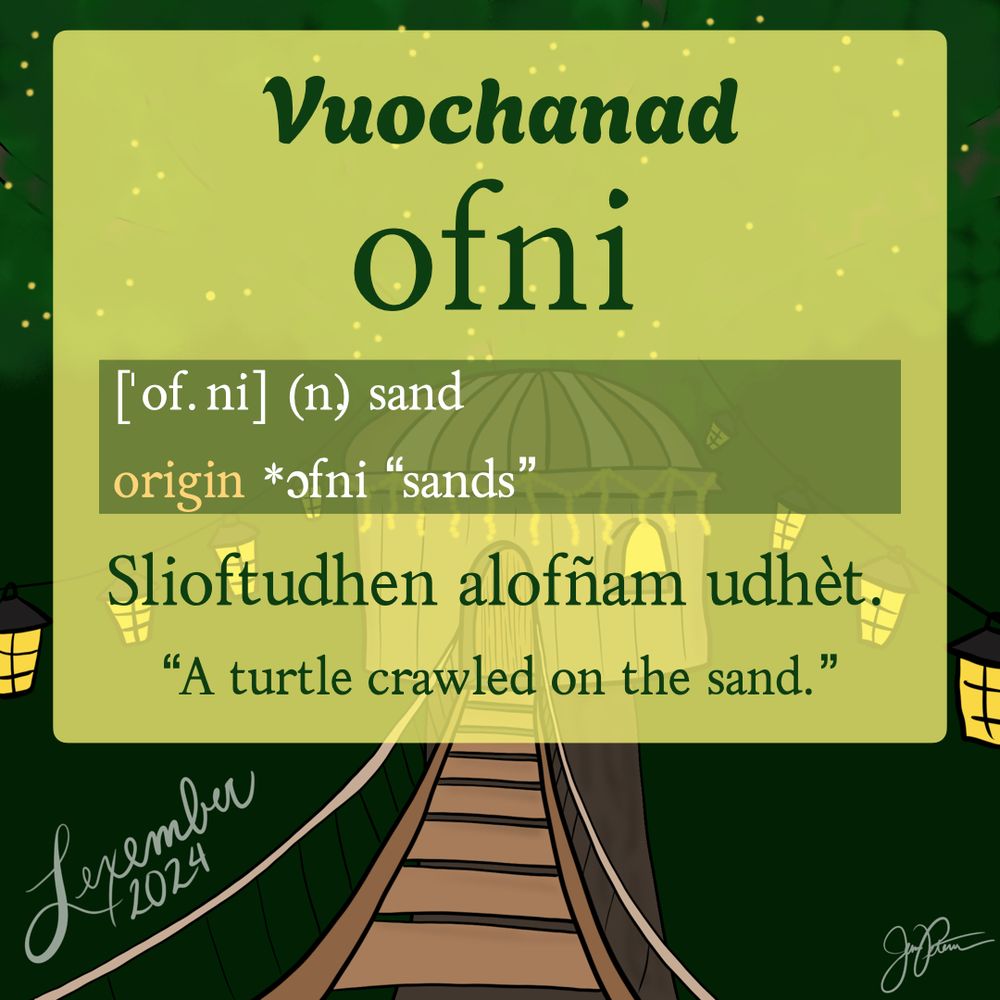
The Vuochanad #Lexember word of the day is “ofni” (“sand”), which also means “beach.” When singular, it can refer to a grain or clump of sand. In “Slioftudhen alofñam udhèt” (“A turtle crawled on the sand”), the final “i” is reduced before “-am," resulting in “ofñam.”
#conlang
#conlang
December 14, 2024 at 6:58 PM