




Harnessing Pluripotency
@pluripotency.bsky.social
Pluripotency = the power to (re)generate any body part 🌱
Fact-based insights on pluripotent stem cells & organoids for regenerative medicine
Run by a transplant nephrologist / stem-cell biologist
Views my own • No medical advice
Fact-based insights on pluripotent stem cells & organoids for regenerative medicine
Run by a transplant nephrologist / stem-cell biologist
Views my own • No medical advice
PART 1 - Setting up the kidney-forming niche in vitro 🔬
Using their previous protocols, they combined hPSC-UB 🌱 (RET+) and hPSC-NPCs🫘 (SIX1/2+). A simple media with only ROCK1/2 inhibitor and BMP inhibitor for 48 h was enough to induce epithelial vesicles (JAG1+/LHX1+) and a branching UB.
Using their previous protocols, they combined hPSC-UB 🌱 (RET+) and hPSC-NPCs🫘 (SIX1/2+). A simple media with only ROCK1/2 inhibitor and BMP inhibitor for 48 h was enough to induce epithelial vesicles (JAG1+/LHX1+) and a branching UB.

May 25, 2025 at 11:23 PM
PART 1 - Setting up the kidney-forming niche in vitro 🔬
Using their previous protocols, they combined hPSC-UB 🌱 (RET+) and hPSC-NPCs🫘 (SIX1/2+). A simple media with only ROCK1/2 inhibitor and BMP inhibitor for 48 h was enough to induce epithelial vesicles (JAG1+/LHX1+) and a branching UB.
Using their previous protocols, they combined hPSC-UB 🌱 (RET+) and hPSC-NPCs🫘 (SIX1/2+). A simple media with only ROCK1/2 inhibitor and BMP inhibitor for 48 h was enough to induce epithelial vesicles (JAG1+/LHX1+) and a branching UB.
BACKGROUND 🧩
A kidney forms when two cell clusters meet:
• Metanephric Mesenchyme – contains NPCs that will become the filtration units/nephrons
• UB – branching duct that connects with NPCs/nephrons to drain them🚰
hPSCs can make both, but getting them fuse in vitro is what today’s paper tackles.
A kidney forms when two cell clusters meet:
• Metanephric Mesenchyme – contains NPCs that will become the filtration units/nephrons
• UB – branching duct that connects with NPCs/nephrons to drain them🚰
hPSCs can make both, but getting them fuse in vitro is what today’s paper tackles.

May 25, 2025 at 11:23 PM
BACKGROUND 🧩
A kidney forms when two cell clusters meet:
• Metanephric Mesenchyme – contains NPCs that will become the filtration units/nephrons
• UB – branching duct that connects with NPCs/nephrons to drain them🚰
hPSCs can make both, but getting them fuse in vitro is what today’s paper tackles.
A kidney forms when two cell clusters meet:
• Metanephric Mesenchyme – contains NPCs that will become the filtration units/nephrons
• UB – branching duct that connects with NPCs/nephrons to drain them🚰
hPSCs can make both, but getting them fuse in vitro is what today’s paper tackles.
PART 4: MECHANISM OF BENEFIT
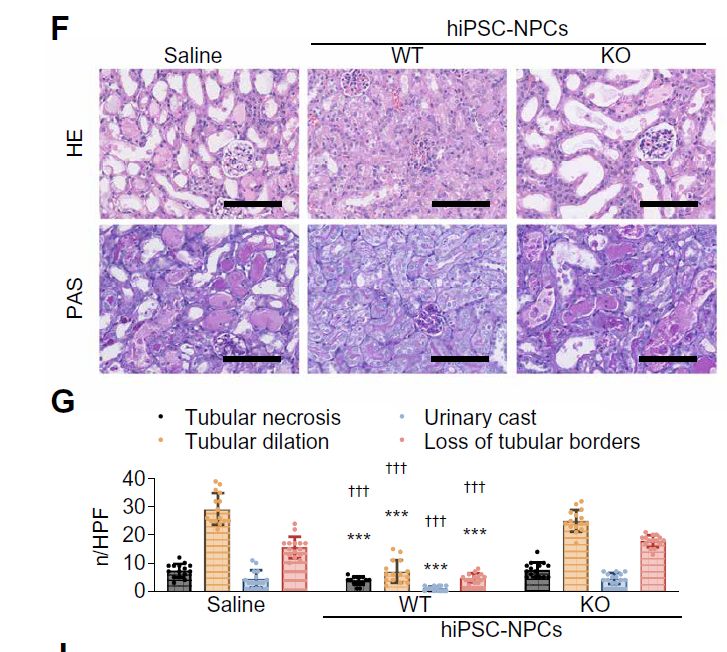
Surprisingly, the NPCs did not integrate with the host kidney. Instead, they were found to produces VEGF-A after transplantation. VEGF-A hydrogels without NPCs could protect from AKI, and genetic inactivation of VEGF-A in NPCs greatly reduced their benefits.
Surprisingly, the NPCs did not integrate with the host kidney. Instead, they were found to produces VEGF-A after transplantation. VEGF-A hydrogels without NPCs could protect from AKI, and genetic inactivation of VEGF-A in NPCs greatly reduced their benefits.
May 20, 2025 at 12:48 PM
PART 4: MECHANISM OF BENEFIT
Surprisingly, the NPCs did not integrate with the host kidney. Instead, they were found to produces VEGF-A after transplantation. VEGF-A hydrogels without NPCs could protect from AKI, and genetic inactivation of VEGF-A in NPCs greatly reduced their benefits.
Surprisingly, the NPCs did not integrate with the host kidney. Instead, they were found to produces VEGF-A after transplantation. VEGF-A hydrogels without NPCs could protect from AKI, and genetic inactivation of VEGF-A in NPCs greatly reduced their benefits.
PART 3: TREATING KIDNEY DISEASE
Using a mouse🐁 model of AKI (cisplatin), they made the surprising finding that histologic tubular damage and serum creatinine can be improved by NPC injection and NOT terminal organoids. Similarly, NPCs could improve fibrosis in a model of CKD (aristocholic acid)
Using a mouse🐁 model of AKI (cisplatin), they made the surprising finding that histologic tubular damage and serum creatinine can be improved by NPC injection and NOT terminal organoids. Similarly, NPCs could improve fibrosis in a model of CKD (aristocholic acid)

May 20, 2025 at 12:48 PM
PART 3: TREATING KIDNEY DISEASE
Using a mouse🐁 model of AKI (cisplatin), they made the surprising finding that histologic tubular damage and serum creatinine can be improved by NPC injection and NOT terminal organoids. Similarly, NPCs could improve fibrosis in a model of CKD (aristocholic acid)
Using a mouse🐁 model of AKI (cisplatin), they made the surprising finding that histologic tubular damage and serum creatinine can be improved by NPC injection and NOT terminal organoids. Similarly, NPCs could improve fibrosis in a model of CKD (aristocholic acid)
Part 2: PURIFYING NPCs USING c-MET
One problem with hPSC technology is that cells don't always behave consistently. Planning for cases where cells don't differentiate to NPCs well, they found a protein specific to NPCs, "c-MET", that could be use to purify them using a technology called FACS.
One problem with hPSC technology is that cells don't always behave consistently. Planning for cases where cells don't differentiate to NPCs well, they found a protein specific to NPCs, "c-MET", that could be use to purify them using a technology called FACS.

May 20, 2025 at 12:48 PM
Part 2: PURIFYING NPCs USING c-MET
One problem with hPSC technology is that cells don't always behave consistently. Planning for cases where cells don't differentiate to NPCs well, they found a protein specific to NPCs, "c-MET", that could be use to purify them using a technology called FACS.
One problem with hPSC technology is that cells don't always behave consistently. Planning for cases where cells don't differentiate to NPCs well, they found a protein specific to NPCs, "c-MET", that could be use to purify them using a technology called FACS.
PART 1: MAKING BETTER NPCs
Aiming to treat humans with kidney disease, they realized they would need to make tons of NPCs. So they first improved the method of growing these OSR1+SIX2+ NPCs in large numbers, using "CFY" media💧 containing:
C: Canonical Wnt agonist
F: FGF9
Y: ROCK1/2 inhibitor
Aiming to treat humans with kidney disease, they realized they would need to make tons of NPCs. So they first improved the method of growing these OSR1+SIX2+ NPCs in large numbers, using "CFY" media💧 containing:
C: Canonical Wnt agonist
F: FGF9
Y: ROCK1/2 inhibitor

May 20, 2025 at 12:48 PM
PART 1: MAKING BETTER NPCs
Aiming to treat humans with kidney disease, they realized they would need to make tons of NPCs. So they first improved the method of growing these OSR1+SIX2+ NPCs in large numbers, using "CFY" media💧 containing:
C: Canonical Wnt agonist
F: FGF9
Y: ROCK1/2 inhibitor
Aiming to treat humans with kidney disease, they realized they would need to make tons of NPCs. So they first improved the method of growing these OSR1+SIX2+ NPCs in large numbers, using "CFY" media💧 containing:
C: Canonical Wnt agonist
F: FGF9
Y: ROCK1/2 inhibitor
BACKGROUND:
Human pluripotent stem cells (hPSCs) can generate any tissue - including the kidney🫘. To do this, they must first specialize into nephron progenitors (NPCs), which are kidney-specific stem cells (can't make other organs).
The authors published on this before
e.g. tinyurl.com/4ufzv9pf
Human pluripotent stem cells (hPSCs) can generate any tissue - including the kidney🫘. To do this, they must first specialize into nephron progenitors (NPCs), which are kidney-specific stem cells (can't make other organs).
The authors published on this before
e.g. tinyurl.com/4ufzv9pf

May 20, 2025 at 12:48 PM
BACKGROUND:
Human pluripotent stem cells (hPSCs) can generate any tissue - including the kidney🫘. To do this, they must first specialize into nephron progenitors (NPCs), which are kidney-specific stem cells (can't make other organs).
The authors published on this before
e.g. tinyurl.com/4ufzv9pf
Human pluripotent stem cells (hPSCs) can generate any tissue - including the kidney🫘. To do this, they must first specialize into nephron progenitors (NPCs), which are kidney-specific stem cells (can't make other organs).
The authors published on this before
e.g. tinyurl.com/4ufzv9pf