




Owen Hovey
@owenhovey.bsky.social
Postdoc in Lehtiö group at SciLifeLabs/Karalinsa. Canadian abroad 🇨🇦. Proteomics and PTMs.
Can you link the original patient?
July 25, 2025 at 3:03 PM
Can you link the original patient?
Has the ENO and ONE been compared with lower input samples 1-5ng?
June 27, 2025 at 5:58 AM
Has the ENO and ONE been compared with lower input samples 1-5ng?
Very interesting study, would have been nice to see a SP3 workflow added.
June 6, 2025 at 6:03 PM
Very interesting study, would have been nice to see a SP3 workflow added.
It’s Canadian, but the Lake Louise Tandem MS is more technological and also good if you like skiing.
April 20, 2025 at 4:26 PM
It’s Canadian, but the Lake Louise Tandem MS is more technological and also good if you like skiing.
Are you using SP3 or S-Trap?
April 5, 2025 at 7:41 PM
Are you using SP3 or S-Trap?
See if any of the +1 match this list. If so then you have your answer where it is coming from
proteomicsresource.washington.edu/protocols05/...
proteomicsresource.washington.edu/protocols05/...
UWPR
proteomicsresource.washington.edu
April 5, 2025 at 7:10 PM
See if any of the +1 match this list. If so then you have your answer where it is coming from
proteomicsresource.washington.edu/protocols05/...
proteomicsresource.washington.edu/protocols05/...
What are the charge states at the end of the gradient?
April 5, 2025 at 1:56 AM
What are the charge states at the end of the gradient?
Shadowing a postdoc from one of my committee members during my master's.
March 20, 2025 at 1:36 PM
Shadowing a postdoc from one of my committee members during my master's.
I don't have experience with EvoSep. However, they do see it at the end of the gradient in this paper in Fig 5A on Evosep. On our Neo-eclipse setup, I've only ever observed it as the dimer 1021.62 at the end of the gradient when we ramp to 95% B. www.mcponline.org/article/S153...

Universal Pretreatment Development for Low-input Proteomics Using Lauryl Maltose Neopentyl Glycol
In BriefWe developed a lauryl maltose neopentyl glycol (LMNG)-assisted sample preparation
(LASP) method for low-input proteomics. LMNG surfactant is added for reducing protein
and peptide loss into th...
www.mcponline.org
March 19, 2025 at 12:31 PM
I don't have experience with EvoSep. However, they do see it at the end of the gradient in this paper in Fig 5A on Evosep. On our Neo-eclipse setup, I've only ever observed it as the dimer 1021.62 at the end of the gradient when we ramp to 95% B. www.mcponline.org/article/S153...
It comes off as a dimer at 1021.62 at the end of gradient. See supplemental figure 3 doi.org/10.1021/acs....
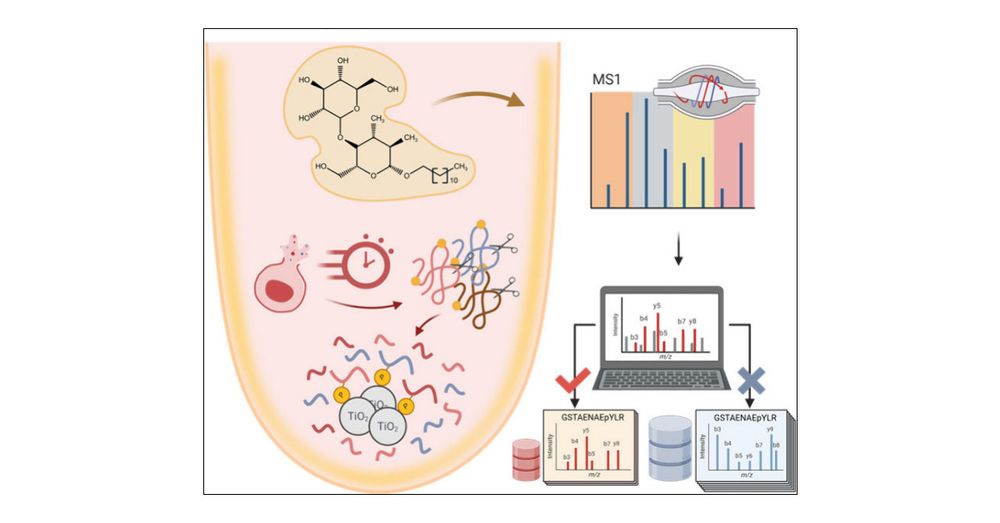
A Rapid One-Pot Workflow for Sensitive Microscale Phosphoproteomics
Compared to advancements in single-cell proteomics, phosphoproteomics sensitivity has lagged behind due to low abundance, complex sample preparation, and substantial sample input requirements. We present a simple and rapid one-pot phosphoproteomics workflow (SOP-Phos) integrated with data-independent acquisition mass spectrometry (DIA-MS) for microscale phosphoproteomic analysis. SOP-Phos adapts sodium deoxycholate based one-step lysis, reduction/alkylation, direct trypsinization, and phosphopeptide enrichment by TiO2 beads in a single-tube format. By reducing surface adsorptive losses via utilizing n-dodecyl β-d-maltoside precoated tubes and shortening the digestion time, SOP-Phos is completed within 3–4 h with a 1.4-fold higher identification coverage. SOP-Phos coupled with DIA demonstrated >90% specificity, enhanced sensitivity, lower missing values (<1%), and improved reproducibility (8%–10% CV). With a sample size-comparable spectral library, SOP-Phos-DIA identified 33,787 ± 670 to 22,070 ± 861 phosphopeptides from 5 to 0.5 μg cell lysate and 30,433 ± 284 to 6,548 ± 21 phosphopeptides from 50,000 to 2,500 cells. Such sensitivity enabled mapping key lung cancer signaling sites, such as EGFR autophosphorylation sites Y1197/Y1172 and drug targets. The feasibility of SOP-Phos-DIA was demonstrated on EGFR-TKI sensitive and resistant cells, revealing the interplay of multipathway Hippo-EGFR-ERBB signaling cascades underlying the mechanistic insight into EGFR-TKI resistance. Overall, SOP-Phos-DIA is an efficient and robust protocol that can be easily adapted in the community for microscale phosphoproteomic analysis.
doi.org
March 18, 2025 at 5:43 PM
It comes off as a dimer at 1021.62 at the end of gradient. See supplemental figure 3 doi.org/10.1021/acs....
We’ve done a small amount of testing so far with LMNG in digestion buffer and resuspension with DDM, and we have improved recovery. DDM always comes off the end of the gradient as a dimer.
March 8, 2025 at 7:03 PM
We’ve done a small amount of testing so far with LMNG in digestion buffer and resuspension with DDM, and we have improved recovery. DDM always comes off the end of the gradient as a dimer.
Also DDM coated tubes improve phosphoproteomics pubs.acs.org/doi/10.1021/...
A Rapid One-Pot Workflow for Sensitive Microscale Phosphoproteomics
Compared to advancements in single-cell proteomics, phosphoproteomics sensitivity has lagged behind due to low abundance, complex sample preparation, and substantial sample input requirements. We pres...
pubs.acs.org
March 8, 2025 at 4:25 PM
Also DDM coated tubes improve phosphoproteomics pubs.acs.org/doi/10.1021/...
This paper compared DDM and other similar surfactants for multiple applications (phospho, AP-MS, EVs and single cell) in digestion and resuspension.
www.mcponline.org/article/S153...
www.mcponline.org/article/S153...
Universal Pretreatment Development for Low-input Proteomics Using Lauryl Maltose Neopentyl Glycol
In BriefWe developed a lauryl maltose neopentyl glycol (LMNG)-assisted sample preparation
(LASP) method for low-input proteomics. LMNG surfactant is added for reducing protein
and peptide loss into th...
www.mcponline.org
March 8, 2025 at 4:22 PM
This paper compared DDM and other similar surfactants for multiple applications (phospho, AP-MS, EVs and single cell) in digestion and resuspension.
www.mcponline.org/article/S153...
www.mcponline.org/article/S153...
Was this run on a desktop or server?
February 21, 2025 at 1:40 AM
Was this run on a desktop or server?
@resynbio.bsky.social has also been labeled as spam
February 13, 2025 at 1:35 PM
@resynbio.bsky.social has also been labeled as spam
MaxQuant YouTube videos are a good starting point. There are also lots of great R scripts.
youtu.be/fdd9MPt2sAU?...
youtu.be/fdd9MPt2sAU?...

MQSS 2019 | L15: Computational PTM proteomics | Kirti Sharma
YouTube video by Max Quant
youtu.be
January 31, 2025 at 5:15 AM
MaxQuant YouTube videos are a good starting point. There are also lots of great R scripts.
youtu.be/fdd9MPt2sAU?...
youtu.be/fdd9MPt2sAU?...
We do DIA without FAIMS on our Eclipse, and it hasn’t given us that much of a boost for our normal workflows. We did see a boost when exploring low inputs below 1ng. Here is a publication of the Olsen lab using FAIMS DIA.
www.mcponline.org/article/S153...
www.mcponline.org/article/S153...

A Compact Quadrupole-Orbitrap Mass Spectrometer with FAIMS Interface Improves Proteome Coverage in Short LC Gradients*
Orbitrap Exploris 480 MS with FAIMS Pro provides fast, sensitive and robust profiling
of proteomes when combined with Evosep One. The combination of Data Independent Acquisition
(DIA) and FAIMS with s...
www.mcponline.org
January 21, 2025 at 5:10 PM
We do DIA without FAIMS on our Eclipse, and it hasn’t given us that much of a boost for our normal workflows. We did see a boost when exploring low inputs below 1ng. Here is a publication of the Olsen lab using FAIMS DIA.
www.mcponline.org/article/S153...
www.mcponline.org/article/S153...
This paper from the Aebersold lab. Depending on the cell type, 0.06 (CMP) to 0.5 (GMP) R^2

January 11, 2025 at 3:10 PM
This paper from the Aebersold lab. Depending on the cell type, 0.06 (CMP) to 0.5 (GMP) R^2
I'll be back in the lab on January 7th. Can you wait until then?
December 26, 2024 at 10:06 PM
I'll be back in the lab on January 7th. Can you wait until then?
We've only used Thermos barcode plates. Could you try purchasing a thermos 96-well plate and then making a copy of the barcode or transferring the barcodes to new plates? It looks like I could peel off the barcodes.
December 26, 2024 at 9:13 PM
We've only used Thermos barcode plates. Could you try purchasing a thermos 96-well plate and then making a copy of the barcode or transferring the barcodes to new plates? It looks like I could peel off the barcodes.
HUPO in Toronto Canada
December 17, 2024 at 1:56 AM
HUPO in Toronto Canada
What’s the average peptide length? What’s the cost?
December 5, 2024 at 8:31 PM
What’s the average peptide length? What’s the cost?