




Network Law Review
@networklawreview.bsky.social
Dedicated to the complex science of markets & digital laws.
https://www.networklawreview.org
https://www.networklawreview.org
🚨 Just out: The world’s most downloaded antitrust articles of 2025 on SSRN 🚨 www.networklawreview.org/top-2025/

The world’s most downloaded antitrust articles of 2025 - Network Law Review
As for previous years, here are the world’s most downloaded antitrust and competition law articles posted on SSRN during 2025.
www.networklawreview.org
January 2, 2026 at 1:19 PM
🚨 Just out: The world’s most downloaded antitrust articles of 2025 on SSRN 🚨 www.networklawreview.org/top-2025/
Here are @profschrepel.bsky.social’s monthly reading suggestions. Topics include measure market power, nascent competition and killer acquisitions, the end of the Brussels effect, the welfare effect of price discrimination, great-powers competition, and more.
www.networklawreview.org/december-2025/
www.networklawreview.org/december-2025/

Reading suggestions – December 2025 - Network Law Review
Here are Thibault Schrepel’s monthly reading suggestions. Topics include measure market power, nascent competition and killer acquisitions, the end of the Brussels effect, the welfare effect of price ...
www.networklawreview.org
January 2, 2026 at 9:08 AM
Here are @profschrepel.bsky.social’s monthly reading suggestions. Topics include measure market power, nascent competition and killer acquisitions, the end of the Brussels effect, the welfare effect of price discrimination, great-powers competition, and more.
www.networklawreview.org/december-2025/
www.networklawreview.org/december-2025/
NEW: In this paper, William Lehr, Volker Stocker & Jason Whalley argue that EU digital sovereignty fails if it sacrifices intra-EU competition or confuses control with self-sufficiency, especially in the AI stack.
www.networklawreview.org/lehr-stocker...
www.networklawreview.org/lehr-stocker...

December 12, 2025 at 11:13 AM
NEW: In this paper, William Lehr, Volker Stocker & Jason Whalley argue that EU digital sovereignty fails if it sacrifices intra-EU competition or confuses control with self-sufficiency, especially in the AI stack.
www.networklawreview.org/lehr-stocker...
www.networklawreview.org/lehr-stocker...
What if antitrust’s obsession with consumer welfare is hurting US competitiveness? Jonathan Barnett shows how global power politics (especially China’s mercantilism) force a fundamental rethink of US antitrust. Essential reading. www.networklawreview.org/barnett-grea...

December 3, 2025 at 1:04 PM
What if antitrust’s obsession with consumer welfare is hurting US competitiveness? Jonathan Barnett shows how global power politics (especially China’s mercantilism) force a fundamental rethink of US antitrust. Essential reading. www.networklawreview.org/barnett-grea...
Trade barriers can drive rivals like China to innovate, but true edge belongs to those plugged into global tech networks. The US-China chip conflict reveals the paradox of protectionism in industrial policy.
👉🏼 Read Dick Langlois on the subject: networklawreview.org/langlois-pro...
👉🏼 Read Dick Langlois on the subject: networklawreview.org/langlois-pro...

China and the Paradox of Protectionism? - Network Law Review
This special issue examines the coexistence of industrial and competition policy in a period of geopolitical rivalry and rapid technological change. The contributions analyze these tensions through th...
networklawreview.org
December 2, 2025 at 9:54 AM
Trade barriers can drive rivals like China to innovate, but true edge belongs to those plugged into global tech networks. The US-China chip conflict reveals the paradox of protectionism in industrial policy.
👉🏼 Read Dick Langlois on the subject: networklawreview.org/langlois-pro...
👉🏼 Read Dick Langlois on the subject: networklawreview.org/langlois-pro...
What happens when data from one product quietly boosts a firm’s power in other markets? AI-era spillovers make leveraging strategies far more profitable, and far harder to evaluate. A must read, by Erik Hovenkamp (Cornell) networklawreview.org/hovenkamp-ai...

AI, Data, And Leveraging Strategies: Implications For Antitrust - Network Law Review
In product markets that rely heavily on artificial intelligence (AI), firms both use data and generate data. For a multiproduct firm, the data generated by one product will often have spillover benefi...
networklawreview.org
December 2, 2025 at 9:53 AM
What happens when data from one product quietly boosts a firm’s power in other markets? AI-era spillovers make leveraging strategies far more profitable, and far harder to evaluate. A must read, by Erik Hovenkamp (Cornell) networklawreview.org/hovenkamp-ai...
Europe’s renewed push for industrial policy is a golden moment for antitrust agencies according to Frédéric Jenny (OECD). To stay relevant, he suggests they must embrace innovation, sustainability, resilience & growth.
networklawreview.org/jenny-indust...
networklawreview.org/jenny-indust...

The Rise of Industrial Policy in Europe and the Search for Growth and Innovation: A Golden Opportunity for Competition Authorities - Network Law Review
This paper argues that the unintended and unanticipated costs of globalization revealed during the 2008 financial crisis and the 2020 COVID-19 pandemic have led to a renewed embrace of industrial poli...
networklawreview.org
December 2, 2025 at 9:52 AM
Europe’s renewed push for industrial policy is a golden moment for antitrust agencies according to Frédéric Jenny (OECD). To stay relevant, he suggests they must embrace innovation, sustainability, resilience & growth.
networklawreview.org/jenny-indust...
networklawreview.org/jenny-indust...
Here are @profschrepel.bsky.social's monthly reading suggestions about antitrust, AI, economics, and more:
www.networklawreview.org/november-2025/
www.networklawreview.org/november-2025/

December 2, 2025 at 6:50 AM
Here are @profschrepel.bsky.social's monthly reading suggestions about antitrust, AI, economics, and more:
www.networklawreview.org/november-2025/
www.networklawreview.org/november-2025/
Antitrust is no longer a domestic game. Daniel Crane (University of Michigan Law School) maps how Great Powers use antitrust law as a geopolitical lever across tech, culture, finance, and even wartime supply chains.
Read here 👇 www.networklawreview.org/crane-great-...
Read here 👇 www.networklawreview.org/crane-great-...

November 21, 2025 at 4:43 PM
Antitrust is no longer a domestic game. Daniel Crane (University of Michigan Law School) maps how Great Powers use antitrust law as a geopolitical lever across tech, culture, finance, and even wartime supply chains.
Read here 👇 www.networklawreview.org/crane-great-...
Read here 👇 www.networklawreview.org/crane-great-...
What happens when industrial policy moves from tariffs to invisible regulatory barriers? Daniel Spulber shows how non-tariff barriers distort trade & erode incentives to innovate. New in the NLR x ICLE special issue on competitiveness.
👉 networklawreview.org/spulber-indu...
👉 networklawreview.org/spulber-indu...

November 17, 2025 at 1:45 PM
What happens when industrial policy moves from tariffs to invisible regulatory barriers? Daniel Spulber shows how non-tariff barriers distort trade & erode incentives to innovate. New in the NLR x ICLE special issue on competitiveness.
👉 networklawreview.org/spulber-indu...
👉 networklawreview.org/spulber-indu...
Is “industrial policy” really back? Giovanni Dosi argues it’s mostly a dystopian reboot, more zero-sum than visionary-oriented strategy. Our new NLR–ICLE special issue starts with a bang.
www.networklawreview.org/dosi-industr...
www.networklawreview.org/dosi-industr...

November 14, 2025 at 9:54 AM
Is “industrial policy” really back? Giovanni Dosi argues it’s mostly a dystopian reboot, more zero-sum than visionary-oriented strategy. Our new NLR–ICLE special issue starts with a bang.
www.networklawreview.org/dosi-industr...
www.networklawreview.org/dosi-industr...
Industrial policy is back in fashion. From AI to semiconductors, governments are rethinking the balance between intervention and competition.
This new issue (with ICLE) explores this tension. Read the introduction 👉 www.networklawreview.org/special-issu...
This new issue (with ICLE) explores this tension. Read the introduction 👉 www.networklawreview.org/special-issu...

November 12, 2025 at 8:53 AM
Industrial policy is back in fashion. From AI to semiconductors, governments are rethinking the balance between intervention and competition.
This new issue (with ICLE) explores this tension. Read the introduction 👉 www.networklawreview.org/special-issu...
This new issue (with ICLE) explores this tension. Read the introduction 👉 www.networklawreview.org/special-issu...
Reposted by Network Law Review

The EU's "future-proof" AI regulation is a fantasy. AI evolves through emergent properties—GPT-1 to GPT-4 was metamorphosis, not iteration. We need future-responsive regulation, not monuments By @profschrepel.bsky.social at @networklawreview.bsky.social
www.networklawreview.org/schrepel-fut...
www.networklawreview.org/schrepel-fut...

The Future-Proof Fantasy of AI Regulation - Network Law Review
The EU’s quest for “future-proof” AI regulation is a fantasy. AI evolves through emergent properties that defy prediction, yet Brussels continues to draft rules with an industrial, linear mindset. The...
www.networklawreview.org
October 16, 2025 at 4:09 PM
The EU's "future-proof" AI regulation is a fantasy. AI evolves through emergent properties—GPT-1 to GPT-4 was metamorphosis, not iteration. We need future-responsive regulation, not monuments By @profschrepel.bsky.social at @networklawreview.bsky.social
www.networklawreview.org/schrepel-fut...
www.networklawreview.org/schrepel-fut...
New Antitrust Antidote: Apple case moves ahead; per se tying theory on Hermès doesn’t fly; alleged algorithmic/benchmarking collusion suits stumble on pleadings... All you need to know about recent U.S. antitrust cases is here: www.networklawreview.org/antidote-7/

October 7, 2025 at 10:29 AM
New Antitrust Antidote: Apple case moves ahead; per se tying theory on Hermès doesn’t fly; alleged algorithmic/benchmarking collusion suits stumble on pleadings... All you need to know about recent U.S. antitrust cases is here: www.networklawreview.org/antidote-7/
Here are @profschrepel.bsky.social’s monthly reading suggestions: DMA & EU users, killer acquisitions, auditable AI, AI Act political economy, GenAI & democracy, AI agents in econ, adaptive regulation + a special issue on law, tech & econ of AI: www.networklawreview.org/september-20...

October 1, 2025 at 1:28 PM
Here are @profschrepel.bsky.social’s monthly reading suggestions: DMA & EU users, killer acquisitions, auditable AI, AI Act political economy, GenAI & democracy, AI agents in econ, adaptive regulation + a special issue on law, tech & econ of AI: www.networklawreview.org/september-20...
The EU says its AI rules are “future proof.” They’re not, @profschrepel.bsky.social argues. Without adaptive regulation (modular rules, real-time monitoring, plural triggers, institutional memory) Brussels (and others!) will always be behind the curve. www.networklawreview.org/schrepel-fut...

October 1, 2025 at 9:38 AM
The EU says its AI rules are “future proof.” They’re not, @profschrepel.bsky.social argues. Without adaptive regulation (modular rules, real-time monitoring, plural triggers, institutional memory) Brussels (and others!) will always be behind the curve. www.networklawreview.org/schrepel-fut...
What if competition law had to be personalized, i.e., tailored to firms, sectors, even algorithms? Adrian Kuenzler (University of Hong Kong) argues AI forces us to abandon one-size-fits-all enforcement. The age of bespoke antitrust is here
www.networklawreview.org/kuenzler-ai/
www.networklawreview.org/kuenzler-ai/

Personalized Competition Law: The New Frontier of AI Market Governance - Network Law Review
Artificial Intelligence technologies prompt several doctrinal shifts in competition law. For AI market governance, this means moving toward personalized enforcement. Rather than applying one-size-fits...
www.networklawreview.org
September 26, 2025 at 11:35 AM
What if competition law had to be personalized, i.e., tailored to firms, sectors, even algorithms? Adrian Kuenzler (University of Hong Kong) argues AI forces us to abandon one-size-fits-all enforcement. The age of bespoke antitrust is here
www.networklawreview.org/kuenzler-ai/
www.networklawreview.org/kuenzler-ai/
Reposted by Network Law Review

How can regulatory frameworks keep up in the age of #AI?
New in @networklawreview.bsky.social, Visiting Professor @flogsell.bsky.social outlines how #GDPR provisions often fail to apply to AI systems, highlighting the need for more adaptive, flexible, and responsive regulatory approaches.
New in @networklawreview.bsky.social, Visiting Professor @flogsell.bsky.social outlines how #GDPR provisions often fail to apply to AI systems, highlighting the need for more adaptive, flexible, and responsive regulatory approaches.

Statutory Obsolescence in the Age of Innovation: A Few Thoughts about GDPR - Network Law Review
This article examines the problem of statutory obsolescence in the regulation of rapidly evolving technologies, with a focus on GDPR and generative AI. It shows how core GDPR provisions on lawful proc...
www.networklawreview.org
September 24, 2025 at 4:20 PM
How can regulatory frameworks keep up in the age of #AI?
New in @networklawreview.bsky.social, Visiting Professor @flogsell.bsky.social outlines how #GDPR provisions often fail to apply to AI systems, highlighting the need for more adaptive, flexible, and responsive regulatory approaches.
New in @networklawreview.bsky.social, Visiting Professor @flogsell.bsky.social outlines how #GDPR provisions often fail to apply to AI systems, highlighting the need for more adaptive, flexible, and responsive regulatory approaches.
How to implement the EU #AIAct without stifling innovation?
Daniel Schnurr highlights 5 key challenges: risk mitigation, trade-offs, adaptability, value-chain responsibility & coherence with sectoral rules.
www.networklawreview.org/schnurr-ai-a...
Daniel Schnurr highlights 5 key challenges: risk mitigation, trade-offs, adaptability, value-chain responsibility & coherence with sectoral rules.
www.networklawreview.org/schnurr-ai-a...

September 24, 2025 at 12:35 PM
How to implement the EU #AIAct without stifling innovation?
Daniel Schnurr highlights 5 key challenges: risk mitigation, trade-offs, adaptability, value-chain responsibility & coherence with sectoral rules.
www.networklawreview.org/schnurr-ai-a...
Daniel Schnurr highlights 5 key challenges: risk mitigation, trade-offs, adaptability, value-chain responsibility & coherence with sectoral rules.
www.networklawreview.org/schnurr-ai-a...
NEW: Korea’s new AI regime shows both promise and peril of overlapping regulators, argues Yo Sop Choi. The 2023 Digital Bill of Rights aims for coherence, but real clarity will hinge on agency coordination: www.networklawreview.org/choi-ai/

September 22, 2025 at 7:43 AM
NEW: Korea’s new AI regime shows both promise and peril of overlapping regulators, argues Yo Sop Choi. The 2023 Digital Bill of Rights aims for coherence, but real clarity will hinge on agency coordination: www.networklawreview.org/choi-ai/
New @networklawreview.bsky.social piece by Kyohei Yamamoto & Yasunori Tabei summarizing Japan’s emerging AI regulation: a soft-law AI Bill, a JFTC market study on generative AI, and the new MSCA for mobile software www.networklawreview.org/yamamoto-tab....

Japanese AI Regulation and Competition Law - Network Law Review
The Network Law Review is pleased to present a special issue entitled “The Law & Technology & Economics of AI.” This issue brings together multiple disciplines around a central question: What kind of ...
www.networklawreview.org
September 19, 2025 at 5:40 AM
New @networklawreview.bsky.social piece by Kyohei Yamamoto & Yasunori Tabei summarizing Japan’s emerging AI regulation: a soft-law AI Bill, a JFTC market study on generative AI, and the new MSCA for mobile software www.networklawreview.org/yamamoto-tab....
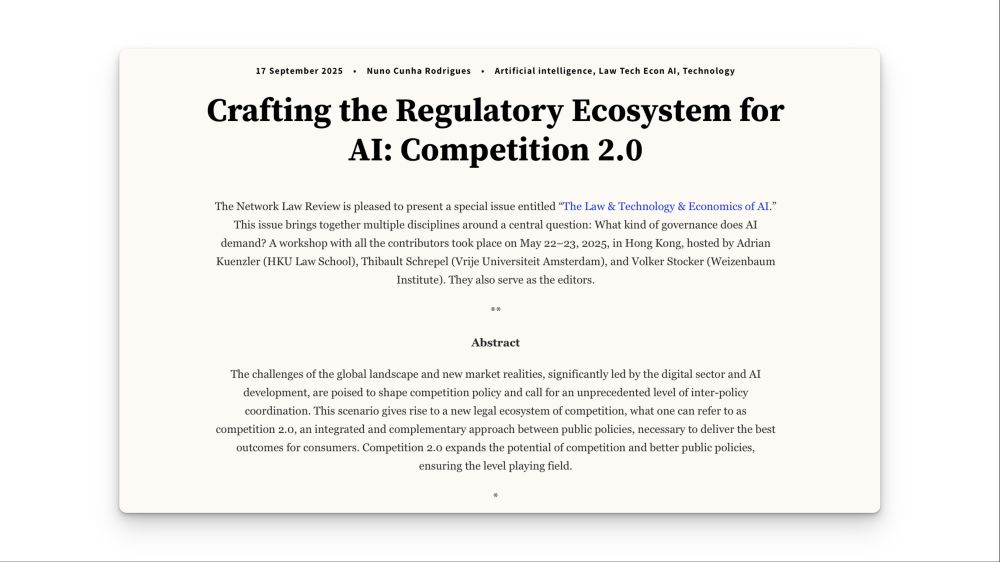
NEW article by Nuno Cunha Rodrigues, President of Portuguese Competition Authority.
He argues that AI disruption demands a new regulatory ecosystem where competition law works hand in hand with other public policies www.networklawreview.org/cunha-rodrig...
He argues that AI disruption demands a new regulatory ecosystem where competition law works hand in hand with other public policies www.networklawreview.org/cunha-rodrig...
September 17, 2025 at 9:15 AM
NEW article by Nuno Cunha Rodrigues, President of Portuguese Competition Authority.
He argues that AI disruption demands a new regulatory ecosystem where competition law works hand in hand with other public policies www.networklawreview.org/cunha-rodrig...
He argues that AI disruption demands a new regulatory ecosystem where competition law works hand in hand with other public policies www.networklawreview.org/cunha-rodrig...
Generative AI exposes GDPR’s limits: consent at scale, accuracy of outputs, erasure in trained models. The fix isn’t more principles, says Florence G'sell (Stanford University), it’s adaptive institutions (EU AI Office, expert panels) and iterative rules. www.networklawreview.org/gsell-statut...

September 15, 2025 at 8:24 AM
Generative AI exposes GDPR’s limits: consent at scale, accuracy of outputs, erasure in trained models. The fix isn’t more principles, says Florence G'sell (Stanford University), it’s adaptive institutions (EU AI Office, expert panels) and iterative rules. www.networklawreview.org/gsell-statut...
NEW: Jin, Wagman & Zhong show how privacy, security & cross-border data laws overlap with AI policies. These overlaps create trade-offs: innovation vs. protection, competition vs. compliance costs. They call for internationally coordinated AI/data gov www.networklawreview.org/jin-wagman-z...

September 3, 2025 at 7:38 AM
NEW: Jin, Wagman & Zhong show how privacy, security & cross-border data laws overlap with AI policies. These overlaps create trade-offs: innovation vs. protection, competition vs. compliance costs. They call for internationally coordinated AI/data gov www.networklawreview.org/jin-wagman-z...
NEW: @paulohm.bsky.social (Georgetown Law) argues that as AI drives the cost of compliance toward zero, debates on AI regulation should focus on its substance rather than its administrative burden www.networklawreview.org/ohm-ai-regul...

Toward Compliance Zero: AI and the Vanishing Costs of Regulatory Compliance - Network Law Review
AI systems now perform core compliance tasks once reserved for humans. Prof. Ohm argues that this will drive the marginal cost of regulatory compliance toward zero. The claim is grounded in the nature...
www.networklawreview.org
September 2, 2025 at 7:19 AM
NEW: @paulohm.bsky.social (Georgetown Law) argues that as AI drives the cost of compliance toward zero, debates on AI regulation should focus on its substance rather than its administrative burden www.networklawreview.org/ohm-ai-regul...