



NEST Simulator
@nest-initiative.org
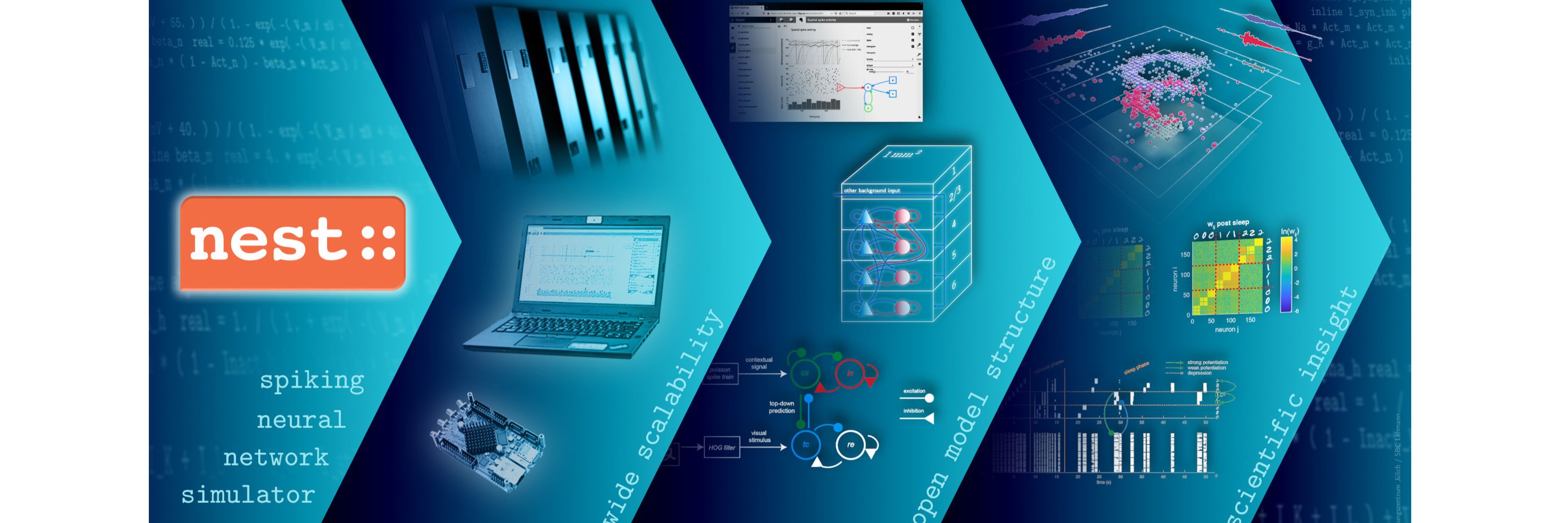
The NEST Simulator is an open-source high-performance tool designed for large-scale neural network simulations, offering exceptional scalability, flexibility, and interoperability. Visit https://nest-simulator.org to learn more! #nestsim
Using the NEST simulator, they offer a more realistic model for neuronal networks that includes these glial cells, including a model with calcium dynamics and connectivity generation scheme for tripartite interactions.

October 8, 2025 at 9:47 AM
Using the NEST simulator, they offer a more realistic model for neuronal networks that includes these glial cells, including a model with calcium dynamics and connectivity generation scheme for tripartite interactions.
The second publication focuses on the NESTML and NEST-based simulation framework for multicompartment models. Now, you can define scalable network simulations featuring dendritic processes with NEST! www.biorxiv.org/content/10.1...
A NEST-based framework unlocks massively parallel simulation of networks of multicompartment neurons with customizable subcellular dynamics
While the implementation of learning and memory in the brain is governed in large part by subcellular mechanims in the dendrites of neurons, large-scale network simulations featuring such processes remain challenging to achieve. This can be attributed to a lack of appropriate software tools, as neuroscientific simulation software focuses on the one hand on highly detailed models, and on the other hand on massive networks featuring point-neurons. Here, we fill this gap by implementing a framework for the massively parallel simulation of simplified dendrite models with customizable subcellular dynamics. To achieve this, we leverage the NEural Simulation Tool (NEST), the neuroscientific reference with respect to efficient massively parallel simulations of point neuron networks. By co-opting the already existing model descriptions language NESTML, we generate C++ code implementing user-configurable subcellular dynamics. Through benchmarking and profiling, we show that the generated models run efficiently, leading to scalable NEST network simulations. We demonstrate relevant functionalities by showing that a key sensory computation – the association of top-down context arriving at distal dendrites in layer 1 and feedforward sensory input arriving perisomatically – can be achieved in a single shot fashion through apical calcium dynamics. Our work thus unlocks the study of how dendritic processes shape learning, and in particular of how brain-wide communication through long-range, layer 1-targetting connections steers perisomatic plasticity. ### Competing Interest Statement The authors have declared no competing interest. Helmholtz Association of German Research Centres, https://ror.org/0281dp749 Italian Ministry for Universities and Research (MUR), CUP I53C22001400006, CUP B51E22000150006
www.biorxiv.org
July 9, 2025 at 7:25 AM
The second publication focuses on the NESTML and NEST-based simulation framework for multicompartment models. Now, you can define scalable network simulations featuring dendritic processes with NEST! www.biorxiv.org/content/10.1...
Using the NEural Analysis Toolkit (NEAT), you can create simplified neuron models from detailed ones. This toolbox provides a missing link between single neuron computation and large-scale network analysis! www.biorxiv.org/content/10.1...
The neural analysis toolkit unifies semi-analytical techniques to simplify, understand, and simulate dendrites
While simulating compartmental dynamics in response to various input patterns is the prevalent technique for understanding dendritic computation, a great deal can be learned from classical analytical methods that provide solutions for the dendritic voltage. For example, such solutions are needed to simplify spatially extended neuron models, to understand frequency-dependent response properties, to elucidate the interaction between synaptic inputs, and hence to reveal the effective compartmentalization of dendrites into functional subunits. Nevertheless, these methods have not been implemented in modern software tools. This works describes the NEural Analysis Toolkit (NEAT), a Python toolbox that implements classical algorithms to compute response properties of spatially extended neuron models, and that leverages these algorithms to simplify them. Packaged with this are a range of useful utilities to plot morphologies and spatial quantities defined on the morphology, to distribute locations on the morphology, and to select parts of the morphology to e.g. apply morphological ablations or alter the membrane properties. The resulting models can be exported to NEURON and NEST, two commonly used simulators, the former focused on detailed single neuron model simulations, and the latter geared towards distributed network simulations. As a consequence, this toolbox provides a missing link between single neuron computation and large-scale network analysis, substantially facilitating the study of the role of dendritic computation in shaping emergent network dynamics. NEAT is available through pip under the name ‘nest-neat’, or from its source code (<https://github.com/nest/NEAT>), which is provided under the GNU General Public License. Furthermore, support for NEAT is provided on its GitHub page and through the NEST user mailing list (users{at}nest-simulator.org). ### Competing Interest Statement The authors have declared no competing interest. Helmholtz Association of German Research Centres, https://ror.org/0281dp749
www.biorxiv.org
July 9, 2025 at 7:25 AM
Using the NEural Analysis Toolkit (NEAT), you can create simplified neuron models from detailed ones. This toolbox provides a missing link between single neuron computation and large-scale network analysis! www.biorxiv.org/content/10.1...
They used NEST and NESTML to develop an energy-dependent leaky integrate-and-fire neuron model and a three-factor synaptic plasticity rule incorporating postsynaptic energy as a 3rd factor, enabling sensitivity tuning to energy imbalance.
Full source code is available 🎉: github.com/Wiss/edsnn
Full source code is available 🎉: github.com/Wiss/edsnn
GitHub - Wiss/edsnn: spiking neural networks simulations with energy-dependent neuron and synapse models
spiking neural networks simulations with energy-dependent neuron and synapse models - Wiss/edsnn
github.com
July 3, 2025 at 8:07 AM
They used NEST and NESTML to develop an energy-dependent leaky integrate-and-fire neuron model and a three-factor synaptic plasticity rule incorporating postsynaptic energy as a 3rd factor, enabling sensitivity tuning to energy imbalance.
Full source code is available 🎉: github.com/Wiss/edsnn
Full source code is available 🎉: github.com/Wiss/edsnn
Want to learn more? - check out the NEST virtual conference 2025 (nest-simulator.org/conference) or the CNS meeting (www.cnsorg.org/cns-2025), which will offer workshops on integrating dendritic compartments in large-scale network simulations!
CNS 2025
www.cnsorg.org
May 20, 2025 at 12:11 PM
Want to learn more? - check out the NEST virtual conference 2025 (nest-simulator.org/conference) or the CNS meeting (www.cnsorg.org/cns-2025), which will offer workshops on integrating dendritic compartments in large-scale network simulations!