



Muhammad Saad, MBBS
@msaadasif.bsky.social
Dow Medical College | Research Analyst | Biostatistician | Aspiring Cardiologist
3/4
After adjusting for confounders:
Underweight status was associated with 38% higher odds of mortality vs. normal weight (OR=1.38)
Overweight & obesity were protective, with class I obesity showing 46% lower odds of mortality (OR=0.54). Could higher BMI actually help in #CAD outcomes?
After adjusting for confounders:
Underweight status was associated with 38% higher odds of mortality vs. normal weight (OR=1.38)
Overweight & obesity were protective, with class I obesity showing 46% lower odds of mortality (OR=0.54). Could higher BMI actually help in #CAD outcomes?

January 3, 2025 at 7:42 PM
3/4
After adjusting for confounders:
Underweight status was associated with 38% higher odds of mortality vs. normal weight (OR=1.38)
Overweight & obesity were protective, with class I obesity showing 46% lower odds of mortality (OR=0.54). Could higher BMI actually help in #CAD outcomes?
After adjusting for confounders:
Underweight status was associated with 38% higher odds of mortality vs. normal weight (OR=1.38)
Overweight & obesity were protective, with class I obesity showing 46% lower odds of mortality (OR=0.54). Could higher BMI actually help in #CAD outcomes?
2/4
Here’s the kicker:
Underweight patients had the highest in-hospital mortality (6.8%),
Normal weight: 5.2%
Overweight: 3.2%
Class III obese: 2.5%
Class I & II obese: ~1.9% - 1.8%
Yes, mortality was lowest in obese groups! Curious why?
Here’s the kicker:
Underweight patients had the highest in-hospital mortality (6.8%),
Normal weight: 5.2%
Overweight: 3.2%
Class III obese: 2.5%
Class I & II obese: ~1.9% - 1.8%
Yes, mortality was lowest in obese groups! Curious why?

January 3, 2025 at 7:41 PM
2/4
Here’s the kicker:
Underweight patients had the highest in-hospital mortality (6.8%),
Normal weight: 5.2%
Overweight: 3.2%
Class III obese: 2.5%
Class I & II obese: ~1.9% - 1.8%
Yes, mortality was lowest in obese groups! Curious why?
Here’s the kicker:
Underweight patients had the highest in-hospital mortality (6.8%),
Normal weight: 5.2%
Overweight: 3.2%
Class III obese: 2.5%
Class I & II obese: ~1.9% - 1.8%
Yes, mortality was lowest in obese groups! Curious why?
1/4
Ever heard of the #ObesityParadox in #Cardiology? 🫀 Our new study on Coronary Artery Disease (CAD) explored how BMI, from underweight to class III obesity, impacts key hospital outcomes using data from >3.6M hospitalizations in the National Inpatient Sample.
#CardioSky #MedSky
Ever heard of the #ObesityParadox in #Cardiology? 🫀 Our new study on Coronary Artery Disease (CAD) explored how BMI, from underweight to class III obesity, impacts key hospital outcomes using data from >3.6M hospitalizations in the National Inpatient Sample.
#CardioSky #MedSky

January 3, 2025 at 7:39 PM
1/4
Ever heard of the #ObesityParadox in #Cardiology? 🫀 Our new study on Coronary Artery Disease (CAD) explored how BMI, from underweight to class III obesity, impacts key hospital outcomes using data from >3.6M hospitalizations in the National Inpatient Sample.
#CardioSky #MedSky
Ever heard of the #ObesityParadox in #Cardiology? 🫀 Our new study on Coronary Artery Disease (CAD) explored how BMI, from underweight to class III obesity, impacts key hospital outcomes using data from >3.6M hospitalizations in the National Inpatient Sample.
#CardioSky #MedSky
Delighted to announce that five of our abstracts have been accepted for presentation at the 74th American College of Cardiology Annual Scientific Session (ACC.25)! @accintouch.bsky.social
#MedSky #CardioSky
#MedSky #CardioSky

December 20, 2024 at 11:30 AM
Delighted to announce that five of our abstracts have been accepted for presentation at the 74th American College of Cardiology Annual Scientific Session (ACC.25)! @accintouch.bsky.social
#MedSky #CardioSky
#MedSky #CardioSky
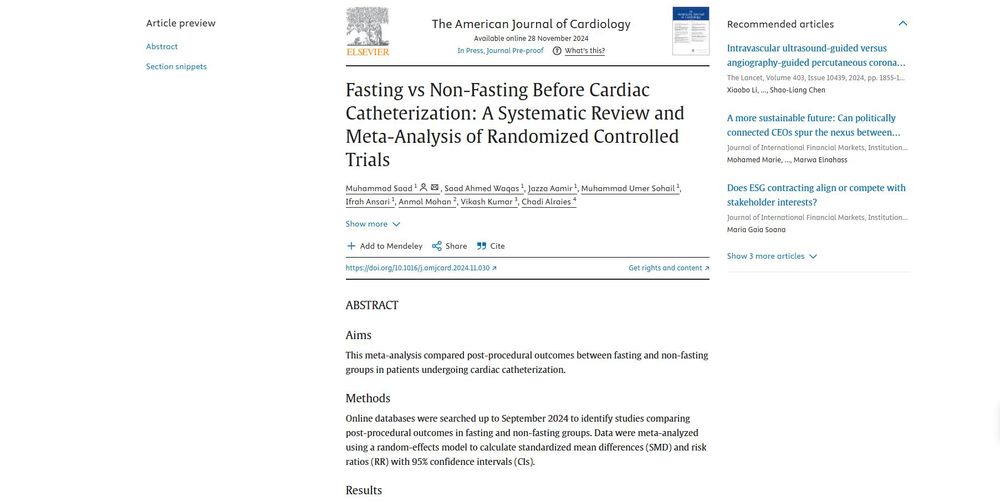
Thrilled to share my first publication as lead author in The American Journal of Cardiology! Our study challenges traditional fasting before cardiac catheterization—finding no significant differences in key clinical outcomes, but better patient satisfaction with non-fasting.
#CardioSky #MedSky
#CardioSky #MedSky
December 2, 2024 at 5:33 AM
Thrilled to share my first publication as lead author in The American Journal of Cardiology! Our study challenges traditional fasting before cardiac catheterization—finding no significant differences in key clinical outcomes, but better patient satisfaction with non-fasting.
#CardioSky #MedSky
#CardioSky #MedSky
Our abstracts are now available online in Circulation and will be presented at the upcoming #AHA24 in Chicago! Congratulations to all the co-authors for their hard work and dedication.


November 19, 2024 at 3:16 PM
Our abstracts are now available online in Circulation and will be presented at the upcoming #AHA24 in Chicago! Congratulations to all the co-authors for their hard work and dedication.