




Pablo Martínez-López
@martinezlopezp.bsky.social
PhD student in Experimental Psychology at @univmalaga.bsky.social
November 25, 2025 at 10:19 AM
Our findings suggest these measures may capture qualitatively different aspects of the construct, indicating that habitual control is a multidimensional process. We call on researchers to report reliability, gather validity evidence, and view validation as an ongoing process
November 25, 2025 at 10:19 AM
Our findings suggest these measures may capture qualitatively different aspects of the construct, indicating that habitual control is a multidimensional process. We call on researchers to report reliability, gather validity evidence, and view validation as an ongoing process
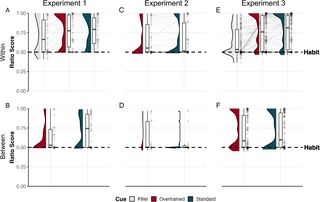
Do these three measures tap into the same construct? We expected three positive correlations but found none—null convergent validity. Except for the RT switch cost in the forced-response task, the measures showed good psychometric reliability (≈ .80), which supported the robustness of our results

November 25, 2025 at 10:19 AM
Do these three measures tap into the same construct? We expected three positive correlations but found none—null convergent validity. Except for the RT switch cost in the forced-response task, the measures showed good psychometric reliability (≈ .80), which supported the robustness of our results
We replicated previous results in the forced-response task, with a time-dependent pattern of habit expression—habits were expressed with short preparation times. Previous findings in the aliens task were reproduced. Interestingly, we also found an RT switch cost effect in the forced-response task


November 25, 2025 at 10:19 AM
We replicated previous results in the forced-response task, with a time-dependent pattern of habit expression—habits were expressed with short preparation times. Previous findings in the aliens task were reproduced. Interestingly, we also found an RT switch cost effect in the forced-response task
The paradigms were the forced-response and aliens outcome-devaluation tasks. Both include a measure sensitive to training: the former via persistence of a trained response when a reversal is required, the latter via RT switch cost—slower goal-directed responses when conflicting with overtrained ones
November 25, 2025 at 10:19 AM
The paradigms were the forced-response and aliens outcome-devaluation tasks. Both include a measure sensitive to training: the former via persistence of a trained response when a reversal is required, the latter via RT switch cost—slower goal-directed responses when conflicting with overtrained ones
Reposted by Pablo Martínez-López

This article is now published in @plosone.org. journals.plos.org/plosone/arti... New analysis added: seemingly habitual responses are explained because contingency deg didn't work for some participants (in line with recent outcome dev results in our lab and in @clairegillan.bsky.social lab)
The degraded contingency test fails to detect habit induction in humans
In experimental psychology and behavioral neuroscience, habits are considered stimulus-response (S-R) associations formed through extended reward training. Accordingly, habits are assessed using one o...
journals.plos.org
October 16, 2025 at 7:31 AM
This article is now published in @plosone.org. journals.plos.org/plosone/arti... New analysis added: seemingly habitual responses are explained because contingency deg didn't work for some participants (in line with recent outcome dev results in our lab and in @clairegillan.bsky.social lab)