



@kohtzarchaeota.bsky.social
Postdoctoral Research Fellow, Monash University | Greening Lab | Methanogens | Archaeal Diversity | Trace Gas Metabolism
Reposted

Proteomic stress response by a novel methanogen enriched from the Great Salt Lake | bioRxiv https://www.biorxiv.org/content/10.64898/2026.01.29.702513v1?rss=1

Proteomic stress response by a novel methanogen enriched from the Great Salt Lake
Methanogenic archaea affect the climate through their production of the greenhouse gas, methane. However, it is unclear how a changing climate and other anthropogenic influences impact methanogen physiology and consequent methane flux. The Great Salt Lake (GSL) is an environment that has been heavily impacted by human activity; more than doubling its salt concentration since the last methanogen was cultured from it in 1985. In this study, we enriched a novel methanogen, for which we propose the name Candidatus Methanohalophilus hillemani, from the GSL at a time when its salinity reached a historical high. Interestingly, Ca. M. hillemani does not increase expression of energy-conservation or osmo-tolerance proteins when challenged with salinity or oxygen. In contrast, Ca. M. hillemani prioritizes trace metal uptake and immune functions in response to the presence of the sulfate-reducing bacterium Desulfovermiculus . 16S rRNA gene amplicon data from GSL shore soils with extremely high and variable methane flux indicated the presence of Ca. M. hillemani. Our results show that Ca. M. hillemani is active when challenged with environmental stressors and contributes to the methane flux emanating from the GSL.
www.biorxiv.org
February 2, 2026 at 10:22 PM
Proteomic stress response by a novel methanogen enriched from the Great Salt Lake | bioRxiv https://www.biorxiv.org/content/10.64898/2026.01.29.702513v1?rss=1
www.biorxiv.org/content/10.6...
The many shapes of magnetosomes! 🤩 Particularly fond of the 'wishbone' shape in the bottom right!
The many shapes of magnetosomes! 🤩 Particularly fond of the 'wishbone' shape in the bottom right!

December 20, 2025 at 4:15 AM
www.biorxiv.org/content/10.6...
The many shapes of magnetosomes! 🤩 Particularly fond of the 'wishbone' shape in the bottom right!
The many shapes of magnetosomes! 🤩 Particularly fond of the 'wishbone' shape in the bottom right!
Reposted

1. As we recently joined BlueSky, we want to repost this story for all newcomers!
We sat down with @radler92.bsky.social to get more insight into the unique videos from his recent preprint on Promethearchaeota (formerly Asgard archaea).
doi.org/10.1101/2025...
(Videos and info below)
We sat down with @radler92.bsky.social to get more insight into the unique videos from his recent preprint on Promethearchaeota (formerly Asgard archaea).
doi.org/10.1101/2025...
(Videos and info below)

Dynamic protrusions mediate unique crawling motility in Asgard Archaea (Promethearchaeota)
Crawling motility is a hallmark of eukaryotic cells and requires a dynamic actin cytoskeleton, regulated adhesion, and spatially organized signalling pathways1–3. Asgard archaea (phylum Promethearchae...
doi.org
December 18, 2025 at 2:08 PM
1. As we recently joined BlueSky, we want to repost this story for all newcomers!
We sat down with @radler92.bsky.social to get more insight into the unique videos from his recent preprint on Promethearchaeota (formerly Asgard archaea).
doi.org/10.1101/2025...
(Videos and info below)
We sat down with @radler92.bsky.social to get more insight into the unique videos from his recent preprint on Promethearchaeota (formerly Asgard archaea).
doi.org/10.1101/2025...
(Videos and info below)
Reposted

“Cultivation of Methanonezhaarchaeia, the third class of methanogens within the phylum Thermoproteota” by @kohtzarchaeota.bsky.social, Sylvia Nupp, and myself is out in Science Advances. 90% enriched culture of a methyl-dismutating thermoproteotal methanogen. #Microsky 🧪 tinyurl.com/bdcc3uzs

Cultivation of Methanonezhaarchaeia, the third class of methanogens within the phylum Thermoproteota
The cultivation of a group of methanogens illuminates their metabolic diversity and the evolution of archaea.
www.science.org
December 12, 2025 at 7:22 PM
“Cultivation of Methanonezhaarchaeia, the third class of methanogens within the phylum Thermoproteota” by @kohtzarchaeota.bsky.social, Sylvia Nupp, and myself is out in Science Advances. 90% enriched culture of a methyl-dismutating thermoproteotal methanogen. #Microsky 🧪 tinyurl.com/bdcc3uzs
Reposted
MSU news article covering our Science Advances paper on Methanonezhaarchaeia, an upcoming paper on the ecology of MCR-encoding Thermoproteota, a (2024) DOE award, and new NSF GRFP and ERFP awards to two of my students, Nicole Matos Vega and Joelie Van Beek #microsky 🦠 www.montana.edu/news/25015/s...
December 18, 2025 at 10:02 PM
MSU news article covering our Science Advances paper on Methanonezhaarchaeia, an upcoming paper on the ecology of MCR-encoding Thermoproteota, a (2024) DOE award, and new NSF GRFP and ERFP awards to two of my students, Nicole Matos Vega and Joelie Van Beek #microsky 🦠 www.montana.edu/news/25015/s...
Reposted

Thanks nature news for featuring our recent preprint on 𝘐𝘯𝘤𝘦𝘯𝘥𝘪𝘢𝘮𝘰𝘦𝘣𝘢 led by @hbrappap.bsky.social
(check out preprint here: doi.org/10.1101/2025...) #protistsonsky
(check out preprint here: doi.org/10.1101/2025...) #protistsonsky
This single-celled amoeba can thrive at temperatures that kill all other known eukaryotic life
go.nature.com/4452LXP
go.nature.com/4452LXP

‘Fire amoeba’ survives in hotter conditions than any other complex cell
The single-celled organism can grow at 63 °C, a record for eukaryotic life.
go.nature.com
December 2, 2025 at 3:15 PM
Thanks nature news for featuring our recent preprint on 𝘐𝘯𝘤𝘦𝘯𝘥𝘪𝘢𝘮𝘰𝘦𝘣𝘢 led by @hbrappap.bsky.social
(check out preprint here: doi.org/10.1101/2025...) #protistsonsky
(check out preprint here: doi.org/10.1101/2025...) #protistsonsky
Fortunate my DECRA fellowship 'Uncovering divergent hydrogen-dependent methane metabolism in novel Archaea' was successful! Immensely grateful to @greening.bsky.social for the continued support and all present/past collaborators, mentors, and colleagues that made this possible!!
tinyurl.com/45cc9ner
tinyurl.com/45cc9ner

MNHS researchers successful in receiving 2026 ARC DECRA and LIEF grants
Monash Medicine, Nursing and Health Sciences researchers have been successful in receiving Australian Research Council (ARC) grants under the Discovery Early Career Research Award (DECRA) 2026 scheme ...
www.monash.edu
November 30, 2025 at 8:52 AM
Fortunate my DECRA fellowship 'Uncovering divergent hydrogen-dependent methane metabolism in novel Archaea' was successful! Immensely grateful to @greening.bsky.social for the continued support and all present/past collaborators, mentors, and colleagues that made this possible!!
tinyurl.com/45cc9ner
tinyurl.com/45cc9ner
Reposted
Clone-FISH paper out: Manuscript/resource alert #microsky 🦠 We present a collection of 30 E. coli (CloneFISH) cultures, each carrying a plasmid for the heterologous expression of a (near) full-length 16S rRNA gene from one of 30 lineages of archaea, including 17 yet uncultured ones.


November 17, 2025 at 2:36 PM
Clone-FISH paper out: Manuscript/resource alert #microsky 🦠 We present a collection of 30 E. coli (CloneFISH) cultures, each carrying a plasmid for the heterologous expression of a (near) full-length 16S rRNA gene from one of 30 lineages of archaea, including 17 yet uncultured ones.
Reposted
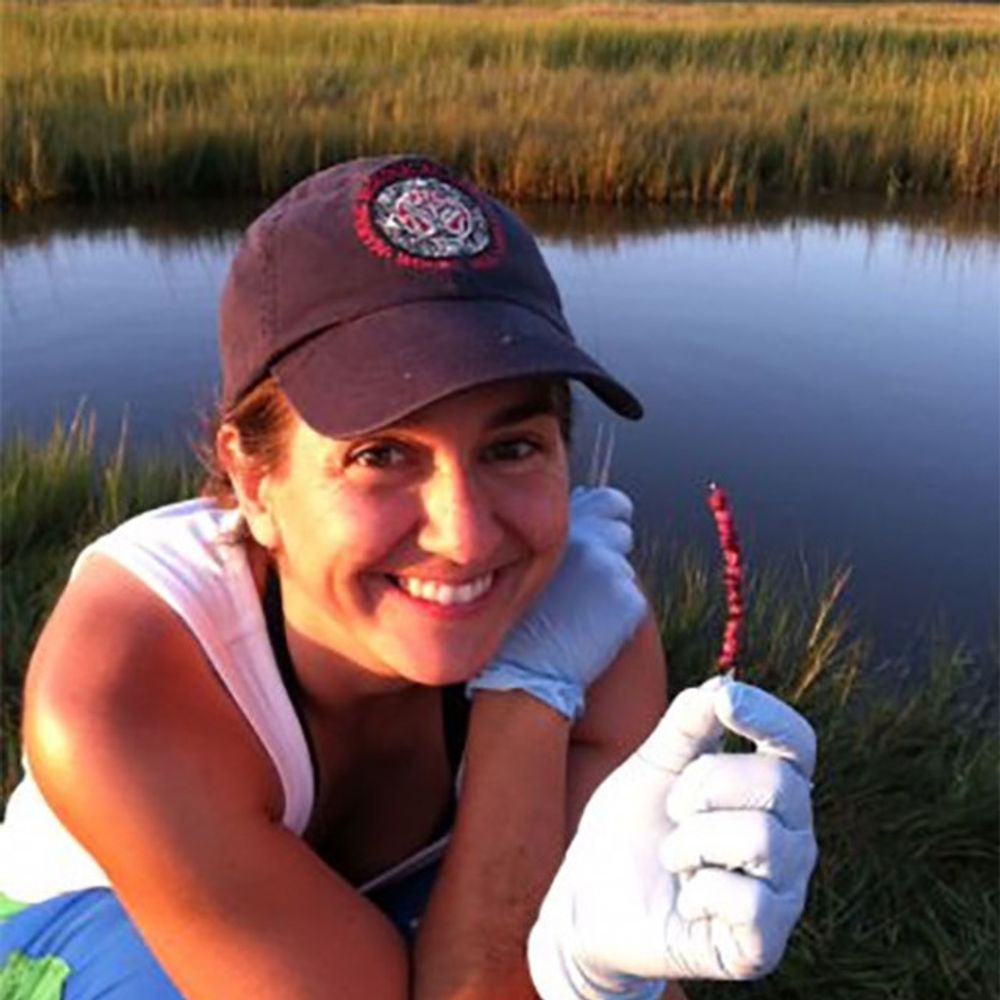
Congrats to @quantaofgeorge.bsky.social for being awarded best postdoc talk NeLLi symposium for his phenomenal work on the first successful cultivation of Thiovulum. Mind blowing collective behaviors by the fastest organism per body length on the planet!

Abstracts are due Oct. 19 for the 2025 New Lineages of Life Symposium — 80 slots available!
See speakers below.
More info: jgi.doe.gov/work-with-us...
Full Agenda: jgi.doe.gov/work-with-us...
@axelvisel.bsky.social 🖥️🧬
See speakers below.
More info: jgi.doe.gov/work-with-us...
Full Agenda: jgi.doe.gov/work-with-us...
@axelvisel.bsky.social 🖥️🧬

November 6, 2025 at 12:58 AM
Congrats to @quantaofgeorge.bsky.social for being awarded best postdoc talk NeLLi symposium for his phenomenal work on the first successful cultivation of Thiovulum. Mind blowing collective behaviors by the fastest organism per body length on the planet!
Reposted

Excited to share our latest work using AI-designed proteins to block heme-piracy by E. coli. Published in @natcomms.nature.com. A team effort between my lab and the @knottrna.bsky.social lab, with experimental work led by the talented @danielrfox.bsky.social
www.nature.com/articles/s41...
www.nature.com/articles/s41...
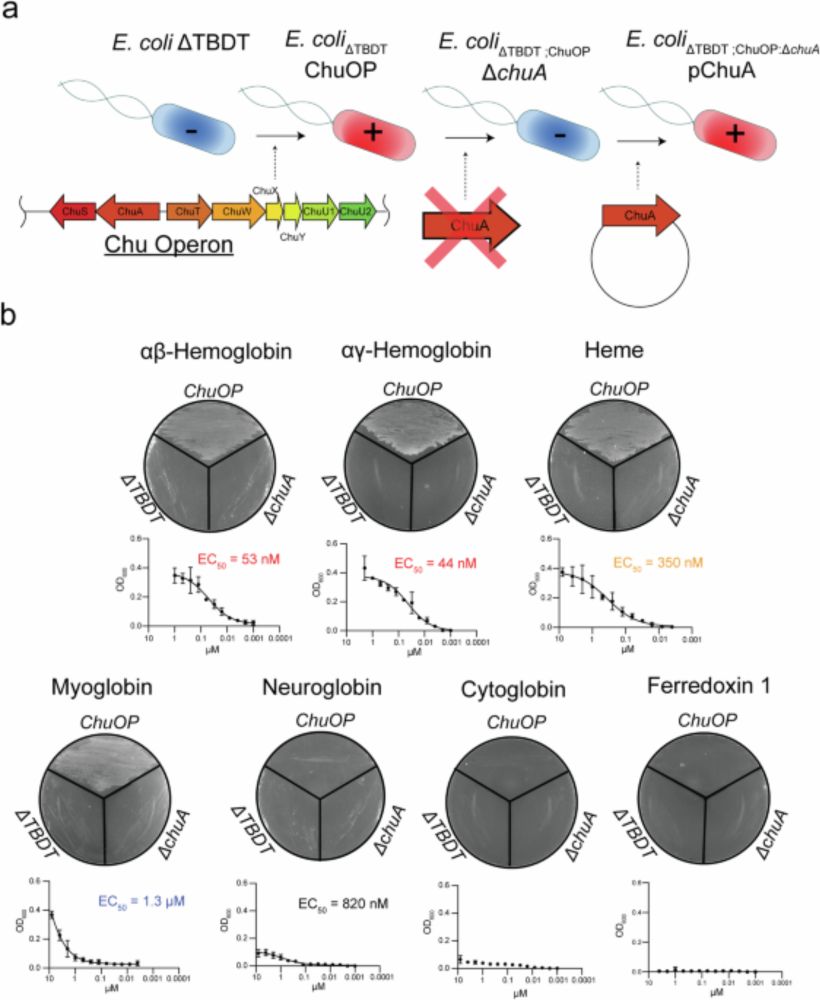
Inhibiting heme piracy by pathogenic Escherichia coli using de novo-designed proteins - Nature Communications
Many pathogens encode transporters that extract heme directly from host proteins. In this study, the authors demonstrate the utility of de novo-designed proteins in understanding the mechanism behind ...
www.nature.com
July 9, 2025 at 11:55 PM
Excited to share our latest work using AI-designed proteins to block heme-piracy by E. coli. Published in @natcomms.nature.com. A team effort between my lab and the @knottrna.bsky.social lab, with experimental work led by the talented @danielrfox.bsky.social
www.nature.com/articles/s41...
www.nature.com/articles/s41...
Reposted

Electron flow in hydrogenotrophic methanogens under nickel limitation www.nature.com/articles/s41... #jcampubs

Electron flow in hydrogenotrophic methanogens under nickel limitation - Nature
Two distantly related methanogens shift the methanogenic pathway under nickel limitation, suggesting that methanogens adapt to changing bioavailability of nickel by rerouting electron flow between two...
www.nature.com
July 3, 2025 at 1:26 PM
Electron flow in hydrogenotrophic methanogens under nickel limitation www.nature.com/articles/s41... #jcampubs
Reposted

Our new consensus statement on reducing and reporting contamination in microbiome studies is the cover image of this month's Nature Microbiology: www.nature.com/articles/s41... In the cover photo, you can see our postdoc Sophie Holland in fully PPE sampling the atmosphere of terrestrial Antarctica.

July 3, 2025 at 3:22 PM
Our new consensus statement on reducing and reporting contamination in microbiome studies is the cover image of this month's Nature Microbiology: www.nature.com/articles/s41... In the cover photo, you can see our postdoc Sophie Holland in fully PPE sampling the atmosphere of terrestrial Antarctica.
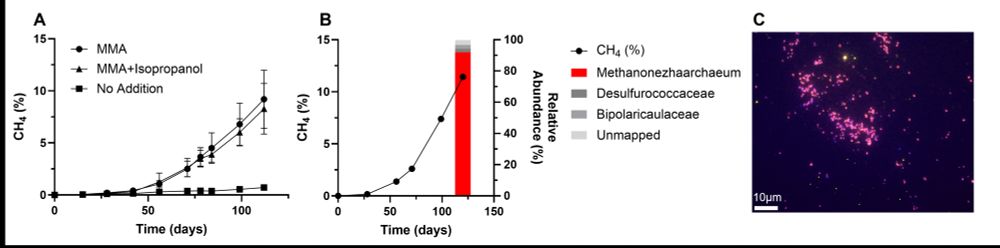
New #methanogen culture just dropped! Check out the 'Methanonezhaarchaeia'! Happy to see this one out. A new methylotrophic methanogen cultivated from a hot spring in Yellowstone National Park. Gives insights into the metabolic diversity and evolution of this group. #microsky 🦠🔥 tinyurl.com/yw8ku2bj
July 1, 2025 at 1:44 PM
New #methanogen culture just dropped! Check out the 'Methanonezhaarchaeia'! Happy to see this one out. A new methylotrophic methanogen cultivated from a hot spring in Yellowstone National Park. Gives insights into the metabolic diversity and evolution of this group. #microsky 🦠🔥 tinyurl.com/yw8ku2bj
Reposted
Hydrogenase-driven ATP synthesis from air www.biorxiv.org/content/10.1... #jcampubs
March 17, 2025 at 4:27 PM
Hydrogenase-driven ATP synthesis from air www.biorxiv.org/content/10.1... #jcampubs
Reposted

In an unprecedented move, the US National Institutes of Health has begun mass terminations of research grants that fund active scientific projects because they no longer meet “agency priorities”.
https://go.nature.com/4bpG2It
https://go.nature.com/4bpG2It
Exclusive: NIH to terminate hundreds of active research grants
Studies that touch on LGBT+ health, gender identity and DEI in the biomedical workforce could be terminated, according to documents obtained by Nature.
go.nature.com
March 6, 2025 at 2:25 AM
In an unprecedented move, the US National Institutes of Health has begun mass terminations of research grants that fund active scientific projects because they no longer meet “agency priorities”.
https://go.nature.com/4bpG2It
https://go.nature.com/4bpG2It
Reposted

Just got an email from the Fulbright Association. As of right now, funding has been cut off to 12,500 US citizens currently abroad and and more than 7,400 foreigner scholars and students in the United States
March 7, 2025 at 10:46 PM
Just got an email from the Fulbright Association. As of right now, funding has been cut off to 12,500 US citizens currently abroad and and more than 7,400 foreigner scholars and students in the United States
Reposted
Isolated in just 3 years! (previously, 12 years). We obtained two strains from 'Hodarchaeales', proposed to be closest to our archaeal ancestor. Our analysis suggests the ancestor was an anaerobic, syntrophic, peptidotrophic, archaeon with a simple intracellular structure and possible aerotolerance.

Eukaryotes' closest relatives are internally simple syntrophic archaea
Eukaryotes are theorized to have originated from an archaeal phylum Promethearchaeota (formerly 'Asgard' archaea)1,2. The first cultured representatives revealed valuable insight3,4 but are distantly ...
www.biorxiv.org
February 27, 2025 at 3:58 AM
Isolated in just 3 years! (previously, 12 years). We obtained two strains from 'Hodarchaeales', proposed to be closest to our archaeal ancestor. Our analysis suggests the ancestor was an anaerobic, syntrophic, peptidotrophic, archaeon with a simple intracellular structure and possible aerotolerance.
Reposted

Here's the promised natural product preprint: Flavoaffinins, elusive cellulose-binding natural products from an anaerobic bacterium. www.biorxiv.org/content/10.1...

February 9, 2025 at 5:46 AM
Here's the promised natural product preprint: Flavoaffinins, elusive cellulose-binding natural products from an anaerobic bacterium. www.biorxiv.org/content/10.1...
Reposted

Would you expect that Bacteria use an archaellum for swimming? We didn't, but we found that some Chloroflexota do! Find the story here: www.biorxiv.org/content/10.1...
A little thread below 1/n
A little thread below 1/n

Horizontal gene transfer of the functional archaellum machinery to Bacteria
Motility in Archaea is driven by a nanomachinery called the archaellum. So far, archaella have been exclusively described for the archaeal domain; however, a recent study reported the presence of arch...
www.biorxiv.org
February 3, 2025 at 10:09 AM
Would you expect that Bacteria use an archaellum for swimming? We didn't, but we found that some Chloroflexota do! Find the story here: www.biorxiv.org/content/10.1...
A little thread below 1/n
A little thread below 1/n
Reposted

Conformational dynamics of a multienzyme complex in anaerobic carbon fixation www.science.org/doi/10.1126/...

Conformational dynamics of a multienzyme complex in anaerobic carbon fixation
In the ancient microbial Wood-Ljungdahl pathway, carbon dioxide (CO2) is fixed in a multistep process that ends with acetyl–coenzyme A (acetyl-CoA) synthesis at the bifunctional carbon monoxide dehydr...
www.science.org
January 31, 2025 at 4:21 AM
Conformational dynamics of a multienzyme complex in anaerobic carbon fixation www.science.org/doi/10.1126/...
Reposted
@quantaofgeorge.bsky.social was on @markowenmartin.bsky.social's Matters Microbial podcast to talk about his PhD work on multicellular magnetotactic bacteria in my lab. Youtube: www.youtube.com/watch?v=XJom... Podcast of your choice: www.microbe.tv/mm/mm-076/

January 30, 2025 at 5:30 PM
@quantaofgeorge.bsky.social was on @markowenmartin.bsky.social's Matters Microbial podcast to talk about his PhD work on multicellular magnetotactic bacteria in my lab. Youtube: www.youtube.com/watch?v=XJom... Podcast of your choice: www.microbe.tv/mm/mm-076/
Reposted
To update people on the NSF PRFB situation: despite the court challenge and rescinding the original memo, the NSF has continued to comply with the executive order. They have not communicated with us at all and our paychecks are still canceled indefinitely. I know people who cannot pay their rent.
January 30, 2025 at 2:37 PM
To update people on the NSF PRFB situation: despite the court challenge and rescinding the original memo, the NSF has continued to comply with the executive order. They have not communicated with us at all and our paychecks are still canceled indefinitely. I know people who cannot pay their rent.
Reposted
Methanol transfer supports metabolic syntrophy between bacteria and archaea www.nature.com/articles/s41...
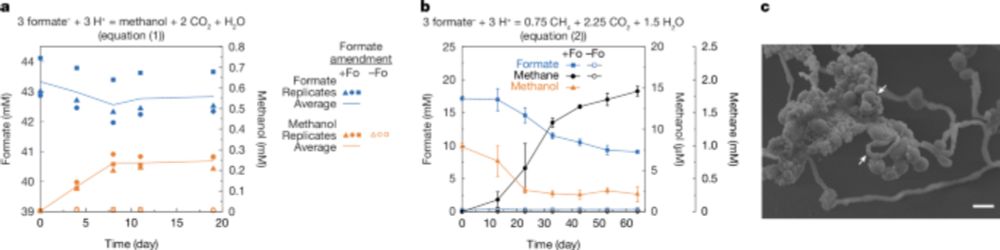
Methanol transfer supports metabolic syntrophy between bacteria and archaea - Nature
Zhaonella formicivorans produces methanol, for a novel syntrophic interaction, without requiring methylated compounds as an input.
www.nature.com
January 29, 2025 at 7:23 PM
Methanol transfer supports metabolic syntrophy between bacteria and archaea www.nature.com/articles/s41...
Reposted
In Nature Chemical Biology today, we reveal how microbes clean our atmospheres by consuming carbon monoxide (CO) gas. A methodological tour de force from Ashleigh Kropp, Rhys Grinter, and David Gillett with broad implications for the atmosphere and bioenergetics. www.nature.com/articles/s41...
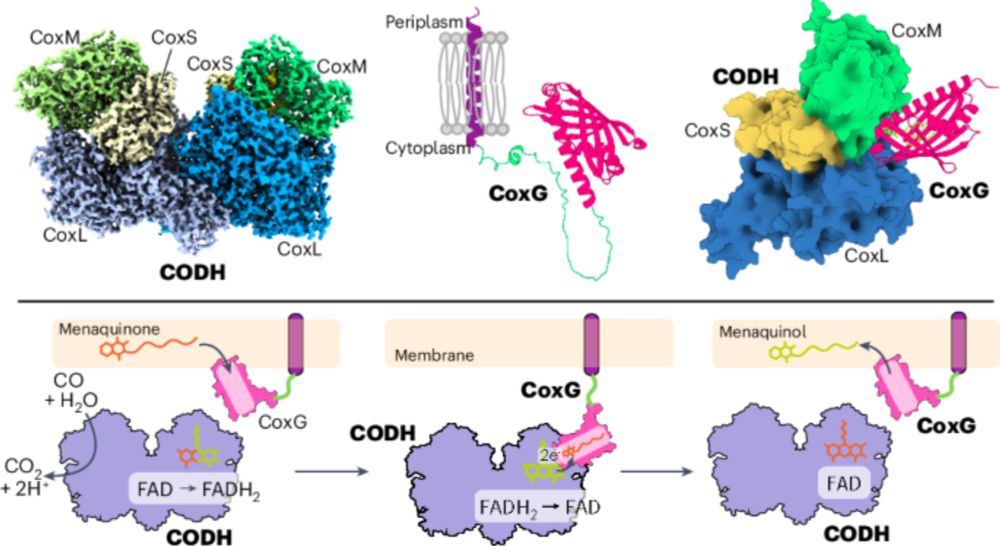
Quinone extraction drives atmospheric carbon monoxide oxidation in bacteria - Nature Chemical Biology
Here, Kropp et al. use cryo-electron microscopy and structural modeling to show that the enzyme [MoCu]-CO dehydrogenase interacts with its partner, the membrane-bound quinone-binding protein CoxG, to ...
www.nature.com
January 29, 2025 at 10:21 AM
In Nature Chemical Biology today, we reveal how microbes clean our atmospheres by consuming carbon monoxide (CO) gas. A methodological tour de force from Ashleigh Kropp, Rhys Grinter, and David Gillett with broad implications for the atmosphere and bioenergetics. www.nature.com/articles/s41...