



Seán Kavanagh
@kavanaghsean.bsky.social
https://sam-lab.net
Computational chemist, physicist, material scientist? Who knows...
Asst Prof in Simulation of Energy Materials at the University of Cambridge (Chemistry)
Formerly Environmental Fellow @harvard.edu
Computational chemist, physicist, material scientist? Who knows...
Asst Prof in Simulation of Energy Materials at the University of Cambridge (Chemistry)
Formerly Environmental Fellow @harvard.edu

Applications are closed for this year, but any outstanding graduating PhD students in computational physics should next year!
October 13, 2025 at 1:56 PM
Applications are closed for this year, but any outstanding graduating PhD students in computational physics should next year!
Yes!
Doped and ShakeNBreak manage other parts of the defect workflow, such as defect enumeration, symmetry, thermodynamics etc, along with input file generation and calc parsing - e.g. doped has been used with AiiDA, atomate2, quacc etc, so they are complimentary to its functionality!
Doped and ShakeNBreak manage other parts of the defect workflow, such as defect enumeration, symmetry, thermodynamics etc, along with input file generation and calc parsing - e.g. doped has been used with AiiDA, atomate2, quacc etc, so they are complimentary to its functionality!
September 30, 2025 at 1:41 AM
Yes!
Doped and ShakeNBreak manage other parts of the defect workflow, such as defect enumeration, symmetry, thermodynamics etc, along with input file generation and calc parsing - e.g. doped has been used with AiiDA, atomate2, quacc etc, so they are complimentary to its functionality!
Doped and ShakeNBreak manage other parts of the defect workflow, such as defect enumeration, symmetry, thermodynamics etc, along with input file generation and calc parsing - e.g. doped has been used with AiiDA, atomate2, quacc etc, so they are complimentary to its functionality!
We briefly mention the development of workflow tools and high throughput studies as one of the motivating factors for better reproducibility and established guidelines, but don't go into more detail on their use as we're not the experts there!
September 30, 2025 at 1:35 AM
We briefly mention the development of workflow tools and high throughput studies as one of the motivating factors for better reproducibility and established guidelines, but don't go into more detail on their use as we're not the experts there!
Thanks Janine!
Yes absolutely, workflow tools should definitely be able to help for reproducibility and throughput here. I think defects are a challenge to workflow tools given the many steps and complexities, but definitely still doable
Yes absolutely, workflow tools should definitely be able to help for reproducibility and throughput here. I think defects are a challenge to workflow tools given the many steps and complexities, but definitely still doable
September 30, 2025 at 1:35 AM
Thanks Janine!
Yes absolutely, workflow tools should definitely be able to help for reproducibility and throughput here. I think defects are a challenge to workflow tools given the many steps and complexities, but definitely still doable
Yes absolutely, workflow tools should definitely be able to help for reproducibility and throughput here. I think defects are a challenge to workflow tools given the many steps and complexities, but definitely still doable
September 29, 2025 at 12:25 PM
Thanks Andrew!!
September 13, 2025 at 4:54 PM
Thanks Andrew!!
Thanks very much David! Tried to run into you at Psi-k to say hello but didn't get to!
September 13, 2025 at 4:53 PM
Thanks very much David! Tried to run into you at Psi-k to say hello but didn't get to!
Certainly not news to anyone who knows me 😅
But please share with prospective students! 🙌
But please share with prospective students! 🙌
September 11, 2025 at 2:29 PM
Certainly not news to anyone who knows me 😅
But please share with prospective students! 🙌
But please share with prospective students! 🙌
I am incredibly grateful for the support of my mentors, collaborators, friends and colleagues over the past few years – too many to tag, beyond the main ones:
@scanlond81.bsky.social @aronwalsh.github.io @boriskozinsky 🙌
@scanlond81.bsky.social @aronwalsh.github.io @boriskozinsky 🙌
September 11, 2025 at 2:29 PM
I am incredibly grateful for the support of my mentors, collaborators, friends and colleagues over the past few years – too many to tag, beyond the main ones:
@scanlond81.bsky.social @aronwalsh.github.io @boriskozinsky 🙌
@scanlond81.bsky.social @aronwalsh.github.io @boriskozinsky 🙌
sam-lab.net (Please share!)
Our lab – the Simulation of Advanced Materials (SAM) Lab – will use state-of-the-art computational methods to design and develop next-generation materials; primarily targeting energy applications ⚡️
Our lab – the Simulation of Advanced Materials (SAM) Lab – will use state-of-the-art computational methods to design and develop next-generation materials; primarily targeting energy applications ⚡️
September 11, 2025 at 2:29 PM
sam-lab.net (Please share!)
Our lab – the Simulation of Advanced Materials (SAM) Lab – will use state-of-the-art computational methods to design and develop next-generation materials; primarily targeting energy applications ⚡️
Our lab – the Simulation of Advanced Materials (SAM) Lab – will use state-of-the-art computational methods to design and develop next-generation materials; primarily targeting energy applications ⚡️
...more recently 𝗡𝗲𝗾𝘂𝗜𝗣 & 𝗔𝗹𝗹𝗲𝗴𝗿𝗼 (nequip.readthedocs.io), using foundation models we have been training with the accelerated infrastructure, now on Matbench Discovery: matbench-discovery.materialsproject.org
LinkedIn
This link will take you to a page that’s not on LinkedIn
lnkd.in
September 8, 2025 at 12:35 PM
...more recently 𝗡𝗲𝗾𝘂𝗜𝗣 & 𝗔𝗹𝗹𝗲𝗴𝗿𝗼 (nequip.readthedocs.io), using foundation models we have been training with the accelerated infrastructure, now on Matbench Discovery: matbench-discovery.materialsproject.org
This work made heavy use of 𝗱𝗼𝗽𝗲𝗱 (defect simulation package – lnkd.in/eU4pggmg), 𝗠𝗔𝗖𝗘 (MLIP – lnkd.in/eHBXxhxV), some 𝗦𝗵𝗮𝗸𝗲𝗡𝗕𝗿𝗲𝗮𝗸 (defect structure-searching – lnkd.in/earFF_sX) and...
LinkedIn
This link will take you to a page that’s not on LinkedIn
lnkd.in
September 8, 2025 at 12:35 PM
This work made heavy use of 𝗱𝗼𝗽𝗲𝗱 (defect simulation package – lnkd.in/eU4pggmg), 𝗠𝗔𝗖𝗘 (MLIP – lnkd.in/eHBXxhxV), some 𝗦𝗵𝗮𝗸𝗲𝗡𝗕𝗿𝗲𝗮𝗸 (defect structure-searching – lnkd.in/earFF_sX) and...
Have a read if you're interested!
July 15, 2025 at 1:40 PM
Have a read if you're interested!
I think this shows exciting potential for MLFFs in defect modelling, but with caveats... they fail dramatically for non-fully-ionised charge states where localisation matters! They work here due to the enormous configuration space but with relatively simple underlying energetics
July 15, 2025 at 1:40 PM
I think this shows exciting potential for MLFFs in defect modelling, but with caveats... they fail dramatically for non-fully-ionised charge states where localisation matters! They work here due to the enormous configuration space but with relatively simple underlying energetics
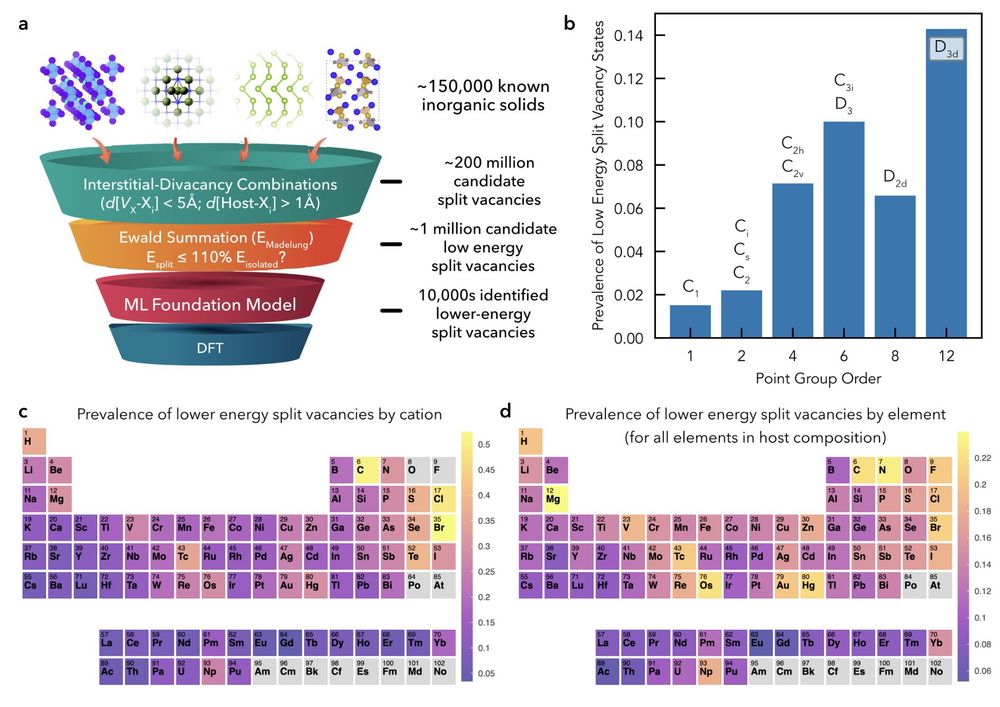
This allows an efficient tiered screening; scanning 𝘢𝘭𝘭 compounds in the ICSD & Materials Project database for split cation vacancies
July 15, 2025 at 1:40 PM
This allows an efficient tiered screening; scanning 𝘢𝘭𝘭 compounds in the ICSD & Materials Project database for split cation vacancies
Indeed, due to the relatively simple underlying energetics (primarily electrostatics and strain), this problem is well-suited to MLIPs. I find that foundation models (MACE, NequIP, Allegro -- stayed tuned for the latter!) successfully predict split vacancy formation in most cases
July 15, 2025 at 1:40 PM
Indeed, due to the relatively simple underlying energetics (primarily electrostatics and strain), this problem is well-suited to MLIPs. I find that foundation models (MACE, NequIP, Allegro -- stayed tuned for the latter!) successfully predict split vacancy formation in most cases